
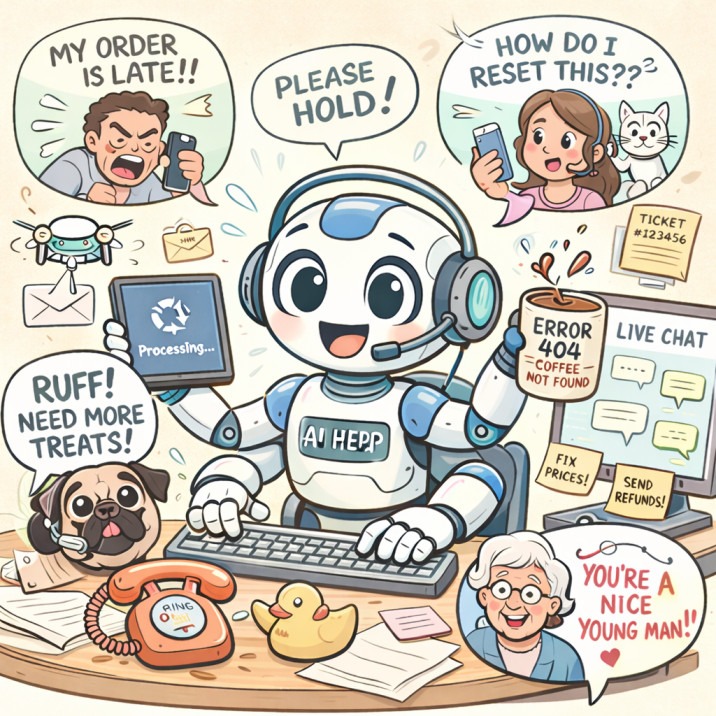
Several large retail groups are embedding retail AI agents for customer service into live support systems rather than limiting them to pilot environments. What distinguishes this phase from earlier automation waves is not interface sophistication, but task authority. These systems are no longer limited to drafting replies or suggesting responses. They are executing actions across order management, refund processing, and customer account systems.
Recent enterprise announcements indicate that AI agents are being embedded into retail support stacks with live system access rather than sandboxed pilot environments. This shift is occurring during a cost-constrained budget cycle, where retailers are under pressure to reduce support overhead while maintaining digital channel responsiveness. The trigger is not novelty. It is an operational strain.
WHAT IS ACTUALLY HAPPENING
Retailers are integrating AI agents directly into backend systems that historically required human mediation. These include:
- Order modification and status resolution
- Refund and return eligibility checks
- Inventory lookup and cross-channel validation
- Escalation routing based on sentiment and risk scoring
Unlike prior chatbot deployments, these agents are being granted scoped permissions within ERP and CRM environments. They operate inside defined workflow boundaries, often with supervisory thresholds that trigger human review when confidence drops below preset levels.
Support architectures are being adjusted accordingly. Tier-one inquiry handling is increasingly automated. Human agents are being repositioned toward exception management and edge-case resolution. This is not full autonomy, but it is a reallocation of decision authority.
WHY THIS IS HAPPENING NOW
Three conditions have converged.
First, support cost pressure has intensified. Retailers face fluctuating demand cycles, seasonal peaks, and rising wage exposure in customer contact operations. AI agents offer variable cost elasticity where headcount traditionally did not.
Second, integration maturity has improved. Retail IT environments now expose APIs and structured data layers that allow agents to execute actions rather than simply retrieve information. Earlier chatbot generations failed because they lacked operational depth.
Third, enterprise AI governance frameworks have stabilized. Logging, permission scoping, and model monitoring controls are more standardized than in 2023 or 2024 pilot phases. Risk officers are more willing to allow scoped autonomy under audit constraints.
The combination of cost discipline, integration readiness, and governance controls has created the conditions for production deployment.
Also read: Chatbots vs AI Agents: An Efficiency Audit for Real Operations
WHAT CHANGES OR BREAKS NEXT
As retail AI agents for customer service expand into core workflows, the stress points will not be conversational quality. They will be systemic.
Failure scenarios shift from incorrect responses to incorrect actions. A misinterpreted return policy can now trigger financial exposure. Incorrect order modifications can cascade into supply chain inconsistencies.
Operational dependencies deepen. If AI agents become embedded into refund or escalation routing pipelines, outages or degraded performance affect transaction flow, not just messaging.
Two emerging risks stand out:
- Permission creep within enterprise systems
- Over-automation that suppresses early signals of product or logistics issues
When agents absorb a large share of front-line interaction, retailers risk losing qualitative friction signals that human teams historically surfaced.
The architecture is becoming automation-first. That changes failure dynamics.
WHAT LEADERS ARE ASKING INTERNALLY
- Where exactly do AI agents have write access inside support workflows?
- What is the financial exposure threshold per automated decision?
- How are audit trails preserved for regulatory and dispute scenarios?
- What percentage of escalations are being suppressed rather than resolved?
- If the model degrades, how quickly can autonomy be rolled back?
Retail AI agents for customer service are no longer positioned as efficiency tools alone. They are becoming operational actors within enterprise systems. That shift alters governance, cost modeling, and architectural risk in equal measure.