Several large retail groups are embedding retail AI agents for customer service into live support systems rather than limiting them to pilot environments. What distinguishes this phase from earlier automation waves is not interface sophistication, but task authority. These systems are no longer limited to drafting replies or suggesting responses. They are executing actions across order management, refund processing, and customer account systems.
Recent enterprise announcements indicate that AI agents are being embedded into retail support stacks with live system access rather than sandboxed pilot environments. This shift is occurring during a cost-constrained budget cycle, where retailers are under pressure to reduce support overhead while maintaining digital channel responsiveness. The trigger is not novelty. It is an operational strain.
WHAT IS ACTUALLY HAPPENING
Retailers are integrating AI agents directly into backend systems that historically required human mediation. These include:
Order modification and status resolution
Refund and return eligibility checks
Inventory lookup and cross-channel validation
Escalation routing based on sentiment and risk scoring
Unlike prior chatbot deployments, these agents are being granted scoped permissions within ERP and CRM environments. They operate inside defined workflow boundaries, often with supervisory thresholds that trigger human review when confidence drops below preset levels.
Support architectures are being adjusted accordingly. Tier-one inquiry handling is increasingly automated. Human agents are being repositioned toward exception management and edge-case resolution. This is not full autonomy, but it is a reallocation of decision authority.
WHY THIS IS HAPPENING NOW
Three conditions have converged.
First, support cost pressure has intensified. Retailers face fluctuating demand cycles, seasonal peaks, and rising wage exposure in customer contact operations. AI agents offer variable cost elasticity where headcount traditionally did not.
Second, integration maturity has improved. Retail IT environments now expose APIs and structured data layers that allow agents to execute actions rather than simply retrieve information. Earlier chatbot generations failed because they lacked operational depth.
Third, enterprise AI governance frameworks have stabilized. Logging, permission scoping, and model monitoring controls are more standardized than in 2023 or 2024 pilot phases. Risk officers are more willing to allow scoped autonomy under audit constraints.
The combination of cost discipline, integration readiness, and governance controls has created the conditions for production deployment.
As retail AI agents for customer service expand into core workflows, the stress points will not be conversational quality. They will be systemic.
Failure scenarios shift from incorrect responses to incorrect actions. A misinterpreted return policy can now trigger financial exposure. Incorrect order modifications can cascade into supply chain inconsistencies.
Operational dependencies deepen. If AI agents become embedded into refund or escalation routing pipelines, outages or degraded performance affect transaction flow, not just messaging.
Two emerging risks stand out:
Permission creep within enterprise systems
Over-automation that suppresses early signals of product or logistics issues
When agents absorb a large share of front-line interaction, retailers risk losing qualitative friction signals that human teams historically surfaced.
The architecture is becoming automation-first. That changes failure dynamics.
WHAT LEADERS ARE ASKING INTERNALLY
Where exactly do AI agents have write access inside support workflows?
What is the financial exposure threshold per automated decision?
How are audit trails preserved for regulatory and dispute scenarios?
What percentage of escalations are being suppressed rather than resolved?
If the model degrades, how quickly can autonomy be rolled back?
Retail AI agents for customer service are no longer positioned as efficiency tools alone. They are becoming operational actors within enterprise systems. That shift alters governance, cost modeling, and architectural risk in equal measure.
Do you remember Maggie Carpenter? Probably not. In Runaway Bride, Maggie, played by the love of a million hearts, Julia Roberts, had a peculiar habit. She did not run early. She waited. She let the dress be tailored, the guests to arrive and the vows to hang in the air. She walked the aisle knowing everyone believed the decision was done. And only at the very last moment, when turning back would feel almost impossible, she left while her fiancé waited.
Now, fast forward 27 years from that aisle into a production environment. Deploying Agentic AIOps often becomes the same kind of late-stage commitment. The CIO, the platform owner, and the security lead do not start with a desire for autonomy. They start with overload. Too many alerts, too little sleep, too much manual triage, and a mandate to reduce MTTR without adding headcount. So the organization approves agents that can act, not just recommend.
The first wins arrive quickly enough to feel like proof. L1 work drops. Response speeds up. The system looks calmer.
Then the “runaway” part shows up, but it looks nothing like a movie. It looks like momentum. Autonomy expands because rolling it back is awkward and expensive. Budget control weakens when agents can scale resources, retry work at volume, or trigger actions that create spend without a human approving each step. Risk control degrades when remediation can execute faster than your approval chain can stop it.
Security control gets strained the moment write access is granted broadly, because every auto-fix path becomes an access path too.
This is why Agentic AIOps is not a tooling decision. It is a control decision. You can take the speed and cost relief, but only if you define what the agents are never allowed to do, who can override them, and what gets audited when they act.
Why Deploying Agentic AIOps Is Getting Pulled Into Production Faster Than Teams Expect
Deploying Agentic AIOps rarely begins as a deliberate transformation program. It shows up as a response to pressure that has already crossed a threshold. Alert volume grows, on-call burns people out, and adding more SREs stops working once someone asks what the new hire will actually remove from the workload.
In practice, most teams are operating with unresolved basics. Alerting is noisy. Runbooks exist, but are outdated. Ownership across services is fuzzy. Dependency maps look clean on slides and wrong in production. Agentic AIOps enters this environment not as a bold bet on autonomy, but as a way to compress chaos into action. It promises fewer pages, faster closure, and relief from repetitive L1 work that never seems to end.
What teams usually discover is how quickly expectations shift once agents start acting.
Early L1 wins get celebrated.
Backlogs shrink.
Humans step back.
The system remediates once, then becomes the default. That is how Deploying Agentic AIOps drifts from assistance into authority, often before governance, budget control, or security boundaries are treated as first-class decisions.
What Agentic AIOps Actually Improves When It Works
Deploying Agentic AIOps pays off by removing human bottlenecks within the first 15 to 30 minutes of an incident. Not the deep root-cause work. The messy part is earlier: triage, correlation, first action, and keeping the blast radius from spreading while people wake up and join the bridge.
Where it performs best is repetitive L1 and “L1.5” work that follows stable patterns. The agent can classify the alert, pull recent changes, check known dependencies, run basic diagnostics, and execute a limited runbook step.
If your environment has clean ownership and predictable runbooks, this is real toil reduction, not a demo.
What you can claim, without lying
Faster triage because the agent gathers context immediately (logs, traces, recent deploys, config diffs) instead of waiting for a human to do it.
Fewer false escalations if the agent can suppress noise based on known-good signals and clear thresholds.
Lower on-call load when the agent handles routine steps that usually consume the first half-hour.
More consistent first response because the agent does not “forget” the checklist at 2 a.m.
Better incident notes because the agent can log actions and evidence as it runs, not after the fact.
What you cannot claim as a default
“Autonomous resolution” for complex incidents. That depends on how deterministic your failure modes are and how strict your guardrails are.
Net cost reduction from day one. Many teams increase spending first by adding tooling, telemetry, and safety layers.
Fewer incidents overall. Agentic AIOps can reduce time-to-mitigate even while incident count stays the same.
If you cannot name the exact incident types the agent is allowed to act on, early wins are noise, not proof.
The Early Warning Signs Teams Miss Before Control Slips
When deploying Agentic AIOps goes wrong, it rarely fails loudly at first. It degrades control quietly, in places teams do not monitor because they still think humans are in charge.
Red flags that show up early
The agent starts handling incidents that were never explicitly approved, usually because “it worked last time.”
Runbooks get executed without version pinning, so the agent follows logic that no longer matches the environment.
Auto-remediation expands from containment actions to corrective actions, even though rollback paths were never tested.
Incident closure rates improve, but post-incident reviews get thinner because fewer humans touch the system.
Cost anomalies appear without a clear owner because actions that trigger spend are now indirect.
Security reviews lag behind deployment because access was granted “temporarily” and never revisited.
In practice, teams notice these signals but dismiss them as maturity gaps. The thinking goes: we will tighten controls later, once the value is proven. That is backward. By the time these patterns stabilize, the agent has already become operationally trusted, which makes clawing back authority politically harder than fixing the original problem.
The most dangerous signal is silence.
Fewer pages, fewer escalations, and fewer complaints can look like success. In reality, it means the system is acting in places no one is watching anymore.
Why Deploying Agentic AIOps Is a Control Plane Decision
Deploying Agentic AIOps fails when it is treated as a smarter monitoring tool. The real change is not better detection. It is delegated authority. The moment an agent can take action, you have moved a slice of decision-making out of human hands and into software. That shift deserves the same scrutiny as any other control plane change, not a faster rollout.
In practice, teams focus on the data plane first. Alerts, signals, correlations, and runbooks get attention because they are visible and measurable. Control decisions stay implicit.
Who approved this action?
What budget boundary applies?
Which security policy blocks it?
What audit trail exists when something goes wrong?
Those questions surface later, usually after the agent has already acted successfully enough to earn trust.
What breaks first is not uptime. It is the authority. When an agent retries jobs, scales resources, drains traffic, or restarts components, it is exercising power that used to sit with humans and processes. If that power is not bounded by explicit rules, approvals, and reversibility, deploying Agentic AIOps becomes a governance shortcut. Speed improves. Oversight erodes.
By the time leadership notices, rolling back autonomy costs more than living with the risk.
How Agentic AIOps Changes Budget Authority in Practice
Cost trigger
What the agent actually does
What keeps spending from running away
Auto-scaling and retries
Scales capacity, increases retry volume, and extends execution time
Hard spend limits per incident and per time window
Traffic rerouting
Shifts load to higher-cost regions or tiers
Explicit region and tier allowlists with default deny
Toolchain actions
Calls paid APIs, diagnostics, or external services
Per-action cost attribution with escalation thresholds
Incident containment
Spins up temporary capacity “just in case.”
Time-bound capacity leases with forced teardown
Repeated remediation
Replays the same fix across incidents
Burn-rate alerts tied to agent actions, not services
Deploying Agentic AIOps quietly moves spending authority from people to software. Humans used to approve retries, scale-ups, and diagnostics explicitly. Agents now trigger the same costs indirectly, through operational actions that look harmless in isolation.
In reality, teams notice only after finance flags unexplained spikes. At that point, the problem is not overspending. It is the unassigned authority.
If finance sees cost anomalies but cannot trace them back to specific agent actions, budget control has already slipped.
The Guardrails That Must Exist Before You Let Agents Act
Deploying Agentic AIOps safely is less about intelligence and more about restraint. These controls are not maturity signals or optional best practices. This is the cost of delegating authority to software.
Do these first:
Write an action allowlist, not a capability slide Specify the exact actions an agent is permitted to execute in production. Restarting a service, draining traffic, and changing configuration are different decisions. Anything not explicitly allowed is denied.
Require reversibility for every automated action If an action cannot be rolled back cleanly, it should not execute without human approval. Confidence in the agent is not a substitute for a tested rollback path.
Set blast-radius limits at the action level Put hard caps on how many nodes, services, or regions a single action can touch. Local incidents do not deserve global permissions.
Make every permission time-bound Overrides, suppressions, and temporary scale-ups must expire automatically unless a human renews them. Permanent automation is how temporary exceptions become permanent risk.
Log ownership like you mean it Every action must record who delegated authority, under which policy, with what limits, and what changed. If ownership cannot be named, the agent should not act.
Teams that try to add these boundaries after early wins usually fail. Once agents are trusted to act, tightening permissions feels like regression.
Control has to be part of deploying Agentic AIOps, not a clean-up step after automation is already in charge.
Security Boundaries That Agentic AIOps Exposes Immediately
Deploying Agentic AIOps forces a security decision most teams postpone. You are no longer securing people and tools only. You are securing delegated authority. The risk is not that the agent makes a wrong call. The risk is that it is allowed to take high-impact actions in places it should not touch.
The first exposure is write access. Read-only agents are mostly harmless. The moment an agent can restart services, modify configuration, rotate credentials, or suppress alerts, every remediation path becomes a security path. That changes your threat model.
An agent with broad write permissions behaves like a privileged operator, except it moves faster and does not pause.
Trade-offs security leaders have to accept:
Pros
Faster containment because actions are immediate
Fewer humans with standing production access
More consistent execution of security-approved runbooks
Cons
Larger blast radius if credentials or policies are mis-scoped
Harder forensics when actions are automatic
Permission creep when temporary access becomes permanent
What breaks first is usually auditability. Human actions create friction that leaves traces: tickets, approvals, chat logs, and hesitations. Agent actions are fast and quiet, so traces must be engineered. If you cannot answer who authorized the action, under which policy, with what scope, and what changed, you have a control gap even if nothing has exploded yet.
If the agent has write access, it is a privileged identity.
Manage it like one: scoped roles, time-bound permissions, and a complete action trail. If you manage it like a script, the first availability incident that touches credentials or access policies will turn into a security incident.
When Automation Moves Faster Than Accountability
Deploying Agentic AIOps breaks an assumption most organizations rely on without realizing it. When humans act, accountability is implicit. A name is attached. A ticket exists. Someone can be asked why a decision was made.
When agents act, that chain is no longer automatic. Actions happen because a policy allowed them, not because a person approved them in that moment.
The gap shows up during incidents, not during demos. An agent drains traffic, restarts a service, suppresses alerts, or retries jobs at scale. The system recovers. Then the questions start.
Who decided this was the right action?
Under which conditions would it have been blocked?
Who carries responsibility if the action worsened impact or violates policy?
Without clear answers, accountability dissolves into “the system did it.” Teams that handle this well separate execution from authority.
Agents can act, but authority is still human-owned and reviewable. Every automated decision is tied back to a named policy owner, a defined risk tolerance, and an escalation path. Post-incident reviews examine agent actions with the same scrutiny applied to human decisions.
Teams that struggle treat accountability as implicit. They assume automation removes the need to ask hard questions. It does the opposite.
When automation moves faster than accountability, incidents close faster, but learning stops. That is when Agentic AIOps becomes operationally efficient and organizationally unsafe.
When Agentic AIOps Is the Wrong Decision Entirely
Deploying Agentic AIOps is the wrong move when autonomy is being used to compensate for unresolved fundamentals. Automation does not fix unclear ownership, noisy signals, or weak decision discipline. It accelerates whatever already exists.
Do not deploy if these conditions are true:
You cannot clearly separate containment actions from corrective actions
Runbooks are outdated, unowned, or exist only in people’s heads
Budget authority for scale, retries, and paid diagnostics is disputed
Security permissions are broad because tightening them is seen as friction
Incident reviews reward closure speed but ignore decision quality
No single role can explain what the agent is allowed to do and why
These are not edge cases. They decide whether autonomy reduces toil or multiplies risk. In these environments, Agentic AIOps does not fail immediately. It appears to work. Incidents close faster. Noise drops. That is exactly what makes the failure expensive. Authority hardens before it is defined.
Maggie did not flee the aisle. She fled the moment when her choice stopped being reversible. That is the real problem: not commitment, but commitment without boundaries. Deploying Agentic AIOps fails when autonomy becomes the default before anyone can describe its limits in plain English. If the limits are unclear, the system will find them for you, and it will do it in production.
Conclusion
Deploying Agentic AIOps is not about trusting the model. It is about deciding, in advance, how much authority the organization is willing to delegate and under what conditions it can be taken back.
The teams that succeed do not slow automation down. They bound it. They treat autonomy as a controlled asset with owners, limits, expiry, and audit, not as a capability that quietly expands because it works. When those controls are explicit, Agentic AIOps delivers real speed, real cost relief, and real operational calm. When they are implicit, the system will still move fast, just not in the directions you chose.
In early 2026, internal reviews of deployed AI systems are surfacing an issue that policy documents rarely address. Ownership. CIOs and risk leaders entering quarterly reviews are finding models in production without a clear accountable owner. These are not experimental pilots. They route tickets, score transactions, summarize case files, and influence decisions that already sit inside audit scope.
The trigger has not been a new regulation alone. It has been routine enterprise reviews colliding with AI systems that grew quietly during delivery cycles. Procurement teams ask who signed off. Security asks who maintains logs. Risk asks who owns failure. The answers vary by system, and often by week.
Enterprise AI reviews now reach beyond performance metrics. They pull in procurement records, access controls, and incident histories. In that process, organizations are discovering that ownership was assumed, not assigned. That gap is becoming visible this quarter because AI systems are no longer isolated tools. They are embedded in operational flows that already face scrutiny.
WHAT IS ACTUALLY HAPPENING
During reviews, teams map deployed models to business processes. The exercise exposes fragmentation. A product team selected the model. An engineering group deployed it. A vendor manages updates. No single role owns the outcome end to end.
In several organizations, review boards encounter multiple versions of the same model running in parallel. One supports customer service. Another supports internal analytics. Each reports to a different manager. Logs exist, but ownership of retention and access is unclear.
Review minutes show repeated patterns. Security teams can describe controls, but not escalation paths. Procurement can produce contracts, but not operational accountability. Delivery teams can explain behavior, but not governance coverage.
The gap becomes clearer when incidents are discussed. Minor failures are fixed locally. Larger issues raise questions about who decides rollback, who signs off changes, and who communicates risk. The review does not fail. It stalls.
WHY THIS IS HAPPENING NOW
AI systems moved from pilot to production faster than governance adapted. Budget cycles funded experimentation. Delivery teams optimized for speed. Ownership models remained informal.
Audits now include AI because these systems touch regulated data and decision flows. Reviews that once focused on infrastructure now include models, prompts, and training data lineage. That expansion exposes assumptions made during build phases.
Procurement pressure also plays a role. Contracts signed for flexibility rarely specify operational responsibility. Vendors provide tooling. Internal teams assume control. Neither side owns accountability in writing.
Headcount constraints matter. Small platform teams support many models. Assigning named owners feels heavy. During early deployment, that trade-off seemed acceptable. During review, it does not.
WHAT CHANGES OR BREAKS NEXT
Ownership gaps change how incidents are handled. When no owner is clear, escalation slows. Decisions default to committees. Fixes take longer.
Review boards begin requesting documentation that did not exist before. Teams respond by retrofitting ownership statements. These may satisfy the review, but they do not resolve operational tension.
There is also a second order effect on deployment speed. Delivery teams anticipate review friction and delay changes. Models stay static longer than intended. Drift risk increases.
Vendors feel pressure as well. Clients ask for clearer boundaries. Some vendors resist taking operational ownership. Others accept limited responsibility with constraints. Contracts grow more complex.
The unresolved risk is not technical failure alone. It is decision paralysis when issues cross team lines without a clear owner.
WHAT LEADERS ARE ASKING INTERNALLY
Who is accountable when this model causes a material incident?
Where is ownership recorded and who approved it?
What happens if the vendor changes behavior or pricing?
Who decides when to disable or replace the model?
How do we explain ownership to auditors without overclaiming?
The answers are not settled yet. The reviews continue. The gaps remain visible.
Most enterprise AI conversations still start in the wrong place.
Teams debate chatbots vs AI agents as an architectural choice, a tooling upgrade, or a maturity signal. A CIO’s question is simpler: Did this reduce operating cost or just move it around?
For many organizations, the answer is unclear. Chatbots reduced ticket volume but increased escalations and rework. Early agents completed multi-step tasks but added orchestration overhead, tool latency, retries, and a bigger governance footprint. Demos improved. Dashboards looked busier. Unit economics did not always improve.
This is why an efficiency audit matters.
What “Efficiency” Actually Means in Production AI
Efficiency in AI operations is not “faster replies” or “more tasks completed.” For a CIO, efficiency means unit economics + controllability: lower cost per resolved outcome, predictable performance under load, and fewer operational surprises. If those three don’t improve together, you usually just shifted cost from one line item to another.
In production, measure efficiency as a stack of surfaces, not a single KPI:
Cost per resolved outcome (AI + platform + people cost divided by outcomes that don’t bounce back as rework)
End-to-end cycle time (including tool calls, queues, approvals, and human fallback)
Completion rate that actually sticks (completed without escalation and passes acceptance checks)
Retries and rework (loops, re-asks, repeated tool runs, “almost right” outputs that humans fix)
Human minutes consumed (supervision, correction, approvals, rollbacks)
Chatbots win when the job is bounded: limited steps, limited tool use, and a clear “done” state. In those zones, agents often add overhead without adding proportionate value.
They typically outperform agents when the work is mostly Q&A or guided navigation, or when the backend action is single-step, like one lookup, one ticket creation, or one update. They also fit better when inputs are messy, but outputs must stay constrained to templates or fixed fields, and when the cost target is strict and predictable because volume is high and margins are thin.
Chatbots are also the safer choice when latency matters more than cleverness, when governance demands minimal risk of action, and when the system landscape is fragmented.
If tool reliability is inconsistent, agents don’t “fix” the environment; they amplify the chaos.
If your use cases are mostly Q&A, guided flows, or single-step actions, a hardened chatbot usually gives better unit economics than an agent. Move to agents only when multi-step execution across tools is unavoidable and measurable end-to-end.
The First Efficiency Trap When Moving to Agents
The first trap is simple: you replace a bounded flow with a multi-step system, but you keep measuring success as if it is still a bounded flow. The agent looks “more capable,” yet your unit cost and cycle time quietly get worse.
What to look at
What you do next
What you should end up with
One workflow at a time
Pick 2 workflows that hurt today (high volume + high delay). Write the “done” condition in plain English
Two short workflow definitions with a clear done state
Step explosion
Run 20 real cases through the agent and count steps and tool calls. Mark where it loops or stalls
A simple tally: steps, tool calls, loop points
Retry cost
Put a hard cap on retries and tool re-calls. Track how often the cap is hit
A list of the top failure reasons when caps are hit
Human drag
Time is how long humans spend fixing outputs, approving actions, or cleaning up partial execution
Minutes per case and the 3 most common human interventions
Go or no-go economics
Compare unit cost and cycle time against the chatbot or manual baseline. Decide to scale, redesign, or revert
One-page decision note with 3 numbers that justify it
Task Completion vs Interaction Completion
A conversation can end cleanly and still fail the operation.
Example: a user requests a refund. The assistant replies confidently, the user stops responding, and the dashboard records a “successful resolution.” But the refund was never initiated, was initiated against the wrong order, or got stuck in an approval queue. The work returns as a reopen, escalation, or manual fix.
This is why interaction-level metrics are misleading in production. They measure how well the system manages dialogue, not how well it manages outcomes. High containment, fast closure, or “agent completed plan” metrics can all improve while operational load increases in the background through reopens, corrections, and cleanup work.
Operations should define completion in business terms, not conversational ones.
A task is complete only when the backend state has changed correctly, downstream systems have accepted the change, and the case does not resurface as a reopen, escalation, or manual fix. Until that point, the work is still in progress, even if the conversation has ended.
If you don’t draw this distinction explicitly, your AI metrics will look better every quarter while your teams stay just as busy fixing the aftermath.
The Cost Audit Most AI Programs Avoid
AI pilots love one kind of math: “The bot handled 38% of chats.” CFOs ask the annoying question: “Cool. Did the cost go down?”
Most teams answer with the wrong numbers. They show token spend or license cost, then act surprised when the real bill shows up elsewhere. Because the money does not disappear. It moves. Usually into orchestration, tool calls, retries, monitoring, security controls, and the biggest one nobody budgets for: people time spent supervising and fixing.
So the cost audit is not complicated. It is just uncomfortable.
Stop counting conversations. Count finished outcomes. Then attach the full cost to that outcome.
When you do that, the “agent upgrade” story often changes. Agents are not expensive because they are smart. They are expensive because they do more steps per case. More steps mean more tool calls. More tool calls mean more latency, more retries, more partial execution, and more cleanup. Your dashboard looks healthier. Your unit cost quietly gets worse.
What you actually total up in the audit:
What you paid the model
What you paid the platform to run the workflow (orchestration, tool gateways, monitoring, logging)
What you paid in retries and exception handling when tools fail
What humans spend in minutes per case (review, approval, correction, rollback)
What came back later as rework (reopens, escalations, complaints)
AI is cheap when it talks. It gets expensive when it touches systems.
The Risk and Control Audit Nobody Wants to Own
Every AI program says, “We’ll add governance later.” Later is when things get expensive.
Risk does not show up as a dramatic failure on day one. It shows up as friction. Extra approvals. More reviews. More people are copied on emails. Slower cycles. Nobody calls it risk cost. Everyone feels it.
This is where the control audit comes in.
When you move from chatbots to AI agents, you are not just changing capability. You are changing who is allowed to act. That triggers a predictable chain reaction: security wants guardrails, legal wants audit trails, ops wants rollback, and compliance wants proof that the system did what it claims it did.
Here’s the uncomfortable part. Every control you add reduces risk, but also eats efficiency. Approvals slow things down. Logging costs money. Rollbacks add process. Human sign-offs turn automation into assisted manual work.
A real audit asks questions most teams avoid:
Which actions are allowed without human approval, and why?
Where does the agent stop and ask for permission?
When does an action partially succeed?
Who is accountable when the agent does the wrong thing correctly?
If the answer is “we’ll handle it operationally,” that is not a plan. That is the future cost.
The pattern to watch for is silent expansion. A pilot runs fine with light controls. Scale starts. Controls multiply. Efficiency drops, but nobody can remove the controls without taking risks. At that point, the agent is technically impressive and operationally slow.
The control audit is not about being paranoid. It is about deciding, upfront, where autonomy is worth the risk and where it is not. If you do not make that decision deliberately, the organization will make it for you, one approval step at a time.
When AI Agents Beat Chatbots on Efficiency
Let’s flip the bias for a moment. Agents are not a mistake. They just fail the efficiency audit more often than teams admit, especially in the early “Chatbots vs AI Agents” hype cycle.
Agents start to make sense only when manual coordination is already the dominant cost. Not when conversations are long. Not when answers are complex. When humans are spending real time stitching steps together across systems.
You usually see this in three situations.
First, the work is genuinely multi-step and cross-system. Not “could be multi-step,” but work that cannot be completed without jumping systems, waiting on dependencies, and resuming later.
Second, the tools are boring and reliable. This is non-negotiable. Agents only behave when the systems they touch behave. Stable APIs, predictable latency, clean failure signals. Flaky tools turn agents into retry engines.
Third, the business accepts delayed gratification. Agents rarely shine on first pass. They earn efficiency after tuning, pruning steps, cutting retries, and tightening the scope.
One sanity check that works in practice: If a human today needs a checklist to finish the job, an agent might help. If a human today just needs a button, an agent is overkill.
When agents win, it is not because they are smarter. It is because they replace coordination, not conversation.
When Agents Actually Reduce Operational Load
Agents help only when people are already doing coordination work by hand. If there is no coordination problem, an agent just adds complexity.
Agents make sense when the work looks like this:
A request cannot be completed in one system
Data has to move across tools before the job is finished
One action depends on another action completing first
Completion has to be checked later, not immediately
Agents do not help when the work looks like this:
One lookup
One update
One ticket
One standard response
Takeaway: If finishing the job requires multiple steps across systems, an agent can reduce the load. If finishing the job is a single action, a chatbot plus deterministic automation is enough.
The Efficiency Audit You Can Actually Run
Most AI discussions collapse because nobody agrees on what to audit. So keep it brutally simple. This is not a maturity model. It is a sanity check.
Start with one workflow. Not a category. One real, high-volume workflow that people complain about today. Freeze it. Do not improve it yet.
Then audit it in this order:
What is the real “done” state? Not “user satisfied.” Not “agent finished.” The exact backend state that proves the work is complete.
How many steps does it really take today? Count human steps, system hops, approvals, and follow-ups. Write the number down. This is your baseline.
What breaks most often? Not hypotheticals. Look at reopens, escalations, and manual fixes. These are where cost hides.
What changes after AI is added? Steps usually shift, not disappear. Some move to the model. Some move to ops. Some move to governance. Track where they land.
What happened to unit cost? One finished outcome. Total cost. No averaging tricks. If this number does not go down, the audit fails.
Only after this should you ask whether the workflow belongs on a chatbot, an agent, or neither.
Hard rule: If you cannot explain the result of the audit on one slide to a CFO, you are not ready to scale the solution.
The Verdict
After your Chatbots vs AI Agents audit, the decision is usually simple. If the workflow is mostly answering, routing, or a single backend action, stick with chatbots. They give better unit economics, lower governance burden, and fewer moving parts. Improve instrumentation and tighten flows, but do not “upgrade” to agents just because you can.
Use agents only where the audit shows real coordination work that humans are doing today across systems and follow-ups. If tools are stable and the “done” state is verifiable in the backend, agents can reduce cycle time and cost per finished outcome. If not, pause and fix foundations first, because agents will amplify instability and push cost into retries, oversight, and cleanup.
At 2:13 a.m., the on-call phone lit up. Not because the local model hallucinated. Because an auditor found customer sentences sitting in a logging bucket nobody remembered existed.
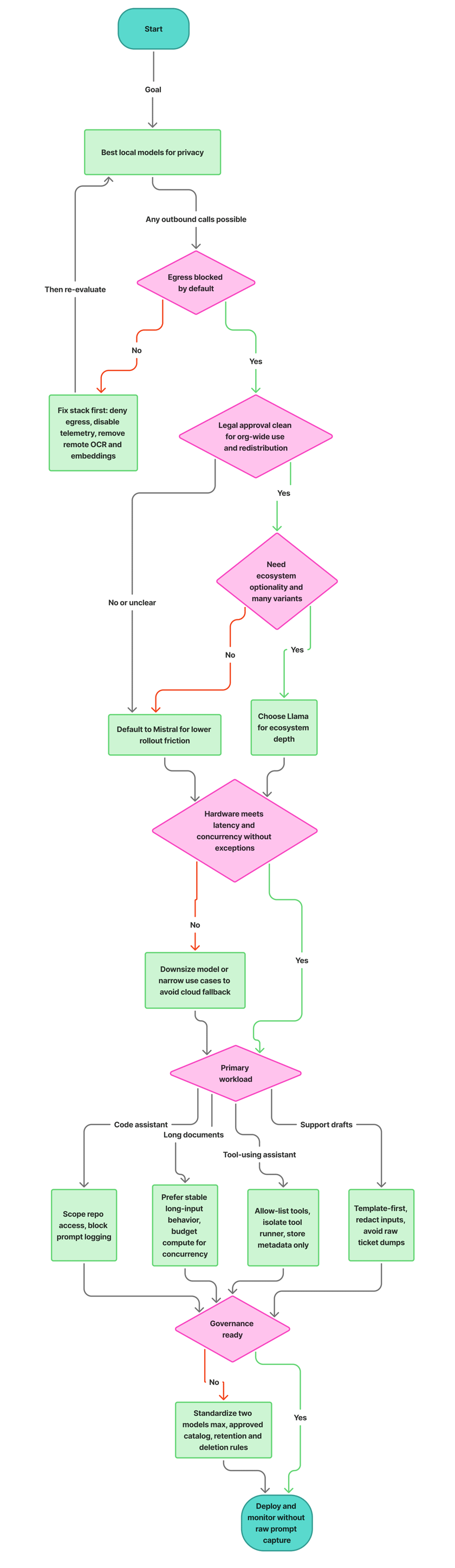
The setup looked clean. LLM weights on-prem. No external API keys. A tidy internal chat UI. The team told leadership they had picked the best local models for privacy. Then the real system showed up: the UI shipped prompts to an analytics endpoint, the inference server kept debug traces during an incident, and the vector database held embeddings indefinitely because retention was “later.” The model never left the building. The text did, just sideways.
By morning, the CIO was not asking Llama vs Mistral. They were asking who turned logging on, who can delete data on request, and why “local” still needs outbound controls.
Privacy starts with a threat model
People obsess over the best local models for privacy and miss the part that gets them burned: “local” does not fail loudly. It fails silently, in places nobody demos. A debug flag left on during an incident. A tracing agent capturing request bodies. A vector store that keeps embeddings forever because “we will add retention later.” Six weeks later, someone asks for evidence of deletion, and the room goes quiet.
You want a direct payoff from reading this section. Here it is: a way to stop buying privacy theater.
Write down three sentences and make them true in your design. If you cannot, do not call it private, no matter what model you run.
First, “No prompt or attachment is stored unless a human explicitly chooses to store it.” That single line forces your UI, gateway, inference server, and observability stack to behave. It kills the casual habit of logging raw payloads “for troubleshooting.”
Second, “Anything we do store has an owner, a retention window, and a deletion path that works across replicas and backups.” If you cannot name the owner, you have already lost. If you cannot delete from backups, you are not doing privacy, you are doing hope.
Third, “Nothing talks to the internet unless we can justify it in writing.” Not the UI, not the model server, not the tool runner, not the metrics agent. Most leaks are not malicious. They are convenient defaults.
Once you enforce those three sentences, model selection becomes a productive conversation. Without them, Llama vs Mistral is a distraction. You are just choosing which car to drive while the fuel tank is leaking.
Licensing decides your “local” strategy
In an enterprise, licensing is not paperwork. It is the switch that decides whether your “local” plan can scale beyond one team.
Mistral is often easier to operationalize because permissive terms reduce review friction. You can standardize faster, redistribute internally with fewer exceptions, and avoid last-minute “legal says no” surprises.
Llama buys you ecosystem gravity, but you also inherit a license that will be scrutinized. That usually means more governance, clearer redistribution boundaries, and tighter internal guidance on where and how it can be used.
Decision rule: if you plan a broad internal rollout, partner delivery, or any product-like packaging, pick the option your legal team can approve once and stop revisiting.
Pro Tip: If legal cannot give you a simple “yes” for enterprise-wide use, your benchmark results do not matter.
Hardware limits are security limits
If performance is tight, teams do stupid things to “make it work.” They add cloud fallbacks, relax controls, and turn on logging. That is not a model problem. It is a sizing problem that becomes a privacy problem.
Pick the weakest machine that must run this. If it cannot run there, you will create “temporary” cloud exceptions.
Define an acceptable response time up front. Tight targets push you to smaller models. Loose targets require queues and capacity planning.
Plan for real concurrency, not a demo. Shared servers force caching and debugging, and sensitive text gets copied.
Treat chat history and retrieval memory as data stores. Add retention, deletion, and access controls on day one.
Use quantization intentionally. If quality drops, users paste more context to compensate. Exposure goes up.
Enforce outbound deny at the host or network layer. App settings are not a control.
More legal review, more internal rules around redistribution
Usually smoother standardization with fewer policy exceptions
Llama: 6/10Mistral: 9/10
Ecosystem depth
Massive ecosystem, many variants, lots of tooling
Smaller ecosystem, often more controlled
Llama: 9/10Mistral: 7/10
Model range
Wide spread from small to very large
Strong small-to-mid lineup, plus larger options
Llama: 9/10Mistral: 8/10
Governance risk
Higher sprawl risk if teams pull random fine-tunes
Easier to keep a tighter catalog
Llama: 7/10Mistral: 8/10
Long documents
Works, but costs rise fast with context and concurrency
Often positioned well for long-context workloads
Llama: 7/10Mistral: 8/10
Internal adaptation
Plenty of recipes and community know-how
Good, but less “everyone has done it” volume
Llama: 8/10Mistral: 7/10
Procurement optics
“Open weight” plus clauses can trigger extra cycles
Permissive perception usually accelerates approvals
Llama: 6/10Mistral: 9/10
Default enterprise pick
Best if you want maximum optionality and can govern it
Best if you want a faster rollout with less licensing debate
Llama: 7/10Mistral: 8/10
Winner: Mistral, if you are optimizing for enterprise rollout. Licensing friction and procurement drag kill programs faster than model quality.
When Llama wins: when you want ecosystem optionality and you have strong governance to prevent model sprawl.
How “local” still leaks data
Local deployments usually leak through routine defaults, not dramatic attacks. The most common route is observability: gateways, reverse proxies, application logs, tracing, and error trackers capturing request bodies when troubleshooting kicks in. Once raw prompts enter logs, they spread fast through replication and backups, and far more people can access them than the LLM itself.
The next leak is “memory” treated as a product feature. Chat history, retrieval snippets, and embeddings become a quiet data store with no named owner. Teams assume embeddings are safe because they are not plain text. In practice, similarity search can surface sensitive context, and you end up maintaining a searchable archive of internal material.
Tools create another leakage path. One plugin call, external OCR, or remote embeddings turns “local” into “mostly local.” Even when tools are on-prem, temp files and caches can remain in containers and shared volumes. Performance fixes like caching and request replay add more copies of sensitive text than anyone planned for.
Finally, deletion often stops at the application layer. The record disappears from the UI, but replicas and backups keep it for months. If you cannot state retention windows and prove deletion across the chain, assume the data remains.
Triage “slow,” “wrong,” “unsafe,” and escalation workflows.
Define retention, deletion, backups, access reviews for prompts and memory.
Restrict variants, standardize packaging, control fine-tunes.
Track latency, saturation, error rates without raw prompt capture.
Match the model to the job
When NOT to buy local LLMs
The best local models for privacy are still the wrong buy if the basics are missing. Local only pays off when you can run it without exceptions, govern it without drama, and prove controls without hand-waving.
Usage is unclear beyond a pilot, or the owner cannot state who will use it and for what tasks
Workloads are spiky and unpredictable, and capacity planning will turn into constant firefighting
No outbound deny posture, and too many components can “accidentally” call home (telemetry, plugins, remote OCR, remote embeddings)
No retention policy for prompts, chat history, or embeddings, and no one can prove deletion across replicas and backups
No data classification for what users will paste, and no redaction rules for tickets, emails, contracts, or customer identifiers
No ealuation muscle: no test set, no quality gate, no red-team checks, just “looks good in the demo”
No governance spine: every team can deploy its own model variant, and behavior will drift week by week
No security owner for the full chain (UI, gateway, inference, tools, vector DB, logging, backups), only partial ownership by function
The business case is “privacy” only, with no operational objective like reduced cycle time, fewer support touches, or faster internal search
If two or more bullets are true, pause the purchase. Fix the foundations, then compare Llama vs Mistral.
A rollout plan that survives month three
Month
Do
Consider it Done when
Month 1
Lock “local” rules. Deny egress. Disable telemetry. Stop raw prompt logging. Pick one pilot workflow.
Zero outbound paths. Logs store metadata only. Pilot scope frozen.
Month 2
Run the pilot. Create an evaluation set. Add a regression gate for upgrades. Set up monitoring without content.
Pilot meets a target. Upgrades can be blocked. Metrics work without storing prompts.
Month 3
Put memory on retention. Prove deletion across replicas and backups. Standardize the model catalog (max two). Allow-list tools. Scale in one wave.
Deletion is provable. No model sprawl. Tools cannot “phone home.” First scale wave passes evaluation.
FAQs
What are local AI models?
Local AI models run on your own machine or private infrastructure instead of external APIs. Your data stays inside your environment, not on a vendor’s servers.
Why are local models preferred for privacy?
Because data does not leave your system. No API calls, no third-party logging, no exposure to external training pipelines. You control storage, access, and processing.
Which local models are commonly used for privacy-focused setups?
Popular choices include LLaMA variants, Mistral models, DeepSeek, and Qwen. The choice usually depends on your hardware, use case, and how much customization you need.
Are local models completely secure by default?
No. Running locally reduces external risk, but internal risks still exist. Poor access control, logging, or misconfigured systems can still expose sensitive data.
How do local models compare to cloud AI in performance?
They are getting close for many tasks like coding, summarization, and structured analysis. But very large cloud models still lead in some complex reasoning tasks.
What hardware is needed to run local models?
3B–7B models: Can run on high-end laptops
7B–13B models: Need decent GPUs
30B+ models: Require dedicated servers
There is always a trade-off between performance and hardware cost.
Are local models cheaper than API-based AI?
At scale, yes. You avoid per-token costs. But you pay upfront for hardware, setup, and maintenance.
Can local models work without internet?
Yes. Once installed, they can run fully offline, which is critical for regulated or sensitive environments.
How do local models support customization?
You can fine-tune them, connect internal data, build RAG pipelines, and control workflows completely. That level of control is not possible with most closed APIs.
Are local models suitable for enterprise use?
Yes, especially where data sensitivity is high. Many enterprises use them for internal tools, document processing, and secure automation.
What is the biggest limitation of local models?
Infrastructure and operations. You own the hardware, uptime, scaling, and security. It is not “plug and play.”
What is the biggest mistake teams make with local AI?
Assuming local automatically means secure. Without proper controls, logging policies, and access governance, local systems can still leak data internally.
When should you choose local models over cloud AI?
Choose local when:
Data is sensitive
Costs are scaling with usage
You need control and customization
Otherwise, cloud AI is faster to deploy and easier to manage.
Do local models eliminate API dependency completely?
Yes, for many internal use cases. But some teams still use hybrid setups where sensitive tasks stay local and general tasks use APIs.
What actually matters more than the model itself?
The setup. Identity controls, data handling, retrieval permissions, logging, and infrastructure discipline matter more than whether you choose LLaMA or Mistral.
Conclusion
The best local models for privacy are the ones you can run without exceptions. Not “best on a benchmark,” best under your licensing constraints, your hardware limits, and your governance reality. If egress is not locked down, if prompts can land in logs, or if retention and deletion are not provable, model choice is a distraction. Pick the family that your legal team can approve cleanly, standardize to a tight catalog, and treat memory, logging, and tools as the real privacy surface. Then local becomes a control you can defend, not a claim you hope nobody tests.
You can ban public AI tools, block browser plugins or even add DLP pop-ups. Then someone pastes a customer escalation thread into a “private” chatbot anyway, because the fastest path still wins. That is the real problem: most leaks are behavioral and operational, not vendor-driven.
Self-hosted LLM infrastructure helps, but only if you treat it like a regulated system, not a science fair. The failure points are unglamorous and costly: overbroad service accounts, chat logs that quietly capture secrets, RAG indexes built without document ACLs, telemetry shipped to “support,” and egress rules that exist only on paper.
One weak control and your “private AI” becomes a very efficient data vacuum.
So, let’s find out the acceptance gates, disqualifiers, and the proof package to demand so you can protect data from public AI without buying a whole circus.
Self-hosting does not block public AI leakage
Self-hosting is a hosting choice, not a security outcome. It can keep company data away from public AI services, but it will not stop internal leakage unless your platform behaves like a controlled system.
What self-hosting CAN remove: your prompts and files are not going to a public AI endpoint by default. You own the runtime boundary, network paths, and storage. That is real value.
What self-hosting DOES NOT remove: over-scoped access, chat history retention, logging of sensitive text, retrieval that ignores document permissions, and outbound telemetry. Those are the usual sources of “private AI” embarrassment.
Procurement decision rule: do not sign until you see proof of these three controls in the demo or POC.
Retention control for prompts, files, and outputs (including logs)
Permissioned retrieval that enforces document-level access (no shared-index leakage)
Egress control and visibility for every outbound path (telemetry, plugins, support, updates)
Contract traps that show up after signature
Procurement is told the same story every time: “Your data stays private,” “We do not train on it,” “Enterprise-grade security.” None of that matters if the contract language is vague or the platform behavior is undocumented. “Protect data from public AI” is a legal and operational requirement; treat it accordingly.
Make the vendor commit to behaviors you can audit, not intentions you can screenshot.
Red flags that usually surface after you are already live:
“No training” but no clarity on retention, backups, or derived artifacts like embeddings and logs
“Private deployment,” but telemetry and diagnostics still leave your environment by default
Support access that is broad, unaudited, or always-on, justified as “necessary for uptime.”
Sub-processors are added silently over time, with notification language that is technically compliant but practically useless.
Data residency and encryption claims without key ownership clarity (who can decrypt, when, and under what process).
What to ask for, in contract terms, not email promises:
Explicit definition of “Customer Data” that includes prompts, uploads, outputs, logs, embeddings, evaluation traces, and fine-tuning artifacts
Retention and deletion obligations with timelines, including backups, and a statement on what cannot be deleted
A list of outbound telemetry categories, whether content is included, and a default of content-free telemetry
A support-access policy: break-glass only, time-boxed, approved, logged, and reviewable
Audit rights or at least audit artifacts: SOC reports, pen test summaries, and log export capability relevant to your deployment
The buyer moves: if the vendor resists specificity here, stop negotiating features. You are not buying a model; you are buying a data-handling system.
Pro Tip: Ask for a one-page “data handling matrix” as an appendix: data type, where stored, retention, who can access, and how it is deleted.
Acceptance gates before demos
Acceptance gate
What you must see as proof
Instant fail condition
Data scope pinned
One-page scope: in-scope data types, users, systems, and exclusions
“We’ll define later,” or the scope expands during the demo
Retention control
Config showing retention for prompts, uploads, outputs, and logs; exportable policy
The vendor cannot show where the data is stored or for how long
Deletion is real
Demonstration of delete request + evidence of what is deleted and what is not (backups, traces)
Exportable audit logs: who asked what, what was retrieved, key config changes
No log export, or logs omitted, retrieval and config changes
POC exit criteria
Written POC rubric mapped to gates, named approvers; pass/fail outcomes
“POC success” is defined as “users liked it.”
You force vendors to show measurable behaviors: retention, deletion, permissioned retrieval, egress control, and audit proof. This also keeps your POC tight. You are validating data-handling and control maturity, not model quality.
Any gate you defer becomes an explicit, owned risk, not a hidden surprise after go-live.
IAM non-negotiables for LLM platforms
If your identity and access model is weak, everything else is decoration. Self-hosted LLM infrastructure becomes a new internal data surface, which means you need the same discipline you apply to source code, ticketing, and production logs. Procurement should treat IAM requirements as disqualifiers, not “phase two.”
Minimum requirements to protect data from public AI in real operations:
Single sign-on only, mapped to your IdP, with enforced MFA and conditional access policies
Role-based access with least privilege, separating end users, builders, reviewers, and admins
No shared accounts. No “one admin to rule them all.” Every privileged action must be attributable
Separate service accounts for each integration, scoped to the smallest dataset and action set
Break-glass admin access that is time-boxed, approved, logged, and reviewed
Environment isolation: dev, test and prod are separated so experimentation cannot touch real data Session controls: idle timeouts, device posture rules, and location or network restrictions if you use them elsewhere
Trade-off you should accept upfront: strong IAM slows early experimentation. That is the point. If a vendor says “security will kill adoption,” they are telling you your users are going to do unsafe things when the system is convenient.
If admins and integrations share one broad role, that role becomes your leak path.
Procurement paths to keep data out of public AI
There are three buying patterns. Self-hosted LLM infrastructure gives you maximum control, but you become the operator. Managed private is faster to launch, but your privacy posture depends on contracts, telemetry limits, and how support access works. Hybrid proxy can reduce exposure quickly, but it is only reliable if teams cannot bypass it.
Before you compare vendors, estimate demand in one line. Monthly tokens in million = Users × prompts/day × tokens/prompt × 30 ÷ 1,000,000. Example: 500 users × 10 prompts/day × 2,000 tokens × 30 ÷ 1,000,000 = 300 million tokens/month.
This number matters because it turns the conversation from opinions to scale.
Hosted options are mostly pay-per-use: million tokens × rate.
Self-hosted is mostly pay-per-month: compute running 24×7 plus the operating work that keeps it safe (on-call, patching, audits, log storage).
If you cannot estimate usage and monthly burn with named owners, you are not ready to commit to self-hosting. Start with a controlled managed path, measure real usage, then decide whether self-hosting is worth the fixed commitment.
Most “private LLM” incidents are not model problems. They are retrieval problems. The moment you add RAG, you are building a new search layer that can quote internal text back to a user. If that layer does not enforce the same permissions as your source systems, your self-hosted LLM infrastructure becomes a cross-team data mixer.
The first leak pattern is the shared index. Teams ingest documents into one corpus because it is faster. Then they bolt on filters that are not tied to real identity and groups. The result is predictable: a user asks an innocent question, retrieval pulls a chunk they were never allowed to see, and the model summarizes it confidently. Nobody calls it a breach until the wrong person recognizes the content.
The second leak pattern is preprocessing. Chunking, OCR and cleaning often strip metadata that you needed for access control. If the pipeline drops document owner, classification, or ACL references, you cannot enforce permissions later.
Embeddings are also derived artifacts.
Even if you do not store raw documents in the vector index, you still need to treat the index as sensitive because it exposes meaning and business context.
What you should demand is boring but decisive.
RAG must be permissioned end to end.
Ingestion must preserve access metadata.
Retrieval must run in the context of the logged-in user.
Answers must be traceable to sources so you can audit what was retrieved.
If a vendor cannot demonstrate a permission failure test such as “user from Team A cannot retrieve Team B content,” your self-hosted LLM infrastructure is not protecting data. It is accelerating the wrong retrieval.
The proof package buyers should demand
If a vendor says “yes, supported,” treat it as noise until you see exports. For self-hosted LLM infrastructure, you need proof you can hand to Security, Legal, and Audit without rewriting it as a story.
Demand these artifacts from the demo or POC:
Audit log export showing who accessed what, when, and from where
Retention settings for prompts, uploads, outputs, and logs, with evidence they are enforced
Deletion proof showing what is deleted, what remains, and why (backups, traces)
Egress evidence: allowlists, blocked outbound attempts, and telemetry scope
Support access model: break-glass flow, approvals, time-boxing, and logs
RAG proof: (You already read it above)
Ownership proof such as who can decrypt, under what process, and how keys rotate
Incident processes like who gets paged, what logs exist, and how you investigate
If the platform cannot produce these quickly, you are not evaluating a product. You are funding a gap.
Trade-offs that change the buying decision
Self-hosted LLM infrastructure buys control, but it also buys ownership. The first trade-off is uptime. Once teams rely on the assistant for incident triage, ticket handling, or customer responses, downtime becomes a business problem, not an IT experiment. If you do not have a clear on-call model and a rollback path, you will either over-engineer for fear or run it unsafely until the first outage forces a scramble.
The second trade-off is security drift. Model servers, vector stores, gateways, and observability stacks need patching and hardening like any other production system. Access creep is also real. The “temporary admin” role that helped the pilot becomes permanent.
The log system quietly retains sensitive prompts because nobody tuned it. The RAG corpus grows without re-validating permissions. These are not dramatic failures, they are slow decay.
The third trade-off is economics. Self-hosting is a monthly commitment. You pay even when usage is low, and the real cost is not only compute. It is engineering time, security reviews, audits, and incident handling.
If you self-host, treat it like a platform product. Name a platform owner, publish acceptance gates, and run quarterly access and retention reviews.
When NOT to buy self-hosted LLM infrastructure
When NOT to buy self-hosted LLM infrastructure
What this looks like inside the org
Financial impact
No approved rollout volume
No signed rollout plan, no minimum active users, no monthly usage target
Fixed monthly burn with low utilization; fast candidate for budget cuts
Peak-load sizing is mandatory
“Must work during incidents and exec escalations” becomes a hard requirement
You pay for peak capacity all month; average usage does not reduce cost
No funded run capacity
Build team is expected to operate infra, patch, monitor, and respond
Hidden labor cost plus delivery slowdown; infra burn continues regardless
Finance wants stable monthly spend and clear allocation
Infra plus audit and incident overhead drives variance and add-ons
“Cost saving” is the primary business case
The case is “API is expensive” without stable usage and utilization assumptions
Front-loaded spend; savings only at sustained high utilization
No chargeback model
No BU owns usage; everything lands under central IT
Consumption grows without accountability; ROI becomes undefendable
Funding horizon is quarter-to-quarter
Re-approvals, freezes, and stop-start governance are common
Sunk cost risk rises; restarting later costs more than finishing now
Audit evidence is required immediately
Security expects evidence packs from week one
Recurring compliance overhead; delays burn money without value delivered
Platform direction is still fluid
Cloud, model family, vendor strategy, and regions are still debated
Re-platforming leads to write-offs and rework, not “optimization”
Data access is politically fragmented
Permissions differ by department with exceptions and manual approvals
Integration and access alignment dominate spend; infra is not the main cost
Conclusion
Self-hosted LLM infrastructure can protect company data from public AI, but only when it is bought and operated like a controlled system. The winning programs do not start with model benchmarks. They start with procurement gates, hard proof of retention and deletion behavior, permissioned retrieval that respects document access and outbound controls you can audit.
If you anchor the buy on evidence and financial shape, self-hosting stops being a risky science project and becomes a defensible platform decision that Security, Legal, and Finance can live with.
Too many smart leaders are treating their AI strategy like a permanent hotel stay. You are paying a luxury markup for a room you can never decorate and a bed you do not own. Public APIs served a purpose during the experimental phase. Now, there is a massive leak in your operational bucket.
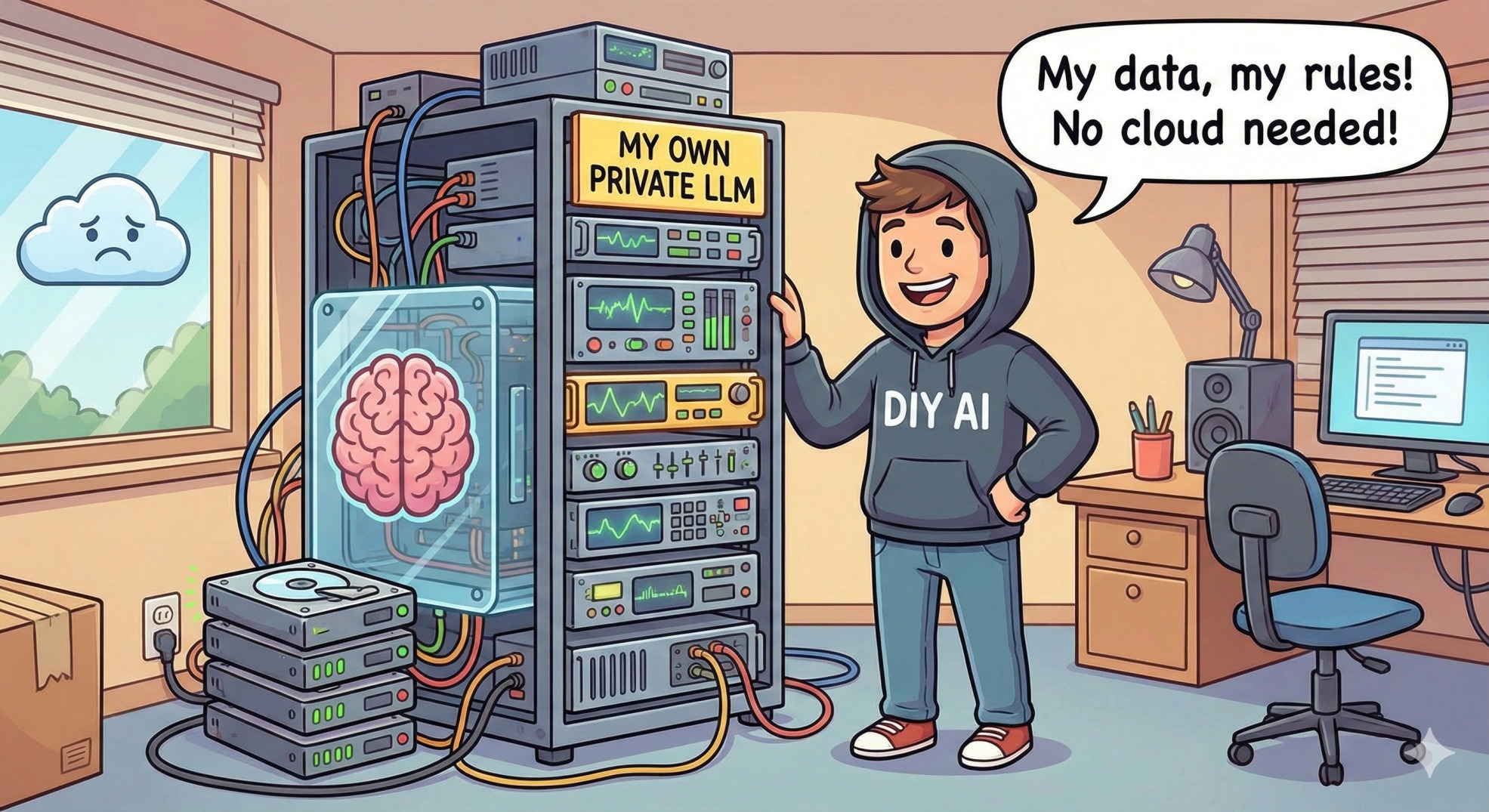
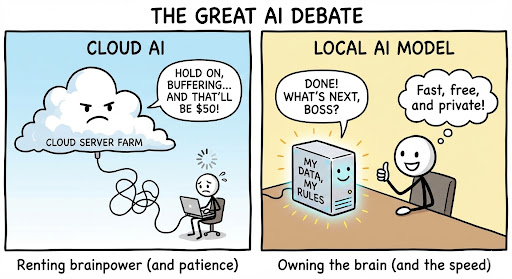
The smartest players in the market realize that renting intelligence by the token is a recipe for margin collapse. It is the digital equivalent of paying for every breath of air in your office. Let’s find out how to stop the bleeding and reclaim forty percent of your budget. Welcome to the world of Local AI Models.
The perpetual API subscription tax on your operational margins
Public APIs are essentially a tax on your success. The more users you attract and the more data you process, the more you owe a third party. It is a backwards way to build a business because your most successful month becomes your most expensive one. I am seeing talented teams hesitate to roll out new features because they are terrified of what the bill will look like at the end of the quarter.
This is where local AI models change the equation from a variable drain to a fixed foundation. When you own the infrastructure, your cost to run one thousand queries is nearly the same as the cost to run ten.
You are moving from a world where you rent a brain by the minute to a world where you own the engine. If your business model relies on a vendor not raising their prices or changing their terms, you are not a manager. You are a hostage.
The financial logic for a pure API strategy falls apart the moment you hit production scale. You are paying a massive premium for a generic service that has zero loyalty to your bottom line. By bringing the compute in-house, you are turning a recurring liability into a strategic asset that actually builds value on your balance sheet.
The winners of this decade will be the ones who stop paying the landlord and start owning the land.
Stripping the provider markup to claim your 40 percent margin dividend
The 40 percent saving is not a guess. It is the result of removing the massive premium that commercial providers charge to cover their own research and marketing. When you use local AI models, you are buying at wholesale prices. You stop subsidizing the profit margins of a trillion-dollar tech giant and start keeping that capital for your own infrastructure.
The markup on a standard API call is often four times the actual cost of the electricity and silicon used to generate it.
The money usually leaks out in three specific ways:
You are paying for a giant brand name and a flashy website that your users never even see.
You are being forced to use a massive model to do a tiny job because the provider wants to simplify their own billing.
Your monthly check is paying for the vendor to train their next version instead of improving your own system.
If you analyze an enterprise workload of 200 million tokens monthly, an API provider might charge you $5,000 for the privilege. Running that same workload on a dedicated server cluster costs a few hundred dollars in power and maintenance.
Local AI Models: the only cure for the hidden productivity tax of latency
Every millisecond your data spends traveling to a server farm three states away is a millisecond your staff spends staring at a gray loading bar. While a three-second delay feels negligible for a single query, it becomes a massive bottleneck when integrated into high-frequency business processes or real-time customer interfaces.
By deploying local AI models, the intelligence sits in the same rack as the task, turning a stuttering workflow into a seamless stream of results that keeps your team in a state of high output.
Efficiency Factor
Public Cloud API
Local AI Models
Direct Benefit
Response Latency
2.0s – 5.0s (Network overhead)
0.1s – 0.5s (Internal bus speed)
Eliminate the wait tax on customer facing apps to boost retention.
System Throughput
Capped by vendor rate limits
Limited only by your GPU VRAM
10x more transactions per hour with your existing staff.
Worker Productivity
High context switching risk
Near instant flow state support
Save thousands of work hours annually on high volume audit tasks.
Operational Uptime
Vulnerable to ISP and Cloud outages
100% available behind your firewall
Core logic remains functional even if the global internet flickers.
Cost of Idling
Paying for system wait time
Maximum hardware utilization
Stop paying for expensive talent to watch a loading spinner.
Data Travel Distance
Thousands of miles round-trip
Centimeters across the motherboard
Remove 100% of the interception risk from the transport layer.
Concurrency Load
Performance drops during peak hours
Dedicated, consistent performance
Reporting is ready by 8 AM regardless of global traffic.
Batch Processing
High cost for large-scale datasets
Free execution on owned hardware
Deeper analysis of your entire database without fear of a surprise bill.
Debugging Speed
Slow feedback loops via API logs
Real-time local console monitoring
Developers can iterate and ship features twice as fast.
Integration Complexity
Constant API version maintenance
Stable, version-locked environments
Lower DevOps overhead by freezing the model stack.
Locking your data vault by hosting intelligence inside the house
Sending your company data to a cloud API is like handing your house keys to a stranger just because they offered to help you carry the groceries. You are trusting a third party to handle your proprietary secrets, customer records, and internal strategy while they train their own systems on your success.
Far too many leaders treat their data like a public utility when it is actually the only thing keeping them competitive in a crowded market.
The financial stakes of a mistake are no longer a slap on the wrist. Looking at the 2025 numbers, the average cost of a data breach is a direct hit to your valuation. Beyond the legal fines, you have to deal with the fact that most consumers will simply walk away if they do not trust how you handle their personal information.
Using local AI models ensures your data never leaves your own silicon, effectively removing the third-party provider as a point of failure.
By hosting your intelligence on-site, you are building a physical wall around your intellectual property. You stop being a guest in someone else’s data center and start being the warden of your own vault. Total ownership of your stack is the only real insurance policy in an era of high-speed corporate espionage.
Stopping the drain of paying for computing power your tasks do not require
Most cloud providers force you to rent a massive, one-size-fits-all brain to perform basic data entry tasks. It is like hiring a world-class neurosurgeon to put a bandage on a scraped knee. You are paying for billions of parameters of general knowledge and expensive safety alignment that have zero impact on your specific business logic.
By deploying local AI models, you match the size of the model to the complexity of the job, ensuring every dollar spent is directed toward your actual goals.
Use a lean 8B model for document extraction instead of a massive 400B model to cut your power and processing requirements by 90 percent.
Run specialized tasks in parallel on a single GPU cluster to finish a week of data processing in a single afternoon.
Stop paying for the extra compute cycles a cloud provider uses to run ethical filters on your own private, internal data.
Direct every bit of your VRAM toward revenue-generating tasks rather than paying for a giant model’s idle background processes.
Reduce your cost per interaction to near zero by stripping away the “general intelligence” fluff you never asked for.
Trading volatile usage spikes for the peace of a fixed infrastructure budget
Relying on a cloud API means your monthly expenses are tied to a roller coaster you do not control. If your application goes viral or your team runs a massive data audit, your bill spikes without warning. It is impossible to protect your margins when your infrastructure costs change every single day based on how many tokens you happen to consume.
When you shift to local AI models, you are buying the farm instead of paying for every ear of corn. Your infrastructure cost becomes a flat and predictable line on your balance sheet.
You know exactly what your server costs will be for the next three years, regardless of whether you process a thousand requests or a billion. This transition allows you to forecast your margins with total confidence because you have removed the variable pricing risk from your core operations.
A fixed budget model also changes the way your team iterates on products. When every experiment carries a direct financial penalty from a cloud provider, your developers stop taking risks to avoid blowing the budget. With your own hardware, the marginal cost of trying a new idea is zero. You can push your systems to the absolute limit without checking the balance on your credit card.
Treat the shift to local AI models like buying the building instead of renting a cramped basement. The API era served as a useful training wheel phase, but keeping those wheels on during a competitive race is a guaranteed recipe for a margin crash. Owning the hardware is the only way to lock in profit and tell the cloud giants that the bank is closed for good. The dividend of this decision is simple: total autonomy and a balance sheet that finally stops leaking cash with every single query.
Most of startups today claim that they are “AI-based startups”.
Most of them are not.
Some are clever wrappers around APIs. Some are automation tools wearing an AI costume. Some are just hoping the word “AI” buys them time, funding, and forgiveness.
AI-based startups are not magic. They are harder, more expensive, more fragile, and far less forgiving than normal software companies. The upside is massive, yes. But so is the number of founders quietly panicking after the demo applause fades.
Let’s talk honestly. No buzzwords. No worship. Just reality.
What Actually Qualifies as an AI-Based Startups
Let’s get this out of the way.
Using ChatGPT APIs does not magically turn your startup into an AI company. Neither does adding “AI-powered” on the homepage or sprinkling a few prompts inside your product.
An AI-based startup is one where artificial intelligence is not a feature but the core mechanism.
If you remove the AI layer and the product collapses, congratulations, you qualify. If the product still works fine without it, you’re just a regular SaaS wearing an AI costume.
At its core, an AI-based startup uses models to learn, adapt, predict, and make decisions at scale. This could mean recommendation engines that improve with usage, systems that automate judgment-heavy tasks, models that spot patterns humans miss, or agents that act with limited autonomy. The intelligence must compound over time, not stay static.
Another key qualifier is data gravity. Real AI-based startups are obsessed with data pipelines, feedback loops, training quality and inference costs. They worry less about UI polish and more about whether the model is drifting, hallucinating, or learning the wrong behaviour. If your biggest headache is prompt quality and model behaviour, you’re probably building something real.
Finally, AI-based startups solve problems that were either impossible or wildly inefficient before AI matured. They compress time, reduce human dependency, or unlock scale without linear hiring. If your pitch sounds like “the same thing, but faster,” you might be missing the point. AI startups usually change who does the work, not just how fast it gets done.
The Illusion of “We Use AI” vs Real AI Products
Saying “we use AI” has become the startup version of saying “we are scalable.” It sounds impressive. It means almost nothing. A rules engine with a few if-else conditions wrapped inside a shiny dashboard is not AI. Calling an API from OpenAI does not magically turn your product into one of those serious AI-based startups people actually bet on.
Here’s the uncomfortable truth. Many products slap the word AI on top because investors expect it, customers ask for it, and pitch decks look cooler that way. Under the hood, it is basic automation, static logic, or at best some analytics with thresholds. Useful, yes. Intelligent, no. And that gap becomes apparent very quickly once the product faces real-world complexity.
Real AI products behave differently. They learn from data. They improve over time.
They deal with uncertainty, not just predefined flows. A genuine AI-based system makes probabilistic decisions, adapts to patterns, and sometimes even surprises its creators. That is why real AI-based startups invest more in data pipelines, model training, evaluation loops, and monitoring than they do in landing pages.
If your product stops working the moment rules change, or needs constant human tweaking to stay relevant, it is not AI-led. It is just well-packaged software. The difference matters because markets are getting smarter, buyers are asking sharper questions, and the “AI sticker” trick is wearing thin fast.
AI-based startups captured an unprecedented share of global venture capital. The real value of AI startups is not in sounding intelligent. It is in doing something boring, expensive, or painful better than humans ever could. Most successful AI-based startups are not chasing buzzwords. They are quietly replacing fragile processes that break at scale.
The strongest signal of real value is simple. If you remove the AI, the product collapses. If you can remove the AI and still sell the product, then AI was never the core.
Here is where genuine value is actually being created.
End-to-end task ownership, not assistance The best AI startups do not “help” a human do the work. They take full responsibility for the task. Screening resumes. Categorizing support tickets. Reconciling invoices. Flagging fraud. Humans step in only for exceptions, not routine decisions.
Process compression Real AI reduces a five-step workflow into one decision. Not faster screens. Fewer screens. Not dashboards. Fewer meetings. If the product still needs heavy hand-holding, AI is decorative.
Decision-making under uncertainty Valuable AI startups operate where rules break down. Ambiguous data. Incomplete signals. Changing patterns. This is where static automation fails and learning systems earn their keep.
Operational scale without linear hiring When a startup claims AI value, ask one question. Can revenue grow without growing headcount at the same rate? If the answer is no, the AI is cosmetic.
Learning from live data, not static models Strong products improve quietly in the background. Models retrain. Thresholds adjust. Outcomes get better month after month without manual tuning.
Some areas where this value shows up clearly today:
Customer support triage and resolution
Fraud detection and risk scoring
Sales qualification and lead prioritization
Content moderation and compliance checks
Demand forecasting and pricing optimization
And some areas where “AI value” is usually exaggerated:
Area
Reality
AI dashboards
Looks impressive, but teams rarely act on insights due to missing ownership and workflows
Chatbots bolted onto apps
Adds another interface without fixing root process or customer experience issues
Predictive insights with no execution
Predictions exist, but no system triggers actions or accountability downstream
Generic copilots
Produces text and suggestions without measurable impact on real business outcomes
AI alerts and notifications
Too many alerts fired, most ignored after initial excitement fades
AI-powered recommendations
Suggestions are generic because models lack deep context and operational authority
AI analytics for leadership
Reports are consumed in reviews, then forgotten until the next quarterly meeting
AI features sold as differentiation
Sounds advanced in sales decks, but delivers marginal value in daily operations
The Tech Stack Most AI Startups Quietly Depend On
Behind the flashy demos and confident pitch decks, most AI-based startups rely on a surprisingly similar technical backbone. Very few are inventing brand-new algorithms from scratch. The real work happens in stitching together proven cloud infrastructure, mature ML frameworks, scalable data pipelines, and deployment layers that can survive real users. What separates serious AI startups from hobby projects is not the model alone, but how reliably this entire stack works together under load, cost pressure, and imperfect data.
Common building blocks you’ll find under the hood:
Cloud infrastructure (AWS, GCP, Azure): Used for elastic compute, managed storage, GPUs, and rapid scaling without owning hardware.
Model frameworks (PyTorch, TensorFlow, JAX): Core libraries for training, fine-tuning, and experimenting with machine-learning models.
Pretrained and foundation models: Startups rarely train from zero. They fine-tune large language models, vision models, or speech models for narrow, high-value tasks.
Data pipelines and storage layers: Tools like object storage, data warehouses, and stream processors move raw data into usable training and inference formats.
Vector databases and embeddings: Used to power semantic search, recommendations, retrieval-augmented generation, and similarity matching.
Inference and serving layers: APIs, microservices, and model servers that handle real-time predictions with latency and cost controls.
Monitoring, logging, and evaluation tools: Track model drift, performance degradation, hallucinations, and unexpected behavior in production.
Security and access control Authentication, data isolation, and auditability become critical once enterprise customers are involved.
This stack is not glamorous, but it is where most AI startups either become dependable businesses or quietly fall apart.
Why Many AI Startups Will Die Young
AI-based startups are being born at an absurd pace. Decks look sharp, demos feel magical, and everyone claims proprietary intelligence. But beneath the surface, most of these companies are fragile. Not because AI is hard, but because building a real business on AI is harder than wiring an API.
Many startups confuse using AI with owning differentiation. If your core value disappears the moment an LLM API changes pricing or capabilities, you are not a company. You are a temporary wrapper. That fragility shows up the moment costs spike or competitors replicate features in weeks.
Secondly, data reality hits late and hard. Models don’t improve without clean, relevant, continuously flowing data. AI-based startups realize too late that customer data is sparse, noisy, or legally unusable. Training stalls, insights plateau, and the “learning system” quietly stops learning.
Thirdly, unit economics kill the romance. Inference costs, cloud bills, vector databases, and monitoring stacks add up fast. Many AI startups scale usage before fixing margins. Growth feels exciting until revenue cannot outrun infrastructure burn.
Finally, execution discipline is missing. AI cannot compensate for weak distribution, unclear ICPs, or messy workflows. When hype fades, only startups with operational clarity survive.
Revenue Models That Actually Work for AI-Based Startups
Most AI-based startups don’t fail because the tech is weak. They fail because the revenue model is a fantasy. Founders love talking about models, parameters, and benchmarks. Customers care about outcomes, pricing clarity, and whether the thing actually saves money or makes money. Real revenue in AI is boring, repeatable, and tightly coupled to business value. Anything else is noise.
Usage-based pricing tied directly to transactions, documents, calls, or decisions processed.
Per-seat licensing only when AI replaces a real human role, not when it just “assists”.
Revenue share models where AI directly impacts sales, recovery, or cost reduction.
API-based pricing for AI embedded inside customer workflows and systems
Tiered SaaS plans with strict caps, limits, and enforcement to avoid runaway compute costs.
Enterprise contracts focused on outcomes, SLAs, and measurable efficiency gains.
Platform fees combined with professional services for onboarding, tuning, and integration.
The AI-based startups that survive are brutally honest about what customers will pay for. They price outcomes, not intelligence. They align cost with value, avoid vague promises, and build models that scale without bleeding cash. Fancy demos don’t pay salaries. Predictable revenue does.
Enterprise vs Consumer AI Startups
Enterprise and consumer AI startups may use similar underlying technology, but they live in completely different business realities. Enterprise AI is sold into slow, political, risk-averse organizations where trust, compliance, integrations, and ROI matter more than slick demos.
Consumer AI lives in a fast, brutal market where adoption is emotional, switching costs are low, and users leave the moment the product stops feeling magical.
One side optimizes for contracts, stability, and long-term value. The other survives on retention, habit, and scale. Confusing these two worlds is one of the fastest ways AI-based startups burn money without ever finding traction.
Aspect
Enterprise AI Startups
Consumer AI Startups
Primary buyer
CIO, CTO, operations or business heads
Individual users or small teams
Sales cycle
Long, complex, approval-heavy
Short, impulse-driven
Revenue model
High-value contracts, annual subscriptions
Low-cost subscriptions or freemium
Product depth
Deep workflow integration, customization required
Simple, fast, feature-focused
Switching cost
Very high once embedded
Very low, users churn easily
Growth pattern
Slower but more predictable
Fast spikes, equally fast drop-offs
Support expectation
Dedicated support, SLAs, compliance
Minimal support tolerance
Survival risk
Dies slowly if the product fails
Dies quickly if traction drops
Conclusion
Most AI-based startups will not fail because the tech was weak. They will fail because they mistook demos for products, pilots for revenue, and attention for adoption. The ones that survive are brutally clear about the problem they replace, the workflow they live inside, and the money they earn without storytelling gymnastics. AI is no longer a differentiator. Execution is. If your startup cannot prove real value without saying “AI-powered” in every second sentence, the market will do the filtering for you.
Before we start talking about AI-powered CRM, let’s take to flashback.
The last few years were not kind to the CRM giants. Everyone pretended things were fine, but the numbers told a very different story. The industry was slowing down, customers were restless, and the old promise of “digital transformation through CRM” was getting stale.
Take SAP. Revenue went up, but profits collapsed; net income dropped by 68% in 2022. When a company starts cutting thousands of jobs and slimming down its CRM and CX units, it’s not a strategic refinement. It’s a sign that the machine wasn’t running smoothly.
Salesforce, the poster child of cloud CRM, also hit a dull patch. The company that once grew like a rocket suddenly slipped into its slowest growth era. A few quarters of weak revenue forecasts and nervous investors made it clear: the momentum was gone.
Even Oracle felt the drag. Their cloud growth dipped from the 30% range to the mid-20s, and analysts openly called the results “disappointing.” And if the giants felt it, the market felt it too; CRM cloud growth slid from 11.7% in 2022 to 10.8% in 2023.
Flashback done.
Now the stage is set for the comeback story.
Why AI Matters in CRM
A traditional CRM can only record what your team types into it. It stores activities, logs emails, and displays the pipeline, but it cannot interpret intent or guide decisions. This is why so many companies are shifting to an AI-powered CRM model. In a market where customers move fast and signals are scattered across channels, the old CRM approach simply cannot keep up.
What AI actually fixes
Detects warm leads by analysing behaviour and micro signals
Scores opportunities with higher accuracy and reduces wasted effort
Automates follow-ups, email drafts, and repetitive sales admin
Predicts deal timelines instead of letting teams guess every quarter
Routes support tickets intelligently to cut response time
Keeps CRM data clean without manual cleaning or updates
Surfaces insights that sales teams would never notice on their own
This is the real shift. An AI-powered CRM does not wait for humans to update it. It works alongside them, guides actions, highlights who to talk to, and removes the noise that slows teams down. It transforms CRM from a storage tool into a decision engine. This is the upgrade the industry needed much earlier.
Top AI-powered CRM Platforms
Zoho CRM Zoho uses Zia as its built-in intelligence layer. Zia predicts deal success, spots unusual activity in the pipeline, and reads email sentiment to understand buyer mood. For users, this means faster qualification, fewer dead leads, and a clearer idea of which deals deserve attention first. In an AI-powered CRM setup, Zia acts like a small analytical assistant that constantly nudges teams toward the right action.
HubSpot CRM HubSpot’s intelligence comes through HubSpot AI. It offers predictive scoring, automated content suggestions, and smart routing that adjusts to real-time behaviour. For users, this translates into better-timed outreach, cleaner segmentation, and less manual effort in deciding who to contact. The CRM becomes more proactive by telling teams which leads are warming up and what message fits the moment.
Pipedrive Pipedrive uses the AI Sales Assistant to review deal health, calculate win probability, and flag stalled opportunities. It benefits users by cutting guesswork and helping them focus on deals with real potential. Instead of scanning the entire pipeline, reps get simple cues about what to close, what to follow up, and what to drop.
Freshsales Freshsales brings intelligence through Freddy AI. Freddy scores leads, forecasts revenue, and generates quick replies across channels. Users benefit from faster responses and better prioritisation, especially when managing a growing lead pool. It fits naturally into an AI-powered CRM flow, guiding teams toward the leads most likely to convert.
Salesforce Sales Cloud Salesforce integrates Einstein and its conversational assistant Copilot to analyse pipeline health, automate data entry, and forecast revenue. For users, this means fewer manual updates and more reliable predictions about the quarter. The system highlights next steps, suggests actions, and surfaces insights teams would normally miss until it is too late.
Oracle CX Oracle adds intelligence through its Adaptive Intelligent Apps. These tools score opportunities, interpret buying signals, and recommend the next step for complex enterprise deals. Users benefit from sharper qualification and better visibility into which accounts are actually interested instead of just polite. It is built for long sales cycles where small signals make a big difference.
SAP Sales Cloud SAP uses AI-enabled Sales Intelligence to improve forecasting, strengthen account insights, and prompt users with recommended actions. It benefits teams that handle structured enterprise sales by keeping them ahead of delays and identifying priority accounts early. SAP’s AI helps reduce surprises in long pipelines and gives managers a clearer view of what is truly moving.
Choosing an AI-powered CRM is less about brand names and more about how well the system fits the rhythm of your daily work. The right tool should cut noise, guide actions, and make every sales or support task lighter. If the CRM feels like a burden today, the AI layer will not magically fix it tomorrow.
What you should check
Match the CRM to your team size so you do not pay for features that sit unused.
Confirm the AI layer can learn from your current data instead of depending on heavy manual updates.
Ensure it integrates with your core tools like email, WhatsApp, calendars, landing pages, and support systems.
Look for a clean interface because complicated CRMs always end up ignored by busy teams.
Check how quickly the AI can surface the next best action, not just display information.
See if the CRM can auto-fill activities, so reps stop wasting time on data entry.
Test the quality of predictions such as lead score, deal probability, and churn alerts.
Make sure the CRM can personalise outreach without sounding mechanical
Verify mobile usability because many teams work on the go
Look at automation depth for follow-ups, handovers, and reminders
Ensure the system can scale as your lead volume increases
Confirm reporting quality so managers get clear insights without exporting sheets
Check whether onboarding is simple because complex rollouts usually fail
Evaluate cost vs. adoption because expensive tools are useless if the team avoids them
Review how often the vendor updates AI features, so you do not get stuck with outdated intelligence
A good AI-powered CRM should guide you toward the right leads, auto-update the boring parts, and give you confidence in your pipeline. When the CRM starts helping instead of demanding, that is when you know you have chosen the right one.
Conclusion
The CRM market needed a reset. The last few years showed us what happens when systems grow, but intelligence does not. Deals slow down, teams feel the drag, and companies start questioning the value of their tools. An AI-powered CRM changes that rhythm completely. It removes clutter, reads intent, automates the boring parts, and brings clarity back into the pipeline.
This new wave of intelligence is not optional anymore. It is the difference between a team that reacts and a team that leads. With AI taking over the heavy lifting, CRM finally becomes the partner it was always supposed to be. And 2026 is shaping up to be the year where this shift becomes visible in performance, revenue and customer experience. This is not just an upgrade. It is the comeback story the entire CRM world needed.
“You don’t have to explain it again,” the conversational AI assistant replied.
“It’s already in your plan from yesterday.”
A simple line, but it makes people instantly realize that they’re not talking to a chatbot. They’re interacting with something that remembers, adapts, and understands.
Most businesses still measure conversational AI by how well it talks. Smooth replies, natural phrasing, fewer errors: all these are important, but none of them create trust.
What actually builds trust is continuity. When an assistant connects today’s conversation with yesterday’s intent, it stops being a tool and starts becoming a relationship.
That’s the shift here we explore: conversational AI assistants aren’t chatbots.
They’re relationships built on understanding.
Conversations Are Momentary. Relationships Are Continuous.
Most teams still celebrate when their AI gives a clean, polished reply. It looks impressive in a demo. It feels modern. But here’s the practical truth:
A single good conversation does not MEAN ANYTHING, literally.
Anyone can string together a few neat lines. Humans can do it. Machines can do it. Even that friend who replies after three days can do it.
A chatbot that gives perfect answers in the moment is like that colleague who talks politely in meetings and forgets everything the next morning. A chatbot handles the moment. A relationship-based conversational AI assistant handles the pattern.
Users return to assistants that understand context, not assistants that speak perfectly. If it forgets preferences, repeats questions, or behaves like each session is the first, the experience becomes shallow very quickly. No amount of clever language can hide that.
A good conversational AI assistant feels steady.
It learns your rhythm, adjusts when you are rushed, and brings forward what you already settled earlier. It does not need to be dramatic or overly “smart.” It simply needs to show that it is paying attention.
That continuity is what builds trust.
It is also what makes an assistant feel genuinely helpful, rather than just chatty.
Chatbots focus on the reply.
Conversational AI assistants focus on the relationship.
And honestly, if an AI keeps forgetting basic context, it does not matter how polished its wording is. It still comes across as a system that talks a lot but understands very little.
The Human Blueprint for Trust
When people trust someone, it’s never because of one impressive moment. It comes from small behaviours that repeat consistently over time. A conversational AI assistant earns trust the same way. Users don’t care about the technical depth behind the screen. They care about whether the assistant behaves like something that listens, remembers, and doesn’t make them repeat the work. The more human the signals feel, the more natural it is for users to rely on them.
Here’s what that looks like in practice:
Being steady and predictable so the user doesn’t wonder what version of the assistant they’re getting today.
Remembering past interactions or preferences so the user isn’t stuck repeating simple information.
Picking up on cues like frustration, urgency, or confusion and adjusting the tone accordingly.
Following through on tasks without dropping steps or asking for the same input again.
Learning gradually from each interaction, so the experience becomes smoother over time.
These behaviours are small on their own, but together they create a sense of dependability. Trust forms not in the conversation itself but in the continuity that follows. That’s what separates a tool from a relationship.
Designing for Understanding, Not Conversation
Most teams still chase “better chat” as if a conversational AI assistant needs to win a poetry contest. Nice wording looks great in a boardroom demo, but out in the wild, users don’t care. They just want the thing to get them. That’s it. If the assistant can’t understand intent or remember basic context, all that polished language might as well be lipstick on a clueless robot.
Understanding is the real superpower. If the user already explained something, don’t make them repeat it like some punishment. If they’re clearly rushed, drop the essays. If they correct you, don’t mess it up again tomorrow. And if they’re annoyed, maybe don’t respond like a corporate email template.
Conversation is cheap. Understanding is hard. But that’s what makes a conversational AI assistant feel alive in the right way, not human, but genuinely useful. The moment it starts anticipating, adjusting, and acting with context, the whole experience shifts from “chatting with a system” to “working with something that actually pays attention.”
The Invisible Metrics of Relationship-based Conversational AI Assistant
Traditional chatbot metrics look clean on a slide, but they miss the whole point. A conversational AI assistant isn’t judged by how fast it replies or how perfectly it forms a sentence. It’s judged by whether users come back, whether they forgive small mistakes, and whether the experience feels steady instead of mechanical. These signals are subtle, emotional, and often ignored, yet they’re the real indicators of whether an assistant is building a relationship instead of just running a script.
What You Measure
What It Really Shows
Why It Matters
Re-engagement rate
Users return on their own
Trust is forming
Forgiveness rate
Users continue after errors
Emotional comfort exists
Continuity score
Past context is remembered
Experience feels stable
Tone match
Replies fit the user’s mood
Interaction feels natural
Drop-off reasons
Why users leave
Pinpoints trust gaps
When Conversational AI Assistants Start Earning Loyalty
Loyalty shows up the moment a conversational AI assistant stops behaving like a chatbot and starts behaving like something that actually remembers you. Users don’t celebrate perfect sentences. They notice when the assistant picks up yesterday’s thread without making them repeat the basics. That small continuity feels surprisingly powerful.
Over time, the small behaviours add up.
The conversational AI assistant answers faster when you’re in a rush, stays calm when you’re irritated, and keeps track of decisions you’ve already made. Nothing flashy. Nothing dramatic. Just a steady, reliable presence. That’s the stuff people trust.
And once that trust sets in, loyalty follows quietly. The conversational AI assistant becomes part of the user’s routine, not a tool they “try out.” It earns its place by paying attention, not by talking a lot.
The real shift in conversational AI assistants isn’t louder, smarter, or more natural chat. It’s the move toward assistants that actually understand people. Not perfectly. Not magically. Just well enough to remember what matters, adapt when needed, and stay consistent over time. That’s what makes an assistant feel reliable instead of replaceable.
In the end, users don’t form loyalty around conversation. They form it around continuity. When an assistant reduces friction, carries context forward, and behaves like it’s paying attention, the relationship feels real in a practical, grounded way. And that’s the goal. Not chatter. Not clever lines. Understanding.