Tag: Data Strategy

  • DPDP Act Compliance Checklist: The Items Indian IT Leaders Can’t Afford to Miss

    DPDP Act Compliance Checklist: The Items Indian IT Leaders Can’t Afford to Miss

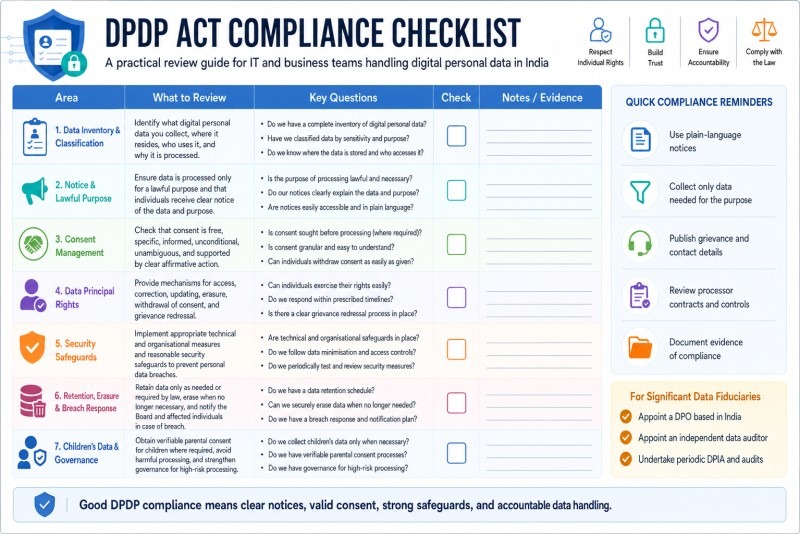
    The Digital Personal Data Protection Act isn’t a legal formality you can delegate to your compliance team. When enforcement begins, the first penalties won’t target your privacy policy language. They’ll target the consent flow that doesn’t actually capture valid consent, the vendor contract that doesn’t define data processing boundaries, and the breach notification process that takes four days when the law gives you 72 hours. Every one of those gaps sits in systems your IT, security and product teams control right now. The statute gives you specific technical requirements, most of which your current architecture wasn’t built to meet. This checklist covers what to verify before you sign anything telling leadership you’re compliant.

    Consent Collection: What Your Current Flows Are Missing

    Walk through every touchpoint where you collect personal data and verify these items. Missing even one creates liability the moment enforcement starts.

    Checklist items:

    • Free consent mechanism exists at collection point. If the user can’t proceed without consenting to non-essential data collection, that’s not free consent under DPDP. Your signup flows that bundle essential and marketing consent into one checkbox fail this test.
    • Clear notice in English and one scheduled language. The law requires notice in English plus at least one language from the Eighth Schedule. If your consent forms only exist in English, you’re non-compliant for any user base outside metro markets.
    • Verifiable consent for users under 18. You need explicit parental or guardian consent with a verification mechanism. If your age gate is just a dropdown with no verification backend, you have no defensible consent for minor users.
    • Withdrawal mechanism as easy as granting consent. If users can sign up in two clicks but need to email support to withdraw consent, the asymmetry violates DPDP requirements. Audit how many steps each direction takes.
    • Purpose limitation stated at collection. Generic language like “to improve our services” won’t hold up. The stated purpose must be specific enough that a user knows exactly what you’re doing with their data.

    Most teams discover their product signup flows, marketing forms and mobile app permissions all fail at least two of these checks. Budget time to rebuild consent UI, not just update privacy policy text.

    Personal Data Inventory: The Audit Your Security Team Needs to Run Now

    You can’t demonstrate compliance without knowing where personal data actually lives. The exercise isn’t a documentation review, it’s a technical audit of every system that touches user data.

    Start with your documented data flows and then verify reality. In three out of four cases, the inventory surfaces:

    • Data exports sitting in shared drives or S3 buckets that nobody classified as personal data stores
    • Analytics and monitoring tools ingesting PII your architecture diagrams don’t acknowledge
    • Development and staging environments running on production data clones with weaker access controls
    • Legacy systems still operational but no longer in your data map
    • Third-party SDKs embedded in mobile apps that send personal data to vendors you didn’t contract directly

    Your security team needs to run this audit at the infrastructure level, not rely on application teams to self-report. The question isn’t what systems should have personal data based on design docs. It’s what systems do have personal data when you actually scan databases, logs, backups and API traffic.

    For SaaS-heavy teams, verify that every vendor integration in production appears in your vendor registry. Check your CDN logs, your error tracking service, your session replay tools. Most collect personal data by default and most IT teams never classified them as data processors requiring DPDP-compliant agreements.


    RED FLAG

    If developers can access personal data in staging or test systems without the same controls that govern production, you’re processing data outside stated purposes. DPDP requires equivalent protection regardless of environment. Enforcement will care that the data exists in multiple places, not that one instance is labeled “non-production.”

    DPDP Act Compliance Checklist: The Request Workflows You Don’t Have Built Yet

    The Act gives users specific rights with defined timelines. Verify you can actually fulfill each request type within the statutory window.

    Rights fulfillment checklist:

    • Access request response in less than 30 days. Can you aggregate all personal data for a single user across every system, format it as readable output, and deliver it securely? Time how long this takes with your current process. If it requires manual work from three teams, you won’t meet the deadline at scale.
    • Correction workflow that propagates everywhere. When a user updates personal data, does the change flow to every system, including backups, analytics warehouses and vendor systems? If not, you’re storing inaccurate data, which DPDP explicitly prohibits.
    • Erasure that actually deletes, not just flags. Soft deletes and retention flags don’t satisfy erasure rights. The data must be deleted or anonymized such that you can’t re-identify the individual. Verify your database schemas can hard-delete without breaking referential integrity.
    • Grievance redressal officer contact published. DPDP requires you to designate and publish contact details for a grievance officer. If your privacy policy just lists a generic support email, you’re missing a statutory requirement.
    • Nomination mechanism for deceased user data. Users can nominate someone to exercise rights on their behalf after death. You need a technical workflow to handle this, not just a legal acknowledgment that the right exists.

    Run a test request through each workflow before you claim compliance. In most cases, fulfilling a single erasure request requires manual intervention from engineering. That doesn’t scale when enforcement starts and users realize they can force you to delete their data.

    Vendor Contracts: The Clauses Your Legal Team Missed

    Every vendor processing personal data on your behalf needs a DPDP-compliant data processing agreement. Most SaaS contracts signed before 2023 don’t include the required clauses.

    What to verify in every vendor contract:

    • Explicit “data processor” definition and scope. The contract must define the vendor as a data processor, specify what personal data they process, and limit processing to your documented instructions. Generic MSAs and Terms of Service don’t satisfy this.
    • Sub-processor notification and consent rights. If your vendor uses sub-processors (most SaaS platforms do), the contract must give you notification rights and the ability to object. If you’re just discovering from a vendor’s trust center that your data lives on AWS, Azure and three analytics vendors, your contract is deficient.
    • Data localization commitments if data stays in India. If your architecture requires India-resident data for performance or compliance reasons, the contract must explicitly commit to India-only storage and processing. Verify this matches the vendor’s actual infrastructure, not just contract language.
    • Breach notification timeline of 72 hours or less. DPDP gives you 72 hours to notify the Data Protection Board after becoming aware of a breach. If your vendor’s SLA is five business days, you have no way to meet the statutory deadline.

    Audit your top 15 vendors by data volume. Most mid-market teams discover that fewer than half have compliant agreements in place. Renegotiation takes weeks, and some vendors won’t agree to DPDP-specific terms until October gets closer.

    Cross-Border Transfers: What Changes If Your Data Leaves India

    DPDP allows cross-border transfers to countries the government approves, but no approval list exists yet. If your current architecture sends personal data outside India, verify these conditions.

    Cross-border transfer checklist:

    • Documented transfer mechanisms for every data export. You need to know which systems send data abroad, to which jurisdictions, under what legal mechanism. If your answer is “probably AWS Singapore but we’re not sure,” you can’t demonstrate compliance.
    • Contract clauses with foreign vendors that mirror DPDP obligations. Transferring data abroad doesn’t eliminate your compliance obligations. The receiving vendor must commit to equivalent data protection standards in writing.
    • Government approval pathway if data includes sensitive categories. The Act empowers the government to restrict certain cross-border transfers. If you process financial, health or children’s data and store it outside India, verify you have a plan to repatriate if restrictions get announced.
    • Fallback architecture that supports India-only processing. If the government restricts transfers before your preferred cloud region gets approved, can you reroute processing to India-resident infrastructure within 90 days? Most teams relying entirely on global SaaS platforms have no viable fallback.

    The enforcement risk isn’t theoretical. Financial services regulators already demonstrated willingness to mandate data localization with only months of notice. If your entire stack depends on data leaving India, you’re carrying concentration risk most boards haven’t formally accepted.


    RED FLAG

    Your SaaS vendors process Indian user data in US or EU regions.

    DPDP allows transfers to approved countries, but that approval list doesn’t exist yet and may never include every jurisdiction your vendors use. If rearchitecting for India-resident processing would take longer than six months, you have a compliance gap with no technical mitigation ready. Enforcement won’t care that “everyone uses the same vendors.”

    Breach Notification: The 72-Hour Window Your Incident Response Plan Ignores

    DPDP requires notification to the Data Protection Board within 72 hours of becoming aware of a breach likely to harm users. Most incident response plans weren’t built for that timeline.

    Breach readiness verification:

    • Detection tools that surface personal data exposure specifically. Generic security monitoring won’t tell you if the compromised system contained personal data or how many users are affected. You need tooling that tags personal data stores and alerts on exposure, not just intrusion.
    • Escalation path from detection to legal notification in under 24 hours. The 72-hour clock starts when you become aware of the breach, not when you finish investigating. If your process requires incident confirmation, impact assessment, and legal review before anyone considers external notification, you’ll miss the deadline.
    • Defined harm threshold that triggers mandatory reporting. Not every data incident requires Board notification, only breaches likely to harm users. Your legal and security teams need a pre-agreed definition of that threshold so incident responders know when to escalate.

    Time your last incident response exercise against the DPDP notification timeline. Most teams discover their current process assumes five to seven days for investigation before external communication, which puts them in automatic violation if a reportable breach occurs.

    Readiness Check: What to Verify Before You Tell Leadership You’re Compliant

    Run through this final validation before signing off on DPDP compliance status.

    Compliance Item Why It Matters Red Flag If Missing
    Consent audit completed across all user touchpoints First enforcement actions will target invalid consent, not policy language No documented review of signup flows, mobile permissions, marketing opt-ins
    Personal data inventory includes all environments You can’t demonstrate compliance for data you don’t know exists Inventory only covers production, skips dev/test/analytics
    Data Principal rights tested with real requests Statutory timelines start the day a user submits a request No test requests processed end-to-end through current workflows
    Vendor agreements reviewed and non-compliant contracts flagged You’re liable for vendor violations if agreements don’t establish processor obligations No systematic contract review completed, relying on vendor trust centers
    Breach notification runbook updated with 72-hour timeline Missing the notification deadline creates automatic liability Current incident response plan has no external notification trigger defined

    Interpretation for buyers: This matrix is what your compliance status report to the board should cover. If any item in column three describes your current state, you’re not compliant regardless of what your privacy policy says. The law cares about operational reality, not documentation completeness. Before October, verify that every item in column one is demonstrably true, meaning you can show evidence on request, not just assert that it’s handled.

    The teams that clear this readiness check before enforcement starts will have rebuilt consent flows, renegotiated vendor contracts, and retooled incident response processes. The ones that don’t will discover their gaps when the first Data Principal request arrives with a 30-day deadline attached.

    Before your next leadership update on DPDP readiness, run through Section 3 and verify you can fulfill every Data Principal right within statutory timelines. That’s the compliance item most likely to surface publicly when enforcement begins.


    Also read: MeitY DPDP Act

    Related reading

  • Deep Learning Techniques: 5 ways to Build the Fortune of Tomorrow

    Deep Learning Techniques: 5 ways to Build the Fortune of Tomorrow

    Deep learning technique is a term that’s been buzzing around the tech world for a while now, and it’s not just hype. It’s a type of artificial intelligence that’s making a big splash across various industries, offering new ways for businesses to solve problems and make decisions. But what does it really mean for you, as a business owner or an IT decision maker?

    At its core, deep learning technique involves teaching computers to do what comes naturally to humans: learn from experience. It uses algorithms called neural networks that mimic the human brain’s structure and function, enabling machines to recognize patterns, interpret data, and make informed decisions.

    Why should you care? Because deep learning can transform how your business operates. It can automate complex tasks, provide insights from data that were previously overlooked, and even predict future trends. Whether it’s improving customer service, streamlining operations, or creating more personalized marketing campaigns, deep learning has the potential to boost efficiency and drive growth.

    In this blog post, we’re diving into the practical side of deep learning for businesses. We’ll explore how it’s already making a difference in various sectors and how you can leverage its power to benefit your own business. So, even if you’re not a tech expert, stay with us. This journey into the world of deep learning is about unlocking new opportunities and understanding how technology can serve your business goals.

    Practical Use of Deep Learning Techniques in Customer Service

    Deep learning technique is revolutionizing customer service by providing intelligent automation solutions that improve efficiency and enhance the customer experience. By making use of vast datasets and complex algorithms, businesses can now deploy chatbots and virtual assistants that understand and process natural language at a level that closely mimics human interaction.

    A few key benefits are:

    • Automated customer service solutions can operate continuously, providing instant responses to customer inquiries anytime.
    • By automating routine inquiries, businesses can reduce the workload on human agents, leading to significant cost savings.
    • Quick and accurate responses to customer queries improve overall satisfaction levels.
    • Deep learning models can handle a large volume of queries simultaneously, scaling as customer demand increases without the need for proportional increases in support staff.
    • The system can learn from previous interactions to offer more personalized customer service experiences over time.
    • Analysis of customer queries and interactions provides valuable insights into common concerns and potential areas for improvement in products or services.

    Deep learning can analyze customer sentiment to identify unhappy customers by using a variety of techniques, including:

    • Natural language processing (NLP) to understand the meaning of customer communications, such as text, speech, and social media posts.
    • Sentiment analysis to identify the emotional tone of customer communications and determine whether they are positive, negative, or neutral.
    • Machine learning algorithms to learn from historical data and identify patterns that indicate customer dissatisfaction.

    For example, a deep learning model could be trained on a dataset of customer support tickets to learn the relationship between the language used in the tickets and the customer’s satisfaction level. Once the model is trained, it can be used to analyze new customer support tickets and identify those that are likely to be from unhappy customers.

    Deep learning models can also be used to analyze customer sentiment in real time. For example, a deep learning model could be used to analyze the sentiment of customer interactions on a live chat platform. This information could then be used to route customers to the most appropriate customer service representative or to provide automated support for customers who are unhappy.

    In marketing

    Deep learning is transforming the marketing endeavors  by enabling more personalized, efficient, and data-driven strategies. Through the analysis of vast amounts of data, from customer behavior to market trends, deep learning algorithms can predict consumer preferences and optimize marketing efforts in real-time. This level of insight and automation allows businesses to formulate marketing campaigns that align with their target audience and thereby, improving engagement and driving sales.

    Key advantages of applying deep learning in marketing include:

    • Deep learning enables hyper-personalized marketing campaigns by analyzing individual consumer behaviors and preferences.
    • By predicting which marketing channels and messages are most effective for different segments, businesses can allocate their budgets more efficiently.
    • Analysis of customer data through deep learning helps uncover new customer segments and preferences, informing product development and marketing strategies.
    • Automatically generate or recommend content that matches individual user interests, increasing engagement rates.
    • Use deep learning to adjust pricing in real-time based on market demand, competition, and consumer behavior patterns.
    • Forecast future consumer trends and behaviors, allowing businesses to stay ahead of market shifts and tailor their marketing strategies accordingly.
    • Detect fraudulent marketing activities, such as click fraud and fake reviews. This can help businesses to protect their marketing budgets and improve the quality of their marketing data.

    Examples:

    Amazon uses deep learning techniques to analyze customers’ past purchases and browsing preferences, presenting highly relevant product recommendations that significantly enhance the shopping experience and boost sales. Netflix, similarly, personalized viewers’ home screens by using deep learning to sift through their viewing histories, ensuring recommendations are precisely tailored to individual tastes, thus increasing content consumption and subscriber satisfaction. Google’s targeted advertising is powered by deep learning analyses of search histories and browsing behaviors, ensuring that ads displayed to users are both relevant and likely to evoke interest. Meanwhile, Facebook employs deep learning to combat fraudulent activities on its platform, including fake reviews.

    A few companies that offer services for improving marketing efforts by using deep learning techniques are:

    Adobe Sensei: Integrates AI and machine learning into Adobe’s cloud platform, enhancing marketing efforts with data-driven insights and personalized experiences.

    Salesforce Marketing Cloud: Utilizes AI to personalize customer journeys, optimize marketing campaigns, and predict the optimal timing and content for engagement.

    HubSpot: Offers AI-powered solutions that enhance inbound marketing, content management, and customer relationship management, tailored to improve engagement and conversions.

    Oracle AI: Provides AI-driven marketing solutions that help businesses personalize customer experiences, optimize marketing campaigns, and improve ROI.SAS: Offers advanced analytics and AI solutions, including customer intelligence and marketing optimization tools, to drive personalized customer interactions and insights.

    Deep Learning for Fraud detection

    Deep learning is now a critical tool in combating financial fraud, equipping businesses with the ability to identify and thwart fraudulent activities as they happen. Through the analysis of vast datasets for unusual patterns and anomalies, deep learning algorithms can successfully spot fraudulent transactions that could slip past traditional detection methods. This is especially crucial in industries such as banking, e-commerce, and online payments, where the sheer scale and rapid pace of transactions could outstrip the capabilities of standard fraud detection techniques. 

    Key benefits of deploying deep learning for fraud detection include:

    • Deep learning models process transactions instantaneously, flagging fraudulent activities as they occur and minimizing potential losses.
    • By learning from vast amounts of transaction data, these models improve over time, reducing false positives and ensuring legitimate transactions proceed smoothly.
    • Deep learning algorithms can adapt to evolving fraud tactics, continuously learning from new data and patterns to stay ahead of sophisticated fraud schemes.
    • Unlike rule-based systems, deep learning can analyze a broader range of data points, including transaction context and user behavior, leading to more nuanced and effective fraud detection.

    Following companies are considered experts in the use deep learning techniques in fraud detection:

    IBM Watson: IBM offers advanced AI and deep learning solutions designed to enhance fraud detection and financial crime prevention.

    Kount: An Equifax company, Kount uses deep learning and AI to protect digital transactions and prevent payment fraud.

    Feedzai: Specializes in using AI and machine learning to detect and prevent fraud in real-time across banking and commerce.

    Darktrace: Uses AI to detect and respond to cyber threats, including fraudulent activities, in real-time.

    SAS: Offers sophisticated analytics solutions, including deep learning-based fraud detection and prevention.

    Read our post on: AI in Supply Chain Management

    Product development

    Deep learning is transforming product development by enabling a data-driven approach to innovation. It utilizes large datasets from customer feedback, market research, and product usage to come out with new features and insights for a new or improved product. This method allows businesses to precisely forecast market trends and consumer demands. As a result, products are developed that not only meet but also surpass customer expectations, ensuring businesses stay ahead in a competitive market.

    Deep learning techniques can assist in product development in a number of ways, including:

    • Use deep learning to sift through customer data, such as surveys and social media, pinpointing key preferences and needs for targeted product development.
    • Use deep learning to explore feature combinations, sparking innovative product ideas that differentiate from competitors.
    • Apply deep learning to fine-tune product designs, ensuring they meet customer desires for functionality and aesthetics.
    • Utilize deep learning for simulating customer interactions, enabling early detection and correction of potential product issues.
    • Employ deep learning to analyze sales trends and factors, accurately predicting demand to optimize production and inventory management.

    Examples:

    • Nike uses deep learning to design new shoes that are both functional and stylish. 
    • Tesla uses deep learning to develop self-driving cars that are safer and more efficient. 
    • BMW uses deep learning to develop new features for its cars, such as gesture control and voice control. 
    • Siemens uses deep learning to develop new medical imaging technologies, such as MRI machines and CT scanners. 
    • GE uses deep learning to develop new wind turbines that are more efficient and reliable.
    • Google uses deep learning to develop new AI-powered products, such as the Google Pixel smartphone and the Google Home smart speaker.

    Risk management

    Deep learning technique is significantly enhancing risk management practices, enabling businesses to make more informed and precise decisions. By analyzing vast datasets, deep learning algorithms can predict potential risks and identify strategies to mitigate them. This technology allows companies to navigate uncertainties with greater confidence, protecting assets and ensuring stability.

    Here are the core benefits of applying deep learning in risk management:

    • Deep learning models process and analyze complex datasets to forecast various risks, from financial to operational.
    • Continuously learn from new data, allowing for real-time updates to risk assessments as conditions change.
    • Can predict disruptions, helping businesses to proactively manage supply chain risks.
    • Automated analysis of regulatory requirements and company data ensures compliance and minimizes legal risks.
    • In finance, deep learning tailors insurance policies based on precise risk assessments, benefiting both providers and clients.

    For businesses aiming to incorporate deep learning into risk management, consider exploring services from these companies:

    Palantir: Specializes in data integration and analytics platforms for comprehensive risk analysis, helping businesses to proactively identify and mitigate risks.

    Riskified: Uses advanced machine learning techniques to protect eCommerce businesses from fraud and abuse, enhancing overall risk management strategies.

    Ayasdi: Offers AI-driven tools tailored for financial services, including sophisticated risk management solutions that leverage deep learning for predictive analytics.

    DataRobot: Provides an enterprise AI platform that automates the building and deployment of machine learning models, including those for risk assessment and management.H2O.ai: Known for its open-source machine learning platform, H2O.ai also delivers advanced AI solutions that can be applied to risk management, offering predictive insights and analytics.

    Conclusion

    Deep learning techniques are changing the game across several business domains, from customer care to product development, and it’s doing so in a big way. By tapping into vast amounts of data, businesses are finding new ways to engage customers, innovate products, safeguard transactions, and navigate risks. It’s not just about automating tasks; it’s about making smarter decisions and offering personalized experiences that truly resonate with consumers.

    As we’ve seen, whether it’s providing round-the-clock customer service, tailoring marketing efforts, detecting fraud before it hits, managing risks with precision, or crafting the next big product, deep learning stands at the forefront, offering solutions that were once deemed futuristic. And the best part? This is just the beginning. As technology evolves, so too will the capabilities and applications of deep learning in the business world.

  • How to Leverage Data Analytics to Drive Data-Driven Decision Making

    How to Leverage Data Analytics to Drive Data-Driven Decision Making

    Data analytics is not a new concept. It has been around for more than a decade now. The major difference today is that the tools and techniques have become more mature, enabling us to do complex analyses much faster and easier than ever before. This allows us to make better decisions based on data rather than just relying on our gut instincts or hunches.

    What is data-driven decision-making?

    Data-driven decision-making is the process of making decisions based on data analysis. It’s a way to make better decisions by using data to support your decisions, rather than relying solely on intuition or gut instinct. Data-driven decision-making can be used to improve existing processes and help identify new opportunities for improvement.

    Why is it important for your business?

    Data-driven decision-making is the process of using data to make better business decisions. It helps you make decisions with more certainty and confidence, which can result in better organizational performance, reduced costs, and improved customer satisfaction.

    Data analytics is an essential tool for any organization looking to become more data-driven and organizations can create more personalized experiences for their customers. With a well-defined data analytics process, you can gain insights into your customer base that will help you improve their experience interacting with your brand or product offerings by providing them with customized experiences based on their behavior patterns over time.

    This can include things like:

    • Finding trends in customer behavior or preferences
    • Identifying opportunities for improvement in your products or services

    The goal of using data analytics is not just making more informed decisions; it’s also about increasing efficiency and reducing costs by eliminating guesswork from the decision-making process, which allows you to make faster, more accurate choices while minimizing risk exposure

    How to get started with data analytics to make better decisions

    Before you get started with data analytics, it’s important to define the problem you’re trying to solve. 

    How to get started with data analytics to make better decisions

    In other words, what do your stakeholders want and how can you help them achieve their goals?

    Once you’ve established what you’re trying to achieve and how much time and money is available, start thinking about the data itself. What kind of data do you have? Can it be used for analysis in some way? If not, can it be augmented with other datasets or sources (such as business intelligence)?

    Once you’ve determined what data is available, it’s time to think about how that data can be used. 

    You May Also Like: Will quantum computers make human lives better?

    Fostering a data-driven culture in your organization

    A data-driven culture is not just about using analytics to make decisions. It’s also about fostering a learning environment where people are encouraged to experiment and innovate, empowered to make decisions based on objective evidence and grow their skills through continuous improvement.

    For your organization to truly become data-driven and reap all the benefits that come with it, you will need to create an environment where all employees feel empowered in their work, regardless of their role or seniority level within the company. This can be achieved by:

    • Setting up KPIs (key performance indicators) at each level of leadership so everyone knows exactly what they should be doing every day as part of their jobs
    • Defining clear roles and responsibilities within teams; establishing accountability measures with strong incentives built into them (bonuses/commissions)
    • Removing barriers between departments so communication flows freely throughout teams
    • Providing training opportunities outside regular work hours so people are constantly learning new things outside class time too!

    Educate and obtain buy-in throughout the organization

    Data analytics is a powerful tool for making decisions, but it’s not something that can be implemented overnight. You’ll need to educate everyone in your organization about the importance of data-driven decision-making and get buy-in from all levels of the organization.

    For example, if you want to measure the success of your marketing campaign by looking at sales data, everyone must understand what this means for them: 

    • Are they responsible for bringing in more leads? 
    • Are they responsible for converting those leads into customers? Or are they just responsible for delivering great service so that people want to come back again? 

    Once everyone understands their role in generating revenue or increasing customer satisfaction scores through their efforts (and not just through advertising), then it becomes easier for them to understand why analyzing this information is so important–and how doing so will help improve our business overall.

    Identifying the right data sources

    Identifying the right data sources is critical to a successful analytics program. The right data can help you make better decisions, but it’s important to understand that there are many different types of information out there and each has its benefits and drawbacks.

    For example, internal data sources include financial information about your company, customer information (names and addresses), employee data (salaries), etc. External sources include social media posts or news articles that mention your brand name or products/services, and governance and security practices center around who owns the data.

    If you’re dealing with customer information, then it’s necessary to have clear governance and security practices in place. If you’re dealing with internal data sources (financial information), then ownership and access rights are more fluid because there may not be an existing structure for this type of information. Thus, it is important to understand the sources before you start your data analytics model.

    Define data ownership, governance, and security practices

    Defining data ownership, governance, and security practices upfront is crucial for the successful implementation of a data analytics model. It ensures the protection of data, compliance with regulations, maintenance of data quality, facilitation of effective decision-making, and consideration of privacy and ethical concerns. By laying a solid foundation, organizations can maximize the value derived from data analytics initiatives while minimizing associated risks. A few crucial aspects are:

    • Data ownership: Who owns the data, and how can you make sure there are no lapses in ownership?
    • Data governance and security: How will you ensure that your team members have appropriate access to the data they need and that they’re following best practices with their access?
    • Data analytics roles: Who will be working with the data, and what are their responsibilities?
    • Data quality: What will your team do to ensure that the data is accurate and consistent? 
    • Data sharing: How will your teams share data? 
    • System architecture and integration: What technology will be needed for this project, and how will it work together?

    You May Also Like: Message Broker: Is it Worth Spending Money on It?

    Acquire appropriate technology

    As you begin to think about the technology that will help you meet your business goals, there are several key considerations to make:

    • Data collection, storage, and processing technologies must be able to handle the volume of data being generated by your organization.
    • The tools used in data analysis should be flexible enough to allow you to conduct ad hoc analyses as well as build predictive models using a variety of machine learning algorithms.
    • Visualization tools should let analysts access data quickly so they can make decisions based on insights gleaned from analytics reports rather than having their attention diverted from strategic tasks by cumbersome business intelligence tools that require hours or days before getting useful results back from them 

    Analytics tools should be easy to use, intuitive, and flexible. They should also allow users to create reports that are customized and tailored to their needs. For example, analysts at an online retailer may want to view different metrics depending on whether they are optimizing the checkout process or improving customer retention.

    Here’s a list of popular data analytics tools and platforms.

    Tableau: A data visualization tool allowing users to analyze, visualize, and share useful insights resulting from data.

    Power BI: A Microsoft business intelligence tool that provides visualization, interactive dashboard, and data exploration features.

    Google Analytics: A web analytics tool that keeps track of website traffic, user behavior, and conversion rates.

    RapidMiner: An open-source data science platform available for a variety of analytical tasks including data preprocessing, modeling, and evaluation.

    Python: A versatile programming language that possesses several libraries and frameworks, such as Pandas, NumPy, and Scikit-learn, typically used for data analysis and machine learning.

    R: A widespread programming language providing statistical computing and graphics; with several packages suitable for data visualization, statistical analysis, and manipulation.

    IBM Watson Analytics: A cloud-based analytics platform that allows data exploration, predictive modeling, and data storytelling capability.

    SAS: A complete analytics tool suite covering data visualization, predictive modeling, data management, and advanced analytics.

    Apache Hadoop: An open-source framework that allows distributed processing of large datasets across computer clusters.

    Apache Spark: Another open-source big data processing framework with fast in-memory data processing and analytics capabilities.

    Alteryx: An intuitive self-service data analytics tool allowing users to blend, clean, and analyze data without coding.

    QlikView: A data analytics and visualization tool that presents drag-and-drop functionality for creating interactive dashboards and reports.

    Set Priorities and Benchmarks

    Prioritizing your goals and setting benchmarks is a great way to ensure that you’re making the best use of your time and resources. For example, if one of your goals is to increase sales by 10%, then you might set a benchmark for how many calls or emails should be sent out per day or week (or both). This can help ensure that all departments are contributing to the same goal.

    Setting priorities also helps with buy-in from department heads who may not always agree on what should be prioritized as important data points. By creating clear guidelines for each department head about what needs to happen for them to achieve their goals, everyone will know exactly what’s expected from them at any given point in time.

    How to measure the success of data analytics endeavor

    Data-driven decision-making is about making informed, smart choices. It’s about understanding what you have, what you don’t have, and how best to use it all. The key is having a clear idea of the goals you want to achieve with your data analytics endeavor and then measuring how successful you are at achieving those goals. Some of the widely-used metrics are listed below.

    Accuracy: This metric measures the model’s ability to predict the correct outcomes by comparing the number of correct predictions to the total number of predictions. It provides a general assessment of the overall performance of the model.

    Precision and Recall: Precision and recall are important metrics for assessing the performance of a model in binary classification tasks. Precision quantifies the accuracy of positive predictions, while recall measures the model’s ability to identify positive instances correctly. These metrics are particularly useful in situations where maintaining a balance between true positives and false positives is crucial.

    F1 Score: This score combines Precision and Recall into a single metric by calculating the harmonic mean of the two. It provides an overall score that represents the model’s performance on binary classification tasks.

    Mean Squared Error (MSE): This metric is commonly used for regression models. It measures the average squared difference between the predicted and actual values, and lower MSE values indicate superior model performance.

    R-squared (R²): R-squared is a statistical measure that evaluates the model’s fit to the data by determining the percentage of variance in the dependent variable explained by the independent variables of the model. R-squared values vary between 0 and 1, with larger numbers implying a better fit between the model and the data.

    Area Under the Curve (AUC): This widely used metric evaluates binary classification models. It assesses the overall performance of the model in classifying instances correctly across various probability thresholds, and higher AUC values correspond to better model performance.

    Lift: This metric is used in marketing analytics to measure a model’s effectiveness in targeting specific segments or groups. It compares the response rate of a model-driven segment to the average response rate, with values greater than 1 indicating outperformance.

    Profitability Metrics: For business-oriented models, metrics such as Return on Investment (ROI), Customer Lifetime Value (CLTV), or Cost-Per-Acquisition (CPA) can be used to assess the financial impact and effectiveness of the model.

    User Engagement Metrics: These metrics are used to evaluate the success of models aimed at improving user engagement, with examples including click-through rate (CTR), session duration, or conversion rate.

    You May Also Like: Comparison of the top four Cloud Platforms – Google Cloud, Amazon Web Services, Microsoft Azure, and IBM Cloud

    Gather Data and Analyze

    Now that you have a sense of the different types of data available to you, let’s talk about how to gather and analyze it.

    To begin with, there are two main ways that companies gather their data: through internal sources (like sales reports) or external sources (like social media). Once you’ve gathered your information, there are a variety of tools available for analyzing it. For example, if your company has an e-commerce website with an online store manager like Shopify or BigCommerce then those platforms will provide analytics tools built into their systems; alternatively, if they don’t offer this functionality then there are third-party services such as Google Analytics which can help track traffic sources and conversions on websites built using these platforms.

    Implement Your Actions

    Implementing your action is the most important step, and it’s also probably the most difficult. If you are struggling to implement a new process or change in your organization, start small. Don’t try to do everything at once! Instead of trying to implement every recommendation from this guide at once, start by selecting one or two things from each section that seem like they would have the biggest impact on your business (or life). For instance, if you’re interested in improving customer service quality but aren’t sure where to start with data analytics initiatives, try tracking how long it takes for customers who call the support number against emailing them first before reaching out over social media channels.

    Conclusion

    Data analytics can be used to drive better decision-making in your organization. To do so, you will need to:

    • Identify the most important metrics for your business and set goals around them.
    • Monitor these metrics regularly and make adjustments when needed.
    • Make sure your team members are on board with this strategy by communicating the importance of data-driven decision-making through training programs or other methods.

    Data analytics is a powerful tool for making data-driven decisions, but it’s not a magic wand. It takes time and effort to implement, so don’t expect instant results. However, if you follow the steps outlined in this post, you should be able to get started on your data analytics journey in no time!