Category: Cybersecurity

  • Cybersecurity Best Practices That Actually Reduce Risk in 90 Days

    Cybersecurity Best Practices That Actually Reduce Risk in 90 Days

    Cybersecurity best practices sound easy on paper, but most organizations do not get safer after adopting them. The reason is simple: controls get added without sequence, ownership, or operational capacity. So the same gaps keep reopening, especially when you have a tight budget, a small ops team, and workloads spread across multiple clouds. In that setup, “do everything” quickly becomes “do nothing well.”

    What makes this worse is that attackers do not need a “big” weakness. They win through small, common misses: one over-permissioned admin account, one unpatched laptop, one cloud storage policy left public, one alert rule that nobody watches. These are not rare edge cases. They are the default failure points in most environments.

    This post breaks cybersecurity best practices into a practical order of execution. Let’s find out what to do first, what to standardize across clouds, what to avoid and how to shortlist tools that improve security without adding operational load.

    The 5 failure patterns that make best practices useless

    Most cybersecurity best practices fail for a boring reason: they are adopted as a list, not as an operating model (ref: NIST Cybersecurity Guideline). Teams implement controls in silos, measure activity instead of risk reduction, and slowly create a security stack that looks impressive but does not change outcomes.

    In lean environments, the gap becomes visible quickly. You add tools, alerts increase, tickets pile up, and the team starts ignoring noise. Meanwhile the real exposures stay open because nobody owns the basics end-to-end.

    What to do

    • Identify your top 5 business-critical systems and data paths
    • Map who owns identity, endpoints, cloud, and incident response
    • List the controls you run today, plus who operates each one
    • Track repeat incidents and their root causes for 90 days
    • Remove or tune anything creating noise without detection value

    How to do it

    1. Run a 60-minute workshop: systems, data flows, and current controls.
    2. Tag each control as prevent, detect, respond, or report.
    3. Mark every control with a clear operator and a weekly time cost.
    4. Find the “orphan controls” with no owner or no maintenance routine.
    5. Pick 3 gaps that repeat and align next steps to those gaps.

    What to avoid

    • Buying a new tool to compensate for missing ownership
    • Treating compliance checkboxes as real security progress
    • Running alerting without a triage routine and escalation path

    Quick decision rule: If a control has no owner and no weekly routine, it does not exist.

    Establish a minimum security baseline (what “good enough” looks like)

    A baseline is the set of controls you can run consistently, even when the team is busy. Without it, security becomes a series of reactions: you harden one system after an incident, then drift back because there is no enforced standard. In multi-cloud, baseline gaps multiply because every platform has its own defaults and policy layers.

    A “good enough” baseline is not perfection. It is a small set of non-negotiables that reduce the most common breach paths and are measurable. The goal is consistency across users, devices, workloads, and cloud accounts.

    What to do

    • Define baseline controls for identity, endpoints, cloud, and logging
    • Standardize configuration via policy, not manual settings
    • Set minimum patch timelines by severity and exposure
    • Enforce baseline on new assets before they go live
    • Measure baseline compliance weekly, not quarterly

    How to do it

    1. Write a one-page baseline: identity, endpoints, cloud, logging, backups.
    2. Convert baseline to enforceable policies (IdP, MDM, CSPM, IaC).
    3. Create exceptions with expiry dates and business justification.
    4. Roll out in phases: admins first, then privileged apps, then everyone.
    5. Publish three metrics: MFA coverage, patch SLA, critical mis-configs.

    What to avoid

    • Baselines that require constant manual policing
    • Exceptions that never expire and become permanent holes
    • Treating “we have a tool” as the same as “we enforce policy”

    Decision rule: If you cannot measure it weekly, it is not part of your baseline.

    Identity is the new perimeter (MFA, PAM, least privilege, service accounts)

    Most real-world breaches still start with identity. Not always through fancy exploits, but through stolen credentials, reused passwords, session theft, phishing, and over-permissioned accounts. In multi-cloud, identity risk expands because access is spread across cloud consoles, SaaS admin panels, CI/CD pipelines, and service accounts that nobody reviews after setup.

    If you fix only one area in the next quarter, fix identity. It reduces the highest number of common attack paths and makes every other control easier to operate. (please refer: OWASP Top 10:2025 to know the top risks)

    What to do

    • Enforce MFA everywhere, especially for admin and remote access
    • Remove standing admin access; use just-in-time elevation
    • Implement least privilege with role-based access and periodic reviews
    • Control service accounts and API keys like privileged identities
    • Centralize identity in one IdP with consistent conditional access

    How to do it

    1. Start with privileged users: admins, finance, production access, DevOps.
    2. Turn on phishing-resistant MFA where possible for privileged access.
    3. Replace shared admin accounts with named accounts and audit trails.
    4. Implement PAM for elevation, session recording, and approval flows.
    5. Inventory service accounts, rotate keys, and restrict scopes and lifetimes.

    What to avoid

    • MFA only for VPN but not for cloud and SaaS admin consoles
    • Keeping “break glass” accounts without strict controls and monitoring
    • Long-lived API keys and service accounts with broad permissions

    Quick decision rule: If an identity can access production without MFA and approval, it is a priority risk.

    Secure endpoints without turning IT into a ticket factory

    One of the most ignored cybersecurity best practices is endpoint discipline. Endpoints are where security becomes real or imaginary. One unmanaged laptop, one browser running outdated plugins, one user with local admin “temporarily,” and suddenly your cloud controls do not matter. Attackers do not need sophistication if endpoints give them persistence.

    For cyber security for business, the objective is not perfect endpoint hardening. It is an endpoint baseline that runs with minimal human effort, produces low-noise signals, and blocks the most common lateral-move behaviors.

    Also read: Affordable Cybersecurity for Startups: 9 Essential Tips

    What to standardize (minimum baseline)

    • No local admin by default; use time-bound elevation
    • Full-disk encryption, auto-lock, and device compliance checks
    • Patch SLAs for OS, browser, and office/PDF tools
    • EDR installed and reporting healthy, with tamper protection enabled
    • Application control for high-risk binaries where feasible

    A rollout that does not break your team

    Use two rings:

    • Ring 1 (highest risk): Admin devices, DevOps machines, finance, VPN-heavy users
    • Ring 2: Everyone else

    Enforce in this sequence:

    1. Require MDM enrollment for email and core apps.
    2. Remove standing privileges; introduce approved elevation.
    3. Automate patching and define reboot windows.
    4. Tune EDR so you only alert on what you can respond to.
    5. Add behavior blocks gradually: macros, risky scripting, unknown USB.

    What to avoid

    • Hard blocks without an exception workflow
    • “Installed EDR” with no health monitoring and policy tuning
    • Unmanaged BYOD access to SaaS without conditional access
    • Patch “best effort” instead of a time-bound SLA

    Quick decision rule: If you cannot enforce device compliance, you do not have endpoint security, you have endpoint hope.

    Multi-cloud security essentials (what to standardize vs what to localize)

    In multi-cloud, cybersecurity best practices fail when security becomes “cloud-specific.” Teams end up with different identities, different logging, different network patterns, and different policy styles across AWS, Azure, and GCP. That drift creates blind spots, and attackers love blind spots because detection and response get slower.

    For cyber security for business, you do not need identical tooling in every cloud, but you do need consistent guardrails. Standardize the controls that reduce risk across all clouds, then localize only where a cloud has a unique native advantage or a hard requirement.

    The practical approach is simple: standardize identity, baseline policies, and logging first, then standardize how you deploy and review cloud changes. Once those are stable, decide whether a single cross-cloud tool is worth it or whether you will rely on each cloud’s native security stack with a common operating model.

    What to do

    • Standardize identity and access patterns across all clouds
    • Enforce baseline guardrails: public exposure, encryption, key rotation
    • Centralize logs and normalize events for detection and reporting
    • Run cloud security policies as code, not console settings
    • Define one approval path for high-risk cloud changes

    How to do it

    1. Choose one IdP model and enforce consistent role design in each cloud.
    2. Deploy policy guardrails: block public storage, restrict open inbound ports.
    3. Centralize cloud audit logs into one detection pipeline.
    4. Use IaC with review gates for network, IAM, and data services.
    5. Schedule weekly drift checks and monthly privilege reviews.

    What to avoid

    • Separate IAM models per cloud with no unified review
    • Relying on manual console changes for production guardrails
    • Logging everything but investigating nothing due to alert overload

    Quick decision rule: If you cannot explain who can access what across clouds in one view, standardize identity and policy first.

    Logging and detection that you will actually use

    Most cybersecurity best practices guides advice around logging sounds like: collect everything. In real life, that turns into alert fatigue, ignored dashboards, and a security posture that looks busy but is blind. If your team is small, detection has to be designed around one question: what can we realistically investigate and close?

    Think of logging as a product you operate, not a dump you store. For cyber security for business, you need a small set of high-signal events, a clear triage routine, and an escalation path that does not depend on heroics.

    Build detection in layers. Start with identity and admin activity, then endpoints, then cloud control-plane events, then data access anomalies. Each layer should have a response playbook, even if the playbook is “disable account, isolate device, rotate keys, open incident ticket.”

    What to do (minimum viable detection)

    • Pick 12–15 high-signal detections you will respond to every time
    • Create one triage queue with severity rules and owner rotation
    • Make identity events non-negotiable (login anomalies, admin role changes)
    • Define “containment first” actions for account and endpoint incidents
    • Report weekly on two numbers: true incidents and time-to-contain

    How to do it (operable routine)

    1. Define your top 5 incident types (identity compromise, ransomware, cloud exposure, data leak, endpoint malware).
      For each, write a 10-line playbook: detect, confirm, contain, recover, learn.
    2. Reduce noise: disable low-value alerts until you have bandwidth.
    3. Ensure logs are complete: IdP, EDR, cloud audit logs, DNS, email security.
    4. Run a weekly 30-minute review: what fired, what was real, what to tune.

    What to avoid

    • Logging everything without a triage owner and closure discipline
    • Alerting on “interesting” events that you cannot act on
    • Depending on one person to interpret every security signal

    Decision rule: If an alert does not have a defined containment action, it is not a detection, it is a distraction.

    Security stack options for cybersecurity for business

    Option to evaluateBest fit scenarioDecision note (what matters most)
    IdP + MFA + conditional accessAny organization, fastest risk reductionEnforce MFA for privileged users first. Policy quality matters more than brand.
    Endpoint management + EDRLaptop-heavy teams, remote workforceChoose what your team can tune weekly. Healthy telemetry beats “more alerts.”
    CSPM (cloud posture)Multi-cloud or fast cloud growthWorks only with ownership for remediation. Otherwise it becomes a dashboard.
    Vulnerability managementMixed infra, compliance or audit pressureAsset inventory is the start. Without it, scanning is theatre.
    MDR (managed detection and response)Small ops team needing 24×7 coverageClarify response authority. Define what the vendor can contain without approvals.
    SIEM (central logging)Regulated orgs, mature security operationsDo it only with triage capacity. Otherwise cost grows faster than value.
    Email security + anti-phishingFrequent phishing, executive targetingEnforce DMARC and mailbox controls. Training alone will not fix phishing.
    Backup + recovery hardeningRansomware risk, business continuity priorityTest restores. Immutable backups and clear RTO/RPO are non-negotiable.

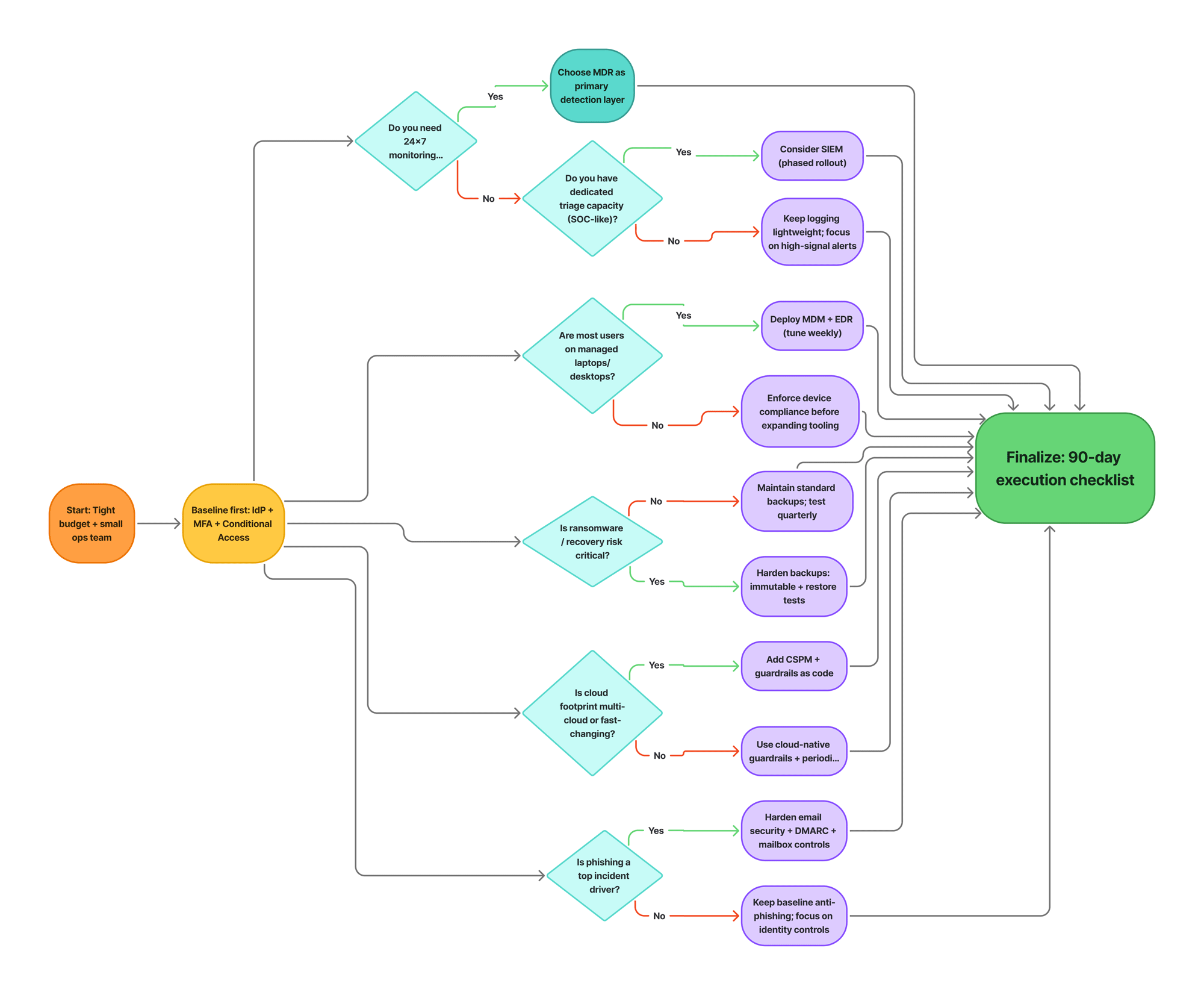
    Decision matrix: how to choose tools under a tight budget + small ops
    cybersecurity best practices

    Checklist: 90-day plan to implement cybersecurity best practices

    Use this as a working checklist for cyber security for business when budget and ops capacity are limited.

    Identity and access hardening

    ✅ MFA enforced for all privileged and remote access
    ✅ Conditional access policies set for risky sign-ins and unknown devices
    ✅ Standing admin access removed or tightly restricted
    ✅ Privileged access approvals and audit trails enabled
    ✅ Service accounts and API keys inventoried, scoped, and rotated

    Endpoint and device baseline

    ✅ MDM enrollment required for email and core SaaS access
    ✅ Local admin removed for standard users with time-bound elevation
    ✅ Disk encryption and screen lock enforced across managed devices
    ✅ Patch SLAs defined and monitored for OS, browser, office/PDF tools

    Cloud configuration and guardrails

    ✅ Cloud accounts/subscriptions organized with clear ownership and tagging
    ✅ Public exposure guardrails enforced (storage, ports, load balancers)
    ✅ Encryption enforced for data at rest and in transit, with key controls
    ✅ IAM roles standardized and reviewed monthly across clouds
    ✅ Infrastructure changes routed through IaC with review gates

    Logging, detection, and response basics

    ✅ Audit logs enabled for IdP, endpoints, and each cloud control plane
    ✅ High-signal detections selected (identity changes, admin actions, risky sign-ins)
    ✅ One triage queue defined with severity rules and escalation path
    ✅ Containment playbooks written for account compromise and endpoint infection

    Governance, vendor controls, and measurable reporting

    ✅ Asset inventory is accurate enough to drive patching and scanning
    ✅ Vendor access reviewed, least privilege enforced, and logged
    ✅ Backup restore tests scheduled and tracked, not assumed
    ✅ Weekly scorecard published (MFA coverage, patch compliance, critical misconfigs, incidents)

    Conclusion

    If you approach cybersecurity best practices as an execution plan, not a checklist, you can improve security posture quickly even with a small team and a tight budget. Start with identity, enforce a clean endpoint baseline, standardize multi-cloud guardrails, and keep detection focused on signals you will act on. That sequence turns cyber security for business into steady, measurable risk reduction without tool sprawl or burnout.

  • 9 Latest Cybersecurity Threats: How Devastating These Can Be

    9 Latest Cybersecurity Threats: How Devastating These Can Be

    In 2024, the latest cybersecurity threats aren’t just a concern for large corporations—it’s something every business owner needs to consider. As technology becomes more integral to our operations, the threats we face are becoming more sophisticated and widespread. Cybercriminals are now using advanced tools like artificial intelligence and machine learning to launch targeted attacks that can cripple businesses of any size. Whether you’re running a small business or managing a larger enterprise, you can’t afford to ignore the rise of AI-driven cyber attacks, deepfake technology, and ransomware-as-a-service (RaaS) platforms.

    These emerging threats mean that you need more than simply having basic security measures in place is required. It’s crucial to be proactive – anticipating potential threats and being ready to respond quickly and effectively. Understanding these top emerging cybersecurity threats is your first step toward protecting your business. I will now walk you through the most significant cybersecurity threats of 2024, focusing on the newest types of attacks and how to mitigate them.

    AI-Powered Cyber Attacks: One of the latest cybersecurity threats

    Artificial intelligence (AI) is revolutionizing many industries and cybersecurity is no exception. However, while AI offers powerful tools to strengthen defenses, it also provides cybercriminals with new ways to launch highly sophisticated attacks. For business owners, AI-powered cyber attack mitigation is way too difficult since it is hard to detect or preempt.

    latest cybersecurity threats

    Some of the key characteristics of AI-powered cyber attacks include:

    • AI-driven attacks can quickly adjust their tactics based on the defenses they encounter, making traditional security measures less effective.
    • Using AI, attackers can craft highly personalized and convincing phishing messages, significantly increasing the likelihood of success.
    • Malicious software can now be designed to mutate and evolve, allowing it to evade detection by conventional security systems.
    • AI can analyze vast amounts of data to identify vulnerabilities and plan more targeted attacks, increasing the precision and impact of breaches.

    For businesses, the implications are clear: the scope of the threat is becoming more complex, and the speed at which AI-powered attacks can occur demands a proactive and advanced defense strategy. Relying on outdated security measures is no longer an option. To protect your business, it’s essential to invest in AI-driven security solutions that can detect and respond to threats in real time ensuring you stay ahead of the attackers who are increasingly leveraging AI to their advantage.

    Deepfake Technology: A Growing Threat to Digital Integrity

    Deepfake technology is one of the latest cybersecurity threats and the most troubling one, enabling attackers to create highly realistic but entirely fake images, videos, and audio. This technology poses serious risks to businesses, as it can be exploited for fraud, misinformation, and other malicious activities that threaten digital integrity.

    A few examples from recent years:

    • In 2023, a video impersonating Elon Musk falsely announced a major investment deal, briefly influencing stock prices before being debunked.
    • An audio deepfake mimicking the CFO of a tech company led to the unauthorized transfer of funds, causing significant financial loss.
    • A video of Ukrainian President Volodymyr Zelenskyy falsely showed him urging soldiers to surrender, raising concerns about the use of deepfakes in wartime propaganda.
    • A deepfake targeting a European Union official spread misinformation about a policy decision, causing confusion and temporary diplomatic tensions.

    The risks associated with deepfake technology are profound. Financial losses from impersonation scams, the spread of damaging misinformation, and the potential for market manipulation are just a few of the dangers. In the cyber attack mitigation plan, business owners should implement rigorous verification processes for communications and transactions and stay updated on deepfake detection technologies.

    Ransomware as a Service (RaaS): Democratizing Cybercrime

    Ransomware has escalated into one of the most alarming cybersecurity threats in 2024, with the rise of Ransomware as a Service (RaaS) amplifying the danger. What once required advanced technical expertise is now available to anyone willing to pay. RaaS platforms have opened the floodgates for cybercriminals, enabling even those with minimal skills to launch devastating ransomware attacks. This development has led to a surge in attacks, leaving businesses of all sizes vulnerable to crippling financial and operational damage.

    Here’s how RaaS typically works:

    • Cybercriminals can subscribe to a RaaS platform, paying a fee for access to a ransomware kit and associated services.
    • RaaS operators often run affiliate programs, where affiliates receive a share of the ransom payments in exchange for distributing the ransomware.
    • RaaS platforms often allow users to customize the ransomware, choosing specific encryption methods, ransom amounts, and target criteria.
    • Many RaaS platforms provide technical support to their users, helping them deploy the ransomware effectively.
    • RaaS operators handle the logistics of ransom payments, often through cryptocurrency, making it difficult to trace transactions.

    The ability of less-skilled attackers to launch sophisticated attacks has expanded the threat, making it harder for businesses to defend themselves. To mitigate these risks, businesses must adopt a proactive approach to cybersecurity, including regular data backups, employee training on phishing, and investing in advanced threat detection and response tools.

    Learn about: 5 Exclusive Free open-source AI tools for small businesses to automate tasks

    Supply Chain Attacks: Targeting the Weakest Link

    Supply chain attacks have emerged as a significant threat in cybersecurity, where attackers infiltrate an organization by compromising its less secure suppliers, vendors, or third-party service providers. These attacks are particularly dangerous because they target the weakest link in a company’s security chain, often going undetected until significant damage has been done.

    Here’s how supply chain attacks typically work:

    • Focus on third-party vendors with weaker security.
    • Insert malicious code into legitimate software updates.
    • Hijack trusted communication channels to distribute malware.
    • Compromise widely used software or hardware components.
    • Use social engineering to trick vendor employees.
    • Steal vendor credentials to access target networks.
    • Embed malware in files shared within the supply chain.
    • Introduce malware during the manufacturing process.
    • Launch indirect attacks on multiple clients via a compromised vendor.
    • Maintain long-term infiltration of vendor networks to gather intelligence.

    The growing prevalence of supply chain attacks underscores the need for businesses to scrutinize their partnerships and third-party relationships closely. Effective cyber attack mitigation requires not only securing your network but also ensuring that your suppliers and vendors adhere to stringent security practices.

    IoT Vulnerabilities: A Growing Risk in a Connected World

    The rapid expansion of the Internet of Things (IoT) has revolutionized how businesses operate, offering enhanced connectivity and efficiency across various sectors. From smart factories to connected healthcare devices, IoT technology is increasingly integrated into critical operations. However, this surge in connected devices also brings a new array of cybersecurity challenges that cannot be overlooked. Many IoT devices are designed with convenience in mind rather than security, making them prime targets for cybercriminals.

    One of the most significant issues with IoT devices is their often inadequate security protocols. Many come with default settings that are rarely changed by users, creating easy entry points for attackers. Additionally, IoT devices are frequently not updated with the latest security patches, leaving them exposed to known vulnerabilities. The sheer volume of these devices, combined with their varied and often lax security measures, vastly increases the attack surface that organizations need to defend.

    The consequences of IoT vulnerabilities can be severe. Cybercriminals can exploit these weaknesses to form botnets, launching massive distributed denial-of-service (DDoS) attacks that can cripple networks. Moreover, the data collected by IoT devices—ranging from personal health information to industrial process data—can be highly sensitive. A breach could lead to significant privacy violations or operational disruptions. Even more concerning is the potential for physical harm; compromised IoT devices can be used to manipulate critical systems, such as smart locks or industrial controls, posing a direct threat to safety.

    Social Engineering Attacks: Exploiting Human Vulnerability

    Social engineering attacks remain one of the most effective methods for cybercriminals to gain access to sensitive information and systems. Unlike technical exploits, social engineering relies on manipulating human psychology to deceive individuals into revealing confidential information or performing actions that compromise security. 

    Here’s how social engineering attacks typically work:

    • Phishing: Attackers send emails or messages that appear to be from legitimate sources, tricking recipients into clicking on malicious links or providing sensitive information.
    • Spear Phishing: A more targeted form of phishing where attackers customize their messages to specific individuals, often using personal details to increase credibility.
    • Vishing (Voice Phishing): Attackers use phone calls to impersonate trusted figures, such as company executives or IT support, to extract sensitive information or gain access to systems.
    • Pretexting: Attackers create a fabricated scenario, such as pretending to be an employee or a vendor, to manipulate victims into providing confidential information.
    • Baiting: Cybercriminals lure victims by offering something enticing, like free software or media files, which are in fact, malicious.
    • Quid Pro Quo: Attackers offer a service or benefit in exchange for information, such as pretending to be tech support in exchange for login credentials.
    • Tailgating: Attackers gain physical access to a secured area by following an authorized person, often by pretending to have forgotten their access card.
    • Impersonation: Cybercriminals pose as trusted individuals, such as executives or colleagues, to manipulate victims into taking actions that compromise security.

    The breach often erodes trust within the organization and with clients, partners, and customers. Beyond the immediate damage, such attacks can result in long-term consequences, including legal liabilities, loss of competitive advantage, and increased exposure to future threats. The human factor in these attacks makes them particularly dangerous, as even the most advanced security measures can be compromised by a single manipulated individual.

    Cloud Security Breaches: Risks in the Age of Digital Transformation

    As more businesses migrate their operations to the cloud, the convenience and scalability of cloud computing are accompanied by new security challenges. Cloud environments, while offering flexibility and cost savings, also present unique vulnerabilities that can be exploited by cybercriminals. 

    Cloud security breaches can occur in several ways:

    • Incorrect access controls or open ports expose cloud resources to unauthorized access.
    • Over-permissive roles and lack of multi-factor authentication lead to unauthorized access.
    • Insecure APIs allow attackers to exploit weak authentication or input validation.
    • Data in transit without encryption can be intercepted by attackers.
    • Compromised devices connected to the cloud serve as entry points for attacks.
    • Insufficient logging and monitoring delay the detection of unauthorized activities.
    • Exploitable flaws in container images or hypervisors provide attackers with access to cloud environments.
    • Failure to secure customer-managed aspects of the cloud infrastructure leads to breaches.

    Sensitive information stored in the cloud—such as customer data, intellectual property, and financial records—is particularly at risk. A breach compromises this data, potentially resulting in regulatory scrutiny, legal action, and a damaged reputation.

    Cryptojacking: The Silent Hijacking of Computing Power

    Cryptojacking is one of the latest cybersecurity threats where attackers secretly use a victim’s computing resources to mine cryptocurrencies without their knowledge or consent. Unlike other cyber attacks, cryptojacking is often stealthy and goes unnoticed for extended periods, gradually degrading system performance and increasing energy consumption. As cryptocurrency mining becomes more profitable, cryptojacking has emerged as a significant concern for businesses and individuals alike in 2024.

    Here’s how cryptojacking typically takes place:

    • Malicious Scripts: Attackers inject malicious scripts into websites or online ads that execute cryptocurrency mining code when visited by users.
    • Compromised Software: Legitimate software or apps are compromised with cryptojacking code, running mining operations in the background.
    • Browser Extensions: Malicious or compromised browser extensions can include hidden mining scripts that use the browser’s processing power.
    • Email Phishing: Attackers use phishing emails to trick users into downloading cryptojacking malware onto their devices.
    • Cloud Exploitation: Attackers exploit vulnerabilities in cloud services to deploy cryptojacking scripts, harnessing the cloud’s powerful computing resources.
    • Infected IoT Devices: IoT devices with weak security are compromised and used for cryptocurrency mining, often going unnoticed due to their low processing power.

    The impact of cryptojacking can lead to increased electricity costs, reduced system performance, and accelerated hardware degradation. For businesses, the presence of cryptojacking malware on their systems can disrupt operations and reduce the efficiency of critical applications. Additionally, cryptojacking often indicates that a system has other vulnerabilities that could be exploited for more damaging attacks.

    Zero-Day Exploits: The Race Against Time

    Zero-day exploits are one of those cybersecurity threats that can cripple your entire business with a single stroke. Imagine a flaw in your software that no one knows about—not the developers, not the security teams, and certainly not you. Now, picture a hacker discovering that flaw before anyone else and creating a way to exploit it. That’s the reality of a zero-day exploit. These vulnerabilities are like ticking time bombs because they’re unknown until they’re actively used in an attack. By the time you realize something’s wrong, the damage might already be done.

    The scary part is how quickly these exploits can be weaponized. Once attackers find a zero-day vulnerability, they don’t waste any time. They craft specific exploits—malware or other malicious code—that can infiltrate systems, bypass defenses, and wreak havoc. Since there’s no patch or fix available yet, traditional security measures are often useless against these attacks. This makes zero-day exploits particularly dangerous because they can slip through the cracks without setting off any alarms.

    What’s worse, these exploits aren’t just limited to a single target. Attackers can use zero-day vulnerabilities to launch widespread attacks, affecting multiple organizations across various sectors. Whether it’s stealing sensitive data, deploying ransomware, or gaining control over critical systems, the consequences can be catastrophic. And because the vulnerability is unknown, even the most vigilant cybersecurity teams might not spot the threat until it’s too late.

    The race to patch a zero-day vulnerability is intense. As soon as a zero-day exploit is discovered in the system, developers and security professionals scramble to create and deploy a fix. But during this “zero-day window,” attackers are in a race of their own, trying to exploit the flaw as widely as possible before a patch can be released. It’s a high-stakes game of cat and mouse, where every moment counts, and the balance between discovery and defense is constantly shifting.

    How to Neutralize Emerging Cybersecurity Threats

    Neutralizing emerging cybersecurity threats in 2024 requires a combination of cutting-edge technology, robust security practices, and constant vigilance. Partnering with the right cybersecurity companies can make a critical difference in defending against sophisticated attacks like zero-day exploits, ransomware, and phishing. Startups in the cybersecurity space often bring innovative approaches and cost-effective solutions to the table, making them valuable allies in the fight against cyber threats.

    Here’s a list of 15 cybersecurity companies to consider:

    1. Tessian – Specializes in email security by using machine learning to prevent phishing and other email-based threats. (https://www.tessian.com)
    2. Cybereason – Provides an AI-powered platform for endpoint detection and response to combat advanced cyber threats. (https://www.cybereason.com)
    3. Snyk – Focuses on securing code by identifying and fixing vulnerabilities in open-source libraries and container images. (https://snyk.io)
    4. Cynet – Offers an autonomous breach protection platform that includes detection, response, and prevention in one solution. (https://www.cynet.com)
    5. Aqua Security – Concentrates on container security, protecting applications from development to production. (https://www.aquasec.com)
    6. Arctic Wolf – Delivers managed detection and response services to small and mid-sized businesses. (https://arcticwolf.com)
    7. Orca Security – Provides agentless cloud security, delivering full-stack visibility and monitoring across cloud environments. (https://orca.security)
    8. Axonius – Helps organizations manage and secure all their devices by providing comprehensive asset visibility and security management. (https://www.axonius.com)
    9. BigID – Focuses on data privacy and protection, helping businesses comply with global privacy regulations. (https://bigid.com)
    10. Darktrace – Uses AI to detect and respond to cyber threats in real-time across networks, cloud, and IoT environments. (https://www.darktrace.com)
    11. Expel – Offers transparent managed security services that focus on simplifying threat detection and response. (https://expel.io)
    12. CyberGRX – Provides a third-party cyber risk management platform that helps businesses assess and mitigate risks from vendors. (https://www.cybergrx.com)
    13. Vectra AI – Specializes in network detection and response, using AI to find and stop cyberattacks in real-time. (https://www.vectra.ai)
    14. Immersive Labs – Focuses on upskilling cybersecurity teams through real-time threat intelligence and hands-on exercises. (https://www.immersivelabs.com)
    15. Todyl – Delivers a cloud-first, all-in-one cybersecurity solution tailored for small businesses, combining network, endpoint, and SOC-as-a-service. (https://www.todyl.com)

    Conclusion

    Staying ahead of cybersecurity threats might seem challenging, but it’s doable with the right approach. By adopting proactive strategies and working with innovative cybersecurity specialists, you can protect your business from emerging risks and build a stronger, more resilient operation. The tools and expertise you need are more available than ever, helping you not just defend against potential attacks, but also prepare for whatever comes next. With the right mindset, cybersecurity isn’t just about protection—it’s about empowering your business to thrive.

  • Affordable Cybersecurity for Startups: 9 Essential Tips

    Affordable Cybersecurity for Startups: 9 Essential Tips

    In the vibrant and fast-paced world of startups, where innovation is the lifeblood and agility a mantra, cybersecurity for Startups emerges as an essential yet often undervalued component. These nascent companies, abuzz with groundbreaking ideas and technological prowess, find themselves in a digital landscape abundant with opportunities. Yet, this same landscape harbors shadowy cyber threats that can undermine their hard-earned progress. In this context, cybersecurity transcends its traditional role as a mere safeguard; it becomes a strategic enabler – a critical element that underpins the startup’s operational integrity, customer trust, and long-term viability.

    As we embark on this exploration, we will unravel the multifaceted challenges startups face in cybersecurity, the nature of cyber threats that stealthily prey on them, and the strategies to craft a resilient and cost-effective security architecture. This journey is about more than just erecting digital defenses; it’s about embedding a culture of security awareness and resilience at the heart of the startup ethos.

    Understanding the Risks: Common Cyber Threats to Startups

    As startups venture into the digital world, they face a myriad of cyber threats that can jeopardize their growth and credibility. It’s a landscape where vulnerabilities can be exploited swiftly and with damaging consequences. Being cognizant of these threats is as important as any business strategy for a startup. Below is a rundown of the common cyber risks that startups encounter, each representing a potential challenge to their security posture and operational integrity. Understanding these threats is the first step towards crafting a robust cybersecurity defense.

    • Phishing Scams: Deceptive emails or messages that trick employees into divulging sensitive information. A prevalent risk, especially as startups expand their networks.
    • Ransomware Attacks: Malware that locks access to data or systems, demanding a ransom. For startups, this can result in operational shutdowns and financial losses.
    • DDoS Attacks: Overwhelming a system with traffic to disrupt operations. Startups relying on online platforms are particularly vulnerable.
    • Insider Threats: Security breaches caused by current or former employees, either intentionally or through negligence. These can be especially damaging in smaller, tight-knit startup teams.
    • Advanced Persistent Threats (APTs): Long-term, stealthy cyberattacks, often targeting startups with valuable data or intellectual property.Zero-Day Exploits: Attacks exploiting newly discovered software vulnerabilities. Startups may struggle to respond quickly due to limited resources.

    Real-world impacts of these threats on startups can range from stolen customer data to complete operational paralysis. Understanding these risks is crucial, not just for immediate defense but also for maintaining long-term trust and viability in the market.

    Budget: Key Strategies Cybersecurity for Startups

    In the enterprising world of startups, where every resource counts, achieving robust Cybersecurity for Startups without straining the budget is a significant challenge. However, with strategic thinking and smart choices, startups can effectively shield themselves against cyber threats. Embracing cost-effective cybersecurity practices is not just about saving money; it’s about instilling a culture of security that aligns with the startup’s innovative spirit and growth ambitions. The key lies in identifying and implementing high-impact, low-cost measures that fortify digital defenses while preserving financial agility. This approach ensures startups remain resilient and secure, turning potential vulnerabilities into strengths.

    • Utilize Free or Low-Cost Security Tools: Leverage free antivirus programs, firewalls, and open-source encryption tools. Many reputable providers offer basic versions of their products at little to no cost.
    • Basic Cyber Hygiene Practices: Simple steps like enforcing strong password policies and regular software updates can significantly enhance security without incurring extra costs.
    • Implement Essential Access Controls: Restrict access to sensitive data and systems. Use built-in security features in your operating system and cloud services to control who can access what data.
    • Regular Data Backups: Implement a routine for backing up critical data. This can often be done using affordable cloud storage solutions, protecting you against data loss from ransomware or other attacks.
    • Leverage Cloud Services: Many cloud providers include robust security features as part of their standard offering. Using cloud services can reduce the need for in-house security infrastructure and expertise.
    • Encourage a Culture of Security Awareness: Foster awareness through regular discussions and sharing best practices among team members. This approach helps in recognizing and mitigating risks without the need for formal, costly training programs.
    • Simple Incident Response Planning: Develop a basic incident response plan using available online resources. Knowing how to react in case of a breach can greatly reduce its impact.
    • Use Multi-Factor Authentication (MFA): Many services offer MFA options at no extra cost. Enabling MFA adds an additional layer of security beyond just passwords.
    • Regularly Review and Update Security Practices: Stay informed about emerging threats and update your practices accordingly. This proactive approach can help prevent security issues without additional spending.

    Essential Cybersecurity Tools for Startups

    In the fast-paced and budget-conscious world of startups, cybersecurity often takes a backseat, viewed as a luxury rather than a necessity. Fortunately, there are numerous affordable cybersecurity for startups tools available that offer robust protection without straining startup budgets. These tools not only guard against external threats but also help in creating a culture of security awareness within the organization. Let’s delve into some of these essential tools:

    • Firewalls: Basic yet powerful, firewalls like ZoneAlarm provide a strong first line of defense against unauthorized access.
    • Antivirus Software: Solutions like Avast offer comprehensive malware protection at startup-friendly pricing.
    • VPN Services: With remote work on the rise, affordable VPNs like NordVPN ensure secure, encrypted connections for off-site employees.
    • Intrusion Detection and Prevention Systems (IDPS): Tools like Snort offer sophisticated network monitoring for unusual activities, tailored for small-scale operations.
    • Security Information and Event Management (SIEM): Platforms such as Splunk offer scalable, real-time security logging and analysis, suitable for growing startups.
    • Multi-Factor Authentication (MFA): Services like Google Authenticator add an essential layer of security beyond passwords at minimal cost.
    • Encryption Tools: Encrypting sensitive data is crucial, and tools like VeraCrypt provide this at no financial burden.
    • Data Loss Prevention (DLP) Software: Solutions from providers like McAfee offer scalable protection, ensuring data integrity and recovery capabilities.
    • Cybersecurity Training Programs: Affordable training platforms such as KnowBe4 equip employees with the knowledge to identify and mitigate threats.

    Implementing Strong Password Policies and Authentication

    Now, let’s explore essential steps to enhance cybersecurity for startups, focusing on implementing strong password policies and authentication measures.

    • Password Complexity: Enforce complex passwords with a mix of characters (upper and lower-case), numbers, and special symbols.
    • Regular Updates: Require password changes every 60 to 90 days to reduce the risk of compromised credentials.
    • Secure Storage: Safely store passwords using encryption methods and avoid storing them in plaintext.
    • Account Lockout: Prevent brute force attacks with account lockout policies after repeated login failures.
    • Password Recovery: Ensure a secure password recovery process.
    • Monitoring and Logging: Continuously monitor login activities and maintain detailed logs.
    • Third-Party Vendors: Ensure third-party services align with strong password and authentication practices.

    Educating Your Team: Cybersecurity Awareness and Training

    Every member of your startup plays a crucial role in safeguarding sensitive data and protecting your company from cyber threats. To bolster your cybersecurity posture, it’s essential to invest in Cybersecurity for Startups awareness and training programs. Fortunately, there are several free cybersecurity training programs available that can benefit both beginners and advanced users. Here are some popular options:

    • Cybrary: Cybrary offers a wide range of free courses covering various cybersecurity topics, including ethical hacking, network security, and more.
    • Open Security Training: This platform provides free, open-source training materials, including lectures, presentations, and hands-on labs.
    • SANS Cyber Aces Online: SANS Cyber Aces Online provides complimentary online courses focused on fundamental cybersecurity principles. This platform is an ideal starting point for beginners in the field.
    • Carnegie Mellon University’s CyLab Security and Privacy Institute: CyLab provides free, high-quality cybersecurity education materials, including videos and lecture notes.
    • Kaspersky Free Cybersecurity Training: Kaspersky offers free cybersecurity courses on topics such as ransomware, phishing, and malware.

    Read our post on Cybersecurity Training and Awareness

    Developing a Cybersecurity Plan: Steps for Startups

    Developing a comprehensive Cybersecurity for Startups plan is crucial for startups to protect their digital assets and maintain trust with their customers. Here is a step-by-step guide to creating a cybersecurity plan tailored for startups:

    SL No.StepAction ItemDetails
    1Risk AssessmentIdentify Assets, Vulnerability Analysis, Threat IdentificationList digital assets, determine vulnerabilities, identify potential threats
    2Define Cybersecurity GoalsProtection Objectives, Compliance RequirementsEstablish protection needs, understand legal and regulatory data security requirements
    3Establish Security PoliciesAccess Control, Data Management, Remote Work PolicyDefine data and system access, outline data handling, set remote access rules
    4Implement Security MeasuresFirewalls/Antivirus, Data Encryption, Regular UpdatesInstall protective software, encrypt data, ensure system software is updated
    5Employee Training and AwarenessCybersecurity Training, Phishing AwarenessTrain employees in best practices, educate on phishing risks and signs
    6Incident Response PlanDetection/Reporting, Response Team, Recovery PlanProcedures for breach detection/reporting, establish a response team, develop recovery strategies
    7Regular Audits and MonitoringContinuous Monitoring, Security AuditsMonitor network activities, conduct audits to assess security measures
    8Review and Update the PlanPeriodic Review, Feedback LoopRegularly update the cybersecurity plan, incorporate feedback from incidents
    9Partner with Cybersecurity ExpertsConsult Experts, Outsource Security NeedsSeek professional advice, consider outsourcing security aspects
    10Invest in Cyber InsuranceRisk MitigationObtain insurance to mitigate financial risks from data breaches

      Leveraging Cloud Services for Enhanced Security

      Startups today can significantly enhance their cybersecurity by leveraging cloud services. These services offer advanced security features that are constantly updated to protect against emerging threats, often surpassing what startups could achieve with in-house resources. The cost-effectiveness of cloud services is particularly beneficial for startups. They offer scalable security solutions that can be tailored to a company’s size and needs, allowing for a flexible approach to cybersecurity without the hefty price tag of traditional methods. Key benefits of using cloud services for cybersecurity include:

      • Automated Security Updates: Ensuring protection against the latest threats without additional effort.
      • Data Encryption and Automated Backups: To protect sensitive data and maintain data integrity.
      • Regulatory Compliance: Cloud providers often meet various industry standards, aiding startups in compliance.
      • Identity and Access Management (IAM): Tools for user authentication and access control policies.
      • Disaster Recovery: Cloud services enable quick data recovery and provide redundant storage for business continuity.

      Top 5 Affordable Cloud Services for Startups:

      1. Amazon Web Services (AWS): Known for its extensive features and scalability options, AWS offers a pay-as-you-go model that can be cost-effective for startups.
      2. Microsoft Azure: Azure provides a wide range of security features and is particularly beneficial for startups looking for integration with Microsoft products.
      3. Google Cloud Platform (GCP): GCP is recognized for its strong data analytics and machine learning capabilities, along with competitive pricing for startups.
      4. IBM Cloud: Offers a wide range of services including AI, blockchain, and more, with flexible pricing models suitable for startups.
      5. DigitalOcean: Known for its simplicity and ease of use, DigitalOcean is an excellent choice for startups looking for straightforward, affordable cloud solutions.

      Compliance and Legal Considerations in Cybersecurity

      Compliance with cybersecurity laws and regulations is a critical aspect that startups need to address. This involves understanding and adhering to various legal frameworks and industry standards to protect sensitive data and avoid legal penalties.

      • Data Protection Regulations: Familiarize yourself with laws like the GDPR in the European Union or the CCPA in the U.S., which dictate how personal data should be managed and protected.
      • Industry-Specific Standards: Adhere to regulations such as HIPAA for healthcare or PCI DSS for payment processing.
      • International Laws: For startups operating internationally, compliance with cybersecurity laws of each country is necessary.
      • Contractual Obligations: Meet cybersecurity standards required in contracts, especially when dealing with larger corporations or government entities.

      Cybersecurity breaches can lead to serious legal implications, including lawsuits, fines, and damage to reputation. Therefore, startups must implement robust cybersecurity practices to mitigate these risks. Some of the legal aspects are as follows:

      • Breach Notification Laws: Be aware of the obligation to report data breaches, which varies by region and can carry significant fines for non-compliance.
      • Liability and Legal Actions: Inadequate cybersecurity can lead to legal liability, especially in cases of negligence.
      • Intellectual Property Protection: Implement measures to safeguard intellectual property against cyber threats.

      To effectively manage these compliance and legal aspects, startups should conduct regular risk assessments, maintain accurate records of their cybersecurity practices, and seek legal advice to ensure ongoing compliance. Regular employee training and the development of clear data handling policies are also vital to uphold these legal and regulatory standards.

      Building a Cybersecurity Culture in Your Startup

      For startups, establishing a robust cybersecurity culture is as crucial as implementing technical security measures. This involves embedding cybersecurity awareness and practices into every layer of the organization.

      • Leadership Commitment: Leaders should model and advocate for cybersecurity best practices, demonstrating its importance to the entire startup.
      • Employee Training: Conduct regular training sessions on cybersecurity awareness, emphasizing the role of each employee in maintaining security.
      • Clear Security Policies: Develop clear, accessible policies on data handling, password management, and incident response.
      • Open Communication: Encourage a culture where employees can freely report security concerns and incidents without fear of blame.
      • Regular Updates and Information Sharing: Keep the team informed about the latest cybersecurity threats and updates to the organization’s security strategies.
      • Recognizing Secure Behavior: Acknowledge and reward compliance with security protocols and proactive security behaviors among employees.
      • Continuous Improvement: Regularly review and update cybersecurity policies and practices, encouraging feedback from all levels of the organization.
      • Incorporating Security in Daily Operations: Make cybersecurity an integral part of daily operations and decision-making processes.
      • Fostering a Security Mindset: Encourage employees to adopt a security-first mindset, considering the potential cybersecurity implications in their work.

      Conclusion

      Cybersecurity for startups is not a luxury but a necessity. By smartly leveraging cost-effective resources and fostering a security-conscious culture, startups can achieve robust cybersecurity without substantial financial strain. Key strategies include utilizing affordable cloud services, adhering to compliance standards, and embedding security awareness in every aspect of the business.

      Remember, effective cybersecurity is an ongoing journey, integral to a startup’s resilience and success in the digital age. By prioritizing cybersecurity, startups not only safeguard their assets but also build trust with their customers and partners, setting a strong foundation for sustainable growth.

    • Cybersecurity Training and Awareness: Empowering Employees as the First Line of Defense

      Cybersecurity Training and Awareness: Empowering Employees as the First Line of Defense

      In the bustling streets of Paris, a storm was brewing amongst the banks. An invisible force was at play, orchestrating a series of mind-boggling incidents that sent shockwaves through the city. No vaults were breached nor were guards overpowered, yet money vanished from the accounts, victims were locked out, and confusion reigned supreme. It was a mystery without fingerprints, a crime neither seen nor heard, and the citizens trembled with unease.

      Word of these inexplicable events reached the ears of Hercule Poirot, the renowned detective known for mastering the intricacies of the human mind. As his sleek silhouette dominated the room, Poirot’s sharp eyes missed nothing. He sensed a clandestine hand behind this digital chaos, a mind that thrived in the shadows and lurked in the deepest recesses of the internet.

      With his revered cane tapping in perfect rhythm, Poirot delved into the digital labyrinth, armed with his trademark aplomb and unwavering determination. He deciphered lines of code, unraveled encrypted messages, and navigated treacherous virtual landscapes, all while the clock ticked ominously. The stakes were high, the culprits elusive, their nefarious schemes shrouded in secrecy. Every passing moment brought new revelations and sinister twists, captivating Poirot’s senses and fueling his desire for justice.

      But as Poirot ferreted his way through the enigmatic maze, an unsettling question echoed in his mind. Who were these cunning adversaries, defying the bounds of traditional crime? With each discovery, the puzzle grew more intricate and beguiling, drawing him further into the abyss of digital skullduggery. 

      Since the first known incident of hackers breaking into a computer network, the world started to take hacking and information security very seriously. Information security has become a core value for many companies to keep their data and information safe. That is why so many companies are investing in cybersecurity training to develop the security-minded teams they need for the future. Some companies have opted for all-employee awareness training to build basic cybersecurity skills among all employees while others have provided targeted training sessions for cybersecurity professionals such as system administrators and information security officers.

      Cybercriminals are constantly evolving their tactics, and they’re getting more sophisticated every year. The average cost of a data breach has risen by more than 200% in just four years. One way to help stop cybercrime is through employee training on cybersecurity risk management and awareness. Cybersecurity training provides employees with information on how to recognize malicious activity, what to do if they encounter it, and why they need to report any suspicious behavior they might see within your organization’s networks.

      You May Also Like: Missing out on key Google Cloud Platform services means missing revenue growth

      The rise of new digital threats

      A recent study by Google revealed that 40 percent of employees are unaware of their companies’ security policies and procedures. Even worse? Only 30 percent of employees said they would report suspicious activity if they saw something wrong online or offline — and only 11 percent said they were confident in their ability to do so correctly.

      Creating a Security Culture

      A security culture is a set of shared beliefs, values, and behaviors that characterize the attitude toward security within an organization. A strong security culture can help ensure that everyone in your company works together to protect information assets from threats.

      A successful security culture includes employees who understand their role in protecting data and:

      • Are empowered to take action when they see something suspicious or risky happening with company data
      • Feel confident raising concerns without fear of retaliation or adverse consequences (such as losing their jobs)
      • Have access to resources needed for effective cybersecurity activities such as training and toolsets
      • Feel comfortable reporting incidents/risks without fear of reprisal from management or peers

      Awareness and empowerment of employees lead to better overall risk management outcomes for organizations because people will be more likely to take action against threats if doing so feels safe.

      Why Is Employee Security Training and Awareness So Important?

      Cybersecurity Training and Awareness

      Employees are the first line of defense against cyberattacks because they are the least likely to be targeted by hackers and other cybersecurity threats. Employees are also the most vulnerable to cyberattacks, as they’re less likely to be aware of their vulnerabilities or how they can be exploited.

      They have access to sensitive information that could be used in malicious ways if it were stolen or compromised by a hacker. For example, an employee may know where certain customer records or proprietary information is stored on a company’s servers and this could give hackers an advantage when trying to infiltrate those systems.

      Employees also can make mistakes that lead directly back into companies’ networks through email attachments, phishing scams, and other forms of social engineering attacks (e-mails designed specifically for malicious purposes). These mistakes often result from simple human error but have serious consequences for businesses’ overall cybersecurity posture. For example, sending an attachment containing malware could allow hackers easy entry into your company’s internal network through compromised devices like laptops and smartphones connected via WiFi hotspots.

      You May Also Like: Humanizing the AI: Creating Empathetic Chatbot Experiences

      How Can Organisations Build a Security Culture?

      Organizations can foster a security culture by encouraging a positive mindset toward security protocols and concerns. They should also foster a culture where employees feel comfortable reporting suspicious activities or potential breaches, performing frequent security audits and risk assessments to identify potential weaknesses, cultivating open communication and collaboration between employees to exchange security insights and experiences, promoting accountability throughout the organization for security-related actions (including its leadership), continuously evaluating and enhancing security measures based on emerging threats and industry best practices.

      Develop a Plan for Cybersecurity Culture

      Your plan should essentially be considered based on the following aspects:

      Goals: Clearly define the goals and objectives of the cybersecurity awareness plan.

      Target Audience: Identify and define the target audience for the cybersecurity awareness program (e.g., all employees, specific departments).

      Training Needs Assessment: Conduct a comprehensive assessment of employees’ current knowledge and awareness levels in cybersecurity.

      Training Delivery: Determine the most effective methods for delivering training, such as in-person sessions, online modules, or both.

      Frequency & Duration: Determine the frequency and duration of training based on the needs of the organization (i.e., weekly one-hour sessions over six weeks).

      Create an In-Depth Cybersecurity Training Program

      A comprehensive cyber training program is an essential part of any organization’s cybersecurity strategy. The ideal training includes:

      • In-depth, comprehensive information on the latest cybersecurity threats and how to combat them
      • Hands-on exercises that allow employees to practice the skills they’ve learned in the classroom
      • Customization based on your organization’s needs (your company’s cybersecurity requirements may be unique)

      Employees should receive regular refresher courses as new threats arise, so they can stay up-to-date with best practices and new technology developments. All employees, not just IT specialists, should be trained for your company to benefit fully from its investment in this area.

      You May Also Like: How to Leverage Data Analytics to Drive Data-Driven Decision Making

      What Types of Training Are Available in Cybersecurity?

      There are several types of training available to organizations. The most common is online, where employees can access the information at their convenience from a computer or mobile device. In addition to web-based learning, there are also self-paced eLearning courses that require no instructor and can be taken on the go with a mobile device. If your organization prefers a more hands-on approach, in-person training might be a good fit for you.

      Create a Policy Set for Your Organization

      Any cybersecurity policy should meet the following:

      • Keep business objectives in mind.
      • A balance between general and specific.
      • Make it comprehensible for all employees, not just IT professionals or managers.
      • Only include technical details that are relevant to the majority of your workforce; instead, refer them to an IT person if they have questions about how something works or why specific policies exist.
      • Include realistic dos and don’ts: For example, saying that employees should never open emails from unknown senders is unrealistic because this happens all the time. Instead of saying never do X, say when X happens then do Y instead. 

      Encourage Employees to Speak Up

      Encourage your employees to report any suspicious activity or cyber threats they encounter, whether it’s something happening on their computers or in their offices. You can do this by having a clear policy on reporting and making sure that employees know what will happen if they report something suspicious. For example, make it clear that no one will be punished for reporting a threat; this includes both the person who reported it and anyone who acts based on that report (i.e., blocking access).

      Make sure you have an established process in place to handle reports. For example, someone who receives them might alert management while another person investigates further before taking action against an offender. This way, everyone has some sort of responsibility when it comes time for action!

      You May Also Like: Will quantum computers make human lives better?

      Conclusion

      We hope this post has given you some insight into how to create a culture of cybersecurity in your organization. While it may seem like a daunting task to tackle at first, we believe that with the right tools and knowledge, anyone can do it!

      In a city steeped in mystery, where reality merged with illusion, Hercule Poirot embarked on his perilous quest. With the weight of Paris’s hopes resting upon his shoulders, he would navigate the treacherous terrain of cyber warfare, aiming to unmask the unseen culprits and restore harmony to the trembling corners of the city. The clock ticked, the stakes soared, and a thrilling battle of wits unfolded with Hercule Poirot at its heart. Will Hercule Poirot be able to unravel the secrets that lay within the darkest corners of the internet? Can he unveil the true identity of those responsible for the chaos infiltrating the banks of Paris? Only time will tell if Poirot’s unmatched brilliance can penetrate this enigmatic world of cybercrime.