Tag: In the radar

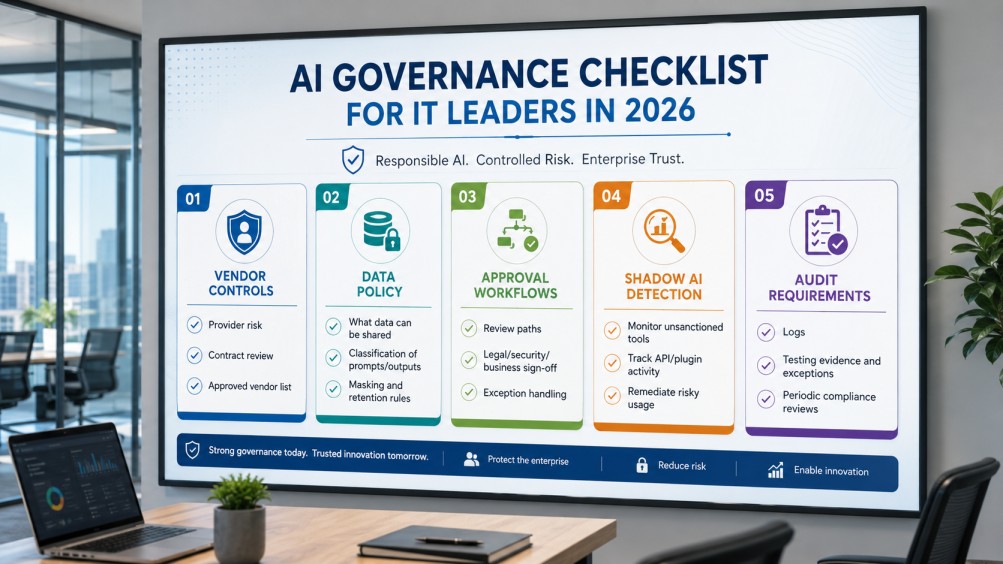
  • The AI Governance Checklist for IT Leaders in 2026 Before Your Next Deployment

    The AI Governance Checklist for IT Leaders in 2026 Before Your Next Deployment

    Most AI governance policies fail within six months because they focus on principles instead of practical controls. By the time you discover shadow AI usage or a vendor compliance gap, you’re managing a crisis instead of preventing one. The gap isn’t philosophical. It’s operational. Your policy document says “responsible AI use,” but nobody defined what happens when an employee pastes customer data into ChatGPT or a vendor refuses to log the prompts your compliance team will need during an audit. This AI governance checklist for IT leaders in 2026 covers the specific controls that prevent those problems before they require incident response. You’ll know what to verify before approving internal AI use, what contract terms stop vendor problems at signing, how to detect shadow AI without dedicated tooling, and what audit trail your first compliance review will demand.

    Internal Use Controls Before the First Model Goes Live

    Run through these five items before you approve general employee access to any AI tool. Missing even one creates a compliance gap your audit team will find six months later.

    Acceptable use policy specific to AI
    Your existing acceptable use policy doesn’t cover generative AI. You need explicit language defining what constitutes approved use, prohibited data types, and consequences. Don’t repurpose your social media policy.

    Data classification training refresher
    Employees need to know which data types they can’t submit to AI tools. If your data classification system hasn’t been reviewed in 18 months, half your team won’t remember what qualifies as sensitive.

    Approved tool list published and enforced
    Saying “use approved tools only” without publishing the list guarantees shadow AI. Name the specific tools, include version numbers if relevant, and update it quarterly.

    Incident reporting path for AI-related concerns
    Your team needs to know where to report an accidental data exposure or a problematic AI output. If the path isn’t clear, they won’t report until the problem escalates.

    Access tied to training completion
    Make AI tool access conditional on completing a 15-minute training module. It’s not foolproof, but it eliminates the “I didn’t know” defense and creates an audit trail proving due diligence.

    Vendor AI Controls That Stop Problems at Contract Stage

    The vendor will not volunteer these terms. You need to require them before the contract is signed, because retrofitting compliance language after deployment costs six figures in legal fees and re-negotiation leverage you no longer have.

    Your vendor contract must specify where your data goes, how long it’s retained, whether it’s used for model training, and who can access it. Most vendor agreements are silent on training data usage or bury consent in a clause your legal team will object to nine months later. Get written confirmation that your inputs and outputs are excluded from training datasets. Require the vendor to specify data residency if you operate under jurisdiction-specific privacy laws.

    The second gap: audit rights and incident notification. Your contract needs explicit language granting you the right to audit AI usage logs and requiring the vendor to notify you within 24 hours of a data incident involving your inputs. Vendor SLAs typically cover uptime, not compliance incidents.

    What to require in every vendor AI agreement:

    • Explicit prohibition on using your data for model training or improvement
    • Data residency specification that matches your regulatory requirements
    • Audit rights covering access logs, prompt history, and data handling
    • 24-hour incident notification for breaches involving your data

    RED FLAG: VENDOR CONTRACT GAP

    The liability clause doesn’t cover AI-generated outputs.

    Standard software liability clauses cover defects and downtime. They don’t cover the risk of the AI generating content that violates copyright, defames someone, or breaches a regulation. If your contract is silent on output liability, you’re assuming all downstream risk from anything the model produces using your data. Require explicit vendor liability for outputs that violate law or regulation when used as directed.


    Data Governance Items Your Legal Team Needs Documented

    Your existing data governance policy needs AI-specific amendments. The controls that worked for traditional software don’t translate cleanly when employees can submit unstructured data to a model and receive outputs you can’t predict in advance.

    Sensitive data submission prohibition
    Define which data classifications are prohibited from AI tool input. If “confidential” and “restricted” are banned but “internal use” is allowed, document it explicitly and train to it.

    Output handling requirements
    AI-generated content needs a classification rule. Does it inherit the classification of the input data? Does it default to a specific tier? Your data handling policy must cover outputs, or you’ll discover inconsistent practices during your first audit.

    Cross-border data flow documentation
    If your vendor’s AI processes data outside your operating jurisdiction, document it. Most privacy regulations require notice and sometimes consent when data crosses borders. API calls to a U.S.-based LLM from your EU office trigger this requirement.

    Third-party data restrictions
    If you handle customer or partner data under contractual terms, verify those terms permit AI processing. Your customer agreement may prohibit third-party processing or require specific safeguards that your AI vendor doesn’t meet.

    Retention and deletion alignment
    Your AI vendor’s data retention period must align with your own data retention and deletion policies. If you’re required to delete customer data on request, but your AI vendor retains prompts for two years, you’re out of compliance the moment a deletion request arrives.

    Approval Workflows That Don’t Slow Down Every Request

    A governance process that requires CIO sign-off for every AI use case will be bypassed within a month. You need tiered approval based on actual risk, not bureaucratic caution. The goal is to make low-risk use fast and high-risk use visible.

    Tier your approval structure into three levels. Low-risk use cases operate under general authorization with no per-use approval. An employee using an approved tool on non-sensitive data for internal work doesn’t need a ticket. Medium-risk use cases require department head approval and a brief risk assessment. Processing internal data that’s confidential but not regulated, or generating content for external use, fits here. High-risk use cases require cross-functional review involving IT, legal, and compliance before any deployment.

    The risk factors that determine tier: data sensitivity, external visibility of outputs, automated decision-making, and whether the use case involves personal data under privacy regulation. If any single factor is high, the entire use case is high-risk. Don’t average risk scores.

    Approval tiers that work in practice:

    • General authorization: Approved tools, non-sensitive data, internal use only, human review of all outputs
    • Department head approval: Confidential data, external-facing outputs, or workflow automation with human oversight
    • Cross-functional review: Personal data under GDPR/CCPA, fully automated decisions, or any use case that could create legal or regulatory exposure
    • Ongoing monitoring requirement: All medium and high-risk use cases require quarterly usage review to verify they’re operating within approved parameters
    • Emergency provisional approval: IT head can grant 30-day provisional access for urgent business need, but full review must complete before the provisional period ends

    Shadow AI Detection Before It Becomes a Compliance Problem

    Shadow AI happens when employees adopt unapproved tools because your approved options are too slow, too restrictive, or non-existent. You won’t eliminate it entirely, but you can detect it early enough to remediate instead of investigate.

    Unusual outbound traffic patterns to known AI services
    Your firewall logs show traffic to OpenAI, Anthropic, Google AI, and similar domains. Baseline normal traffic, then flag anomalies. A 300% spike in one department over two weeks is a signal.

    Expense report line items for AI subscriptions
    Employees expense ChatGPT Plus, Jasper, or Midjourney subscriptions. Your finance team sees these. Flag any AI-related expense that isn’t tied to an approved tool list.

    Browser extension audits
    AI writing assistants and productivity tools run as browser extensions. Your endpoint management platform can inventory installed extensions. Run quarterly audits and cross-reference against approved tools.

    Department-level data export volume changes
    If a department’s data export volume doubles without a project explanation, someone may be feeding data to an external tool. Correlate export spikes with known AI adoption timelines.

    Employee surveys that ask directly
    Twice a year, survey employees about which tools they use to get work done. Make it anonymous, frame it as process improvement, and you’ll get honest answers. The goal is visibility, not punishment, and employees will tell you if you ask correctly.


    RED FLAG: SHADOW AI USAGE PATTERN

    Approved tools exist, but shadow AI usage is growing anyway.

    Your detection system works. You’re finding unapproved tools in regular use. But employees keep adopting new ones despite having approved alternatives. That’s not a compliance problem. That’s a signal your approved tools are too restrictive, too slow, or missing critical capabilities. If shadow AI persists after you’ve published an approved list and trained everyone, the problem is your tool selection, not your users. Fix the tool gap before you tighten enforcement, or you’ll drive usage further underground and lose visibility entirely.


    Model Governance When You’re Training or Fine-Tuning

    Most teams don’t need model governance yet. If you’re only using vendor APIs and pre-built models, skip this section. Model governance becomes mandatory when you start training models on your own data, fine-tuning vendor models with proprietary datasets, or deploying models that make decisions without human review.

    The threshold: if the model’s behavior can change based on data you control, you need model governance. That includes fine-tuning a vendor LLM on your support tickets, retraining an open-source model on your transaction history, or adjusting weights in a classifier you’re running internally. Once you cross that line, you’re responsible for model behavior in ways you aren’t when you’re just calling someone else’s API.

    Model governance requires tracking which data went into training, who approved the training run, what the model’s intended use case is, and how you’ll monitor for drift or bias after deployment. Document model versioning so you can reproduce outputs or roll back to a previous version when something goes wrong. Establish a review cadence: models trained on your data need quarterly performance reviews at minimum, more often if they’re making automated decisions that affect customers or employees.

    Model governance requirements once you cross the training threshold:

    • Training data provenance documentation: source, date range, cleaning steps, any exclusions
    • Model card or equivalent: intended use case, known limitations, performance benchmarks, and decisions the model should not make
    • Version control for model artifacts: every deployed version tagged, stored, and reproducible
    • Monitoring plan for drift and fairness: defined metrics, review cadence, and escalation path if metrics degrade

    AI Audit Trail Requirements Before Your First External Review

    Your first compliance audit will ask for logs proving who used AI on what data and when. If you can’t produce that documentation, the audit fails regardless of whether your actual usage was compliant. Audit trail requirements aren’t optional once you’re operating under privacy regulation, industry-specific compliance frameworks, or contractual obligations to customers.

    The table below defines what your AI audit trail must include, why each item matters for compliance, and the red flag that signals your vendor or internal system won’t meet the requirement when you need it.

    Checklist Item Why It Matters Red Flag If Missing
    User prompt logging Required for most AI compliance frameworks and breach investigation Vendor claims prompts are ephemeral or not accessible
    Model version tracking Reproducing outputs or rolling back requires knowing which model version ran Vendor API doesn’t expose model version in response metadata
    Access audit trail Determines who used AI on what data and when Logging is user-configurable instead of mandatory
    Data lineage for training Proves training data provenance for regulatory review Vendor won’t document data sources in contract
    Retention policy alignment AI logs must match your existing data retention schedule Default retention is shorter than your compliance requirement

    The biggest audit trail failure happens when your vendor’s logging doesn’t meet your retention requirements. Standard SaaS logging often retains data for 90 days, but privacy regulations typically require 12 to 24 months. If your vendor’s logs expire before your retention policy allows, you can’t produce documentation during an audit that covers a date range more than 90 days old. Verify retention alignment before signing, because extending vendor log retention after the fact usually requires an enterprise tier upgrade and costs more than negotiating it into the original contract.

    Your internal systems need logging too. If employees access AI through an internal portal or wrapper, that system must log user actions, timestamps, and data accessed. Treat AI logging with the same rigor you apply to database access logs or privileged account activity. The standard is the same: every action that touches sensitive data or produces an output with compliance implications must be logged, tamper-evident, and retained per policy.

    Conclusion

    The AI governance checklist for IT leaders in 2026 works when it stops problems at contract signing, policy publication, and first deployment, not after the compliance team finds a gap nine months later. If you’re operating under privacy regulation, handling customer data under contract, or facing an audit in the next 12 months, your approval workflows and vendor contracts are the highest-priority items on this list. If shadow AI is already widespread, your detection plan needs to run within the next 30 days, not next quarter. Before your next vendor call or internal AI pilot, verify every item in Section 2 and Section 7. Those are the gaps that create liability, and they’re the easiest to close before you sign anything.
    Related reading

  • Evaluating AI Agent Orchestration Platforms: What Production Reality Looks Like After the Demo

    Most teams evaluate AI agent orchestration platforms during a proof-of-concept phase when everything still works. The vendor’s demo handles three agents beautifully. The sample workflows execute cleanly. The dashboard shows exactly what you’d want to see. Then you move to production with your actual infrastructure, your legacy identity systems, and your real error conditions, and the platform that looked production-ready in week two becomes a six-month integration project your team didn’t budget for.

    The gap isn’t the platform’s fault. It’s that orchestration platforms solve a specific class of problems, most buyers evaluate them before they’ve actually felt those problems in production, and the vendor has no incentive to tell you which parts of the orchestration layer you’re still going to build yourself.

    You’re not buying a complete solution. You’re buying infrastructure that assumes you already know how to coordinate multiple AI agents at scale, that you’ve already designed your error-handling logic, and that your team has the engineering capacity to maintain the orchestration rules the platform won’t write for you. If those assumptions don’t describe your situation, the platform will create more work than it saves.

    Here’s how to make this call clearly, before the vendor deadline forces it for you.

    The Demo Runs on Their Infrastructure, Not Yours

    The vendor demo runs clean because it’s running in a controlled environment where every dependency is already configured. Their sample agents call APIs that return data in the exact format the orchestration logic expects. Their identity layer has one authentication method. Their error conditions are the three scenarios they designed the platform to handle gracefully.

    Your environment has four authentication providers left over from two acquisitions. Your agents call internal APIs that sometimes return XML, sometimes JSON, and sometimes error messages that don’t follow any standard format. Your error conditions include scenarios the vendor has never seen because they’re specific to your compliance requirements and your legacy data pipeline.

    The integration work that takes 20 minutes in the demo will take your team six weeks once you account for the adapter code you’ll write to translate between your systems and what the platform expects. That’s not a failure of the platform. That’s the cost of integrating any new infrastructure layer into an environment that wasn’t designed around it.

    Most of the “quick start” timelines vendors publish assume you’re starting with a greenfield environment or that you’ve already standardized your API contracts and authentication flows. If you haven’t, the clock starts when you begin that standardization work, not when you install the platform.

    The real tell is how the vendor responds when you ask what happens when an agent calls an API that returns an unexpected error. If the answer is “the platform logs it and moves to the next step,” that’s fine. If the answer is “you’ll configure the error-handling rules in our workflow editor,” what they mean is you’re going to write and maintain the logic that decides what happens next. Budget for that before you commit.


    BUYER’S REALITY

    You’re paying for the platform and building the logic.

    Most orchestration platforms handle routing and state persistence. The business rules that decide which agent runs when, what happens on failure, and how exceptions route back to humans? That’s still your code. Budget engineering time accordingly.


    What “Agent Coordination” Actually Means in Your Environment

    Agent orchestration platforms solve three problems: routing requests to the right agent, managing state across multi-step workflows, and handling failures when one agent can’t complete its task. What they don’t solve is the business logic that defines “right agent,” “complete,” and “failure” in your specific use case.

    The platform will route a request to Agent B after Agent A finishes. You still write the rule that says Agent A is “finished” when it returns a confidence score above 0.85, or when it’s made three attempts, or when a human approves its output. The platform will persist state between steps. You still define what state matters, how long to keep it, and what triggers a state reset.

    Most platforms call this “configuration,” but configuration is code. It’s logic your team writes, tests, and maintains. The difference between a low-code workflow editor and a Python script is syntax, not ownership.

    What the platform handles:

    • Request routing based on rules you define
    • State persistence across workflow steps
    • Retry logic for transient failures
    • API-level communication between agents

    What your team handles:

    • The business rules that determine which agent runs when
    • Error classification (transient vs. permanent, retry vs. escalate)
    • Human-in-the-loop trigger conditions
    • Agent output validation and quality thresholds

    The value proposition is real if you’re already running multi-agent workflows and spending engineering time on the infrastructure those four bullets represent. The value proposition falls apart if you’re not yet at that scale, because you’ll spend your first year building the logic the platform needs to make intelligent decisions on your behalf.

    The clearest signal that you’re ready for orchestration tooling is that your team is already maintaining homegrown state management and retry logic, and that code is becoming a maintenance burden. If you haven’t written that code yet, you’re not buying a solution to a problem you have. You’re buying a framework you’ll spend six months learning to configure.

    The Agent Monitoring Gap Most Platforms Won’t Close

    Monitoring a single AI model is straightforward. You track latency, token usage, error rate, and output quality. Monitoring a workflow that chains five agents together is harder because the failure modes multiply. Agent A succeeds but returns low-confidence output. Agent B times out. Agent C produces valid output that violates a business rule Agent A should have caught. The workflow completes successfully but takes 90 seconds instead of 12.

    Most orchestration platforms give you high-level dashboard metrics: workflow success rate, average completion time, agent-level error counts. What they don’t give you is the tooling to debug why a specific workflow failed, which agent introduced the bad data, or how often agents are succeeding technically but failing to produce useful output.

    The gap shows up in production when your success rate is 94% but your business stakeholders are escalating failures daily. The platform reports success because every agent returned a response and the workflow reached its end state. Your users report failure because the output was unusable. The platform can’t see that gap because it doesn’t know what “usable” means in your context.

    You’ll close that gap one of two ways. You either instrument your own logging and monitoring around the platform, tracking the metrics the platform doesn’t surface, or you accept that 6% of workflows will fail invisibly and you’ll find out when users complain.

    The vendor will tell you their logging captures everything you need. What they mean is it captures everything the platform does. It doesn’t capture the quality signals, business rule violations, or semantic failures that matter to your users. Logging that Agent C returned a response in 140 milliseconds is useful. Logging that Agent C’s response failed your internal data quality threshold is more useful, and that’s yours to build.

    If your team already has observability tooling and engineering capacity to extend it, this is a solvable problem. If you don’t, the monitoring gap becomes an operational risk you’ll spend the first year working around.

    Framework Lock-In Costs More Than the License

    Most agent orchestration platforms are built on top of, or tightly integrated with, a specific agent framework. That’s not inherently bad. The problem is that once you’ve built your workflows in that framework, migrating to a different platform means rewriting not just the orchestration logic but the agent implementations themselves.

    The lock-in cost isn’t the workflow definitions you’ll rewrite. It’s the integration code, the error-handling rules, the state management logic, and the monitoring instrumentation you’ve built around the platform’s specific SDK and API contracts. After 12 months in production, that code is worth more than the license fee you’re paying, and switching platforms means throwing most of it away.

    Vendor pricing reflects this. Year-one pricing is often reasonable because they’re buying your lock-in. Year-three pricing assumes you’re not leaving because the switching cost is prohibitive. That’s not unique to orchestration platforms, but the cost curve is steeper here because the integration surface area is larger.

    Four signals that lock-in risk is higher than the vendor is representing:

    • Workflow definitions are stored in a proprietary format, not as code you can version-control independently.
    • Agent implementations require platform-specific decorators, base classes, or SDKs that don’t map cleanly to other frameworks.
    • State management is handled by the platform’s internal database with no export or migration path.
    • Monitoring and logging are tightly coupled to the platform’s observability stack, not your existing tools.

    The cleaner the separation between your agent logic and the platform’s orchestration layer, the lower your switching cost. If the platform positions itself as “the only tool you’ll need,” that’s usually a signal that extraction will be expensive.

    Portability has a cost too. Platforms that prioritize interoperability and open standards often lag on features compared to vertically integrated alternatives. The decision isn’t “avoid lock-in at all costs.” It’s “know what you’re committing to, and price the exit before you sign.”

    Buying Decision Table: When This Makes Sense and When It Doesn’t

    Your Situation What It Means for This Decision Buy Now / Wait / Skip
    Team size under 10, no dedicated platform engineering You’ll spend more time managing the platform than building agents Skip
    Running 3+ agents in production, homegrown state management becoming a maintenance burden The platform solves a problem you’re already paying to solve poorly Buy now
    Budget available but no multi-agent use case live yet You’ll pay for a year of tooling while you’re still figuring out the workflows Wait
    50 to 200 users, compliance or auditability driving the decision Orchestration platforms with built-in audit trails close a real gap Buy now
    Greenfield implementation, no legacy identity or API constraints Integration costs will be lower than average, value realization faster Buy now if engineering capacity exists
    Multi-cloud or hybrid environment, agents calling services across cloud providers Orchestration complexity is high; platform ROI depends on cross-cloud state management working reliably Buy now, but vendor-test cross-cloud scenarios in proof-of-concept
    Current tooling is a workflow engine (Airflow, Temporal) being adapted for agent orchestration Migration cost to a purpose-built platform may not justify the capability gain Wait until current tooling breaks
    Fewer than 10 agents planned, workflows mostly linear (agent A, then B, then C) Orchestration overhead is overkill; simpler pipeline tooling will cost less Skip

    The row that describes most buyers who regret the purchase is “budget available but no multi-agent use case live yet.” Orchestration platforms solve coordination problems you only understand after running agents in production for three to six months. Buying the platform first means you’ll misconfigure it, underuse it, and spend your first year paying for infrastructure you’re not ready to leverage. The vendors who push hardest for early commitment are the ones who know that once you’ve lived the pain, you’ll evaluate alternatives more carefully.


    RED FLAG

    If you don’t have a multi-agent use case in production yet, wait.

    Platforms solve coordination problems you only understand after running agents in production for three to six months. Buying orchestration tooling before you’ve felt that pain means you’ll spend the first year misconfiguring a system you don’t yet need.


    The Internal Resource Cost Nobody Budgets For

    The license cost is the easy part. Most of the real cost sits in the engineering and admin work your team absorbs in months two through six, and again every time you add a new agent or modify an existing workflow.

    Orchestration platforms don’t run themselves. Someone on your team owns the platform configuration, writes and maintains the workflow definitions, manages the integration between the platform and your existing observability stack, and debugs the failures that the platform logs but doesn’t resolve. For most teams, that’s 0.3 to 0.5 FTE in steady state, more during initial rollout.

    If you don’t have engineering capacity to own that work, the platform becomes shelfware. You’ll use it for the two or three workflows you configured during onboarding, and everything else will route around it because modifying the platform configuration is slower than writing a script.

    The resource cost scales with workflow complexity, not agent count. A workflow that chains three agents linearly is low-overhead. A workflow with conditional branching, parallel agent execution, and human-in-the-loop checkpoints requires ongoing engineering attention every time a business rule changes or a new edge case surfaces.

    The way to budget correctly is to ask the vendor for a reference customer at your scale and ask that customer how much time their team spends on platform maintenance per month. Vendor estimates are always optimistic. Customer reality is usually double.

    What Goes Wrong 12 Months In

    The orchestration platform works. The agents run. The workflows complete. But the operational load is higher than you expected, and the system is more brittle than the proof-of-concept suggested. These are the four failure modes that show up after the initial rollout success:

    The platform becomes a single point of failure. When orchestration is centralized, an outage in the platform stops every agent workflow. Your agents are still running, your APIs are still up, but nothing executes because the orchestration layer is down. If the platform’s uptime SLA is lower than your agents’ SLA, you’ve introduced a reliability regression.

    Configuration drift makes workflows unmaintainable. Six engineers modify workflow definitions over eight months. No one documents the changes. The workflow that was simple in month one is now a nested set of conditionals that only one person understands, and that person just left. The platform has version control, but your team didn’t enforce a review process, so every change went straight to production.

    Error-handling logic doesn’t scale. The retry rules you configured in month two made sense for three agents and four workflows. Now you’re running 18 agents and 40 workflows, and the error-handling logic that worked at small scale is creating retry storms that consume your API rate limits and slow down every workflow.

    The platform’s framework falls behind the state of the art. The agent framework the platform is built on was current when you signed. Twelve months later, new frameworks have better performance, lower token costs, or capabilities the platform doesn’t support. Migrating your agents to the new framework means rewriting every integration with the orchestration platform, or waiting for the vendor to add support, which may not happen.

    None of these are inevitable, but all of them are common. The buyers who avoid them are the ones who treat the platform as critical infrastructure from day one: they enforce change management, they monitor the platform’s own performance separately from agent performance, and they design workflows with failure isolation in mind.


    BUYER’S REALITY

    Switching costs hit six figures after year one.

    Once you’ve embedded workflow logic, monitoring dependencies, and agent state into a proprietary orchestration layer, migrating to another platform means rewriting every integration and re-testing every failure path. Plan for a three-year commitment before you sign.


    Who This Is NOT For

    This is the wrong purchase if you check two or more of these conditions:

    • [ ] Your team is fewer than five people, and no one has “platform engineering” anywhere in their job description.
    • [ ] You’re running one or two agents in production, and both of them operate independently without needing to share state or coordinate execution.
    • [ ] Your current agent workflows are handled by scripts or simple API chaining, and no one on your team has complained about the maintenance burden yet.
    • [ ] You don’t have observability tooling already in place for your existing infrastructure, and you’re expecting the orchestration platform to be your first monitoring solution.
    • [ ] The business case for agent orchestration depends on headcount reduction, but you haven’t modeled the FTE cost of owning the platform itself.
    • [ ] You’re evaluating this because a vendor pitched it, not because your team surfaced it as a solution to a production problem they’re already managing manually.

    If your IT team is under three people, the admin overhead alone will consume any efficiency gain in year one. The platform expects someone to own it, configure it, and maintain it. If that responsibility lands on the same person who’s building the agents, writing the business logic, and managing your infrastructure, you’ve added a task without adding capacity.

    The other disqualifying condition is subtler: if your agents don’t need to coordinate, orchestration is overhead. A platform that routes requests, manages shared state, and handles multi-step workflows is solving a problem you don’t have. Two agents that run independently and return results to different systems don’t need orchestration. They need API management and monitoring, which you probably already have.

    The Alternative: Build Lightweight Orchestration In-House

    The platform purchase makes sense when the cost of building and maintaining orchestration logic in-house exceeds the cost of licensing and operating a commercial platform. For many teams, especially in the first 12 months of running multi-agent workflows, that math doesn’t work out.

    What a platform gives you:

    • Pre-built routing, state persistence, and retry logic that works out of the box
    • A UI for defining workflows without writing code (value depends on whether your team prefers UIs or code)
    • Vendor support when something breaks
    • Faster time-to-production if the platform’s assumptions match your environment

    What lightweight in-house orchestration gives you:

    • Full control over the orchestration logic, no framework lock-in
    • Lower operational cost (no license fee, no platform maintenance)
    • Simpler architecture (fewer dependencies, less surface area for failures)
    • Tight integration with your existing tooling (observability, CI/CD, identity management)

    The in-house path works when your workflows are simple, your team is comfortable writing and maintaining orchestration code, and your agent framework (LangGraph, for example) already includes lightweight state management. You’re trading vendor support and pre-built tooling for control and cost savings.

    The platform path works when your workflows are complex enough that building orchestration logic in-house would consume significant engineering time, when you need auditability and governance features the platform provides, or when your team doesn’t have the capacity to maintain custom infrastructure.

    Most teams that regret the platform purchase are teams that bought it before they knew which path made sense for them. The teams that get value from orchestration platforms are the ones who spent three to six months running agents in production with lightweight tooling, hit the limits of that tooling, and then bought a platform to solve the specific problems they’d already felt.

    Conclusion

    The core trade-off is this: orchestration platforms solve real production problems for teams running multiple agents at scale, but only after those teams have already felt the pain of managing state, retries, and workflow complexity manually. Buying the platform makes sense when you’re already spending engineering time on those problems and the platform’s cost is lower than continuing to solve them in-house. Buying the platform doesn’t make sense when you’re still figuring out your multi-agent workflows, when your team is too small to own another piece of infrastructure, or when your agents don’t actually need to coordinate.

    If you’re running three or more agents in production, if homegrown orchestration is already a maintenance burden, and if your team has the capacity to own the platform, this is the right time to buy. If you’re evaluating this because it sounds like the next logical step but you haven’t hit the operational pain yet, wait six months and revisit when you know what problem you’re solving.

    Your next step in the next 48 hours: ask your team how much time they spent last month managing agent state, debugging multi-step failures, or writing retry logic. If the answer is more than 20 hours, request demos and price three vendors. If the answer is less than 10 hours, defer the purchase and put that budget toward the agent work itself.


    Also read: Anthropic engineering blog on agent design

    Related reading

  • EDR tool for mid sized organizations

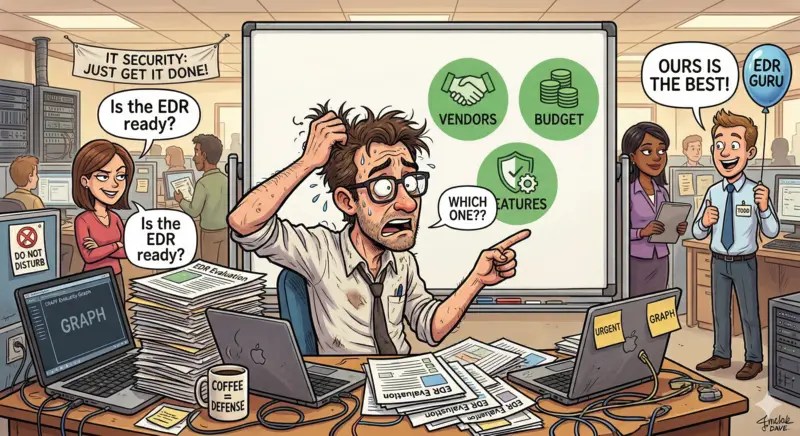
    Understanding EDR Tools for Mid-Sized Organizations

    Endpoint Detection and Response (EDR) tools have become essential security components for organizations of all sizes. For mid-sized companies—typically those with 100 to 1,000 employees—selecting the right EDR solution requires balancing comprehensive protection with practical considerations like budget, IT staff resources, and ease of management.

    What EDR Tools Actually Do

    EDR tools continuously monitor endpoints such as laptops, desktops, servers, and mobile devices for signs of malicious activity. Unlike traditional antivirus software that primarily relies on signature-based detection, EDR solutions use behavioral analysis to identify suspicious activities that may indicate a security threat.

    The core functions include:

    • Real-time monitoring of endpoint activities
    • Threat detection through behavioral analysis
    • Incident investigation and forensics
    • Automated or guided response to security events
    • Data collection for compliance and reporting

    Why Mid-Sized Organizations Need EDR

    Mid-sized organizations occupy a challenging position in the security landscape. They often handle sensitive data and conduct substantial business operations, making them attractive targets for cybercriminals. However, they typically lack the extensive security teams and unlimited budgets of enterprise organizations.

    Traditional antivirus solutions no longer provide adequate protection against modern threats such as ransomware, fileless malware, and advanced persistent threats. EDR tools fill this gap by providing visibility into what is happening on endpoints and enabling faster response to incidents.

    Key Features to Consider

    Detection Capabilities

    Look for EDR solutions that use multiple detection methods, including signature-based detection, behavioral analysis, and machine learning. The tool should detect both known and unknown threats without generating excessive false positives that overwhelm your security team.

    Response and Remediation

    Effective EDR tools should enable quick response to threats. This includes the ability to isolate infected endpoints from the network, terminate malicious processes, delete harmful files, and roll back unauthorized changes. Some solutions offer automated responses for common threats, while others provide guided workflows for security analysts.

    Investigation and Forensics

    When an incident occurs, your team needs to understand what happened, how it happened, and what was affected. EDR tools should provide detailed timeline views of endpoint activities, allow searching through historical data, and help trace the scope of an incident.

    Ease of Management

    For mid-sized organizations with limited IT security staff, management overhead matters. The EDR console should be intuitive, provide clear information about threats, and not require extensive training to use effectively. Cloud-based solutions often reduce the management burden compared to on-premises deployments.

    Integration Capabilities

    Your EDR tool should integrate with other security tools in your environment, such as firewalls, SIEM systems, and threat intelligence feeds. This integration improves overall security posture and enables more effective incident response.

    Deployment Considerations

    Agent Performance Impact

    EDR tools require agents installed on each endpoint. These agents consume system resources including CPU, memory, and disk space. Before selecting a solution, test the agent’s performance impact on typical user workstations and critical servers to ensure it does not degrade productivity.

    Network Bandwidth

    EDR agents send telemetry data back to management consoles or cloud platforms. Evaluate how much bandwidth this will consume, particularly if you have remote offices with limited connectivity. Some solutions allow configuring data transmission schedules or compression to manage bandwidth usage.

    Coverage Requirements

    Determine which endpoints need EDR protection. While covering all workstations and servers is ideal, budget constraints may require prioritization. Start with critical systems, servers containing sensitive data, and endpoints used by privileged users.

    Evaluating Vendor Options

    The EDR market includes solutions from established security vendors and specialized endpoint security companies. Mid-sized organizations should consider:

    Vendor Stability and Support

    Choose vendors with proven track records and strong customer support. Your team will need assistance during deployment, when investigating incidents, and when dealing with complex security events.

    Pricing Models

    EDR pricing typically follows per-endpoint models, often with tiered pricing based on features. Understand what is included in base pricing versus premium tiers. Consider total cost of ownership including implementation, training, and ongoing management.

    Managed Detection and Response Options

    Many vendors offer Managed Detection and Response (MDR) services alongside their EDR tools. These services provide expert security analysts who monitor your environment and respond to threats on your behalf. For organizations without dedicated security operations centers, MDR services can provide enterprise-level protection at a predictable cost.

    Implementation Best Practices

    Start with a Pilot Program

    Deploy EDR to a limited number of endpoints initially. This allows your team to become familiar with the tool, tune detection settings, and verify performance before rolling out organization-wide.

    Establish Response Procedures

    Having an EDR tool is only valuable if your organization can respond effectively to the threats it detects. Develop clear incident response procedures that define who responds to alerts, how to escalate serious incidents, and what steps to take for different threat types.

    Plan for Training

    Invest time in training the staff who will use the EDR tool. This includes understanding the console, interpreting alerts, conducting investigations, and executing response actions. Most vendors provide training resources and documentation.

    Regular Review and Tuning

    After deployment, regularly review EDR alerts and adjust detection rules to reduce false positives while maintaining effective threat detection. Review incident response metrics to identify areas for improvement.

    Common Challenges and Solutions

    Alert Fatigue

    EDR tools can generate numerous alerts, overwhelming small security teams. Address this by tuning detection rules, prioritizing alerts based on risk, and implementing automated responses for low-risk events. Consider MDR services if internal resources are insufficient.

    Legacy Systems

    Older operating systems or specialized equipment may not support modern EDR agents. Document these gaps, implement compensating controls where possible, and include endpoint modernization in long-term planning.

    Performance Concerns

    If EDR agents impact system performance, work with the vendor to optimize agent configuration. Most solutions allow adjusting scanning schedules, reducing telemetry collection, or excluding specific processes from monitoring.

    Measuring EDR Effectiveness

    Track metrics that demonstrate the value of your EDR investment:

    • Mean time to detect threats
    • Mean time to respond to incidents
    • Number of threats detected and blocked
    • False positive rate
    • Endpoint coverage percentage

    These metrics help justify the investment to leadership and identify opportunities for improvement.

    Looking Forward

    EDR technology continues to evolve. Extended Detection and Response (XDR) solutions expand monitoring beyond endpoints to include network traffic, cloud workloads, and email. While XDR offers broader visibility, mid-sized organizations should focus on implementing effective EDR first before considering more comprehensive platforms.

    Selecting and implementing an EDR tool represents a significant investment for mid-sized organizations, but it provides essential protection against modern cyber threats. By carefully evaluating your requirements, choosing appropriate solutions, and following sound implementation practices, you can significantly improve your security posture without overwhelming your IT team.

  • How to Reduce Cloud Bill Without a DevOps Team: A Practical Cost Control Guide for Lean IT

    How to Reduce Cloud Bill Without a DevOps Team: A Practical Cost Control Guide for Lean IT

    Cloud bills do not usually become painful because of a single mistake by the engineer. They become painful because even small defaults keep charging quietly.

    A test server stays alive. Storage snapshots pile up. Data transfer is ignored. A larger instance is selected because nobody wants performance complaints. The invoice looks technical, but the problem is often operational ownership.

    That is why learning how to reduce cloud bill without a DevOps team starts with discipline, not tooling. You do not need a full platform team to cut waste. You do need visibility, a review rhythm, and enough control to stop obvious leakage before it becomes normal spend.

    This guide is for lean IT teams that need practical savings without disrupting production, slowing delivery, or buying a FinOps platform prematurely.

    The goal is simple: reduce waste first, improve commitments second, and build a cost routine your team can actually maintain.

    Start With Visibility, Not Discounts

    Most teams jump straight to reserved instances, savings plans, or vendor negotiations. That is how you lock in waste at a lower price instead of removing it.

    If you are serious about reducing your cloud bill without DevOps, your first move is not to optimize. It is visibility you can actually act on.

    Start here:

    • Break down the cost by service, not the total bill
      Compute, storage, database, and data transfer behave very differently. A single number hides where action is possible.
    • Identify the top 10 cost contributors.
      Not 100. Not everything. Focus on the few services or workloads driving most of the spend.
    • Separate production vs non-production
      This is where most hidden costs sit. Dev, QA, and staging environments rarely get the same scrutiny.
    • Track daily or weekly cost trend.
      Monthly invoices are too late. You need to see drift early, not after finance flags it.
    • Map cost to owners
      If a workload has no owner, it will never be optimized. Even a basic tag like “team” or “project” is enough to start.

    BUYER’S REALITY

    You cannot reduce what you cannot attribute. Most cloud waste exists in resources nobody clearly owns.

    Vendor tools, such as cost explorers in Amazon Web Services, Microsoft Azure, and Google Cloud Platform, will give you this visibility. But they do not enforce action. They only show data.

    The risk here is false confidence. You see dashboards, but no one changes behavior. That is where bills keep growing.

    Your decision at this stage is simple. Do not optimize yet. First, make sure you can answer, in minutes, where your cloud spend is going and who is responsible for it.

    The Chaos of Enterprise Cloud Pricing Analysis: AWS vs Azure vs GCP 2026

    Kill Idle and Forgotten Resources First

    This is the safest place to start because you are not redesigning anything. You are removing waste that should not exist.

    Look for resources that are running, reserved, or stored without a current business reason.

    Start with these:

    • Stopped or unattached disks
    • Old snapshots and backups
    • Idle virtual machines
    • Unused load balancers
    • Test databases left running
    • Orphaned public IPs
    • Expired proof-of-concept environments
    • Storage buckets with no active usage
    • Dev and QA environments running after office hours

    The trick is not to delete everything aggressively. That creates production risk and internal panic. First label resources as “review,” confirm ownership, then retire them in batches.

    A simple workflow works well:

    1. Export the top unused or low-usage resources.
    2. Assign each item to an owner.
    3. Give a short review window.
    4. Shut down non-production items first.
    5. Delete only after backup or business confirmation.

    The hidden cost is not just the resource charge. It is the habit. Once teams know that cloud resources can live forever, every new project adds permanent spend.

    For lean IT teams, idle cleanup can often produce the first visible savings without buying anything. It also builds the cost discipline needed before rightsizing, reservations, or third-party tooling.

    The decision implication is clear: do not begin with architecture optimization. Start with obvious waste. It is faster, safer, and easier to defend.

    FinOps Tool for Cloud Cost Optimization: How to Evaluate and Use Them Without Wasting 6 Months

    How to reduce cloud bill without a DevOps team? Rightsize Before You Reserve.

    Reserved capacity looks smart because the discount is easy to show. The trap is committing before you know whether the workload size is correct.

    A large instance at 35% usage is not efficient because it is reserved. It is still oversized.

    CheckpointWhat to ReviewRightsize First WhenReserve First WhenBuyer Risk
    Usage patternCPU, memory, storage, IOPSUtilization is low or unevenUsage is stable for monthsYou lock in excess capacity
    EnvironmentDev, QA, staging, productionNon-production runs all dayProduction baseline is predictableTest waste becomes permanent
    Workload maturityNew, changing, or stable appThe app is still evolvingApp demand is steadyDiscount hides poor sizing
    Region/service familyLocation and instance familyWorkloads may moveRegion and family are fixedWrong commitment limits flexibility
    Team capacityMonitoring and rollback abilityYour team can test small changesYour team can track commitmentsSavings need ongoing ownership

    Rightsizing should take precedence over commitment discounts when your team lacks deep DevOps coverage. You need fewer long-term decisions, not more.

    how to reduce cloud bill without a DevOps team

    Start with non-production workloads. Move oversized instances down one tier. Watch performance for a week. Then repeat carefully for production workloads with clear rollback.

    The hidden cost is commitment pressure. Once finance sees a discount, everyone assumes the problem is solved. But if you reserved the wrong size, wrong region, or wrong service family, you have only made the waste harder to unwind.

    For cloud cost optimization, the rule is simple: resize what you can prove, and reserve only what stays stable.

    Cloud vs. Bare Metal: Picking the Winner for Your 2026 Budget

    Use Native Cloud Tools, But Do Not Trust Them Blindly

    AWS, Azure, and Google Cloud all provide cost visibility tools. Use them first. They are already available, tied to your billing data, and good enough for the first round of cleanup.

    PlatformNative ToolGood ForLimitationBuyer Decision
    AWSCost Explorer, Budgets, Compute OptimizerSpend trends, budgets, and rightsizing signalsRecommendations need validationUse for first-pass cleanup
    AzureCost Management, AdvisorDepartment-level cost review, reservation checksCan get noisy across subscriptionsGood for Microsoft-heavy teams
    Google CloudBilling Reports, RecommenderProject-level cost tracking, idle resource signalsRequires clean project ownershipUseful when projects are well structured

    Do not treat these tools as automatic savings engines. They show where to look. They do not understand business priority, production risk, customer impact, or internal politics.

    A tool may recommend downsizing an instance because utilization looks low. But that workload may spike during batch processing, month-end reporting, or customer onboarding. If nobody checks the usage pattern, the “saving” becomes a risk of outage.

    how to reduce cloud bill without a DevOps team

    The trade-off is simple. Native tools are cheaper and faster to get started with, but they require human review. Third-party tools may give better reporting and automation, but they add another subscription and another workflow.

    For a lean team, start native. Build your first cost view, remove obvious waste, validate rightsizing, and only then decide whether the gap is operational or tooling-related.

    Set Guardrails That Non-DevOps Teams Can Actually Maintain

    Cost control fails when every rule needs engineering effort. Your guardrails should be simple enough for IT, finance, or application owners to review without opening a deployment pipeline.

    Start with these controls:

    • Monthly budget alerts by account, project, or subscription
    • Owner tagging for every new workload
    • Auto-shutdown schedules for dev and QA
    • Approval for large instance types
    • Expiry dates for proof-of-concept environments
    • Storage lifecycle rules for logs, snapshots, and backups
    • Separate billing views for production and non-production

    The point is not to block teams. The point is to make waste visible before it becomes normal.

    The implementation risk is over-control. If every small change needs approval, teams will bypass the process or delay work. Keep the rules focused on high-cost actions: large compute, always-on databases, premium storage, and public networking resources.

    If a cloud resource has no owner and no review date, it is already a cost risk.

    Where Third-Party Cost Tools Make Sense

    Third-party cloud cost tools make sense when native dashboards are no longer enough to drive action.

    That usually happens when you have multiple cloud accounts, weak tagging, shared services, unclear ownership, or finance teams asking for cleaner chargeback reports. At that point, the problem is not just seeing spending. It is explaining spending.

    Look at third-party tools when you need:

    • Cleaner cost allocation across teams, products, or customers
    • Better anomaly detection than native alerts
    • Multi-cloud reporting in one place
    • Scheduled executive reports
    • Commitment tracking across accounts
    • Policy-based recommendations
    • Forecasting that finance can understand

    But do not buy too early.

    A FinOps tool cannot fix missing ownership. It cannot magically clean poor tagging. It cannot tell you which test environment is politically safe to shut down. Someone still has to make decisions.

    The hidden cost is operating the tool itself. You need owners, review meetings, follow-up discipline, and someone to challenge recommendations. Otherwise, you are just paying for a better dashboard of the same bad behavior.

    The buyer’s decision is simple: buy when reporting complexity is slowing action. Do not buy when basic cleanup has not even started.

    When NOT to Buy a Cloud Cost Tool

    Buying a FinOps or cloud cost platform feels like progress. In many teams, it becomes another layer of reporting with no change in behavior.

    Do not buy a tool if you are still here:

    • No clear ownership of workloads
    • No tagging discipline or inconsistent tags
    • No separation between production and non-production
    • No regular cost review rhythm
    • Idle resources still exist in large numbers
    • Rightsizing has not been attempted
    • Budgets and alerts are not configured

    In this state, a tool will surface more data, not more decisions.

    The trade-off is straightforward. You either fix behavior first or pay to visualize the same waste more clearly. Most vendors will show dashboards, anomaly alerts, and optimization suggestions. None of that removes cost unless your team acts on it.

    The implementation risk is distraction. Teams start exploring features, dashboards, and integrations instead of fixing the obvious issues already visible in native tools.

    The rule is discipline before tooling. If your team cannot maintain a monthly review using native tools, adding a third-party platform will not change the outcome.

    Build a Monthly Cloud Cost Routine Your Team Can Sustain

    Cloud cost reduction cannot be a one-time cleanup. Bills rise again when no one reviews new workloads, storage growth, unused environments, or vendor recommendations.

    Keep the routine simple:

    Monthly StepOwnerWhat to CheckDecision NeededOutput
    Review top spendIT leadTop services and accountsIs the spending justified?Cost summary
    Check idle resourcesApp ownersUnused compute, disks, IPsKeep, stop, or deleteCleanup list
    Review non-productionProject teamsDev, QA, staging uptimeFull-time or scheduled?Shutdown plan
    Validate rightsizingInfra/app ownerLow-utilization resourcesResize or monitorAction tracker
    Check commitmentsIT + financeReservations, savings plansBuy, renew, or waitCommitment note

    The hidden cost is follow-through. If every review ends with “we will check later,” the bill will keep drifting. Assign owners, set dates, and track closure like any other operational task.

    The right outcome is not perfect FinOps. It is a repeatable routine your team can run without a DevOps function. 

    The practical answer: remove obvious waste, prevent new waste, and only buy tooling when your operating discipline is already working.

    Wrap Up

    The core trade-off is simple: you can reduce cloud spend without a DevOps team, but you cannot reduce it without ownership.

    Start with visibility. Remove idle resources. Rightsize before committing. Use AWS, Azure, or Google Cloud’s native tools first. Buy a third-party cost tool only when reporting complexity is slowing real action.

    This is worth doing when your bill is growing, but your team is still lean. It is not worth over-engineering when the basics are still ignored.

    Your next step: build a monthly cost-review routine and make every major cloud line item accountable to an owner.

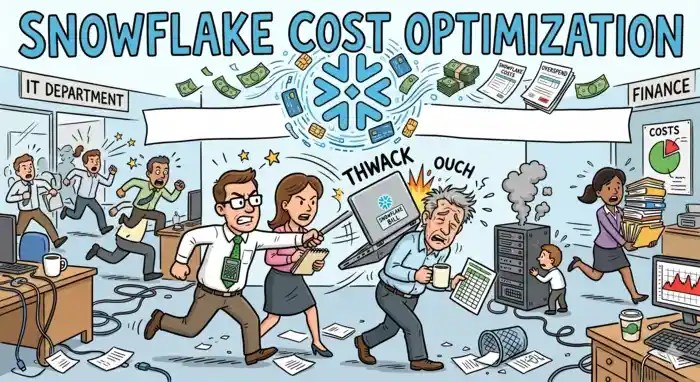
  • Snowflake Cost Optimization: How to Control Data Platform Spend Before Finance Notices

    Snowflake Cost Optimization: How to Control Data Platform Spend Before Finance Notices

    Your Snowflake bill rarely blows up because of one dramatic mistake.

    It usually gets worse through small, approved, reasonable-looking decisions. A dashboard refresh gets tightened. A warehouse stays up longer than expected. A pipeline runs more often because nobody wants stale data. An analyst pulls far more data than the job requires. 

    None of that sounds reckless when it happens. 

    Put it together over a month, and finance starts asking why spending climbed when nobody launched anything big.

    That is why Snowflake cost optimization gets mishandled. You look at the bill after the damage is done instead of looking at the habits that created it. 

    The platform is not trying to cheat you. It is charging exactly as instructed. The problem is that convenience, speed, and loose usage rules quietly turn into recurring costs.

    If you want control, stop treating Snowflake spend as a surprise on the bill. Treat it as an operating discipline. 

    You need to know what starts burning money first, which behaviors hide inside normal usage, and what to fix before cost drift becomes your new baseline.

    Snowflake Cost Optimization Starts When You Stop Thinking In Credits

    Credits make the problem look smaller than it is.

    You say, “We used more credits this month,” and it sounds like a discussion about usage. It is not. It is a spending discussion that you have wrapped in technical language, so nobody feels the impact immediately.

    Switch the lens.

    A warehouse that stays active longer than expected is not “usage.” It is money staying on the meter. A dashboard that refreshes too often is not “engagement.” It is a recurring cost loop. A badly written query is not “inefficient.” It is a direct hit to your budget.

    Once you start translating everything into money, patterns become obvious. The same warehouse that looked harmless at a glance now appears to be a system that never really shuts down. 

    The same set of dashboards now appears to be a continuous compute trigger, not a reporting layer.

    That is where Snowflake cost optimization actually begins. Not with dashboards. Not with alerts. With a change in how you interpret behavior.

    You are not managing a data platform. You are managing a cost engine that reacts exactly to what you allow.

    What One Snowflake Warehouse Actually Costs You In A Day

    “Just one warehouse” is how people talk right before the bill gets stupid.

    So do the math like an adult, not like a hopeful dashboard viewer.

    Say you run a Medium warehouse at 4 credits per hour. I am not using currency here because your actual rate depends on contract, region, edition, and how clever procurement felt that quarter. So keep it in credits for now and translate later.

    Start with the innocent version:

    • 2 hours a day
    • 4 credits per hour
    • 8 credits a day

    Over 30 days, that becomes:

    8 × 30 = 240 credits per month

    Fine. Nobody panics. Nobody starts writing “urgent” in subject lines.

    Now let the same warehouse behave the way it usually does in real life.

    It auto-resumes all day because queries keep hitting it. It stays awake between jobs because the suspend setting is lazy. It is treated like a shared public utility rather than a controlled workload. Your runtime is no longer 2 hours. It becomes 10.

    Now the same warehouse costs:

    10 × 4 = 40 credits a day
    40 × 30 = 1,200 credits a month

    Nothing flashy happened. No new platform. No giant launch. No dramatic architecture failure. You just allowed runtime to spread like a stain.

    Now add concurrency. Snowflake scales because you asked it to. Good for performance. Bad for your blood pressure. If that warehouse starts using 2 clusters instead of 1 during busy windows, your effective burn doubles:

    1,200 × 2 = 2,400 credits a month

    Same warehouse name. Very different financial outcome.

    That is why people get fooled by the “warehouse size” conversation. Size is only half the story. Runtime is the real killer. Concurrency is the accomplice who acts innocent in the meeting.

    Here is the cheat sheet version:

    Monthly warehouse cost in credits = credits per hour × active hours per day × days per month × average cluster multiplier

    So if you want a fast estimate:

    4 × 10 × 30 × 2 = 2,400 credits

    That single line is more useful than three cost dashboards and a sad retrospective.

    And here is the part you should remember: warehouse cost rarely explodes because you chose the wrong size once. 

    It usually explodes because you stopped controlling how long it runs, who shares it, and how often it wakes up. 

    That is the gap you need to close before finance notices the number moved and starts asking whether your data team is mining bitcoin on company time.

    Query Math Is Where Snowflake Cost Optimization Gets Real

    A warehouse does not become expensive by sitting there looking pretty. It becomes expensive because somebody keeps asking dumb, oversized, badly-scoped questions.

    That is the part people dodge. They talk about warehouse sizing because it feels infrastructural and respectable. Query behavior is messier. It points to habits. It points to sloppy analysis. It points out that speed has been subsidizing laziness.

    So strip the emotion out and do the math.

    Say your warehouse burns 4 credits per hour. One query runs for 5 minutes.

    That cost is:

    4 × (5 ÷ 60) = 0.33 credits

    Now look at that number and try not to get overconfident. One-third of a credit feels harmless. That is how bad patterns survive. Nobody gets fired over 0.33 credits.

    Now repeat the same query:

    • 20 times a day by one analyst
    • 10 times by a dashboard refresh cycle
    • 15 times by someone “testing” minor variations because apparently development now means guessing in production

    Now you are at:

    45 × 0.33 = 14.85 credits a day

    Over 30 days:

    14.85 × 30 = 445.5 credits a month

    That is one ugly query pattern. Not a crisis. Not a breach. Not an outage. Just a recurring act of carelessness wearing business-casual clothes.

    Now, make it worse the way reality usually does.

    Let’s say the query is not just frequent. It is fat.

    • pulls more columns than needed
    • Scans old partitions nobody asked for
    • joins large tables before filtering
    • uses SELECT * because discipline was apparently optional that day

    So instead of 5 minutes, it runs for 12.

    Now the cost becomes:

    4 × (12 ÷ 60) = 0.8 credits per run

    Run that same pattern 45 times a day:

    45 × 0.8 = 36 credits a day

    Monthly:

    36 × 30 = 1,080 credits

    That is how you get a bill that feels rude without any single dramatic event behind it.

    Here is the cheat-sheet logic:

    Query cost in credits = warehouse credit rate × execution time in hours

    And if you want a rough daily estimate:

    daily query pattern cost = cost per run × number of runs per day

    Simple. Brutal. No storytelling required.

    The lesson is not “optimize queries” because that sounds like a sad poster in an engineering hallway. The real lesson is this: a slow query is not only a performance problem. It is a spending decision that keeps replaying whenever someone reruns it, embeds it, schedules it, or forgets to kill the dashboard that depends on it.

    You do not need to hunt every bad query in the platform. Start with the repeat offenders. Anything slow and recurring is more dangerous than something ugly that runs once and dies. Frequency is what turns bad design into budget damage.

    That is why query math belongs near the top of any Snowflake cost review. Warehouse size gets attention. Query repetition does the real damage while pretending to be normal.

    Why Your BI Dashboards Are Silently Doubling Snowflake Spend

    You think you built dashboards.

    What you actually built is a system that keeps asking Snowflake the same questions all day.

    A human opens a dashboard a few times. A BI tool does not behave like a human. It refreshes on a schedule, triggers dependent queries, and does so without asking whether the answer has changed enough to justify the cost.

    So let’s put numbers on it.

    Say you have:

    • 10 dashboards
    • Each refreshes every 5 minutes
    • Each refresh triggers 3 queries

    That gives you:

    10 × (60 ÷ 5) × 3 = 360 queries per hour

    Now pause for a second.

    That is not “dashboard usage.” That is a continuous workload.

    Even if each query is light, the warehouse:

    • never reaches auto-suspend
    • stays active across the entire working day
    • Often scales up when multiple refreshes collide

    So your “reporting layer” becomes the reason compute never sleeps.

    Let’s translate that into runtime.

    If dashboards keep the warehouse active for, say, 12 hours instead of 3, your cost does not increase by a small percentage. It multiplies.

    Using the same 4 credits/hour example:

    • 3 hours → 12 credits/day
    • 12 hours → 48 credits/day

    Monthly:

    • 12 × 30 = 360 credits
    • 48 × 30 = 1,440 credits

    Nothing about your business changed. You did not add customers. You did not launch a new product. You just allowed dashboards to behave like background jobs instead of user-triggered tools.

    Now layer concurrency on top.

    Multiple dashboards refreshing at the same time create bursts. Snowflake responds by scaling clusters. You get performance. You also get a higher burn rate during those windows.

    So even if average usage looks stable, peak windows quietly inflate cost.

    Here is the part that usually gets ignored:

    Dashboards are rarely owned like pipelines are.

    • No one reviews refresh frequency regularly.
    • No one questions whether every metric needs near-real-time updates
    • No one deletes dashboards that are no longer used

    So cost accumulates around things that feel “harmless.”

    If you want control, stop treating dashboards as passive. They are active cost drivers. Every refresh interval is a pricing decision. Every unnecessary query is a recurring charge.

    You do not need to kill dashboards. You need to make them earn their runtime.

    Pipeline Frequency is Where Snowflake Cost Drift Accelerates

    You increase pipeline frequency because someone asked for “fresher data.”

    It sounds reasonable. It almost always is, at the start.

    Then it quietly becomes expensive.

    An hourly job moves every 15 minutes. Nobody pushes back because latency sounds like a performance problem, not a cost decision.

    The pipeline keeps doing what it was already doing, just more often. Same transformations. Same scans. Same inefficiencies. Just repeated.

    Now the platform is not working as hard because the business has changed. It is working harder because the schedule has changed.

    That difference matters.

    If your pipeline is already inefficient, increasing frequency does not improve anything. It multiplies the same waste. A full refresh job that used to hurt once an hour now hurts four times an hour. A joint that was already heavy now runs again before the previous impact has even faded.

    The cost curve does not rise gently here. It steps up.

    There is also a behavioral trap. Once faster data becomes available, people begin to rely on it. Dashboards get wired to tighter refresh cycles. Downstream jobs align with the new cadence. 

    Rolling back frequency later becomes politically harder than approving it in the first place.

    So you end up locking in a higher cost without a clear point where someone consciously approved that trade-off.

    If you want control, treat pipeline frequency as a financial decision, not a technical tweak.

    Before you reduce intervals, ask:

    • Is this pipeline incremental or still doing full work every time
    • Does anyone actually use the extra freshness, or is it just available
    • What breaks if this runs less often

    If those answers are fuzzy, you are not improving data freshness. You are buying it unthinkingly.

    That is how pipeline frequency turns into a steady source of cost drift.

    Inter-AZ Data Transfer Cost Optimization: The Silent Bill You Forgot to Budget

    Snowflake cost governance fails when nobody owns the spend

    You do not have governance because you tagged workloads and built a dashboard.

    You have governance when somebody owns the cost-creating behavior.

    That is where Snowflake cost governance usually breaks. Data engineering owns pipelines. BI owns dashboards—analysts’ own queries. The platform owns the account. Finance owns the irritation. Spend moves across all of them, so nobody feels fully responsible for it.

    That is why the bill keeps rising without a clean answer.

    A shared warehouse with no clear owner will stay shared until it becomes expensive. A dashboard with no owner will keep refreshing. 

    A bad recurring query will keep running because no one is required to defend it. 

    Cost control fails long before finance notices. It fails the moment expensive behavior becomes ownerless.

    So keep it blunt.

    Assign owners for:

    • warehouse runtime
    • dashboard refresh policy
    • recurring heavy queries
    • pipeline frequency changes

    That is governance. Everything else is reporting.

    Snowflake Cost Control Playbook: Fix These First

    Cost Leak Area What You Notice What It Usually Means Commercial Damage What You Should Check Decision / Fix
    Warehouse runs longer than expected Spend rises even on days with no major delivery or reporting event Auto-suspend is too loose, or small workloads keep waking the warehouse all day You pay for idle runtime dressed up as “availability” Active hours by warehouse, suspend settings, resume frequency Tighten auto-suspend, review wake-up triggers, and stop treating shared compute like office lighting
    Shared warehouse for BI, pipelines, and ad-hoc queries One warehouse looks expensive, but nobody can explain which function caused it Different workloads are colliding, so cost attribution is useless You lose accountability and keep debating instead of cutting spending Warehouse-to-workload mapping, concurrency windows, top consumers by time slot Split warehouses by workload class so cost has an owner and a reason
    Dashboard refresh frequency Reporting spend stays high even when user traffic is ordinary Dashboards are refreshing far more often than business users need You fund machine curiosity, not business value Refresh interval, dashboard open rate, query count per refresh cycle Slow refresh frequency, increase cache use, and kill vanity “real-time” where nobody acts in real time
    Recurring heavy query One query pattern keeps showing up in history and runtime reports Bad SQL has been operationalized through dashboards, notebooks, or scheduled jobs A small design mistake becomes a monthly budget item Top repeated queries, scan volume, execution time, query source Fix repeated offenders first; frequency matters more than technical ugliness
    SELECT * culture Queries look simple, but scan much more data than the answer needs People are pulling convenience data, not necessary data You burn compute to avoid writing precise SQL Columns scanned vs columns used, scan bytes, query templates Force narrower query design for recurring workloads and dashboards
    Poor filter pushdown / weak pruning Runtime stays high even for narrow business questions Queries hit large table regions before filtering useful rows You pay enterprise rates for sloppy retrieval logic Partition pruning behavior, clustering effectiveness, filter placement in SQL Rewrite queries so filtering happens early, not after the warehouse has already done the expensive work
    Pipeline frequency increase Costs jump after “freshness improvement” or “latency reduction” work Job cadence increased without redesigning the underlying transformation logic You multiplied waste and called it modernization Old vs new schedule, runtime per run, scan volume per run, business dependency on freshness Challenge frequency first; if the business cannot defend the interval, cut it back
    Full refresh jobs Spend spikes around ETL windows even though source changes are limited Jobs are reprocessing too much data every cycle You keep paying to rediscover what you already knew yesterday Incremental logic, CDC usage, full-table scans inside recurring jobs Move to incremental loads before approving any higher cadence
    Concurrency bursts Costs look manageable at average load, but jump during busy windows Multiple users, dashboards, or jobs collide and trigger scaling Performance is purchased at the exact moment nobody remembers approving the cost Cluster scaling events, time-of-day usage spikes, overlapping schedules Stagger jobs, isolate workloads, and decide where speed is worth the premium
    Oversized warehouse choice Queries feel fast, but the bill feels rude You are buying comfort margin instead of the tested need Overprovisioned compute turns laziness into fixed burn Warehouse size by workload type, queue time, actual runtime improvement from larger sizes Downsize where runtime gain does not justify credit burn
    Too many “temporary” test workloads Non-production spend keeps hanging around long after the experiment Sandbox activity became semi-permanent without cost review Prototype spend quietly graduates into recurring spend Dev/test warehouse runtime, user ownership, last meaningful usage date Set expiry logic for test compute and make owners renew it explicitly
    Unused or low-value dashboards Old reports still refresh, but nobody can name the users who care Dashboard retirement never happens because deletion feels risky You keep paying subscription-like compute for dead reporting assets Open rate, last accessed date, refresh history, business owner Retire unused dashboards and make owners justify continued refresh
    No workload owner Everyone agrees spending is high, but nobody changes behavior Cost sits at the platform level, while decisions happen elsewhere Visibility without accountability becomes an expensive ritual Owner mapping for warehouses, dashboards, pipelines, recurring query families Assign named owners for expensive behaviors, not just for the Snowflake account
    Monthly-only cost review Finance sees the issue before engineering does Review cadence is too slow to interrupt bad patterns early You discover problems after they have already become invoice history Review frequency, alert thresholds, time lag between behavior change and escalation Move cost review closer to workload change events, not just end-of-month reporting
    No business value test for “real-time” Freshness keeps improving, but nobody can point to a business action that depends on it Speed has become a status symbol You are buying lower latency without monetizing it Decision windows, operational response times, consumer teams’ actual usage behavior Downgrade refresh and pipeline intervals where business action does not match technical freshness
    FinOps seen as finance’s problem Platform, analytics, and finance keep using different language for the same issue Cost is being reported, not governed You end up with meetings, not savings Cost vocabulary, ownership model, decision rights for workload changes Treat Snowflake as part of the data platform FinOps, with workload economics reviewed alongside performance and freshness

    You do not need another list of best practices. You need a quick way to decide where to act first. Not every leak deserves equal attention. Some fixes cut spending immediately. Others take time and barely move the number. If you want Snowflake cost optimization to work, prioritize based on impact versus effort, not technical neatness.

    Leak Source Credit Burn Pattern Monthly Impact (Relative) Effort to Fix Fastest Action Who Should Own It
    Warehouse never suspends Continuous low-level burn across the day High Low Tighten auto-suspend to aggressive thresholds Platform / Data Infra
    Dashboard refresh loops Repeated query bursts every few minutes High Low Reduce refresh frequency and enable caching BI / Analytics
    Recurring inefficient queries Same query executed dozens of times daily High Medium Fix top 5 repeated queries first Analytics / Data Eng
    Pipeline over-frequency Linear increase in job-triggered compute High Medium Challenge refresh interval before optimizing code Data Engineering
    Full refresh ETL jobs Large scan repeated every run Very High High Move to incremental or CDC-based loads Data Engineering
    Concurrency spikes Short bursts of high cluster scaling Medium to High Medium Stagger workloads and isolate warehouses Platform / Scheduling
    Oversized warehouses High burn per query regardless of efficiency Medium Low Downsize and measure runtime impact Platform Team
    Unused dashboards Background refresh with zero business value Medium Low Audit and remove inactive reports BI / Business Owner
    Ad-hoc experimentation sprawl Irregular but repeated exploratory compute Low to Medium Low Set usage boundaries or quotas Platform / Governance
    No ownership model Diffuse, untraceable cost growth Very High Medium Assign workload-level cost ownership Leadership / Platform Head

    Red Flags That Your Snowflake Cost Optimization Is Just Reporting, Not Control

    The easiest way to spot fake control is simple: the bill keeps rising, but the response is always another explanation.

    You review costs once a month. 

    You circulate a neat summary. 

    You point at usage growth, new workloads, or heavier adoption. 

    Then the meeting ends. Nothing gets denied. Nothing gets slowed down. Nothing gets switched off. That is not optimization. That is bookkeeping with better vocabulary.

    Another red flag is when every workload gets treated as equally valid. Nobody asks whether a slower response time would be perfectly fine. Nobody asks whether the extra freshness is worth the spend. 

    Nobody asks whether that user group needs premium performance or just got used to it. 

    When every request passes without friction, costs stop being managed and are absorbed.

    Then there is the culture problem. Expensive behavior survives because saying no feels harder than paying later. 

    Temporary workloads stay alive. 

    Exceptions never expire. 

    Convenience gets approved faster than scrutiny. 

    The platform becomes financially loose long before anyone says the word “overspend”.

    And the clearest red flag of all: there is no point at which someone can say, “No, this is not worth what it costs.” Without that line, you do not have control. You have permission-less spending with delayed commentary.

    Bare-Metal vs Cloud for AI Workloads: Where the Cost Curve Flips

    Snowflake Cost Optimization Fails When The Cost Has No Decision Threshold

    You do not lose control because Snowflake is confusing. You lose control because no one defines the point at which spending stops being acceptable.

    That is the missing piece. You approve faster performance, more frequent data movement, more user access, and greater convenience, but you do not set thresholds for what each of those is allowed to cost. So the platform keeps doing more, and the bill keeps following behavior that was never commercially bound in the first place.

    That is why the better frame is the FinOps data platform. Not because it sounds mature in a steering meeting. 

    Because it forces one uncomfortable question into the room: what level of cost is justified for this workload, this freshness, this response time, this user group? 

    Without that line, every technical improvement keeps passing as reasonable until finance becomes the only function left willing to say no.

    A mature setup does not chase cost after the bill lands. It defines guardrails before usage spreads. 

    Which workloads deserve premium performance? 

    Which ones can tolerate delay? 

    Which users need freedom? 

    Which ones need limits? 

    Which experiments expire unless renewed? 

    That is how you stop cost drift from becoming your default operating model.

    Snowflake cost optimization gets easier once you stop treating spend as an outcome and start treating it as an approval boundary. That is the shift that matters. Not better reporting. Better refusal.

    The Chaos of Enterprise Cloud Pricing Analysis: AWS vs Azure vs GCP 2026

    Conclusion

    Snowflake cost optimization is not a tuning exercise. It is a discipline problem. If you do not put commercial limits around runtime, query behavior, and workload sprawl, Snowflake will keep charging you for every lazy decision your environment permits. The fix is not better visibility. The fix is a tighter refusal. 

    Control the approvals, and the bill settles down. Keep approving convenience without thresholds, and finance will keep discovering your architecture before you do.

    Also read: Snowflake cost optimization: 8 proven strategies for reducing costs

  • Managed SOC vs MSSP: Which One Breaks First During a Zero-Day?

    Managed SOC vs MSSP: Which One Breaks First During a Zero-Day?

    The security services market is a graveyard of mismatched expectations where “visibility” is a polite word for expensive noise. A CIO signs an MSSP contract to offload the crushing weight of log management, only to find the platform team is still drowning in the same alerts, now just wrapped in a third-party email header. 

    This is the uncomfortable reality of the managed SOC vs MSSP debate: one sells a recurring bill for data storage, while the other is supposed to sell the end of a fire drill. 

    Most providers thrive on the fact that a buyer cannot tell the difference until the production environment is melting. In practice, the typical MSSP model breaks the moment an attacker moves laterally because detection without the authority to isolate a host is just a front-row seat to a digital funeral. 

    This is about the technical debt that eats margins and the operational friction that makes the best engineers quit. This is not about choosing a vendor; it is about deciding who actually owns the risk when the logs start screaming.

    The Alert Factory vs. The Response Engine

    The fundamental breakdown in the managed SOC vs MSSP transition occurs at the point of intent. A traditional MSSP functions as a high-volume intake manifold; it is designed to ingest millions of events and output a filtered list of “interesting” occurrences based on static signatures. 

    The model serves the compliance auditor but fails the incident responder. Because these providers often operate on a one-to-many analyst-to-administrator ratio, they lack the deep environmental context needed to distinguish a legitimate admin script from a credential-harvesting attempt.

    A managed SOC operates on the inverse logic of deep integration. Instead of merely forwarding a telemetry hit, the focus shifts to the investigation lifecycle and the telemetry “last mile.” This is where the managed detection and response for the enterprise model either returns value or becomes a sunk cost. 

    If the provider cannot pivot from a workstation alert to a process tree analysis without calling the internal team, the buyer is paying for a middleman rather than a security outcome.

    • Operational Friction: MSSPs usually stop at the notification phase, leaving the internal team to handle the heavy lifting of verification.
    • Failure Threshold: The system fails when alert volume exceeds the internal team’s capacity to investigate “Low” and “Medium” severity tickets, which often hide lateral movement.
    • The Switch: Experienced teams move to a managed SOC when they realize that paying for unverified alerts is a tax on engineering talent.

    When MSSP Scalability Becomes Your Compliance Liability

    The MSSP business model is a volume game that views your security through a peephole. To keep margins fat, these vendors assign one junior analyst to monitor thirty different customer dashboards. 

    It works until a major zero-day hits the wire. When every company on the planet is screaming for help at once, your “priority” support vanishes. You are not buying a dedicated bodyguard; you are buying a seat on a crowded bus during a riot.

    What teams usually discover is that the MSSP meets their SLA by firing off a generic “investigation started” email while the ransomware is already encrypting the backup server. They are optimized for the audit, not the incident. 

    If the person looking at your logs does not know the difference between your staging environment and your crown jewels, they will treat every alert with the same lukewarm urgency.

    If you cannot call your analyst directly or if they do not know your network topology by heart, you have bought a notification service, not a SOC. In a real crisis, a generic ticket is just a documented record of your failure to contain.

    • Response quality craters during sector-wide attacks because the vendor’s staff is spread too thin to pay attention to your specific IP space.
    • MSSPs scale by ignoring the “boring” alerts that are often the initial entry point.
    • Stick with an MSSP for compliance checkboxes, but move to a managed SOC if you actually expect someone to stop an active predator in your network.

    In-House SOC vs MSSP: The Talent Debt Breakpoint

    Building an in-house SOC vs MSSP is not a security debate; it is a recruitment and retention nightmare. To run a 24/7 operation, the math requires at least eight to twelve full-time engineers to cover shifts, vacations, and the inevitable burnout. 

    For most mid-market enterprises, the cost of just finding and onboarding this talent eats the entire security budget before a single tool is deployed. 

    You are not just buying heads; you are competing with tech giants who pay double for the same skill set.

    In practice, small in-house teams eventually turn into “shelfware” managers. They spend 80% of their time fixing broken connectors and tuning noisy rules instead of hunting threats. 

    The system breaks when the lead analyst leaves for a 30% raise elsewhere, taking the tribal knowledge of your entire detection logic with them. At that point, your internal SOC is just an expensive collection of blinking lights.

    Best Cloud Security Platforms for Enterprise: 10 Market-Leaders You Cannot Miss

    The Build vs. Buy Trade-offs

    • Complete data sovereignty; analysts know exactly where the “bodies are buried” in your legacy code.
    • Extreme “key person” risk; high overhead for 24/7 coverage; slow to adopt new detection playbooks.
    • Immediate 24/7 coverage; predictable monthly spend; access to a broader threat intelligence pool.
    • Loss of granular control; “black box” logic; costs scale aggressively with log volume.

    If your security headcount is less than five, do not build a SOC. You will end up with a “9-to-5 SOC” that leaves the door wide open every weekend.

    The Triage Gap: Where the Design Diagram Fails Production

    Architecture diagrams always show a clean, linear path from an alert to a resolution. In the real world, the hand-off between a provider and your internal team is where speed goes to die. This is the “Triage Gap”. 

    In a standard managed detection and response for enterprise setup, the provider sees the smoke, but they do not have the keys to the fire extinguisher. 

    They send a ticket, your team wakes up, logs into a VPN, and tries to reconstruct the context the provider already had three hours ago.

    What breaks first is the Mean Time to Remediate (MTTR). Production environments are messy; they have legacy patches and “temporary” fixes that have lived for five years. 

    An external provider without deep integration will hesitate to kill a suspicious process on a critical server for fear of breaking a production database. This hesitation is the attacker’s best friend. 

    In practice, the “managed” part of the service often stops right when the high-stakes decision-making begins.

    Do not settle for “Read-Only” access. A SOC is only as good as its ability to act. Use API-driven containment—like isolating a host via your EDR or revoking an OAuth token to allow the provider to neutralize threats in seconds without needing a human on your side to click “Approve.”

    Most “response” services are just “advanced notification” services with a higher price tag.

    Latency is not caused by the network; it is caused by the “permission handshake” between your team and theirs.

    If your provider cannot execute at least three pre-approved containment actions (e.g., isolate host, disable user, block IP), they are not managing your response.

    5 Best Okta IAM Alternatives for Modern Identity at a Lower Cost

    Economic Reality: The SOC Comparison Matrix

    The budget battle for security usually boils down to a fight between “protection” and “predictability.” Finance loves the flat monthly fee of a basic MSSP, but the hidden costs of remediation and internal labor usually turn that flat fee into a baseline, not a ceiling. 

    When calculating the managed SOC vs. MSSP ROI, the primary variable is the “Actionability Ratio”: how much of what you pay for actually results in a risk-reducing event.

    MetricManaged MSSPManaged SOC (MDR)In-House SOC
    Primary OutputLog storage & alert alertsValidated incidents & containmentFull lifecycle ownership
    Margin ImpactLow upfront, high internal laborModerate upfront, low internal laborHigh CAPEX & high OPEX
    Breaks When…False positives bury the teamAPIs/EDR integrations failLead analyst quits for a raise

    The delta between these models is the cost of “investigation hours.” With an MSSP, those hours are billed back to your internal engineering team at their highest hourly rate. 

    With a managed SOC, you are effectively outsourcing the investigation labor. In practice, the total cost of ownership (TCO) for a cheap MSSP often exceeds a premium managed SOC because of the “ghost work” your team does to prove the MSSP’s alerts are wrong.

    Choose based on your bottleneck. If your bottleneck is “compliance logs,” buy an MSSP. If your bottleneck is “not enough engineers to investigate alerts,” buy a managed SOC.

    SOC 2 Type II Compliance: A 90-day plan to become enterprise-ready

    The SOC Outsourcing Decision: Technical Prerequisites

    Before you sign a contract and hand over the keys, you must face a hard truth: no provider can secure a house that has no doors. 

    The SOC outsourcing decision fails most often because the buyer treats the service as a “fix-it” button for broken infrastructure. If you do not have the technical plumbing in place, you are just paying a premium for a third party to document your inevitable demise.

    The Operator’s Readiness Checklist

    • [ ] Identity Baseline: Are your critical systems tied to a central IAM? If the SOC cannot see a user move from the VPN to a database, they cannot track lateral movement.
    • [ ] Log Sanity: Have you filtered out the “debug” noise? Sending raw, unparsed logs to a provider is the fastest way to blow your budget on storage rather than security.
    • [ ] Containment Authority: Does your legal and IT team allow an external entity to “kill” a production server? If the answer is “we need a meeting first,” your response time is measured in hours, not minutes.
    • [ ] Asset Criticality: Is there a “Crown Jewel” list? If a junior analyst at the SOC sees an alert on SRV-PROD-09, do they know that is your primary payment gateway?

    What teams usually discover is that onboarding takes six months instead of six weeks because the internal telemetry is a mess. 

    The provider will wait for you to fix your environment while the monthly invoices start immediately.

    If you cannot check at least three of these boxes, delay the purchase. Spend the next quarter fixing your identity and logging architecture first.

    When NOT to Buy a Managed SOC

    There are specific operational conditions where buying a managed SOC is a high-speed way to set money on fire. The most common mistake is treating a SOC as a substitute for basic IT hygiene. 

    If your environment is a “Wild West” where developers have permanent local admin rights and shadow IT is the default, a managed SOC will simply drown. 

    They will send you three hundred “critical” alerts a day that are actually just your team doing their jobs poorly. You will stop reading the emails within a week, and the service will become a very expensive piece of digital wallpaper.

    This is a maturity trap. A managed SOC requires a “stable base” to be effective. If your internal team cannot handle basic patching or MFA enforcement, you do not have a security problem you have an infrastructure problem. 

    What you discover is that the SOC provider will eventually “tune out” the noise to meet their own internal efficiency metrics, effectively whitelisting the very behaviors an attacker would use to hide.

    The Disqualifiers: Do Not Buy…

    • If your internal IT team is too small or too slow to act on the SOC’s findings, you are just paying for a high-definition recording of your own disaster.
    • If your industry regulations (like certain defense or high-finance tiers) prohibit third-party access to raw data or “offshore” analysis, a standard managed SOC model will fail the first audit.
    • If 80% of your business runs on air-gapped systems or ancient mainframe tech that doesn’t speak modern Syslog or JSON, the SOC is blind. You are paying for a service that can only see 20% of your risk.

    Secure the foundation before you hire the guards.

    The Manager’s Verdict on Remediation Ownership

    The final failure mode of the managed SOC vs MSSP debate is the “Accountability Gap” during a live breach. In the middle of an incident, the most expensive commodity is not expertise, but the authority to act. Most contracts are written in the passive voice to protect the vendor’s liability. 

    They “recommend” actions; they do not “execute” them. 

    If the final step of every critical alert is a phone call to your tired SysAdmin at 3:00 AM, you have not bought a managed service. You have bought a very expensive alarm clock.

    True managed detection and response for an enterprise requires a transfer of trust that most organizations are too terrified to document. In practice, the system breaks down due to “Permission Latency.” 

    An analyst sees a credential dumping attempt on a domain controller but waits for a human signature to isolate the host. By the time that signature is acquired, the entire active directory forest is compromised. 

    The cost of a bad decision is high, but the cost of no decision is usually the end of the business.

    The operational reality is that you cannot outsource the consequence. If you are not prepared to give an external partner the API keys to your firewalls and the authority to shut down a business unit during a confirmed attack, stick with a basic MSSP. 

    It is cheaper to be notified of a failure than to pay for a “response” service that is structurally forbidden from responding. Ownership is binary; either the provider can pull the trigger, or your internal team is still on the hook for the bullet.

    Conclusion 

    The pivot from a basic MSSP to a high-density managed SOC is the moment you stop paying for data and start paying for time. While the upfront cost of a managed SOC is higher, the ROI is found in the reclaimed margins of your engineering team and the reduction of Mean Time to Contain. 

    Secure your identity baseline, define your containment playbooks, and choose a partner that values outcome over volume.

    Also read: MSSP vs. SOC: 6 Key Differences and How to Choose

  • Best Cloud Security Platforms for Enterprise: 10 Market-Leaders You Cannot Miss

    Best Cloud Security Platforms for Enterprise: 10 Market-Leaders You Cannot Miss

    Cloud security platforms for enterprises all sound promising at first. Broad visibility. Unified protection. Smarter prioritization. Fewer tools. Better control. For a while, it all sounds great. Then you and I know what happens. The real questions start showing up. What gets noisy after rollout? What becomes painful once the environment grows? What looks affordable at first but quietly turns into a bigger bill later?

    You and I are not here for another shiny dashboard. We are here to figure out which platform can reduce risk without dumping more operational mess on the team. Some look impressive until alerts start piling up. Some go deep, but bring cost and complexity with them. Some feel smooth only when the rest of the stack already leans toward the same vendor.

    So let’s find out which platforms are genuinely worth attention, which ones fit specific enterprise conditions better than others, and which ones start to hurt once the cloud estate grows larger, noisier, and harder to control.

    Why enterprises need a cloud security platform, not just more security tools

    For years, teams kept solving cloud risk the usual way. Add one tool for posture management. Add another for workload protection. Add one more for identity risk. Maybe something else for containers, secrets, or code scanning. 

    On paper, that sounds manageable. In real life, it creates overlap, alert clutter, and too many places to look when something goes wrong.

    That is why cloud security platforms for enterprise have become a serious buying category rather than just another vendor slogan. The problem is no longer a lack of security data. 

    The problem is too much scattered context. 

    One tool sees the misconfiguration. 

    Another sees the exposed workload. 

    A third sees the risky permission path. If your team has to stitch that story together manually, the platform is not helping enough.

    The appeal here is pretty simple. Fewer disconnected tools. Better visibility across cloud assets and identities. 

    A clearer view of what is actually dangerous versus what is just technically wrong. That matters because enterprise environments do not stay neat for long. 

    They grow across accounts, regions, business units, acquisitions, and half-finished projects nobody wants to own.

    A decent platform should help your team cut through that mess, not by throwing even more findings at you, but by connecting the risk in a way that makes action easier. That is the promise behind cloud security platforms for enterprises, and it is also where many vendors start to wobble. 

    They can collect signals. 

    They can generate dashboards. 

    But making the output useful at scale is a very different job.

    So the real need is not “one more security tool.” It is a platform that gives your team a usable picture of risk without turning day-to-day operations into another cleanup project.

    CrowdStrike Alternatives for Enterprise: 15 Tools Compared for Cost, Detection, and Control

    How we chose the best cloud security platforms for enterprise

    Many platforms can look impressive in a buyer’s guide. Clean dashboard. Big promises. Strong feature language. That part is easy.

    We kept the filter simpler and harsher.

    We looked at:

    • visibility across cloud assets
    • workload and runtime coverage
    • identity and permission risk context
    • posture management depth
    • signal quality, not just alert volume
    • ease of investigation and prioritization
    • multicloud strength
    • ecosystem lock-in risk
    • rollout friction
    • day-two operational overhead
    • likely pricing expansion over time

    We also cared about something buyers usually discover too late:

    • Does the platform remain useful as the environment grows?
    • Does it reduce noise or just reorganize noise?
    • Does it help the team move faster, or just give them more to review?
    • Does it work broadly, or mostly inside one vendor-friendly world?

    Some tools are very good at finding issues. That alone is not enough. If the team still has to stitch together the real story by hand, the platform is not doing enough.

    Some cloud security platforms for enterprises go wide. Some go deep. Some are easier to deploy. Some demand more tuning, more patience, and more budget. We kept all of that in view while building this list.

    So the goal here was not to reward the loudest vendor. It was to identify the platforms that look more usable when the demo ends, and real life begins.

    Best Cloud Security Platforms for Enterprises at a Glance

    Not every platform on this list is trying to win in the same way. Some are built to give you broad multicloud visibility fast. Some go harder on runtime and cloud-native depth. Some make more sense when your stack already leans toward a major ecosystem. A few are here because they deserve more attention than they usually get.

    Platform Best For Cost Strengths Trade-Offs
    Wiz Fast multicloud visibility Premium Strong context, fast value Expensive, premium-heavy
    Prisma Cloud Deep code-to-cloud coverage Premium Broad depth, enterprise-ready Complex, can feel heavy
    Upwind Modern runtime-focused teams Mid to premium Strong runtime story, fresh product Smaller footprint, quote-led
    Microsoft Defender for Cloud Microsoft-heavy estates Flexible to premium Strong ecosystem fit, easier entry Costs stack up, ecosystem pull
    Orca Security Agentless enterprise coverage Premium Fast onboarding, good visibility Still costly, some noise
    Sysdig Kubernetes-heavy environments Mid to premium Strong runtime, cloud-native depth More specialized, less broad
    CrowdStrike Falcon Cloud Security SecOps-linked cloud security Premium Strong Falcon tie-in, solid ops fit Best if already in Falcon
    Tenable Cloud Security Exposure-focused teams Mid to premium Good risk view, solid fit Less buzz, less shine
    Aqua Security Container-heavy environments Mid to premium Strong container depth Narrower appeal, can get pricey
    FortiCNAPP Fortinet-leaning enterprises Mid to premium Good stack alignment Less neutral, narrower fit

    Upwind

    Upwind is a good fit if you want runtime context to matter more than static findings. It helps teams focus on what is live, reachable, and relevant instead of drowning in generic cloud risk lists.

    The benefit is sharper prioritization. This works well for teams that are tired of broad posture data without enough production context.

    The trade-off is maturity. It is a newer name, so some buyers will still lean toward safer, more established vendors.

    Microsoft Defender for Cloud

    Microsoft Defender for Cloud makes the most sense when your environment already leans heavily toward Microsoft. It gives you cloud security without forcing you into a completely separate operating model.

    The benefit is ecosystem fit. It is easier to justify when your teams already use Microsoft across identity, endpoint, and security operations.

    The trade-off is neutrality. It is strongest when the rest of your stack already points in the same direction.

    SentinelOne vs Microsoft Defender Scorecard: Which EDR Delivers Better Long-Term Value?

    Aqua Security

    Aqua is a strong pick for container-heavy and Kubernetes-heavy environments. If your cloud security problem is closely tied to workloads, images, and cloud-native application risk, Aqua remains relevant.

    The benefit is depth in cloud-native protection. It works well for teams that care about container security as more than a side feature.

    The trade-off is breadth. It may feel less attractive if you want one broad platform story for every cloud security conversation.

    Orca Security

    Orca works well for teams that want broad visibility without a painful rollout. The agentless model is a big part of the appeal because it lowers friction early.

    The benefit is speed. You can get coverage and context faster without turning deployment into a project of its own.

    The trade-off is cost. It is still an enterprise platform, not a cheap shortcut.

    Sysdig

    Sysdig fits best in cloud-native environments where runtime visibility is critical. If Kubernetes and containers are central to your world, Sysdig becomes much more interesting.

    The benefit is runtime strength. It gives security teams greater depth, whereas many generic platforms still feel too posture-heavy.

    The trade-off is audience fit. It can feel more specialized than some broader cloud security platforms for enterprise.

    Wiz

    Wiz is strong when you want fast visibility and better risk context without dragging the team into a long deployment cycle.

    The benefit is clarity. It connects assets, permissions, identities, and attack paths to facilitate prioritization.

    The trade-off is price. This is usually not the platform people choose because it feels cheap.

    Tenable Cloud Security

    Tenable Cloud Security is a sensible pick for teams that already think in terms of exposure management and broader risk visibility.

    The benefit is perspective. It can make more sense than flashier vendors if your team wants cloud risk tied into a wider risk picture.

    The trade-off is excitement. It does not always get the same buzz as the category darlings.

    CrowdStrike Falcon Cloud Security

    CrowdStrike Falcon Cloud Security makes sense when cloud security is not being bought in isolation. It is stronger when the wider Falcon platform is already part of the environment.

    The benefit is SecOps alignment. Teams can connect cloud risk more naturally with the rest of their security operations motion.

    The trade-off is dependency on the broader stack. It becomes less compelling if you are not already leaning into CrowdStrike.

    Prisma Cloud

    Prisma Cloud is one of the stronger options for broad, deep coverage across the lifecycle, especially for large programs that require code-to-cloud depth.

    The benefit is the range. It can cover a lot, making it attractive to enterprises that do not want to keep adding separate products.

    The trade-off is complexity. The platform can feel heavier to manage than tools built around a simpler story.

    FortiCNAPP

    FortiCNAPP is worth looking at when the broader security stack already leans toward Fortinet. In that kind of setup, the platform can feel more natural than it does in a neutral evaluation.

    The benefit is alignment. It fits better when cloud security is being evaluated as part of a larger Fortinet-led environment.

    The trade-off is standalone appeal. It is harder to love if you want a more vendor-neutral choice.

    Which cloud security platform fits your enterprise best

    Different teams care about different things. Some want faster visibility. Some want deeper protection. Some want less operational pain. Some want better value. That is why cloud security platforms for enterprise should be compared by fit, not just by market noise.

    • Fast visibility and quick time to value: Wiz, Orca Security. Good fit when the priority is seeing risk quickly without dragging rollout into a long project.
    • Deep runtime and cloud-native coverage: Upwind, Sysdig, Aqua Security. Better fit when runtime, containers, and Kubernetes matter more than a broad posture-only story.
    • Microsoft-heavy environments: Microsoft Defender for Cloud. Stronger fit when identity, endpoint, and cloud security already lean toward Microsoft.
    • For teams already tightly integrated with a broader security platform, such as CrowdStrike Falcon Cloud Security and FortiCNAPP. A more natural fit when adding cloud security to an existing Falcon- or Fortinet-led environment.
    • Broad code-to-cloud depth: Prisma Cloud. Better fit when you want wide coverage across the lifecycle and can tolerate more platform weight.
    • Exposure management and risk-centric visibility: Tenable Cloud Security. Sensible fit when the team wants cloud risk tied into a broader risk view, not just a pure CNAPP story.

    Read the cloud security platforms for enterprises market first. Not who sounds biggest, but who fits the kind of problem you are trying to solve.

    Where these platforms start hurting

    Wiz looks great when you want quick visibility and cleaner prioritization. The problem shows up later. It is a premium product, and the bill can get uncomfortable as coverage expands. Easy to admire, harder to defend when finance starts looking closely.

    Prisma Cloud gives you depth, but it also gives you weight. This is the kind of platform that can start feeling like work. More tuning, more coordination, more internal effort. Strong product, but not a light one.

    Microsoft Defender for Cloud is attractive because it feels closely aligned with the rest of the Microsoft world. That same strength becomes a weakness if your environment is mixed or if buyers assume “already in the ecosystem” means “cheap.” It usually does not stay cheap once protections and plans stack up.

    Orca Security sells speed well, especially with the agentless story. Fair enough. But fast rollout does not mean low effort forever. The real test comes later, when teams have to live with the findings, the ownership questions, and the day-to-day noise.

    CrowdStrike Falcon Cloud Security makes the most sense when Falcon is already part of the environment. If it is not, the logic gets weaker. Then it starts looking less like the best cloud choice and more like a platform extension.

    FortiCNAPP has the same issue in a different flavor. It becomes easier to justify when Fortinet is already embedded. Outside that kind of setup, it is harder to get excited about as a neutral first-choice platform.

    Sysdig and Aqua Security are strong when runtime, containers, and Kubernetes really matter. If that is not the center of your risk picture, they can feel too specialized. Good tools, but not always the right shape for the wider enterprise story.

    Upwind has the opposite problem. It feels modern and sharp, which is exactly why some teams will like it. But newer names still make conservative buyers nervous. Product quality may be fine. Procurement nerves are a different issue.

    Tenable Cloud Security is useful, but it does not always create the same excitement as louder CNAPP vendors. That matters more than it should. Sometimes a solid product gets overlooked simply because it does not create enough buzz in the room.

    That is usually how these products go wrong. Not because they are useless. Because they become too expensive, too heavy, too vendor-shaped, or too noisy once real enterprise conditions kick in.

    7 Mistakes That Turn Enterprise EDR Evaluation Into an Expensive Procurement Exercise

    Who Wins the Race

    If you want the cleanest mix of speed, visibility, and buyer confidence, Wiz is the safest strong pick. If you want deeper code-to-cloud coverage and can handle more weight, Prisma Cloud stays serious. If you are already deep in Microsoft, Defender for Cloud is the practical choice, not the romantic one.

    The more interesting names sit just outside the obvious shortlist. Upwind looks sharper than many older platforms if runtime matters a lot. Orca Security stays attractive when fast agentless coverage is a major priority. 

    Sysdig and Aqua Security make more sense when the real cloud problem is containers, Kubernetes, and runtime risk, not just posture. Tenable Cloud Security is solid for teams that think in terms of exposure and risk, even if it does not create the same market excitement. 

    CrowdStrike Falcon Cloud Security and FortiCNAPP get stronger when the wider platform story is already in place.

    So the real verdict is simple. Do not buy the platform with the loudest category reputation. Do not buy the one with the longest feature sheet either. 

    Buy the one that matches your environment, your team’s tolerance for operational weight, and your willingness to pay more later.

    Because in this market, the wrong platform usually does not fail in the demo. It fails after the rollout, when the bill grows, the findings pile up, and the team realizes they bought one more thing to manage instead of one less problem.

    Final verdict

    The best choice here depends less on hype and more on fit. Some platforms win on speed, some on depth, some on runtime strength, and some only make real sense inside a larger vendor ecosystem.

    The smarter move is to pick the platform your team can still live with after rollout, not the one that looked the smartest in the demo.

  • 7 Mistakes That Turn Enterprise EDR Evaluation Into an Expensive Procurement Exercise

    7 Mistakes That Turn Enterprise EDR Evaluation Into an Expensive Procurement Exercise

    Enterprise EDR evaluation has a tendency to make smart people feel safe too early.

    The shortlist looks solid. The demos are polished. The proof of value is tidy. Procurement gets neat pricing bands. Security gets detection stories. Everyone gets just enough structure to believe the process is under control.

    Then production happens.

    Now the real costs start walking in. Analyst fatigue. Tuning overhead. Policy exceptions. Response friction. Add-ons that looked optional when the vendor was still smiling on calls.

    That is the part buyers keep underestimating. They think they are evaluating an EDR product. Often, they are really evaluating how convincingly a vendor can stage confidence within a controlled buying cycle.

    And EDR vendors are not stupid. They know exactly how to make a product look calm before your team has to live with it.

    So the buying process starts to behave like procurement theater, with security vocabulary sprinkled on top. The product scores well. The committee feels organized. The approval moves forward. Then six months later, the SOC is carrying the bill in a form nobody modeled properly.

    Most EDR buyer’s guide content will help you compare names. That is the easy part.

    The harder part is spotting the mistakes that make an EDR decision look clean at approval time and heavy after rollout.

    Enterprise EDR Evaluation Starts With the Wrong Test

    You do not lose this decision in rollout first.

    You lose it earlier.

    Right when the vendor starts setting the mood.

    Clean demo. Crisp detections. Neat proof of value. A lot of confidence in the room. Just enough technical depth to make the process feel serious.

    That is how weak evaluation logic hides.

    Your real pain is usually less glamorous. Too many alerts. Slow triage. Weak containment. A messy estate. Policies that nobody wants to touch twice. Analysts are wasting time on work that should have been easier by now.

    If you do not start there, the rest gets performative fast.

    You are not buying applause from a buying committee.

    You are trying to remove a daily irritation your team keeps paying for in time, effort, and attention.

    So test the pain, not the pitch.

    If analyst fatigue is hurting you, look hard at triage flow and alert quality. If containment is clumsy, test response depth. If your environment is uneven, test tuning burden and policy control. If your team is stretched, test how much operational babysitting the product will demand after go-live.

    Plenty of products look sharp when the path is guided.

    Fewer of them stay sharp when your own people have to live inside them.

    That is the filter you need. Not who looks strongest in a controlled sales cycle. Who removes friction once the product becomes your problem?

    Enterprise AI Reviews Are Exposing Ownership Gaps

    Detection Looks Good Until Alerts Start Piling Up

    Detection is the easy part to admire.

    An alert fires. A malicious chain gets mapped nicely. The console looks smart. The demo gets its moment.

    Then real life begins.

    Alerts keep coming. 

    Analysts keep opening, checking, closing, reopening. 

    The same people who were supposed to investigate real risk start burning time sorting junk, duplicates, weak context, and half-useful signals. 

    At that point, strong detection no longer feels like strength. It starts feeling like extra work with better branding.

    That is the part buyers underrate. You are not paying for detection in isolation. You are paying for what happens after detection. 

    How fast can an analyst understand the alert? 

    How much context shows up without manual digging? 

    How often does the product force your team to stitch the story together on its own? 

    A tool that detects more but makes triage slower can still leave you worse off.

    This is why clean evaluation cycles can be misleading. In a controlled test, detection looks like the star. In daily operations, alert handling decides whether the product helps or drains the team. 

    If the queue keeps growing, the nice detection story quickly loses value.

    Llama vs Mistral: Assessing the best local models for privacy of Business Data

    Post-Rollout Tuning Is Where EDR Cost Starts Rising

    Rollout gives buyers a false sense of closure.

    The product is live. The agent is deployed. The dashboard is populated. On paper, the hard part looks done.

    It is not.

    Post rollout is the stage where EDR starts asking for rent in admin time, SOC attention, and constant cleanup. What looked manageable in evaluation can turn irritating very quickly.

    What starts showing up:

    • false positives that need repeated suppression
    • exclusions that keep growing as edge cases surface
    • policies that work in one part of the estate and break in another
    • endpoint groups that need cleaner logic than the original rollout assumed
    • performance complaints from users that force a compromise
    • Exceptions that keep getting patched instead of being designed properly

    None of this looks dramatic in a buying cycle.

    All of it becomes expensive after rollout.

    That is the catch. Base pricing stays the same. The real cost does not. Your team starts paying through hours, interruptions, retesting, and operational babysitting. 

    A product that needs too much post-rollout tuning can turn a decent buying decision into a long cleanup project.

    Proof of Value Can Make a Weak Fit Look Strong

    A proof of value can make you feel smarter than you really are.

    Everything behaves. The scope is clean. The vendor stays close. The product gets shown in the part of the house where the lights work.

    That should make you cautious.

    What you are seeing is not fake. It is filtered.

    Usually filtered by:

    • controlled scope
    • guided workflows
    • selected use cases
    • Vendor support sitting nearby, success criteria that are easier to pass than the daily operations

    So the product starts looking solid before it has done anything difficult.

    That is a bad reason to feel comfortable.

    You do not need a product that behaves well when the vendor is still driving. You need a product that still makes sense when your own team has the wheel, the queue is ugly, and nobody is around to rescue the workflow.

    A weak fit can survive a tidy proof of value.

    Production is less polite.

    CrowdStrike Alternatives for Enterprise: 15 Tools Compared for Cost, Detection, and Control

    Enterprise EDR Evaluation Scorecard

    Detection gets attention because it is easy to show.

    Response is when the product starts to prove whether it is useful or just impressive.

    Many EDR evaluations get stuck on what the platform can detect. Fair enough. But when something serious lands, the better question is much simpler: can your team act fast without turning every incident into a manual project? That is where weak products start showing their teeth.

    Evaluation Area Weight (%) What You Should Check Bad Sign
    Alert handling 25 How quickly an analyst can understand, validate, and move on to an alert Too much digging, weak context, repeated manual work
    Response speed 20 How easily the team can isolate, contain, or take action during an incident Too many steps, too much coordination, slow action path
    Tuning effort 20 How much cleanup, exclusion work, and policy adjustment shows up after rollout Constant babysitting to keep the product usable
    Workflow fit 15 How well the product fits the way your SOC or security team already works Analysts work around the tool instead of through it
    Cost beyond the license 10 Add-ons, admin burden, service dependence, and operating overhead Base price looks fine, but the real running cost does not
    Test honesty 10 Whether the product still looks strong without vendor hand-holding Smooth only in a guided setup

    A product can score well on detection and still drag you down on everything that follows. 

    If the tool slows response, adds cleanup, and keeps the analyst stuck in extra steps, you are not buying relief. 

    You are buying a more expensive version of the same stress.

    Most EDR Buyer’s Guide Content Ignores Operational Friction

    A lot of buyer’s guide content is designed to help you quickly compare vendors.

    That sounds useful.

    It also creates lazy buying behavior.

    You get the usual checklist. Features. Integrations. Pricing tiers. Maybe a few neat pros and cons. Enough structure to build a shortlist. Not enough pressure to expose what will irritate your team after rollout.

    That is the gap.

    An EDR buyer’s guide can help you collect names. It usually does very little to show:

    • How much analyst time does the product keep consuming
    • How much tuning work keeps showing up after go-live
    • How awkward a response feels when the incident is live
    • How much vendor hand-holding was needed to make the product look smooth
    • How quickly does the real cost expand beyond the base license

    So the shortlist starts looking smarter than it is.

    You do not need help finding products.

    You need help ruling out products that create drag.

    That is why a buyer’s guide should never drive the decision on its own. At best, it gives you a starting list. 

    SentinelOne vs Microsoft Defender Scorecard: Which EDR Delivers Better Long-Term Value?

    Base License Pricing Rarely Reflects Real EDR Cost

    Base pricing is the part that buyers can see clearly.

    That is also why it gets too much respect.

    The quote looks neat. The per-endpoint number feels manageable. The discussion becomes easier because everyone can point to a figure and pretend the cost is now understood. It is not. 

    In EDR, the base license is usually the cleanest part of the bill.

    The real expansion starts later.

    Cost Head What Buyers Expect What Usually Happens
    Base license The main cost is covered It only gets the product through the door
    Data retention Standard history is enough More retention starts costing more once investigations get deeper
    Premium modules Optional extras Gaps in daily use start pushing the team toward upgrades
    MDR or premium support Backup option Becomes necessary when the internal team cannot keep up cleanly
    Tuning effort Short stabilization phase Keeps consuming analyst and admin time long after rollout
    False positive cleanup Early rollout issue Turns into a recurring SOC burden
    Policy exceptions Limited to a few edge cases Grows as the estate gets messier
    Performance complaints Rare and manageable Force compromises, exclusions, and more testing
    Internal admin effort Light ownership overhead Becomes ongoing work across policies, groups, and platform hygiene
    Incident response effort The product will reduce effort by default Analysts still lose time in manual steps and coordination

    What this table shows is simple: EDR costs do not usually jump in a single dramatic moment. It spreads. One extra need here, one added dependency there, one more chunk of analyst time nobody modeled properly. That is how a product that looked reasonably priced in procurement starts feeling heavier in operations.

    So the mistake is not just underestimating spend.

    It is underestimating where the spending moves. The buying team approves a visible number. The security team inherits the invisible workload.

    Conclusion

    A clean enterprise EDR evaluation should do one thing well: stop you from buying a product that shifts cost from procurement to operations. That means less attention to polished demos and more to alert load, tuning burden, response friction, and the operating model behind the tool. If those parts remain weak, the product will feel heavier after rollout, even if it looked good in evaluation.

    The real win is not choosing the most impressive platform. It is ruling out the one your team will regret running.

    Also Read: The Straightforward Buyer’s Guide to EDR

  • 5 Best Okta IAM Alternatives for Modern Identity at a Lower Cost

    5 Best Okta IAM Alternatives for Modern Identity at a Lower Cost

    Best Okta IAM alternatives usually come into the picture the same way many expensive software conversations do. Nobody wakes up wanting to replace a known platform. The trigger is smaller at first. 

    A renewal number lands badly. 

    Your team wants a faster rollout, cleaner developer workflows, or a better fit for external identity, and the platform feels heavier than the problem in front of you.

    That is when the search becomes real. Not theoretical. Not market research for its own sake. You are no longer asking whether Okta is a credible platform. 

    You are asking whether it is still the right commercial and operational fit for your next stage. Those are very different questions.

    Some alternatives look cheaper but end up shifting costs to engineering effort, governance gaps, or support weaknesses. Others give you tighter control, faster implementation, and a platform shape that makes more sense for modern identity use cases. That is the tension behind this shortlist. 

    The goal is not to leave a market leader for the romance of change. The goal is to find out whether you are still paying for the right thing.

    When Okta Stops Making Commercial Sense

    Okta stops making commercial sense when a familiar platform starts feeling too expensive for the job it now has to do.

    That shift rarely happens on day one.

    It usually shows up later, when your identity footprint expands, and the next phase starts asking for more users, more integrations, more flexibility, or a better fit for customer-facing use cases. What once felt like a safe enterprise decision is now attracting tougher questions about cost, rollout effort, and overall fit.

    Price is usually the first trigger, but not the only one. 

    In many cases, the bigger issue is platform weight. Your team may want a faster implementation path, greater control over the identity layer, or a setup that better aligns with modern application flows. Once that happens, the discussion stops being about whether Okta is a credible platform. It becomes a more practical question: are you still paying for the right platform shape?

    The point is not to chase the cheapest option to search for the best Okta IAM alternatives. The point is to find a platform that lowers long-term cost without creating new problems elsewhere. 

    A weaker product can save money on paper and still cost you more through engineering effort, support pain, or operational workarounds.

    The strong alternatives are those that reduce costs without changing the operating model. That is the real filter in this category. 

    You are not trying to spend less at any cost. 

    You are trying to stop paying enterprise-platform overhead, when a leaner, better-aligned option may do the job more cleanly.

    Okta Pricing Explained: IAM Licensing, Add-Ons, and Where Costs Escalate

    The Best Okta IAM Alternatives that Give You More for the Money

    The value gap between Okta and the Best Okta IAM Alternatives becomes clear only when cost and ownership are evaluated together.

    Stytch gives you more for the money when your priority is modern external identity with less enterprise-platform drag. It makes sense when you want strong capabilities, cleaner product alignment, and a setup that doesn’t feel oversized for the use case.

    Ory gives you more for the money when control matters more than convenience. When they have the technical depth, your team will want to manage IAM themselves rather than rely on the vendor-defined model.

    LoginRadius gives you more for your money when you still want an enterprise-facing CIAM platform but do not want Okta-level commercial weight attached. 

    It is easier to defend when the buying process involves security, architecture, and procurement all in the same room.

    Clerk gives you more for the money when speed matters more than depth. It is attractive because the build path is cleaner and the product experience is polished. The risk is that what feels efficient early on may start to feel narrow later.

    SuperTokens gives you more for the money when cost control is a hard requirement, and your team is comfortable owning more of the implementation burden. 

    That is where it becomes compelling. 

    It cuts platform weight, but it also asks more of you.

    So the answer is not just about price.

    The better question is where you want the burden to sit.

    • Keep paying the vendor to reduce risk and internal effort?
    • Want lower platform cost but more ownership on your side?
    • Or, want faster product delivery even if that means accepting a narrower operating envelope?

    That is where these platforms separate.

    The strongest value play for most buyers will come from the option that removes cost without quietly adding complexity somewhere else.

    Best Okta Alternatives for Enterprise: 7 Identity Platforms Compared for Scale, Cost, and Control

    Where These Platforms Win

    The Best Okta IAM Alternatives do not win for the same reasons. Some platforms win because they reduce platform weight. Others win because they preserve enterprise confidence while trimming costs. 

    The difference matters because not every Okta buyer is trying to solve the same problem.

    The cleaner modern identity play sits with Stytch. It wins where you want strong external identity capability without inheriting the full heaviness of a legacy enterprise buying model. The appeal is not only technical. 

    It is also commercial. 

    You get a platform that feels closer to the way modern products are built and sold.

    The control-heavy position belongs to Ory. It wins when your team cares less about vendor comfort and more about owning the identity architecture properly. That makes it more attractive to technically mature teams that do not want their identity stack boxed in by commercial packaging.

    LoginRadius wins where the decision still has to feel enterprise-safe. It gives you a more familiar CIAM shape, which helps when the shortlist must survive security, architecture, and procurement reviews without looking like a developer-led detour.

    Then there is the speed layer. Clerk wins there. It is easier to like because it removes friction quickly for teams that want momentum and a cleaner build path, which matters a lot.

    SuperTokens wins the moment cost control becomes a serious conversation in the boardroom or budget. It draws attention because it gives you a way to reduce licensing overhead and maintain more control. That is a real advantage, not a side note.

    Okta still wins on one thing the alternatives cannot dismiss: institutional comfort. A familiar platform is easier to defend, renew, and maintain when internal resistance to change is high.

    This is the real shape of the market.

    Stytch wins on modern fit.

    Ory wins on control.

    LoginRadius wins on enterprise-safe replacement value.

    Clerk wins on speed.

    SuperTokens wins on cost pressure.

    Best IAM Solutions for Mid-Size Enterprise: What Actually Works After 500 Employees

    Where These Platforms Break

    The shortlist tightens in a few familiar places. The Best Okta IAM Alternatives also start to converge on the same few failure zones.

    Governance is one. A platform can look clean and efficient early on, then start to feel light once identity becomes a policy, control, and review problem. 

    Clerk can come under pressure there. SuperTokens can too, especially when the expectation is strong control without much operating lift on your side.

    Ownership is another. Lower platform cost often means more responsibility shifts to your team. That trade works well in some environments and poorly in others.

    • Ory fits better when your team wants architectural control and can handle it.
    • SuperTokens fits better when cost pressure is real, and your team is willing to own more of the implementation layer.
    • Both lose some appeal when the expectation is lower, with very little internal effort.

    Internal buying comfort also changes the shortlist. A platform may look strong in a technical review but still face resistance once security, architecture, procurement, and business stakeholders weigh in.

    • LoginRadius is easier to carry through a conservative enterprise cycle.
    • Stytch can still hold up well, but the internal case needs to be clearer.
    • Clerk and SuperTokens may face more hesitation in risk-averse environments.

    Speed can also mislead. A platform that feels easy in the first phase may not feel as comfortable once extensibility, non-standard requirements, and long-term operating depth become more important.

    Some platforms reduce spend. Some reduce friction. Very few do both equally well.

    Azure Entra Alternatives: Which IAM Platform Fits Better for B2B SaaS?

    Pricing and Long-Term Cost Reality

    Okta gets expensive in a familiar way. 

    The initial decision may look defensible, but the long-term cost becomes harder to justify as usage grows, more identity scenarios arise, or the team needs more flexibility than the original scope allowed. 

    A known platform can remain in place for a long time due to internal comfort. That does not make the commercial model efficient.

    The alternatives break into different cost shapes.

    • Stytch works when you want a modern external identity without carrying the full weight of an enterprise platform.
    • Ory looks stronger when license control and architectural ownership matter more than vendor-managed convenience.
    • SuperTokens gets attractive when cost pressure is high, and your team is willing to own more of the implementation layer.
    • LoginRadius stays closer to the enterprise CIAM buying model, making the spend easier to defend internally.
    • Clerk looks efficient early, but only if the platform still fits as requirements get heavier.

    Price alone does not settle this category. Identity cost shows up in three places: platform cost, implementation cost, and ongoing operating cost.

    A lower-priced platform can still become expensive if it requires engineering effort, relies on support, or relies on a workaround-heavy delivery. A higher-priced platform can still make sense if it removes enough internal burden.

    That is the commercial test. Cost reduction only matters when it does not create a second problem in delivery, governance, or operations.

    Okta vs Ping Identity Comparison: Buyer Guide for Enterprise Identity Strategy

    Weighted Scoring Framework to Judge Okta Alternatives

    A framework matters because the Best Okta IAM Alternatives do not separate on features alone. These platforms differ in cost, control, rollout effort, governance depth, and the balance of burden between the vendor and your team. A weighted view makes that easier to judge.

    Criterion Why It Matters Weight SuperTokens Ory Clerk Stytch LoginRadius Top Performer
    Core Identity Capability Shows whether the platform can handle serious IAM and CIAM needs without creating gaps later. 3x 3 4 3 4 4 Stytch
    Governance and Security Depth Matters once identity becomes a control, compliance, and review issue. 3x 3 4 3 4 4 LoginRadius
    Integration Flexibility Shows how well the platform fits your stack and non-standard identity requirements. 3x 4 5 3 4 4 Ory
    Implementation Speed Impacts time to value and how quickly your team can move from decision to rollout. 2x 3 3 5 4 3 Clerk
    Admin Overhead Affects how much ongoing effort your team spends managing identity after go-live. 2x 3 3 4 4 3 Stytch
    Long-Term Cost Separates lower license cost from true commercial efficiency over time. 3x 5 4 4 4 3 SuperTokens
    Scalability Shows whether the platform can hold up as usage, integrations, and governance demands expand. 2x 3 4 3 4 4 LoginRadius
    Enterprise Buying Comfort Matters when security, architecture, procurement, and business stakeholders all influence the decision. 2x 2 3 3 4 4 LoginRadius
    Total Weighted Score Sum of score × weight across all criteria. – 58 69 61 72 67 Stytch

    How to read the scores

    • Each platform is scored on a 1–5 scale across the criteria listed in the table.
    • Each criterion is then multiplied by its assigned weight to reflect buying importance.
    • The criteria focus on what usually decides IAM platform selection in practice: capability, governance, integration fit, rollout speed, admin load, long-term cost, scalability, and enterprise buying comfort.
    • Higher totals do not mean a platform is universally better. They mean it holds up better against this specific decision lens.

    Which Platform Should You Choose

    • Choose Stytch when you want the best overall balance of modern identity capability, faster rollout, and lower long-term platform weight.
    • Choose Ory when control, flexibility, and architectural ownership matter more than convenience.
    • Choose LoginRadius when you want a more enterprise-shaped CIAM replacement that is easier to defend internally.
    • Choose Clerk when speed, developer experience, and fast product delivery matter most.
    • Choose SuperTokens when cost pressure is high, and your team is comfortable owning more of the implementation layer.
    • Stay with Okta when governance depth, scale, confidence, and enterprise buying comfort matter more than cost reduction.

    IAM Pricing Models Explained: Per User vs Tiered vs Enterprise Plans

    Final Recommendation

    Among the Best Okta IAM Alternatives, Stytch comes out strongest overall.

    It gives you the cleanest balance of capability, speed, and long-term commercial sense without dragging the full weight of an Okta-style platform model.

    Ory is the better choice when control matters more than convenience.

    LoginRadius is the safer replacement path when the decision needs to feel more enterprise-familiar.

    Clerk is the speed play.

    SuperTokens is the cost play.

    Okta remains the better call when your environment puts the highest value on governance depth, scale, confidence, and internal buying comfort.

    So the decision is fairly clear. Pick:

    • Stytch for the strongest all-around alternative
    • Ory for control
    • LoginRadius for enterprise-safe replacement
    • Clerk for speed
    • SuperTokens for cost
    • Stay with Okta when platform risk matters more than platform weight.
  • AI-Powered Cybersecurity Platforms: What to Buy, Reject, or Fix First

    AI-Powered Cybersecurity Platforms: What to Buy, Reject, or Fix First

    AI-powered cybersecurity platforms are being sold as relief for overworked security teams. Faster triage. Smarter investigation. Fewer analysts are buried under repetitive work. That promise sounds timely because most SOCs already have too many tools, too many alerts, and too little time.

    The trouble starts when the platform leaves the demo and lands in a real environment. Bad telemetry, weak integrations, poor response automation, and noisy controls do not disappear because an AI layer sits on top. In many cases, the platform does not reduce effort. It adds one more system to review, tune, and justify.

    That is the split in this market. Some products remove real analyst work. Some just repackage existing noise with better language and a more polished console. If you are evaluating AI-powered cybersecurity platforms, the decision is not about who has the smartest model. It is about what to buy, what to reject, and what to fix first before the platform becomes another expensive operational burden.

    Where AI-powered cybersecurity platforms break first

    AI-powered cybersecurity platforms usually fail at the point where the signal is supposed to turn into action.

    A vendor shows faster triage, cleaner correlation, stronger summaries, and better prioritization. 

    Fine. 

    None of that buys you much if your analysts still have to slow down, re-check the output, pull context from other systems, and escalate through the same old path. In that situation, the platform is not taking pressure off the workflow. 

    It is inserting itself into the workflow and demanding trust.

    That is how buyers get misled.

    The console looks sharper. The incident narrative reads better. The signal looks more organized. Underneath, your team may still be doing the same labor. 

    Validation stays. 

    Enrichment stays. 

    Second-guessing stays. 

    Tool-hopping stays. 

    The platform helps interpret the problem, but the burden of deciding and acting still sits with your people.

    Another failure point shows up in the data layer.

    If your telemetry is patchy, your identity context is incomplete, your asset picture is unreliable, or your detections are already noisy, the AI layer does not rescue any of that. It absorbs the same weak inputs and produces more polished uncertainty. 

    Now the problem is not just noise.

     It is noise that sounds more convincing because the machine has wrapped it in cleaner language and stronger-looking confidence.

    That creates a different kind of drag.

    Analysts hesitate longer around output that looks authoritative. Bad raw alerts are easier to distrust. Bad machine-shaped output often gets more attention than it deserves, which means review time expands instead of shrinking. 

    The promise was speed. The result can be slower human judgment wrapped in a smarter interface.

    So strip the pitch down to one hard test.

    What specific piece of work leaves your team’s plate if this platform goes live?

    Not visibility.
    Not intelligence.
    Not efficiency.

    Work.

    First-level triage. Manual enrichment. Investigation time. Escalation back-and-forth. Response delay. Pick the step and name it clearly. 

    If nobody can describe that reduction in one line, the platform is already entering your environment as another layer to manage.

    This category breaks early when four conditions show up together: weak telemetry, low trust, added review overhead, and shallow response impact. 

    Once that combination appears, you are no longer looking at operational relief. 

    You are looking at a smarter-looking source of security drag.

    What your environment needs before AI is worth buying

    You do not start with the platform. You start with the environment it has to survive.

    If your telemetry is inconsistent, the AI will inherit the inconsistency. If your asset inventory is stale, the platform will make decisions on stale context. If identity signals are fragmented across IAM, endpoint, cloud, email, and network layers, the AI will still produce output, but the quality of that output will swing harder than the demo ever suggested.

    This is where a lot of security teams lose discipline. They evaluate the product as if it will compensate for environmental weakness. Usually, it does not. It amplifies the cost of that weakness because now you are paying a premium to process bad inputs faster.

    So before you buy anything, check the basics that vendors like to skip past:

    • Can you trust your core telemetry sources?
    • Can you map users, assets, endpoints, and cloud activity with enough consistency to investigate fast?
    • Can your detections feed the platform without flooding it with garbage?
    • Can your team act from the platform without stitching together five other consoles?
    • Can you measure whether analyst effort dropped after deployment?

    Miss two or three of those, and your AI project starts life as an integration project.

    That matters because AI-powered cybersecurity platforms are rarely cheap in operational terms. 

    Even when licensing looks manageable, the real cost starts showing up in data cleanup, rule tuning, workflow redesign, connector maintenance, and trust-building inside the SOC. 

    If your environment is immature, the platform does not land as acceleration. It lands as a new dependency.

    You do not need perfection before AI helps. You do need enough structure for the platform to do more than summarize chaos.

    A good readiness test is simple. Ask whether your team can already answer basic incident questions without wasting time:

    • What asset is involved
    • Who owns it
    • What identity touched it
    • What else happened around it
    • What control can contain it

    If those answers still take too long, AI may make the investigation sound cleaner without making it move faster.

    This is the buying reality. 

    The platform earns its place only after your environment crosses a minimum usefulness threshold. Below that line, you are not buying intelligence. You are funding the cleanup that your stack should have gone through earlier.

    If the vendor leads with summaries instead of telemetry, integrations, and response, the demo is stronger than the product.

    Which security bottlenecks are worth solving with AI

    Not every security problem deserves an AI platform.

    Some problems are good AI candidates. Some are not. If you do not separate the two early, you end up buying intelligence for a problem that is really caused by ownership gaps, poor execution, or bad process design.

    Start with the bottlenecks where analysts are doing too much repetitive judgment.

    That usually includes:

    • First-pass alert triage
    • Repetitive enrichment
    • Stitching together incident context
    • Ranking large volumes of findings
    • Pushing low-level investigation work upward because the first layer is overloaded

    These are good candidates because the work is repetitive, the inputs are usually structured enough, and the value shows up in time saved. 

    If your analysts keep spending hours deciding which alerts deserve attention or pulling the same context from the same tools again and again, AI can help because it is attacking labor, not theory.

    Now look at the other category.

    If your main problem is slow containment, broken response ownership, weak playbooks, poor integrations, or endless back-and-forth between security and IT, AI is not your first fix. 

    In that situation, the bottleneck is not judgment. The bottleneck is execution.

    That distinction matters.

    A platform may tell you faster that something is wrong. Fine. But if your team still cannot isolate the endpoint, disable the identity, block the session, or push the case through the right response path without delay, then the platform has improved awareness without improving control.

    That is a weak return.

    So the decision rule is simple: use AI where the work is repetitive and expensive. Do not start where the real problem is, process friction.

    Here is the practical split:

    • If your analysts are buried in repetitive alert review, AI is worth testing
    • If your team wastes time pulling context from multiple tools, AI is worth testing
    • If your queue is too large and prioritization is weak, AI is worth testing
    • If incidents drag because response ownership is unclear, fix the workflow first
    • If escalation chains are messy, fix the workflow first
    • If response actions are still manual and disconnected, fix the workflow first

    This is what buyers often miss. They buy for the most visible pain, not the most solvable pain.

    The most visible pain may be “too many incidents.” The solvable pain may be “too much manual triage.”

    Those are not the same thing.

    You should only target a bottleneck with AI if four things are true:

    • The work happens often
    • The decision pattern repeats
    • The system has enough usable data
    • There is a path from output to action

    Miss one of those, and the value starts collapsing.

    So do not ask where AI sounds impressive. Ask where it can remove ugly, recurring work without waiting for your whole operating model to improve first.

    Where AI cuts analyst labor and where it quietly adds more work

    Use Case Labor Reduction Trust Need Review Overhead Risk Decision
    Repetitive Enrichment High Medium Low Buy
    Alert Triage High High High Buy Selectively
    Finding Prioritization Medium-High High High Buy Selectively
    Incident Summarization Medium Low Medium Support Only
    Investigation Guidance Medium High High Delay
    Response Recommendations Low-Medium Very High High Reject

    Interpretation: 

    • Start with enrichment because it removes ugly manual work with lower trust risk.
    • Be careful with triage and prioritization because the upside is high, but review overhead rises fast when analysts do not trust the output.
    • Treat summarization as a support value, not a core value, because it improves readability more than workload.
    • Delay guidance-heavy layers until override rates are low and the team trusts the platform.
    • Reject response recommendations as a lead buying reason if your response path is still mostly manual.

    What gets more expensive after deployment

    The contract is only the starting cost.

    The real cost starts after go-live, when your team has to make the platform usable in day-to-day operations.

    That is where the budget line starts spreading:

    • integrations need upkeep
    • detections need tuning
    • Analysts need retraining
    • Workflows need adjustment
    • AI output needs validation
    • The overlap with existing tools needs sorting

    This is the part that many buyers undercount.

    The platform may look efficient on paper, but if your analysts keep double-checking its output, your engineers keep fixing connectors, and your SOC keeps working across the old tools anyway, the platform is not reducing effort. It is creating a second layer of operating work.

    That is why post-deployment cost matters more than license cost.

    A bad platform makes three things heavier:

    • daily operations
    • internal trust
    • stack complexity

    You feel it quickly. Adoption slows. Usage becomes uneven. Teams fall back to old workflows. The product stays live, but the value stays partial.

    The cost problem gets worse when the platform overlaps with tools you already have. SIEM, EDR, SOAR, email security, cloud tooling, case management. If the AI layer does not remove work from any of them, then it is not simplifying the stack. It is adding one more system to feed, tune, and justify.

    So do not ask only, “What will this platform cost?”

    Ask two harder questions:

    • What new operating work will this create?
    • What old operating work will this remove?

    If the first answer is stronger than the second, the economics are already turning against you.

    A platform becomes expensive when it adds operating work faster than it removes analyst work.

    Which AI-Powered Cybersecurity Platforms are shaping the shortlist

    Not all AI-powered cybersecurity platforms are trying to solve the same problem. Some are really XDR-led platforms trying to reduce triage and investigation drag. Some are copilot-style layers designed to sit on top of an existing stack. Some lean harder on anomaly detection and behavioral analysis. If you mix those buying paths together, the shortlist gets sloppy fast.

    Platform What It Really Is Best Fit Where It Breaks First Operator Take
    CrowdStrike Falcon Endpoint-heavy detection and response platform with broader XDR ambitions Teams that want strong endpoint-led visibility and faster investigation flow Gets less convincing when buyers expect it to solve wider workflow and control fragmentation on its own Strong shortlist candidate when endpoint telemetry sits at the center of the security operation
    Cortex XDR / XSIAM Broader SOC workflow play with AI, analytics, and consolidation appeal Buyers trying to reduce analyst drag across a wider operations layer Can become heavy when the environment is not ready for workflow standardization and tool consolidation Worth serious attention when the goal is fewer handoffs, not just better alerts
    Trend Vision One XDR-oriented platform pushing centralized visibility and response Teams looking for broad security visibility without relying on a pure copilot story Value weakens when the team mainly needs deep workflow reduction rather than broad platform coverage Good fit when cross-domain visibility matters more than aggressive workflow compression
    Darktrace AI-heavy anomaly and behavioral detection play Teams that value unusual-activity detection and broader behavioral coverage Can disappoint when the buyer expects measurable workload reduction instead of stronger anomaly surfacing Shortlist it when the buying trigger is detection depth, not workflow compression
    Microsoft Sentinel + Security Copilot SIEM plus copilot layer sitting inside a broader Microsoft security stack Microsoft-heavy environments that want AI assistance close to existing analyst workflows Gets less attractive when the buyer is not already deep in Microsoft security and integration gravity Makes most sense as a stack-leverage decision, not as a standalone AI story
    SentinelOne Endpoint/XDR-led platform with strong AI positioning around threat detection and response Buyers who want a strong endpoint-first option in the AI security conversation Can be overbought when the real bottleneck sits in response ownership and process, not endpoint analysis Credible option when endpoint speed matters more than broad SOC redesign

    Buying faster detection will not fix slow containment

    Faster detection sounds valuable. Sometimes it is. But if containment still moves slowly, the gain is smaller than it looks.

    That is the gap many platforms hide.

    You may detect the threat earlier, group the signals faster, and surface the likely issue in cleaner language. Fine. If your team still cannot isolate the endpoint, disable the identity, block the session, or move the case through the right response path without delay, the security outcome barely improves enough.

    The bottleneck was never detection alone.

    In many environments, the signal already arrives fast enough. The drag starts after that. Manual approvals. Weak playbooks. Disconnected controls. Too many handoffs between SOC, IT, cloud, and identity teams. Slow decisions at that stage wipe out a lot of the value from earlier detection.

    So do not buy on speed alone.

    Buy when the platform helps compress the path from alert to containment. Delay mostly gives you a faster way to understand the same problem, while your response path stays slow.

    That is the real distinction.

    A faster alert is useful. A faster containment path is valuable.

    If the second one does not improve, do not overrate the first.


    CrowdStrike vs SentinelOne EDR comparison: A Buyer’s View on Cost and Complexity

    When AI-powered cybersecurity platforms should not be pursued

    Do not shortlist AI-powered cybersecurity platforms when the platform is being used to cover up weak operations instead of solving a clear, specific bottleneck. If your environment is still noisy, your response path is still slow, and your team is unlikely to trust the output enough to remove steps from the workflow, the platform will add overhead before it adds value.

    Do not shortlist it if:

    • The bottleneck is still vague
    • The telemetry quality is poor
    • detections are already noisy
    • Analysts are unlikely to trust the output
    • The response is still mostly manual
    • The tool overlap is already high
    • The vendor cannot name which workflow step will disappear
    • The value depends on future maturity rather than current operating conditions

    Delay the purchase when two or more of these are true.


    EDR Solutions for Mid-Size Enterprise: The Buying Guide Vendors Won’t Give You

    How polished demos hide weak cybersecurity platforms

    Polished demos make AI-powered cybersecurity platforms look cleaner, faster, and smarter than they usually feel in production. The reason is simple: demos remove the mess. Clean telemetry. Clean workflows. Clean decisions. Your environment will not.

    Push harder when the demo shows:

    • unusually clean incident narratives
    • highly confident prioritization with little explanation
    • strong recommendations without showing response dependencies
    • smooth analyst workflows without exception handling
    • broad AI coverage claims without showing data assumptions
    • fast outcomes without showing the integration load underneath

    Ask direct questions:

    • What happens when telemetry is incomplete
    • How often do analysts override the AI output
    • Which steps still need manual validation
    • What response actions can happen directly from the platform
    • Which integrations are required before the AI becomes useful
    • How much tuning is expected in the first 90 days

    Weak AI-powered cybersecurity platforms usually look strongest in the demo. Strong ones hold up when you introduce friction.

    What an operator-grade shortlist should filter out first

    By the shortlist stage, you are not comparing shiny features. You are trying to avoid buying future operational drag.

    A lot of AI-powered cybersecurity platforms should be out by now. Some look strong only when the data is unusually clean. 

    Some sound intelligent but do very little to reduce analyst effort. Some improve incident interpretation yet leave response friction exactly where it was. None of those deserve to stay in the final round.

    What should survive is a smaller group of products that can prove one thing in your current environment: they reduce a recurring piece of security work without adding another review burden. That is the filter that matters.

    Cut any platform that depends on cleaner future conditions to justify today’s purchase. 

    Cut any platform that makes the workflow look smarter without making it lighter. 

    Cut any platform that still leaves your team stuck in the same slow containment path after the alert is understood.

    Remember: An operator-grade shortlist is not a list of the most impressive products. It is a list of the least dangerous buying mistakes.

    Conclusion

    Expect this market to get harsher, not smarter. Buyers will stop paying for polished AI language and start asking a simpler question: what work disappears after deployment? The platforms that win will be the ones that cut analyst effort, hold up in messy environments, and help containment move faster. The rest will stay in budgets for a year, then turn into shelfware.