Tag: In the radar

  • Cybersecurity Best Practices That Actually Reduce Risk in 90 Days

    Cybersecurity Best Practices That Actually Reduce Risk in 90 Days

    Cybersecurity best practices sound easy on paper, but most organizations do not get safer after adopting them. The reason is simple: controls get added without sequence, ownership, or operational capacity. So the same gaps keep reopening, especially when you have a tight budget, a small ops team, and workloads spread across multiple clouds. In that setup, “do everything” quickly becomes “do nothing well.”

    What makes this worse is that attackers do not need a “big” weakness. They win through small, common misses: one over-permissioned admin account, one unpatched laptop, one cloud storage policy left public, one alert rule that nobody watches. These are not rare edge cases. They are the default failure points in most environments.

    This post breaks cybersecurity best practices into a practical order of execution. Let’s find out what to do first, what to standardize across clouds, what to avoid and how to shortlist tools that improve security without adding operational load.

    The 5 failure patterns that make best practices useless

    Most cybersecurity best practices fail for a boring reason: they are adopted as a list, not as an operating model (ref: NIST Cybersecurity Guideline). Teams implement controls in silos, measure activity instead of risk reduction, and slowly create a security stack that looks impressive but does not change outcomes.

    In lean environments, the gap becomes visible quickly. You add tools, alerts increase, tickets pile up, and the team starts ignoring noise. Meanwhile the real exposures stay open because nobody owns the basics end-to-end.

    What to do

    • Identify your top 5 business-critical systems and data paths
    • Map who owns identity, endpoints, cloud, and incident response
    • List the controls you run today, plus who operates each one
    • Track repeat incidents and their root causes for 90 days
    • Remove or tune anything creating noise without detection value

    How to do it

    1. Run a 60-minute workshop: systems, data flows, and current controls.
    2. Tag each control as prevent, detect, respond, or report.
    3. Mark every control with a clear operator and a weekly time cost.
    4. Find the “orphan controls” with no owner or no maintenance routine.
    5. Pick 3 gaps that repeat and align next steps to those gaps.

    What to avoid

    • Buying a new tool to compensate for missing ownership
    • Treating compliance checkboxes as real security progress
    • Running alerting without a triage routine and escalation path

    Quick decision rule: If a control has no owner and no weekly routine, it does not exist.

    Establish a minimum security baseline (what “good enough” looks like)

    A baseline is the set of controls you can run consistently, even when the team is busy. Without it, security becomes a series of reactions: you harden one system after an incident, then drift back because there is no enforced standard. In multi-cloud, baseline gaps multiply because every platform has its own defaults and policy layers.

    A “good enough” baseline is not perfection. It is a small set of non-negotiables that reduce the most common breach paths and are measurable. The goal is consistency across users, devices, workloads, and cloud accounts.

    What to do

    • Define baseline controls for identity, endpoints, cloud, and logging
    • Standardize configuration via policy, not manual settings
    • Set minimum patch timelines by severity and exposure
    • Enforce baseline on new assets before they go live
    • Measure baseline compliance weekly, not quarterly

    How to do it

    1. Write a one-page baseline: identity, endpoints, cloud, logging, backups.
    2. Convert baseline to enforceable policies (IdP, MDM, CSPM, IaC).
    3. Create exceptions with expiry dates and business justification.
    4. Roll out in phases: admins first, then privileged apps, then everyone.
    5. Publish three metrics: MFA coverage, patch SLA, critical mis-configs.

    What to avoid

    • Baselines that require constant manual policing
    • Exceptions that never expire and become permanent holes
    • Treating “we have a tool” as the same as “we enforce policy”

    Decision rule: If you cannot measure it weekly, it is not part of your baseline.

    Identity is the new perimeter (MFA, PAM, least privilege, service accounts)

    Most real-world breaches still start with identity. Not always through fancy exploits, but through stolen credentials, reused passwords, session theft, phishing, and over-permissioned accounts. In multi-cloud, identity risk expands because access is spread across cloud consoles, SaaS admin panels, CI/CD pipelines, and service accounts that nobody reviews after setup.

    If you fix only one area in the next quarter, fix identity. It reduces the highest number of common attack paths and makes every other control easier to operate. (please refer: OWASP Top 10:2025 to know the top risks)

    What to do

    • Enforce MFA everywhere, especially for admin and remote access
    • Remove standing admin access; use just-in-time elevation
    • Implement least privilege with role-based access and periodic reviews
    • Control service accounts and API keys like privileged identities
    • Centralize identity in one IdP with consistent conditional access

    How to do it

    1. Start with privileged users: admins, finance, production access, DevOps.
    2. Turn on phishing-resistant MFA where possible for privileged access.
    3. Replace shared admin accounts with named accounts and audit trails.
    4. Implement PAM for elevation, session recording, and approval flows.
    5. Inventory service accounts, rotate keys, and restrict scopes and lifetimes.

    What to avoid

    • MFA only for VPN but not for cloud and SaaS admin consoles
    • Keeping “break glass” accounts without strict controls and monitoring
    • Long-lived API keys and service accounts with broad permissions

    Quick decision rule: If an identity can access production without MFA and approval, it is a priority risk.

    Secure endpoints without turning IT into a ticket factory

    One of the most ignored cybersecurity best practices is endpoint discipline. Endpoints are where security becomes real or imaginary. One unmanaged laptop, one browser running outdated plugins, one user with local admin “temporarily,” and suddenly your cloud controls do not matter. Attackers do not need sophistication if endpoints give them persistence.

    For cyber security for business, the objective is not perfect endpoint hardening. It is an endpoint baseline that runs with minimal human effort, produces low-noise signals, and blocks the most common lateral-move behaviors.

    Also read: Affordable Cybersecurity for Startups: 9 Essential Tips

    What to standardize (minimum baseline)

    • No local admin by default; use time-bound elevation
    • Full-disk encryption, auto-lock, and device compliance checks
    • Patch SLAs for OS, browser, and office/PDF tools
    • EDR installed and reporting healthy, with tamper protection enabled
    • Application control for high-risk binaries where feasible

    A rollout that does not break your team

    Use two rings:

    • Ring 1 (highest risk): Admin devices, DevOps machines, finance, VPN-heavy users
    • Ring 2: Everyone else

    Enforce in this sequence:

    1. Require MDM enrollment for email and core apps.
    2. Remove standing privileges; introduce approved elevation.
    3. Automate patching and define reboot windows.
    4. Tune EDR so you only alert on what you can respond to.
    5. Add behavior blocks gradually: macros, risky scripting, unknown USB.

    What to avoid

    • Hard blocks without an exception workflow
    • “Installed EDR” with no health monitoring and policy tuning
    • Unmanaged BYOD access to SaaS without conditional access
    • Patch “best effort” instead of a time-bound SLA

    Quick decision rule: If you cannot enforce device compliance, you do not have endpoint security, you have endpoint hope.

    Multi-cloud security essentials (what to standardize vs what to localize)

    In multi-cloud, cybersecurity best practices fail when security becomes “cloud-specific.” Teams end up with different identities, different logging, different network patterns, and different policy styles across AWS, Azure, and GCP. That drift creates blind spots, and attackers love blind spots because detection and response get slower.

    For cyber security for business, you do not need identical tooling in every cloud, but you do need consistent guardrails. Standardize the controls that reduce risk across all clouds, then localize only where a cloud has a unique native advantage or a hard requirement.

    The practical approach is simple: standardize identity, baseline policies, and logging first, then standardize how you deploy and review cloud changes. Once those are stable, decide whether a single cross-cloud tool is worth it or whether you will rely on each cloud’s native security stack with a common operating model.

    What to do

    • Standardize identity and access patterns across all clouds
    • Enforce baseline guardrails: public exposure, encryption, key rotation
    • Centralize logs and normalize events for detection and reporting
    • Run cloud security policies as code, not console settings
    • Define one approval path for high-risk cloud changes

    How to do it

    1. Choose one IdP model and enforce consistent role design in each cloud.
    2. Deploy policy guardrails: block public storage, restrict open inbound ports.
    3. Centralize cloud audit logs into one detection pipeline.
    4. Use IaC with review gates for network, IAM, and data services.
    5. Schedule weekly drift checks and monthly privilege reviews.

    What to avoid

    • Separate IAM models per cloud with no unified review
    • Relying on manual console changes for production guardrails
    • Logging everything but investigating nothing due to alert overload

    Quick decision rule: If you cannot explain who can access what across clouds in one view, standardize identity and policy first.

    Logging and detection that you will actually use

    Most cybersecurity best practices guides advice around logging sounds like: collect everything. In real life, that turns into alert fatigue, ignored dashboards, and a security posture that looks busy but is blind. If your team is small, detection has to be designed around one question: what can we realistically investigate and close?

    Think of logging as a product you operate, not a dump you store. For cyber security for business, you need a small set of high-signal events, a clear triage routine, and an escalation path that does not depend on heroics.

    Build detection in layers. Start with identity and admin activity, then endpoints, then cloud control-plane events, then data access anomalies. Each layer should have a response playbook, even if the playbook is “disable account, isolate device, rotate keys, open incident ticket.”

    What to do (minimum viable detection)

    • Pick 12–15 high-signal detections you will respond to every time
    • Create one triage queue with severity rules and owner rotation
    • Make identity events non-negotiable (login anomalies, admin role changes)
    • Define “containment first” actions for account and endpoint incidents
    • Report weekly on two numbers: true incidents and time-to-contain

    How to do it (operable routine)

    1. Define your top 5 incident types (identity compromise, ransomware, cloud exposure, data leak, endpoint malware).
      For each, write a 10-line playbook: detect, confirm, contain, recover, learn.
    2. Reduce noise: disable low-value alerts until you have bandwidth.
    3. Ensure logs are complete: IdP, EDR, cloud audit logs, DNS, email security.
    4. Run a weekly 30-minute review: what fired, what was real, what to tune.

    What to avoid

    • Logging everything without a triage owner and closure discipline
    • Alerting on “interesting” events that you cannot act on
    • Depending on one person to interpret every security signal

    Decision rule: If an alert does not have a defined containment action, it is not a detection, it is a distraction.

    Security stack options for cybersecurity for business

    Option to evaluateBest fit scenarioDecision note (what matters most)
    IdP + MFA + conditional accessAny organization, fastest risk reductionEnforce MFA for privileged users first. Policy quality matters more than brand.
    Endpoint management + EDRLaptop-heavy teams, remote workforceChoose what your team can tune weekly. Healthy telemetry beats “more alerts.”
    CSPM (cloud posture)Multi-cloud or fast cloud growthWorks only with ownership for remediation. Otherwise it becomes a dashboard.
    Vulnerability managementMixed infra, compliance or audit pressureAsset inventory is the start. Without it, scanning is theatre.
    MDR (managed detection and response)Small ops team needing 24×7 coverageClarify response authority. Define what the vendor can contain without approvals.
    SIEM (central logging)Regulated orgs, mature security operationsDo it only with triage capacity. Otherwise cost grows faster than value.
    Email security + anti-phishingFrequent phishing, executive targetingEnforce DMARC and mailbox controls. Training alone will not fix phishing.
    Backup + recovery hardeningRansomware risk, business continuity priorityTest restores. Immutable backups and clear RTO/RPO are non-negotiable.

    Decision matrix: how to choose tools under a tight budget + small ops
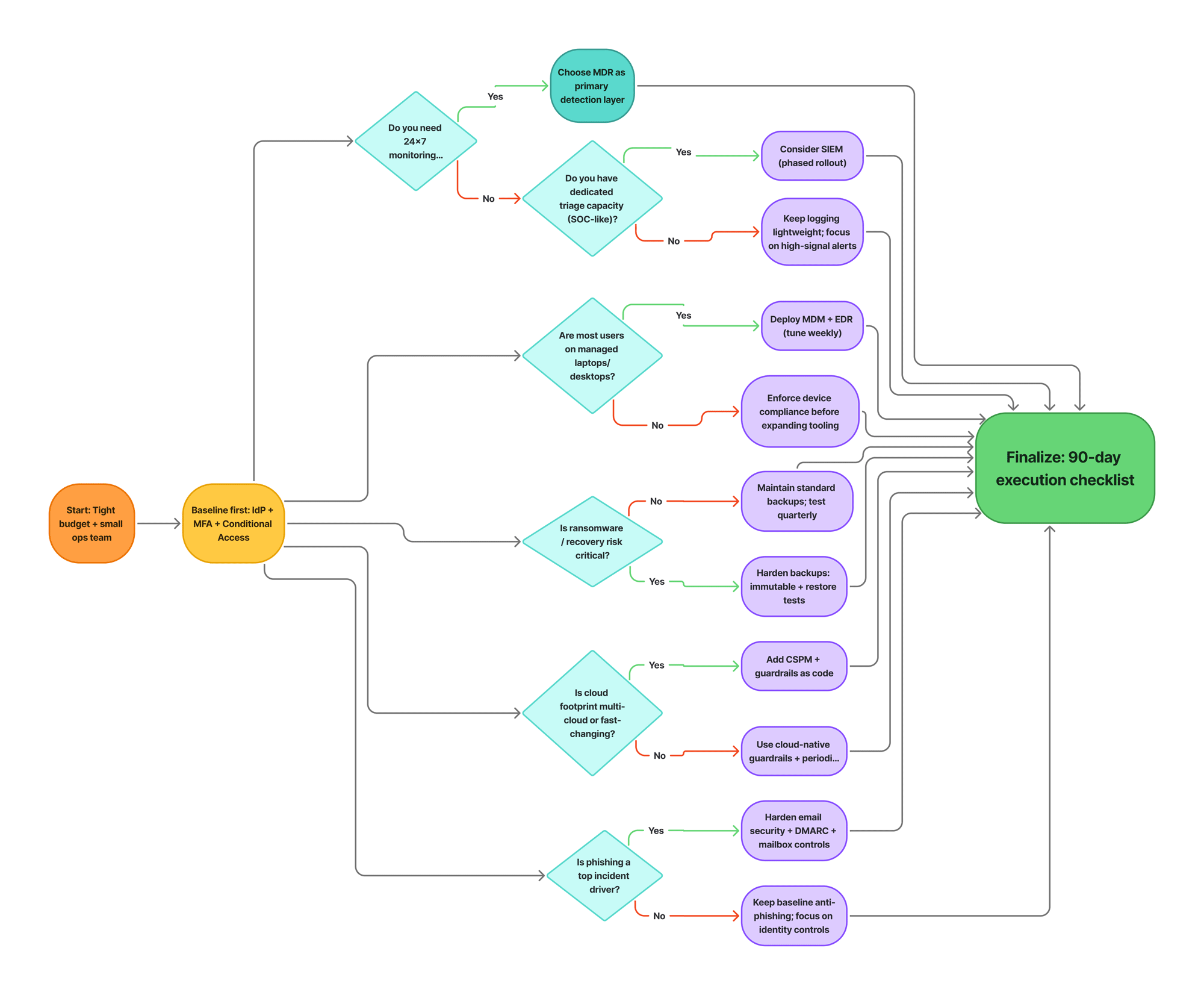
    cybersecurity best practices

    Checklist: 90-day plan to implement cybersecurity best practices

    Use this as a working checklist for cyber security for business when budget and ops capacity are limited.

    Identity and access hardening

    ✅ MFA enforced for all privileged and remote access
    ✅ Conditional access policies set for risky sign-ins and unknown devices
    ✅ Standing admin access removed or tightly restricted
    ✅ Privileged access approvals and audit trails enabled
    ✅ Service accounts and API keys inventoried, scoped, and rotated

    Endpoint and device baseline

    ✅ MDM enrollment required for email and core SaaS access
    ✅ Local admin removed for standard users with time-bound elevation
    ✅ Disk encryption and screen lock enforced across managed devices
    ✅ Patch SLAs defined and monitored for OS, browser, office/PDF tools

    Cloud configuration and guardrails

    ✅ Cloud accounts/subscriptions organized with clear ownership and tagging
    ✅ Public exposure guardrails enforced (storage, ports, load balancers)
    ✅ Encryption enforced for data at rest and in transit, with key controls
    ✅ IAM roles standardized and reviewed monthly across clouds
    ✅ Infrastructure changes routed through IaC with review gates

    Logging, detection, and response basics

    ✅ Audit logs enabled for IdP, endpoints, and each cloud control plane
    ✅ High-signal detections selected (identity changes, admin actions, risky sign-ins)
    ✅ One triage queue defined with severity rules and escalation path
    ✅ Containment playbooks written for account compromise and endpoint infection

    Governance, vendor controls, and measurable reporting

    ✅ Asset inventory is accurate enough to drive patching and scanning
    ✅ Vendor access reviewed, least privilege enforced, and logged
    ✅ Backup restore tests scheduled and tracked, not assumed
    ✅ Weekly scorecard published (MFA coverage, patch compliance, critical misconfigs, incidents)

    Conclusion

    If you approach cybersecurity best practices as an execution plan, not a checklist, you can improve security posture quickly even with a small team and a tight budget. Start with identity, enforce a clean endpoint baseline, standardize multi-cloud guardrails, and keep detection focused on signals you will act on. That sequence turns cyber security for business into steady, measurable risk reduction without tool sprawl or burnout.


  • Top AI Startups in Healthcare: What Works Beyond the Demo

    Top AI Startups in Healthcare: What Works Beyond the Demo

    When people talk about top AI startups in healthcare, most of what gets celebrated would collapse the moment it touches a real hospital, lab, or pharma IT environment. Accuracy charts, flashy demos, and funding headlines mean very little once you’re dealing with legacy systems, regulatory landmines, pissed-off clinicians, and IT teams who already have enough fires to fight.

    Healthcare AI doesn’t fail because the models are dumb. It fails because it ignores how healthcare actually runs. The stack is old, layered, political, and brutally unforgiving. You don’t “move fast and break things” inside an EHR. You don’t casually rewrite lab workflows governed by accreditation bodies. You don’t drop an opaque model into a GxP setup and hope compliance sorts itself out later. Anyone who has tried knows how fast that fantasy dies.

    Vendors sell intelligence. IT teams buy survivability. 

    They care about what systems are touched, what data is read or written, who signs off, what gets logged, and how much damage is done when something goes wrong at 2 a.m. on a Sunday. The real separation between useful AI and expensive noise happens long before outcomes or ROI decks enter the conversation.

    So instead of ranking healthcare AI by buzzwords or clinical promises, this piece looks at it the way IT decision-makers actually do: by where AI plugs into the stack, how deep it goes, and how much trouble it causes when reality shows up. And there’s no better place to start that conversation than diagnostic workflows.

    LIS and LIMS: Where AI Meets Diagnostic Workflows

    Among top AI startups pitching into healthcare, diagnostic labs are often treated as an easy win. The reality is the opposite. LIS and LIMS environments expose weaknesses in healthcare AI startups faster than almost any other system because lab workflows are deterministic, regulated, and relentlessly audited.

    For IT leaders, the first practical question is not what the AI does, but where it sits. In most successful deployments, AI never replaces LIS or LIMS logic. 

    It operates alongside it. Read-only access is the default. Outputs are flags, prioritisation cues, or secondary interpretations that technicians and pathologists explicitly approve. If a healthcare AI startup requires direct write access to test results, it should trigger immediate escalation and architectural review.

    Integration effort is the real differentiator here. Healthcare AI startups that succeed in LIS and LIMS environments usually demonstrate three things early. First, clean handling of sample identifiers across instruments and reruns. Second, explicit traceability of AI output to sample ID, run ID, and model version. Third, a clear answer to how amended reports are handled without corrupting audit trails. If any of these answers are vague, the deployment cost will surface later in compliance reviews or accreditation audits.

    Validation expectations further separate deployable vendors from demo-only ones. In regulated labs and pharma-adjacent settings, AI models are treated as controlled components. 

    Versioning is mandatory. 

    Retraining is not continuous by default. Change control is documented. Healthcare AI startups that approach LIS and LIMS with a consumer software mindset often underestimate this effort and stall after the pilot phase.

    From an IT decision-making perspective, LIS and LIMS are not innovation sandboxes. 

    They are enforcement layers. 

    They force healthcare AI startups to prove operational maturity, not just technical capability. The vendors that pass this stage tend to scale quietly and sustainably. The ones that do not usually pivot away from diagnostics or remain stuck offering offline analytics that never touch production workflows.

    This is why diagnostic platforms remain one of the most reliable filters when evaluating top AI startups in healthcare. If an AI product can coexist with LIS and LIMS without weakening lineage, traceability, or validation discipline, it is far more likely to survive deeper integration elsewhere in the stack.

    RIS and PACS: Imaging-Centric AI Deployments

    Among all clinical systems, imaging is where healthcare AI startups have had the least resistance, and for very practical IT reasons. RIS and PACS environments are already built for high-volume data ingestion, parallel reads, and secondary interpretation. For a hospital or imaging network, AI here usually enters as an additional consumer of images, not a system that rewires workflows. 

    That distinction matters. 

    A healthcare AI startup that understands radiology IT does not try to become the reporting system or the system of record. It focuses on augmenting throughput, prioritisation, and review efficiency without disturbing radiologist ownership or PACS integrity. This is why imaging AI has quietly moved into production faster than most other AI categories, even when clinical impact is modest.

    • Most deployments rely on DICOM-compatible ingestion directly from PACS without changing existing routing rules
    • AI outputs are typically attached as overlays, structured findings, or secondary reports rather than primary interpretations
    • Radiologist sign-off remains mandatory, which keeps clinical governance intact and reduces IT escalation risk
    • Latency expectations are strict, especially for emergency workflows, forcing AI vendors to optimise inference pipelines early
    • PACS vendor compatibility often matters more than model accuracy when scaling across sites
    • Storage, bandwidth, and image retention policies quickly surface hidden infrastructure costs
    • Successful healthcare AI startups design for partial adoption, allowing hospitals to enable AI only for specific modalities or studies

    For IT teams, imaging AI works when it behaves like infrastructure-friendly software rather than a clinical authority. 

    The top AI startups in this space survive not by claiming diagnostic superiority, but by fitting cleanly into RIS and PACS ecosystems that were never designed to be disrupted.

    top ai startups

    EHR Touchpoints: Read, Write, and Governance Boundaries

    Among all healthcare AI deployments, imaging is where most IT teams first see real traction from top AI startups in healthcare. That is not because imaging is easy, but because RIS and PACS environments are structurally more tolerant of AI when handled correctly. Images are immutable, workflows are well defined, and responsibility is already split between acquisition, interpretation, and reporting. 

    Healthcare AI startups that succeed here understand one thing clearly: do not interfere with the image, the radiologist, or the system of record.

    For IT leaders, the value of imaging AI is not diagnostic brilliance. It is operational control. Faster triage, workload prioritisation, consistency checks, and structured reporting assistance without destabilising PACS or triggering governance escalations. 

    Most failures in this space happen when vendors overreach, underestimate PACS vendor constraints, or quietly assume access patterns that will never be approved in production.

    What IT teams actually evaluate in RIS and PACS-based AI deployments:

    • How DICOM ingestion is handled without altering original studies
    • Whether inference runs inline or asynchronously and its impact on reporting latency
    • How AI outputs are attached to studies without becoming part of the image record
    • Whether the radiologist signs off remains mandatory and traceable
    • How model outputs are versioned against reports and timestamps
    • PACS vendor compatibility and limits around proprietary extensions
    • Storage, compute, and egress cost visibility at scale
    • Failure behaviour when AI services are unavailable

    Healthcare AI startups that respect these boundaries move into production faster. Those who push for deeper control get stuck in approvals, exceptions, and endless pilot extensions. In imaging, AI earns adoption not by being smarter, but by being predictable, reversible, and boring enough to trust.

    Data Lakes and EDW: Analytics-First AI Architectures

    For many IT leaders evaluating top AI startups in healthcare, data lakes and EDW environments are where AI feels safest. A healthcare data lake or an Enterprise Data Warehouse (EDW) sits outside frontline clinical execution. It consumes data from LIS, EHR, RIS, billing systems, and devices without interfering with how care is delivered. That separation matters. It allows healthcare AI startups to operate on governed datasets while keeping operational systems untouched.

    Technically, this model works because data movement is controlled and predictable. Extracts flow through ETL or ELT pipelines, land in structured or semi-structured storage, and are processed under clear governance rules. 

    AI models run on historical and near-real-time data, not live transactions. Feature generation, inference, and reporting happen downstream, which means failures do not interrupt lab results, imaging workflows, or clinician order entry. For IT teams, this dramatically reduces blast radius and approval friction.

    The trade-off is speed and proximity to action. Analytics-first architectures are excellent for population health insights, trial analytics, operational forecasting, and retrospective decision support. They are weaker when real-time intervention is required. Still, this is why many healthcare AI startups deliberately position themselves around data lakes and Enterprise Data Warehouses. It gives them scale, auditability, and survivability. 

    For IT decision-makers, this architecture often represents the lowest-risk entry point for deploying healthcare AI at enterprise scale.

    Also read: AI Compliance Becomes a Profit Center in 2026

    Pharma IT Environments: ELN, CDMS, and QMS Constraints

    Pharma IT is a different world altogether. Speed matters, but evidence matters more. AI adoption here is dictated less by shiny architecture and more by how calmly a system can survive audits, inspections, and uncomfortable questions months after a decision was made. This is where many top AI startups in healthcare slow down, not because the models fail, but because their operational discipline does.

    Unlike hospitals or labs, pharma systems live under permanent regulatory scrutiny. Every data point, transformation, and output must be defensible. AI cannot behave like a constantly evolving black box. It must behave like a controlled, versioned system that produces the same result today and six months later, unless a documented change says otherwise. 

    For IT teams, this shifts the conversation from innovation to containment. The question becomes whether an AI system can be governed without creating compliance debt.

    Pharma IT teams evaluate healthcare AI through system boundaries rather than focusing on specific use cases. 

    ELN, CDMS, and QMS each impose different expectations, and startups that blur those lines usually pay for it during validation.

    ELN (Electronic Lab Notebook)

    • AI is typically allowed in research workflows first
    • Outputs are exploratory, not submission-grade
    • Versioning matters, but validation is lighter
    • Problems begin when research AI quietly drifts into regulated data

    CDMS (Clinical Data Management System)

    • Data integrity is non-negotiable
    • Traceability from source to output is mandatory
    • AI is tolerated only when transformations are explainable
    • Any model-driven inference must be reproducible on demand

    QMS (Quality Management System)

    • This is where AI faces the highest resistance
    • Decisions impact deviations, CAPAs, and compliance posture
    • Audit trails must be immutable and exportable
    • Black-box behavior is a deal-breaker, regardless of accuracy

    The pharma takeaway is simple. AI succeeds here only when it behaves like regulated software, not experimental intelligence. Many healthcare AI startups underestimate this shift and position themselves as fast-moving platforms, only to discover that the pharmaceutical industry rewards restraint, documentation, and predictability far more than speed.

    Also read: AI for Financial Analysis in 2026: 10 Breakthrough Ways Finance Leaders Can Use

    Why Some AI Solutions Deliberately Avoid Core Clinical Systems

    Here’s something most healthcare IT folks realise only after getting burned once: not every AI solution is supposed to touch your core systems. In fact, the smarter ones intentionally stay away. Not because they are weak, but because they want to get deployed, stay deployed, and not become tomorrow’s rollback incident.

    Core clinical systems like EHRs, HIS, or lab systems are slow to change for good reasons. Every small modification needs approvals, testing, clinical sign-off, and often weeks of coordination. When an AI tool plugs directly into these systems, it inherits all that friction. So many healthcare AI startups choose a safer route. They work alongside the core systems, read data from governed sources, and deliver value without forcing IT teams into endless change cycles.

    For IT decision-makers, this approach has clear benefits. Faster deployment. Lower risk. Fewer stakeholders yelling when something breaks. These AI solutions still help with planning, prioritisation, insights, or decision support, but they do it without asking for deep access or control. That is often the difference between an AI project that quietly delivers value and one that dies in committee meetings.

    How a Healthcare AI Startup Fits into Enterprise IT

    Here’s the uncomfortable truth most vendors won’t say out loud. Healthcare IT does not adopt AI because it is impressive. It adopts AI because it fits. For IT heads evaluating top AI startups in healthcare, the first question is never about the model. It is about effort. How much integration pain, how many approvals, how many things can go wrong if this goes to production?

    In practice, healthcare AI startups that succeed tend to follow a few predictable patterns that make life easier for IT teams.

    • They integrate around existing systems, not through them
    • They work with read-only access wherever possible
    • They do not demand real-time writes into EHR or core clinical systems
    • They accept existing identity, access control, and audit mechanisms
    • They can be isolated, monitored, and switched off without drama

    A healthcare AI startup that understands IT constraints gets deployed faster, reviewed less aggressively, and trusted sooner. One that ignores them may win pilots but rarely reaches scale. For decision-makers, this difference matters more than accuracy percentages or roadmap promises, because it determines whether AI becomes a quiet operational asset or just another stalled initiative.

    Also read: 7 Hard Truths About AI-Based Startups Nobody Puts in Pitch Decks

    Top AI Startups Worth Evaluating for Real-World Deployment

    Qure.ai
    Imaging-focused AI is deployed alongside PACS, typically read-only with clear clinical sign-off workflows.

    Oxipit
    Radiology triage and reporting automation designed to reduce workload without replacing radiologist authority.

    Deep Bio
    Digital pathology AI that fits into existing lab workflows without interfering with LIS systems of record.

    Ibex Medical Analytics
    Narrow pathology use cases with controlled deployment models and strong clinician-in-the-loop positioning.

    Aignostics
    Computational pathology focused on secondary analysis and research-adjacent deployments.

    Corti
    Real-time voice and decision support for clinical conversations, with minimal dependency on core clinical systems.

    Pieces Technologies
    Clinical insights platform designed to sit next to EHRs without deep write-back dependency.

    Unlearn.ai
    Pharma-focused AI enabling synthetic control arms, typically deployed within regulated analytics environments.

    Saama
    Clinical trial analytics operating across CDMS and data platforms with validation-aware operating models.

    Niramai
    Non-invasive diagnostic AI that integrates at the screening layer without deep hospital IT dependencies.

    SigTuple
    AI-assisted diagnostics for pathology and radiology, typically deployed as adjunct systems rather than replacements.

    Conclusion

    When people search for top AI startups in healthcare, what they usually get are loud names and louder promises. What actually helps IT decision-makers is clarity on fit, friction, and fallout. This post wasn’t about who is smartest or most funded, but about which AI solutions can realistically live inside existing healthcare IT without breaking workflows, audits, or teams. If there’s one takeaway, it’s this: in healthcare, AI succeeds less by being clever and more by being compatible. The startups worth backing, buying, or piloting are the ones that respect the stack you already run and the constraints you cannot wish away.

  • 7 Hard Truths About AI-Based Startups Nobody Puts in Pitch Decks

    7 Hard Truths About AI-Based Startups Nobody Puts in Pitch Decks

    Most of startups today claim that they are “AI-based startups”.

    Most of them are not.

    Some are clever wrappers around APIs. Some are automation tools wearing an AI costume. Some are just hoping the word “AI” buys them time, funding, and forgiveness.

    AI-based startups are not magic. They are harder, more expensive, more fragile, and far less forgiving than normal software companies. The upside is massive, yes. But so is the number of founders quietly panicking after the demo applause fades.

    Let’s talk honestly. No buzzwords. No worship. Just reality.

    What Actually Qualifies as an AI-Based Startups

    Let’s get this out of the way.

    Using ChatGPT APIs does not magically turn your startup into an AI company. Neither does adding “AI-powered” on the homepage or sprinkling a few prompts inside your product.

    An AI-based startup is one where artificial intelligence is not a feature but the core mechanism. 

    If you remove the AI layer and the product collapses, congratulations, you qualify. If the product still works fine without it, you’re just a regular SaaS wearing an AI costume.

    At its core, an AI-based startup uses models to learn, adapt, predict, and make decisions at scale. This could mean recommendation engines that improve with usage, systems that automate judgment-heavy tasks, models that spot patterns humans miss, or agents that act with limited autonomy. The intelligence must compound over time, not stay static.

    Another key qualifier is data gravity. Real AI-based startups are obsessed with data pipelines, feedback loops, training quality and inference costs. They worry less about UI polish and more about whether the model is drifting, hallucinating, or learning the wrong behaviour. If your biggest headache is prompt quality and model behaviour, you’re probably building something real.

    Finally, AI-based startups solve problems that were either impossible or wildly inefficient before AI matured. They compress time, reduce human dependency, or unlock scale without linear hiring. If your pitch sounds like “the same thing, but faster,” you might be missing the point. AI startups usually change who does the work, not just how fast it gets done.

    The Illusion of “We Use AI” vs Real AI Products

    Saying “we use AI” has become the startup version of saying “we are scalable.” It sounds impressive. It means almost nothing. A rules engine with a few if-else conditions wrapped inside a shiny dashboard is not AI. Calling an API from OpenAI does not magically turn your product into one of those serious AI-based startups people actually bet on.

    Here’s the uncomfortable truth. Many products slap the word AI on top because investors expect it, customers ask for it, and pitch decks look cooler that way. Under the hood, it is basic automation, static logic, or at best some analytics with thresholds. Useful, yes. Intelligent, no. And that gap becomes apparent very quickly once the product faces real-world complexity.

    AI-based startups

    Real AI products behave differently. They learn from data. They improve over time.

    They deal with uncertainty, not just predefined flows. A genuine AI-based system makes probabilistic decisions, adapts to patterns, and sometimes even surprises its creators. That is why real AI-based startups invest more in data pipelines, model training, evaluation loops, and monitoring than they do in landing pages.

    If your product stops working the moment rules change, or needs constant human tweaking to stay relevant, it is not AI-led. It is just well-packaged software. The difference matters because markets are getting smarter, buyers are asking sharper questions, and the “AI sticker” trick is wearing thin fast.

    Also Read: AI for Startups: 6 Authoritative Guidelines on Digital Transformation

    Where AI Startups Are Truly Creating Value

    AI-based startups captured an unprecedented share of global venture capital. The real value of AI startups is not in sounding intelligent. It is in doing something boring, expensive, or painful better than humans ever could. Most successful AI-based startups are not chasing buzzwords. They are quietly replacing fragile processes that break at scale.

    The strongest signal of real value is simple. If you remove the AI, the product collapses. If you can remove the AI and still sell the product, then AI was never the core.

    Here is where genuine value is actually being created.

    • End-to-end task ownership, not assistance
      The best AI startups do not “help” a human do the work. They take full responsibility for the task. Screening resumes. Categorizing support tickets. Reconciling invoices. Flagging fraud. Humans step in only for exceptions, not routine decisions.
    • Process compression
      Real AI reduces a five-step workflow into one decision. Not faster screens. Fewer screens. Not dashboards. Fewer meetings. If the product still needs heavy hand-holding, AI is decorative.
    • Decision-making under uncertainty
      Valuable AI startups operate where rules break down. Ambiguous data. Incomplete signals. Changing patterns. This is where static automation fails and learning systems earn their keep.
    • Operational scale without linear hiring
      When a startup claims AI value, ask one question. Can revenue grow without growing headcount at the same rate? If the answer is no, the AI is cosmetic.
    • Learning from live data, not static models
      Strong products improve quietly in the background. Models retrain. Thresholds adjust. Outcomes get better month after month without manual tuning.

    Some areas where this value shows up clearly today:

    • Customer support triage and resolution
    • Fraud detection and risk scoring
    • Sales qualification and lead prioritization
    • Content moderation and compliance checks
    • Demand forecasting and pricing optimization

    And some areas where “AI value” is usually exaggerated:

    AreaReality
    AI dashboardsLooks impressive, but teams rarely act on insights due to missing ownership and workflows
    Chatbots bolted onto appsAdds another interface without fixing root process or customer experience issues
    Predictive insights with no executionPredictions exist, but no system triggers actions or accountability downstream
    Generic copilotsProduces text and suggestions without measurable impact on real business outcomes
    AI alerts and notificationsToo many alerts fired, most ignored after initial excitement fades
    AI-powered recommendationsSuggestions are generic because models lack deep context and operational authority
    AI analytics for leadershipReports are consumed in reviews, then forgotten until the next quarterly meeting
    AI features sold as differentiationSounds advanced in sales decks, but delivers marginal value in daily operations

    The Tech Stack Most AI Startups Quietly Depend On

    Behind the flashy demos and confident pitch decks, most AI-based startups rely on a surprisingly similar technical backbone. Very few are inventing brand-new algorithms from scratch. The real work happens in stitching together proven cloud infrastructure, mature ML frameworks, scalable data pipelines, and deployment layers that can survive real users. What separates serious AI startups from hobby projects is not the model alone, but how reliably this entire stack works together under load, cost pressure, and imperfect data.

    Common building blocks you’ll find under the hood:

    • Cloud infrastructure (AWS, GCP, Azure): Used for elastic compute, managed storage, GPUs, and rapid scaling without owning hardware.
    • Model frameworks (PyTorch, TensorFlow, JAX): Core libraries for training, fine-tuning, and experimenting with machine-learning models.
    • Pretrained and foundation models: Startups rarely train from zero. They fine-tune large language models, vision models, or speech models for narrow, high-value tasks.
    • Data pipelines and storage layers:  Tools like object storage, data warehouses, and stream processors move raw data into usable training and inference formats.
    • Vector databases and embeddings: Used to power semantic search, recommendations, retrieval-augmented generation, and similarity matching.
    • Inference and serving layers: APIs, microservices, and model servers that handle real-time predictions with latency and cost controls.
    • Monitoring, logging, and evaluation tools: Track model drift, performance degradation, hallucinations, and unexpected behavior in production.
    • Security and access control
      Authentication, data isolation, and auditability become critical once enterprise customers are involved.

    This stack is not glamorous, but it is where most AI startups either become dependable businesses or quietly fall apart.

    Why Many AI Startups Will Die Young

    AI-based startups are being born at an absurd pace. Decks look sharp, demos feel magical, and everyone claims proprietary intelligence. But beneath the surface, most of these companies are fragile. Not because AI is hard, but because building a real business on AI is harder than wiring an API.

    Many startups confuse using AI with owning differentiation. If your core value disappears the moment an LLM API changes pricing or capabilities, you are not a company. You are a temporary wrapper. That fragility shows up the moment costs spike or competitors replicate features in weeks.

    Secondly, data reality hits late and hard. Models don’t improve without clean, relevant, continuously flowing data. AI-based startups realize too late that customer data is sparse, noisy, or legally unusable. Training stalls, insights plateau, and the “learning system” quietly stops learning.

    Thirdly, unit economics kill the romance. Inference costs, cloud bills, vector databases, and monitoring stacks add up fast. Many AI startups scale usage before fixing margins. Growth feels exciting until revenue cannot outrun infrastructure burn.

    Finally, execution discipline is missing. AI cannot compensate for weak distribution, unclear ICPs, or messy workflows. When hype fades, only startups with operational clarity survive.

    Revenue Models That Actually Work for AI-Based Startups

    Most AI-based startups don’t fail because the tech is weak. They fail because the revenue model is a fantasy. Founders love talking about models, parameters, and benchmarks. Customers care about outcomes, pricing clarity, and whether the thing actually saves money or makes money. Real revenue in AI is boring, repeatable, and tightly coupled to business value. Anything else is noise.

    • Usage-based pricing tied directly to transactions, documents, calls, or decisions processed.
    • Per-seat licensing only when AI replaces a real human role, not when it just “assists”.
    • Revenue share models where AI directly impacts sales, recovery, or cost reduction.
    • API-based pricing for AI embedded inside customer workflows and systems
    • Tiered SaaS plans with strict caps, limits, and enforcement to avoid runaway compute costs.
    • Enterprise contracts focused on outcomes, SLAs, and measurable efficiency gains.
    • Platform fees combined with professional services for onboarding, tuning, and integration.

    The AI-based startups that survive are brutally honest about what customers will pay for. They price outcomes, not intelligence. They align cost with value, avoid vague promises, and build models that scale without bleeding cash. Fancy demos don’t pay salaries. Predictable revenue does.

    Enterprise vs Consumer AI Startups

    Enterprise and consumer AI startups may use similar underlying technology, but they live in completely different business realities. Enterprise AI is sold into slow, political, risk-averse organizations where trust, compliance, integrations, and ROI matter more than slick demos. 

    Consumer AI lives in a fast, brutal market where adoption is emotional, switching costs are low, and users leave the moment the product stops feeling magical. 

    One side optimizes for contracts, stability, and long-term value. The other survives on retention, habit, and scale. Confusing these two worlds is one of the fastest ways AI-based startups burn money without ever finding traction.

    AspectEnterprise AI StartupsConsumer AI Startups
    Primary buyerCIO, CTO, operations or business headsIndividual users or small teams
    Sales cycleLong, complex, approval-heavyShort, impulse-driven
    Revenue modelHigh-value contracts, annual subscriptionsLow-cost subscriptions or freemium
    Product depthDeep workflow integration, customization requiredSimple, fast, feature-focused
    Switching costVery high once embeddedVery low, users churn easily
    Growth patternSlower but more predictableFast spikes, equally fast drop-offs
    Support expectationDedicated support, SLAs, complianceMinimal support tolerance
    Survival riskDies slowly if the product failsDies quickly if traction drops

    Conclusion

    Most AI-based startups will not fail because the tech was weak. They will fail because they mistook demos for products, pilots for revenue, and attention for adoption. The ones that survive are brutally clear about the problem they replace, the workflow they live inside, and the money they earn without storytelling gymnastics. AI is no longer a differentiator. Execution is. If your startup cannot prove real value without saying “AI-powered” in every second sentence, the market will do the filtering for you.

  • 5 Things No One Talks About Human Capital Management Software (But You Learn the Hard Way)

    5 Things No One Talks About Human Capital Management Software (But You Learn the Hard Way)

    Do you need Human Capital Management Software? Duh! Every company claims its people are its biggest asset, and they are managed all by themselves!

    Cool. Then why does HR still look like a drunk group project where everyone is forwarding PDFs, digging through Excel sheets named “final_v12_last_version_real_final.xlsx”, and praying payroll doesn’t blow up again?

    Let’s be honest, ok? Most businesses don’t manage people.

    They manage chaos that involves people.

    Interviews get lost in email threads.

    Attendance records look like they were tracked by a blindfolded intern.

    Half the performance reviews feel like they were copy-pasted from last year.

    And onboarding?

    That’s just a ritual where new employees sign 27 forms and hope someone remembers to create their laptop request.

    HR teams aren’t lazy. They’re drowning.

    Drowning in admin.

    Drowning in compliance.

    Drowning in “Can you resend that document?”

    Drowning in bosses who want numbers but refuse to give systems.

    This is exactly why human capital management exists, not the fluffy, brochure version.

    The real reason:

    Because running HR manually in 2026 is like trying to run a marathon in flip-flops. You’ll survive, but you’ll look stupid doing it all through it.

    And that’s where things get interesting.

    What HCM Actually Means When You Remove the Corporate Packaging

    Most HR tools promise to “streamline people operations,” which is a fancy way of saying: we will stop your HR team from losing their mind every Monday morning.

    Human capital management software is basically the central nervous system of your organisation. It keeps your people data clean, your processes predictable, and your managers a little less dramatic.

    At its core, it replaces the ten different tools, five different spreadsheets, and two WhatsApp groups you currently use to run HR.

    Attendance, payroll, hiring, onboarding, performance reviews, exits; everything sits in one place, so HR doesn’t spend half their life asking, “Who updated this file?”

    And here’s the truth nobody likes to say out loud: When companies grow, chaos grows faster. Human capital management software slows that chaos down.

    It gives you visibility, control, compliance, and a single version of the truth: something most businesses desperately need but rarely admit.

    The Everyday HR Problems That HCM Quietly Solves

    Most companies don’t realise how much money, morale, and time they burn until they finally switch to a proper system. These are the everyday fires human capital management software quietly puts out:

    • Scattered employee data: IDs in one folder, resumes in another, leave history in emails, performance notes in someone’s notebook. HCM centralises everything, so HR stops playing detective.
    • Payroll mistakes: Miscalculations, wrong deductions, late salaries, compliance slip-ups. A modern HCM keeps payroll predictable and audit-ready.
    • Broken onboarding: New hires wandering around because nobody knows who should give them what. Automated workflows turn Day 1 into a real welcome, not a treasure hunt.
    • Attendance chaos: Missing logs, buddy punching, rejected leave requests that nobody saw. HCM adds transparency and accountability.
      Messy performance reviews: Managers filling forms 10 minutes before the appraisal cycle. HCM forces structure, reminders, and continuous feedback.
    • Compliance anxiety: Labour laws, PF/ESI, overtime rules, contract staff records; HCM helps you stay clean and avoid legal surprises.
    • Zero workforce visibility: Leadership has no clue who’s doing what, where the bottlenecks are, or who’s burning out. HCM dashboards give real-time clarity.

    If these feel too real, it’s because they happen everywhere, from startups with 20 employees to enterprises pretending Excel is immortal.

    The Core Modules You Should Expect in Modern Human Capital Management Software

    ModuleWhat It Actually DoesWhy It Matters
    Core HR RecordsCentralised employee data, documents, and contractsReduces admin mess and avoids compliance disasters
    Payroll & ComplianceSalary processing, tax handling, statutory updatesPrevents errors that cost money and reputation
    Time & AttendanceTracks hours, shifts, remote work, overtimeHelps managers plan realistically and pay accurately
    Recruitment & OnboardingHiring pipeline, offer letters, and onboarding tasksSaves weeks in hiring and avoids “who’s doing what?” chaos
    Performance & GoalsReviews, KPIs, feedback loopsBuilds transparency and reduces bias in evaluations
    Learning & DevelopmentCourses, skill journeys, certificationsMakes upskilling a habit, not an afterthought
    Workforce AnalyticsInsights on attrition, productivity, hiring gapsHelps leadership make decisions with clarity
    Employee Self-ServiceMobile-first updates, leave, requestsCuts HR workload and improves employee satisfaction

    Where AI Starts to Make HR Smarter in 2026

    Artificial intelligence stopped being a “future HR dream” the moment companies realised people problems cost real money. Hiring delays, poor performance reviews, biased decisions, broken onboarding, and exit chaos; all of these eat into the bottom line. And that’s where modern human capital management software quietly slips in and fixes the mess without shouting about it.

    Every company sits on mountains of employee data, but uses maybe 5% of it. AI flips that equation. It reads patterns, behaviours, timelines, and activity logs that humans simply don’t have time to analyse. It doesn’t replace HR; it stops HR from drowning in repetitive admin so they can focus on actual humans instead of Excel sheets that resemble crime scene files.

    The real magic isn’t that AI “automates tasks.” The real magic is that AI makes people’s decisions predictable. Attrition flags. Skills gaps. Team-level behavioural risks. Hiring funnel leaks. Performance inconsistencies. These are things managers used to sense intuitively when they weren’t buried in emails. AI brings that intuition back, but with data.

    And because AI sits inside HCM tools instead of being bolted on as a gimmick, companies finally get something HR leaders have begged for since 2014: one view of the entire employee lifecycle. One source of truth. One system that says, “Here is what’s happening, why it’s happening, and what you should fix first.”

    AI Capabilities You’ll Find in Modern HCM Tools

    • Predictive attrition scoring
    • Skills-matching for internal mobility
    • AI-assisted hiring (screening, JD creation, candidate scoring)
    • Behaviour analytics for early intervention
    • Automated onboarding journeys
    • Payroll anomaly detection
    • Performance review sentiment analysis
    • AI-guided learning path recommendations

    Also read: AI-powered CRM to make the difference in 2026

    Top HCM Platforms Worth Considering in 2026

    1. Rippling

    Rippling is that loud, overachieving kid in class who wants to do everything at once. It combines HR, IT and finance in one cloud platform, so you can hire someone, issue their laptop, assign apps, run payroll and manage benefits from the same place. It treats human capital management software as a full employee lifecycle engine, not just HR paperwork. Great fit if you are scaling, love automation and do not want ten different tools stitched together with duct tape. 

    2. BambooHR

    BambooHR is the “let us clean up your mess” option for small and mid-sized businesses. It focuses on the basics and does them well: employee records, time off, simple onboarding, light performance, and clean reporting. The idea is simple: pull all people data, payroll info, time, and benefits into one place so HR is not living inside spreadsheets with names like HR_backup_final_new.xlsx. If you want a platform that your HR team and managers actually use without weeks of training, this is a good starting point. 

    3. HiBob (Bob)

    HiBob feels like an HCM built for companies where people actually talk on Slack and do not wear suits. It is a modern HRIS and HCM layer that focuses on engagement, visibility and flexible workflows. You still get core HR, time off and people data, but with a more social, “people first” interface that works nicely for younger or distributed teams. If your culture is modern but your HR stack still looks like 2008, Bob is worth a serious look. 

    4. Workday HCM

    Workday is the big, serious gun in the room. This is full-scale enterprise human capital management software that also plays nicely with finance and planning. It is built for global orgs that care about skills, workforce planning, talent, compliance and analytics at serious volume. You do not buy Workday to clean up a few spreadsheets. You buy Workday when your org chart looks like a spider web and you still want one clean view of people, roles and costs. 

    5. Oracle Fusion Cloud HCM

    Oracle Cloud HCM is for companies that want everything connected and configured their way. It is a full-stack cloud suite that covers recruiting, core HR, payroll, talent, learning and workforce management. The pitch is one data model, one UX and one system for the entire employee journey, from hire to retire. If you already live in the Oracle ecosystem or have very complex structures and policies, this is a natural contender. 

    6. SAP SuccessFactors

    SuccessFactors is SAP’s cloud HCM play and is built to handle the full lifecycle: recruiting, onboarding, performance, compensation, learning and more. The emphasis is on a unified, AI-supported view of people and skills, plus strong integration with the rest of the SAP world. If your backbone runs on SAP and you want human capital management software that respects that landscape, SuccessFactors usually lands on the shortlist. 

    7. UKG (Pro / Ready)

    UKG targets organisations that treat workforce management as serious business, not a side feature. It focuses on time, attendance, scheduling, and complex people operations alongside HR and payroll. If you have shift workers, frontline teams or multi-location operations where labour compliance and rostering can kill your margins, UKG is worth checking. It sits nicely in that space where HR, operations, and compliance all overlap. 

    8. Deel

    Deel exists for the world where your designer sits in Lisbon, your data engineer in Bengaluru and your PM in Toronto. It focuses on global hiring, payroll, compliance and contractor management across more than a hundred countries. You get HR and performance features on top, but its real power is in making remote and distributed teams legally safe and operationally smooth. If your talent strategy is “hire the best anywhere” instead of “hire only in our city”, Deel deserves a hard look. 

    9. Dayforce

    Dayforce (earlier Ceridian) is a mature HCM platform that takes an all-in-one view of HR: payroll, tax, benefits, core HR, recruiting, and workforce management in a single cloud suite. It has a strong reputation in payroll-heavy environments and industries where compliance is painful. Recent investor interest and acquisitions around Dayforce show it is a serious long-term player in the HCM space, not a side project. 

    10. ADP Workforce Now

    ADP has been doing HR and payroll long before “SaaS” was a buzzword, and Workforce Now is its cloud HCM stack for mid-sized and larger organisations. It brings payroll, time, benefits, HR management and talent features into one platform, wrapped with ADP’s long-standing compliance and tax expertise. If your biggest risk is getting payroll, tax, and regulations wrong, Workforce Now is a very safe, very grown-up choice.

    human capital management software

    Implementation Mistakes Companies Keep Repeating (And How to Avoid Them)

    Most companies treat implementation like a software install instead of a behaviour change. They sign up for a powerful human capital management software suite and then dump everything on HR with no cross-department ownership. The result is predictable. Half-configured features. Broken approval chains. Managers who still prefer Excel because no one has trained them properly. The problem is never the tool. It is the lack of planning around people, process and adoption.

    The second mistake is racing to switch everything on at once. Core HR, payroll, attendance, performance, recruitment, learning, analytics. All are activated on day zero. Nobody knows who owns what and the system becomes a Frankenstein of partial configurations. The right approach is phased. Start with core HR and attendance. Stabilise. Then expand into performance and recruitment. When the foundation is clean, every other module behaves as it should.

    The final mistake is treating data migration as an afterthought. Dirty employee records, duplicated IDs, outdated designations and broken reporting lines will choke even the best human capital management software. If the base data is wrong, analytics will lie, payroll will break and workflows will misfire. The fix is simple. Clean the data before migration. Define naming conventions. Lock ownership. Once the input is trusted, the system becomes a true source of truth instead of a digital filing cabinet with prettier screens.

    Conclusion

    At the end of the day, a company is just people trying to do their best work without drowning in chaos. Systems matter because they protect that effort. And whether you’re a ten-person shop or a thousand-person operation, human capital management software is the difference between managing your workforce with intention and managing it with luck. The companies that grow in 2026 will be the ones that take their people engine seriously and build it on clean data, predictable workflows, and honest visibility. The ones who don’t will stay stuck, firefighting the same problems every quarter. Choose your side.

  • 7 Cheapest Cloud Storage Providers We Recommend and How to Choose the Right One

    7 Cheapest Cloud Storage Providers We Recommend and How to Choose the Right One

    Why is everyone after the cheapest cloud storage? The search volume has increased tremendously in Bing and Google Search (well, that’s why I am writing it). Cloud storage used to feel optional. Like something only big companies worry about. Not anymore. 

    Today, it’s where your invoices live, your client files live, your backups live; basically, everything lives there except your peace of mind when the bill arrives.

    And that’s exactly why people search for inexpensive cloud storage. Not because they love comparing plans, but because they’re tired of paying extra for things they don’t even use. Half the time you’re charged for “premium features” you never asked for and probably never will.

    The funny part? What looks cheap on the surface often turns expensive the moment you start actually using it. Some platforms limit downloads, some cap devices, some hide upgrade nudges so cleverly you don’t even notice you’ve clicked “upgrade.” It’s chaos, disguised as cloud.

    Before You Pick a Plan: The Basics You Must Understand

    Choosing the cheapest cloud storage isn’t just about chasing the lowest price tag. It’s about understanding how you actually use your files so you don’t end up paying for things you don’t need. A little clarity upfront saves you from surprise charges, annoying limits, and those “why is my bill suddenly higher?” moments.

    • Know how much data you store today and how fast it’s growing.
    • Check how often you upload or download files.
    • Separate daily-use storage from long-term backup needs.
    • Count how many users genuinely need access.
    • Verify device limits to avoid one-device traps.
    • Check file-size caps, especially if you work with big media files.
    • Look for hidden charges on downloads, sharing, or upgrades.
    • Make sure you can export or migrate your data without pain.

    Now, where will you get all these details in one place? Of course, the comparison sites. However, most comparison sites pretend every provider is amazing (they have the affiliate links, you know), but let’s be honest: half the “popular” platforms become expensive the moment you start using them properly. That’s why finding the most affordable cloud storage is less about brand hype and more about understanding your own habits. If you know what you upload, how often you share, and how many people touch your files, you’ll immediately spot which plans are genuinely cheap and which ones are waiting to ambush your wallet later.

    What Makes The Cheapest Cloud Storage (It’s Not Just Price Per GB)

    When people talk about the Cheapest Cloud Storage, they usually mean the service with the smallest monthly price on the pricing page. That number is only the teaser. Real affordability becomes visible once you start using the storage in your natural, messy way. Random uploads, rushed client folders, weekend backups and everyday sync activity all reveal the true cost. The lowest price tag does not matter if everything else around it quietly chips away at your budget.

    Another thing no one mentions is that cheap depends on how you work. If you upload once a week and mostly store documents, your ideal plan looks very different from someone who handles videos, design files, or heavy media assets. That is where inexpensive cloud storage becomes a personalised choice. A service that works beautifully for one business can feel painful for another simply because of file-size limits, device caps, or slow sharing options. These small restrictions have a very real impact.

    There is also the ecosystem trick. Some platforms look generous on day one, but then hide basic features behind paid upgrades. You try to share a link and suddenly a pop-up tells you to upgrade. You add one more device and the system will gently suggest that you upgrade again. It feels like buying a budget phone and realising the charger is sold separately. What looked like the Cheapest Cloud Storage slowly becomes a plan that constantly asks for a little more money.

    So when you look for truly inexpensive cloud storage, think beyond the headline price. Look at how many people touch your files, how often you download data, and how quickly your storage grows. Cheap storage stays cheap only when the plan fits your behaviour. If it does not, the monthly bill becomes your reminder that choosing on price alone was a bad idea.

    The Factors That Influence Your Actual Monthly Cost

    Your real cloud storage bill rarely matches the number you saw on the pricing page. The cost depends on how you actually use the service, not on the headline price. Even the Cheapest Cloud Storage can become expensive if these factors are ignored.

    • How often do you upload or download files?
    • How many users do you add to your workspace?
    • Whether clients frequently access shared links
    • How quickly does your total storage size grow?
    • Extra charges for higher speeds or priority sync
    • Limits that force you into paid upgrades sooner than expected

    If you keep these in mind, you can choose genuinely inexpensive cloud storage that stays affordable as your data grows, instead of getting surprised by hidden costs or forced upgrades.

    Quick Self-Assessment: What Type of Storage User Are You?

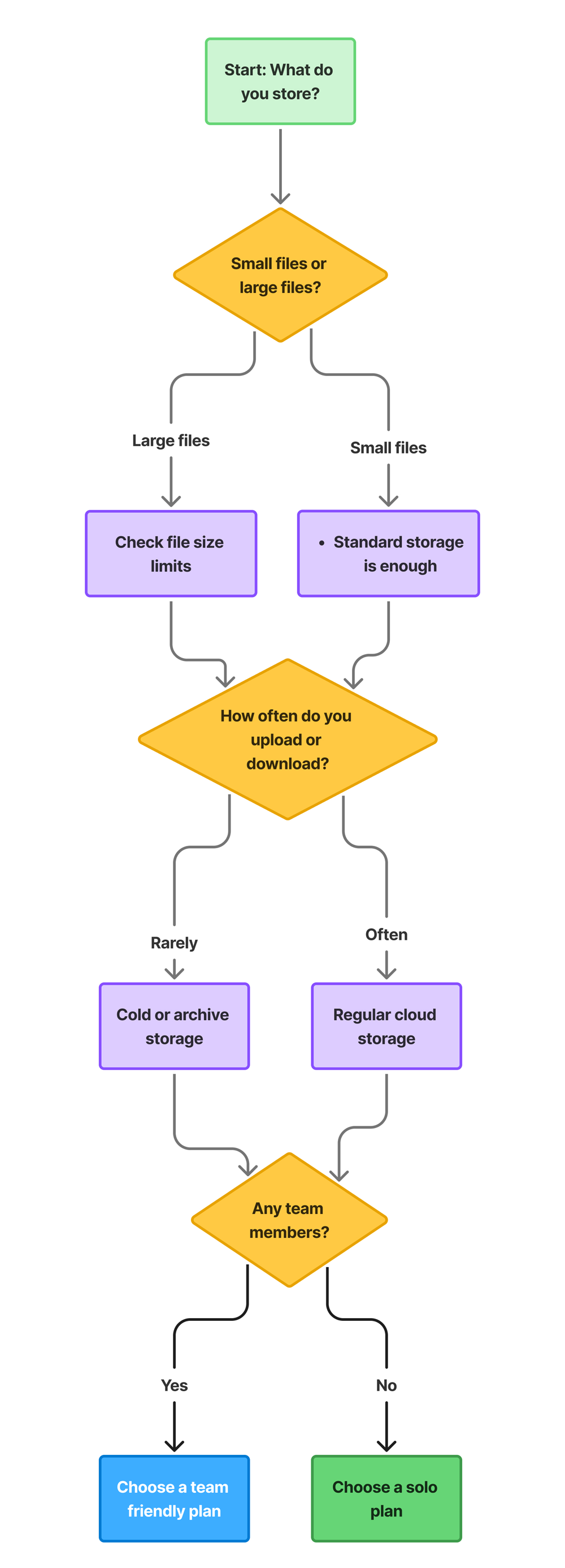
    Before comparing prices in search for the most affordable cloud storage, it helps to understand your own behaviour. This one step saves you from picking the wrong plan and getting forced into upgrades later. Your needs fall into a simple pattern based on how often you upload files, how many people access them and how fast your storage grows. Use this quick flow to understand where you stand.

    cheapest cloud storage

    Hidden Fees That Can Inflate Your Bill

    Most people choose the Cheapest Cloud Storage based on the upfront price, but the real shock comes later when the hidden charges start showing up. Some services quietly bill you for extra downloads, shared links that get too much traffic, faster sync speeds, or even basic collaboration features. These are never highlighted during sign-up, which is why so many users think they got a great deal until the first “unexpected activity charge” lands in their inbox.

    The trick is simple. Every platform makes money from what you do most. If you frequently download files, expect usage fees. If your clients open shared links often, expect traffic charges. If your storage grows quickly, expect auto-upgrades. What looked like inexpensive cloud storage becomes a layered, unpredictable cost. Understanding these hidden fees early means you can choose the services that are transparent and won’t surprise you later.

    Cheapest Cloud Storage Services in 2026

    1. Google Drive / Google One

    Perfect for anyone already using Gmail, Docs, and Photos. Simple, familiar, and smooth for everyday storage and sharing without any learning curve. Around $1.99/month for 100 GB and $9.99/month for 2 TB.

    Pros:

    • Very easy to use and integrate into daily work
    • Great for sharing and collaborating through Docs/Sheets
    • Decent free 15 GB starter space

    Cons:

    • Storage is shared with Gmail and Photos, so it fills faster
    • Not privacy-focused
    • Not ideal for very large media files long-term

    2. Microsoft OneDrive

    Best value for anyone using Word, Excel, Outlook or Windows. Storage feels “built-in” and works flawlessly across devices. Microsoft 365 Family gives 1 TB per person (up to 6 users) for a single monthly fee.

    Pros:

    • Excellent value if you already rely on Microsoft tools
    • Smooth sync on Windows and across devices
    • Reliable for teams using Office apps regularly

    Cons:

    • Storage tied to user accounts, not generic buckets
    • Less attractive if you don’t use Office apps
    • Collaboration is Office-heavy compared to Google

    3. Dropbox

    Known for rock-solid syncing and sharing. Great for creative teams, media-heavy work and constant file exchanges. Around $9.99/month for 2 TB on individual plans. Team plans start higher.

    Pros:

    • Best-in-class sync reliability
    • Excellent for daily sharing and teamwork
    • Strong integrations with third-party tools

    Cons:

    • Typically more expensive per TB
    • Business plans require multiple users
    • Not ideal for pure long-term backup

    4. pCloud

    Ideal for people who want to avoid monthly fees. Lifetime plans make pCloud one of the most cost-effective long-term options. Roughly $4.99/month for 500 GB or $9.99/month for 2 TB. Lifetime plans available.

    Pros:

    • Huge savings with a lifetime one-time payment
    • Optional client-side encryption
    • Great cross-platform support

    Cons:

    • Lifetime plans require a high upfront cost
    • Less mainstream brand recognition
    • Collaboration tools are basic

    5. IDrive

    Fantastic for backing up multiple devices, servers or NAS systems in one account. Designed more for backup than daily collaboration. Around $69–$79 per year for 5 TB (first-year discounts common).

    Pros:

    • Very strong backup features
    • Great value for multi-device protection
    • Large storage options at a low cost

    Cons:

    • Old-school interface
    • Not ideal for day-to-day team sharing
    • Better for backup than everyday file access

    6. Sync.com

    A privacy-first cloud storage option with end-to-end encryption. Great for sensitive documents and compliance-heavy industries. Team plans start around $6/user/month for 1 TB per user (annual billing).

    Pros:

    • Strong encryption and zero-knowledge privacy
    • Good sharing controls and version history
    • Affordable for secure cloud storage

    Cons:

    • Annual billing required for best rates
    • Fewer integrations than Google or Dropbox
    • Less known outside privacy-focused users

    7. Backblaze B2

    Super-cheap bulk storage for backups and archives. Ideal when you store a lot and don’t need fancy collaboration features. About $6 per TB per month for raw storage.

    Pros:

    • Cheapest per-TB pricing in the market
    • Great for large archives and long-term data
    • Simple predictable pricing

    Cons:

    • Not beginner-friendly
    • No “drive-like” interface
    • Not suitable for daily file collaboration or sharing
    • Comparison Snapshot: Pricing, Limits, and Key Features

    Disclaimer:

    Prices may change. Please check the official websites of the above-mentioned service providers for the latest rates. Infogion is not responsible for any pricing updates or variations.

    When to Choose Archive Storage Over Regular Storage

    Archive storage makes sense when you have files that are important but rarely used. Old client deliveries, project folders you are done with, raw footage, past-year financials or bulky media dumps do not belong in your everyday workspace. Keeping these inside regular plans is wasteful when inexpensive cloud storage options exist specifically for long-term parking.

    It also helps you control costs more effectively. Regular storage charges you for convenience, speed, and frequent access. Archive storage removes those premiums and gives you far lower pricing for the same data. If you access these files only a few times a year, choosing the cheapest cloud storage tier designed for archival use can cut your costs dramatically.

    Archive storage is also the best choice when your priority is simply retention. Compliance documents, contracts, backups, audit files, and old creative assets can live safely in an archive tier without slowing down your main storage. This keeps your active workspace clean and efficient while your historical data stays protected at a fraction of the cost.

    Also Read: infogion’s Guidelines on using AI for Startups

    How to Avoid Vendor Lock-In

    Vendor lock-in usually happens when all your files, sharing habits, and workflows get tied so tightly to one provider that moving out feels painful. The goal is to keep your data portable so you can switch to the cheapest cloud storage or any other service whenever you need, without chaos.

    • Keep your files in standard formats like PDF, MP4, CSV, JPG
    • Avoid features that only work inside one provider’s ecosystem
    • Maintain a periodic export or backup of all critical folders
    • Use third-party sync tools instead of provider-only utilities
    • Keep team workflows flexible instead of being tied to one platform’s automation
    • Review your storage size every quarter, so migration never becomes overwhelming

    Practical Tips to Keep Your Storage Bill Low

    Start by cleaning your storage every month. Delete duplicates, old drafts and files you know you will never touch again. Most people pay for extra space simply because they never organise their folders. A quick 10-minute cleanup can delay an upgrade for months.

    Next, push non-essential files into archive tiers or cheaper buckets. Regular storage is for active work, not for forgotten backups or last year’s client videos. Moving the dead weight out of your main drive is the simplest DIY trick to stay within the inexpensive cloud storage plans.

    Keep an eye on sharing habits. Large shared folders, auto-sync from every device and random uploads from apps quietly eat space. 

    Turn off anything you do not use, limit auto-backups to essentials and review your shared links once in a while. Small fixes make a big difference.

    Final Recommendation Framework (Choose in 30 Seconds)

    No overthinking. No spreadsheets. Just pick what matches your style and move on.

    • If you want the cheapest cloud storage with zero learning curve → choose Google Drive.
    • If your entire workflow runs on Word, Excel or Outlook → choose OneDrive.
    • If you need rock-solid syncing and constant file sharing → choose Dropbox.
    • If you want long-term savings with one upfront payment → choose pCloud.
    • If your goal is pure backup across many devices → choose IDrive.
    • If privacy and encryption matter more than anything → choose Sync.com.
    • If you need bulk storage for huge archives → choose Backblaze B2.

    Done. Pick the one that matches your behaviour and forget the rest.

    Conclusion

    Cloud storage is only expensive when you choose it blindly. Once you understand your habits and match them with the right plan, finding the cheapest cloud storage becomes simple. Keep your active files in regular storage, move old stuff to archive tiers, avoid hidden upgrades and pick a service that fits the way you work. Do that, and your storage stays affordable, predictable and quietly efficient in the background while you focus on running your business.

  • AI-powered CRM will bring the depraved leaders back on track in 2026.

    AI-powered CRM will bring the depraved leaders back on track in 2026.

    Before we start talking about AI-powered CRM, let’s take to flashback.

    The last few years were not kind to the CRM giants. Everyone pretended things were fine, but the numbers told a very different story. The industry was slowing down, customers were restless, and the old promise of “digital transformation through CRM” was getting stale.

    Take SAP. Revenue went up, but profits collapsed; net income dropped by 68% in 2022. When a company starts cutting thousands of jobs and slimming down its CRM and CX units, it’s not a strategic refinement. It’s a sign that the machine wasn’t running smoothly.

    Salesforce, the poster child of cloud CRM, also hit a dull patch. The company that once grew like a rocket suddenly slipped into its slowest growth era. A few quarters of weak revenue forecasts and nervous investors made it clear: the momentum was gone.

    Even Oracle felt the drag. Their cloud growth dipped from the 30% range to the mid-20s, and analysts openly called the results “disappointing.” And if the giants felt it, the market felt it too; CRM cloud growth slid from 11.7% in 2022 to 10.8% in 2023.

    Flashback done.

    Now the stage is set for the comeback story.

    Why AI Matters in CRM

    A traditional CRM can only record what your team types into it. It stores activities, logs emails, and displays the pipeline, but it cannot interpret intent or guide decisions. This is why so many companies are shifting to an AI-powered CRM model. In a market where customers move fast and signals are scattered across channels, the old CRM approach simply cannot keep up.

    What AI actually fixes

    • Detects warm leads by analysing behaviour and micro signals
    • Scores opportunities with higher accuracy and reduces wasted effort
    • Automates follow-ups, email drafts, and repetitive sales admin
    • Predicts deal timelines instead of letting teams guess every quarter
    • Routes support tickets intelligently to cut response time
    • Keeps CRM data clean without manual cleaning or updates
    • Surfaces insights that sales teams would never notice on their own

    This is the real shift. An AI-powered CRM does not wait for humans to update it. It works alongside them, guides actions, highlights who to talk to, and removes the noise that slows teams down. It transforms CRM from a storage tool into a decision engine. This is the upgrade the industry needed much earlier.

    ai-powered crm

    Top AI-powered CRM Platforms

    Zoho CRM
    Zoho uses Zia as its built-in intelligence layer. Zia predicts deal success, spots unusual activity in the pipeline, and reads email sentiment to understand buyer mood. For users, this means faster qualification, fewer dead leads, and a clearer idea of which deals deserve attention first. In an AI-powered CRM setup, Zia acts like a small analytical assistant that constantly nudges teams toward the right action.

    HubSpot CRM
    HubSpot’s intelligence comes through HubSpot AI. It offers predictive scoring, automated content suggestions, and smart routing that adjusts to real-time behaviour. For users, this translates into better-timed outreach, cleaner segmentation, and less manual effort in deciding who to contact. The CRM becomes more proactive by telling teams which leads are warming up and what message fits the moment.

    Pipedrive
    Pipedrive uses the AI Sales Assistant to review deal health, calculate win probability, and flag stalled opportunities. It benefits users by cutting guesswork and helping them focus on deals with real potential. Instead of scanning the entire pipeline, reps get simple cues about what to close, what to follow up, and what to drop.

    Freshsales
    Freshsales brings intelligence through Freddy AI. Freddy scores leads, forecasts revenue, and generates quick replies across channels. Users benefit from faster responses and better prioritisation, especially when managing a growing lead pool. It fits naturally into an AI-powered CRM flow, guiding teams toward the leads most likely to convert.

    Salesforce Sales Cloud
    Salesforce integrates Einstein and its conversational assistant Copilot to analyse pipeline health, automate data entry, and forecast revenue. For users, this means fewer manual updates and more reliable predictions about the quarter. The system highlights next steps, suggests actions, and surfaces insights teams would normally miss until it is too late.

    Oracle CX
    Oracle adds intelligence through its Adaptive Intelligent Apps. These tools score opportunities, interpret buying signals, and recommend the next step for complex enterprise deals. Users benefit from sharper qualification and better visibility into which accounts are actually interested instead of just polite. It is built for long sales cycles where small signals make a big difference.

    SAP Sales Cloud
    SAP uses AI-enabled Sales Intelligence to improve forecasting, strengthen account insights, and prompt users with recommended actions. It benefits teams that handle structured enterprise sales by keeping them ahead of delays and identifying priority accounts early. SAP’s AI helps reduce surprises in long pipelines and gives managers a clearer view of what is truly moving.

    Read On: How Conversational AI Assistants can help building business relationships

    Comparison of AI-Powered CRM – Key Features

    CRM PlatformPredictive Lead ScoringDeal / Win ProbabilityEmail & Content IntelligenceAutomated Follow-up & WorkflowForecasting & Pipeline Insights
    Zoho CRM (Zia)YesYesSentiment analysis + suggestionsYesYes
    HubSpot CRM (HubSpot AI)YesPartial (engagement-based)Strong content generationYesYes
    Pipedrive (AI Sales Assistant)YesStrong win probability scoringBasic suggestionsYesDeal progress alerts
    Freshsales (Freddy AI)YesYesAuto replies + intent signalsYesRevenue forecasting
    Salesforce Sales Cloud (Einstein)YesAdvancedStrong NL insights & recommendationsYesAdvanced predictive forecasting
    Oracle CX (AI Apps)YesYesAccount intelligenceSuggested next actionsPipeline risk alerts
    SAP Sales Cloud (AI Sales Intelligence)YesYesAccount insights (less content)Recommended actionsForecast health indicators

    How to Choose the Right AI-Powered CRM

    Choosing an AI-powered CRM is less about brand names and more about how well the system fits the rhythm of your daily work. The right tool should cut noise, guide actions, and make every sales or support task lighter. If the CRM feels like a burden today, the AI layer will not magically fix it tomorrow.

    What you should check

    • Match the CRM to your team size so you do not pay for features that sit unused.
    • Confirm the AI layer can learn from your current data instead of depending on heavy manual updates.
    • Ensure it integrates with your core tools like email, WhatsApp, calendars, landing pages, and support systems.
    • Look for a clean interface because complicated CRMs always end up ignored by busy teams.
    • Check how quickly the AI can surface the next best action, not just display information.
    • See if the CRM can auto-fill activities, so reps stop wasting time on data entry.
    • Test the quality of predictions such as lead score, deal probability, and churn alerts.
    • Make sure the CRM can personalise outreach without sounding mechanical
    • Verify mobile usability because many teams work on the go
    • Look at automation depth for follow-ups, handovers, and reminders
    • Ensure the system can scale as your lead volume increases
    • Confirm reporting quality so managers get clear insights without exporting sheets
    • Check whether onboarding is simple because complex rollouts usually fail
    • Evaluate cost vs. adoption because expensive tools are useless if the team avoids them
    • Review how often the vendor updates AI features, so you do not get stuck with outdated intelligence

    A good AI-powered CRM should guide you toward the right leads, auto-update the boring parts, and give you confidence in your pipeline. When the CRM starts helping instead of demanding, that is when you know you have chosen the right one.

    Conclusion

    The CRM market needed a reset. The last few years showed us what happens when systems grow, but intelligence does not. Deals slow down, teams feel the drag, and companies start questioning the value of their tools. An AI-powered CRM changes that rhythm completely. It removes clutter, reads intent, automates the boring parts, and brings clarity back into the pipeline.

    This new wave of intelligence is not optional anymore. It is the difference between a team that reacts and a team that leads. With AI taking over the heavy lifting, CRM finally becomes the partner it was always supposed to be. And 2026 is shaping up to be the year where this shift becomes visible in performance, revenue and customer experience. This is not just an upgrade. It is the comeback story the entire CRM world needed.

  • Conversational AI Assistants Aren’t Chatbots. They’re Breakthrough Relationships Built on Understanding

    Conversational AI Assistants Aren’t Chatbots. They’re Breakthrough Relationships Built on Understanding

    “You don’t have to explain it again,” the conversational AI assistant replied.

    “It’s already in your plan from yesterday.”

    A simple line, but it makes people instantly realize that they’re not talking to a chatbot. They’re interacting with something that remembers, adapts, and understands.

    Most businesses still measure conversational AI by how well it talks. Smooth replies, natural phrasing, fewer errors: all these are important, but none of them create trust. 

    What actually builds trust is continuity. When an assistant connects today’s conversation with yesterday’s intent, it stops being a tool and starts becoming a relationship.

    That’s the shift here we explore: conversational AI assistants aren’t chatbots.

    They’re relationships built on understanding.

    Conversations Are Momentary. Relationships Are Continuous.

    Most teams still celebrate when their AI gives a clean, polished reply. It looks impressive in a demo. It feels modern. But here’s the practical truth:

    A single good conversation does not MEAN ANYTHING, literally.

    Anyone can string together a few neat lines. Humans can do it. Machines can do it. Even that friend who replies after three days can do it.

    A chatbot that gives perfect answers in the moment is like that colleague who talks politely in meetings and forgets everything the next morning. A chatbot handles the moment. A relationship-based conversational AI assistant handles the pattern.

    Users return to assistants that understand context, not assistants that speak perfectly. If it forgets preferences, repeats questions, or behaves like each session is the first, the experience becomes shallow very quickly. No amount of clever language can hide that.

    A good conversational AI assistant feels steady.

    It learns your rhythm, adjusts when you are rushed, and brings forward what you already settled earlier. It does not need to be dramatic or overly “smart.” It simply needs to show that it is paying attention.

    That continuity is what builds trust.

    It is also what makes an assistant feel genuinely helpful, rather than just chatty.

    Chatbots focus on the reply.

    Conversational AI assistants focus on the relationship.

    And honestly, if an AI keeps forgetting basic context, it does not matter how polished its wording is. It still comes across as a system that talks a lot but understands very little.

    The Human Blueprint for Trust

    When people trust someone, it’s never because of one impressive moment. It comes from small behaviours that repeat consistently over time. A conversational AI assistant earns trust the same way. Users don’t care about the technical depth behind the screen. They care about whether the assistant behaves like something that listens, remembers, and doesn’t make them repeat the work. The more human the signals feel, the more natural it is for users to rely on them.

    Here’s what that looks like in practice:

    • Being steady and predictable so the user doesn’t wonder what version of the assistant they’re getting today.
    • Remembering past interactions or preferences so the user isn’t stuck repeating simple information.
    • Picking up on cues like frustration, urgency, or confusion and adjusting the tone accordingly.
    • Following through on tasks without dropping steps or asking for the same input again.
    • Learning gradually from each interaction, so the experience becomes smoother over time.

    These behaviours are small on their own, but together they create a sense of dependability. Trust forms not in the conversation itself but in the continuity that follows. That’s what separates a tool from a relationship.

    Designing for Understanding, Not Conversation

    Most teams still chase “better chat” as if a conversational AI assistant needs to win a poetry contest. Nice wording looks great in a boardroom demo, but out in the wild, users don’t care. They just want the thing to get them. That’s it. If the assistant can’t understand intent or remember basic context, all that polished language might as well be lipstick on a clueless robot.

    Understanding is the real superpower. If the user already explained something, don’t make them repeat it like some punishment. If they’re clearly rushed, drop the essays. If they correct you, don’t mess it up again tomorrow. And if they’re annoyed, maybe don’t respond like a corporate email template.

    Conversation is cheap. Understanding is hard. But that’s what makes a conversational AI assistant feel alive in the right way, not human, but genuinely useful. The moment it starts anticipating, adjusting, and acting with context, the whole experience shifts from “chatting with a system” to “working with something that actually pays attention.”

    The Invisible Metrics of Relationship-based Conversational AI Assistant

    Traditional chatbot metrics look clean on a slide, but they miss the whole point. A conversational AI assistant isn’t judged by how fast it replies or how perfectly it forms a sentence. It’s judged by whether users come back, whether they forgive small mistakes, and whether the experience feels steady instead of mechanical. These signals are subtle, emotional, and often ignored, yet they’re the real indicators of whether an assistant is building a relationship instead of just running a script.

    What You MeasureWhat It Really ShowsWhy It Matters
    Re-engagement rateUsers return on their ownTrust is forming
    Forgiveness rateUsers continue after errorsEmotional comfort exists
    Continuity scorePast context is rememberedExperience feels stable
    Tone matchReplies fit the user’s moodInteraction feels natural
    Drop-off reasonsWhy users leavePinpoints trust gaps

    When Conversational AI Assistants Start Earning Loyalty

    Loyalty shows up the moment a conversational AI assistant stops behaving like a chatbot and starts behaving like something that actually remembers you. Users don’t celebrate perfect sentences. They notice when the assistant picks up yesterday’s thread without making them repeat the basics. That small continuity feels surprisingly powerful.

    conversational AI assistant

    Over time, the small behaviours add up. 

    The conversational AI assistant answers faster when you’re in a rush, stays calm when you’re irritated, and keeps track of decisions you’ve already made. Nothing flashy. Nothing dramatic. Just a steady, reliable presence. That’s the stuff people trust.

    And once that trust sets in, loyalty follows quietly. The conversational AI assistant becomes part of the user’s routine, not a tool they “try out.” It earns its place by paying attention, not by talking a lot.

    Read On: How AI will shape financial analysis in 2026

    Conclusion

    The real shift in conversational AI assistants isn’t louder, smarter, or more natural chat. It’s the move toward assistants that actually understand people. Not perfectly. Not magically. Just well enough to remember what matters, adapt when needed, and stay consistent over time. That’s what makes an assistant feel reliable instead of replaceable.

    In the end, users don’t form loyalty around conversation. They form it around continuity. When an assistant reduces friction, carries context forward, and behaves like it’s paying attention, the relationship feels real in a practical, grounded way. And that’s the goal. Not chatter. Not clever lines. Understanding.

    A chatbot talks.

    A relationship grows.

  • AI for Financial Analysis in 2026: 10 Breakthrough Ways Finance Leaders Can Use

    AI for Financial Analysis in 2026: 10 Breakthrough Ways Finance Leaders Can Use

    AI for financial analysis is no longer an experiment. Finance teams in various industries use it to find insights, speed up closing cycles, and cut down on manual work. The challenge isn’t accuracy anymore; it’s keeping up with the speed and volume of financial data that floods in every day.

    By 2026, AI will have become a mainstream part of financial operations. From predicting cash flow to summarizing reports, it helps analysts focus on strategy instead of spreadsheets. Traditional tools are useful, but they can’t match the speed and realtime intelligence that AI offers for decision-making.

    This post outlines ten practical ways to apply AI in financial analysis. These specific and proven ideas are ready for finance leaders to explore, test, or put into action in 2026.

    Predictive Cash Flow Forecasting

    Month-end firefighting is not a plan. You want to see liquidity risk early, test “what if” quickly, and walk into reviews with numbers you trust. AI for financial analysis system does that by pulling AR, AP, order book, payroll, and bank feeds into a single model that updates as transactions land. The goal is simple: fewer surprises, tighter working capital, and faster calls on borrowings or investments.

    Use

    • Aggregate AR/AP, bank statements, order pipeline, and seasonality drivers in one store.
    • Start with proven models LSTM, Prophet, or pretrained Chronos for quick baselines.
    • Add drivers like pricing changes, promo calendars, FX, and collections behaviour.
    • Backtest on 12–24 months, track MAPE and P90/P50/P10 intervals, and set alert thresholds.
    • Keep an analyst override log and change notes so Finance owns the forecast, not the model.

    Tools

    Business impact

    • Early visibility into shortfalls so treasury can act days or weeks sooner.
    • Lower idle cash buffers while staying safe, which frees capital for growth.
    • Fewer fire drills at close since forecasts refresh as transactions post.
    • Clear audit trail of overrides and assumptions, which builds trust in reviews.

    Automated Variance & Anomaly Detection using AI for financial analysis

    Finance teams often waste hours looking for numbers that aren’t right. They check for mismatched entries, sudden spikes, or unexplained drops. By the time the issue surfaces, it’s already in the month-end report. AI for financial analysis flips that routine. It continuously scans ledgers, journals, and sub-systems to catch irregularities the moment they occur. Instead of chasing errors after they’re published, analysts can focus on explaining and correcting them early.

    Use

    • Connect your ERP, bank, and expense data into a unified view.
    • Apply unsupervised learning models (Isolation Forest, Autoencoder) to flag deviations in transactions or cost centres.
    • Layer rules for context such as vendor limits, regional expense norms, or historical variance bands.
    • Review flagged anomalies through an analyst dashboard, allowing human validation before escalation.

    Tools

    • MindBridge Ai Auditor: Uses machine learning and control logic to find anomalies across ledgers and journals before audit season.
    • Alteryx Auto Insights: Turns variance data into plain-language summaries for finance teams.
    • DataRobot Time Series: Builds anomaly and trend models with automated feature engineering.
    • Anodot: Real-time anomaly detection for revenue, cost, and operational data streams.
    • Tableau Pulse: Integrates with BI dashboards to highlight unusual metrics automatically.

    Business impact

    • Detects potential fraud, duplicate payments, and manual-entry errors in near real time.
    • Saves hundreds of analyst hours each quarter by replacing manual reconciliation checks.
    • Builds an audit trail of exceptions and corrective actions, improving governance.
    • Reduces surprise variances during close and increases trust in financial data.

    Read on: AI Compliance Becomes a Profit Center in 2026

    Natural-Language Financial Reporting

    AI for financial analysis isn’t only about crunching numbers; it’s also about communicating them clearly. Analysts spend countless hours turning tables and charts into readable commentary for management, investors, and auditors. Natural-language financial reporting uses AI to bridge that gap. It translates raw metrics into easy-to-understand insights, adding context, tone, and even recommendations, all within seconds.

    Use

    • Train large language models (LLMs) on internal data to generate monthly summaries, variance notes, and board-ready commentary.
    • Connect the model with BI tools or your data warehouse so it pulls metrics directly, reducing manual copy-paste.
    • Standardise tone, compliance guidelines, and KPI definitions to maintain consistency.
    • Review and approve generated text to ensure accuracy and alignment with company messaging.

    Tools

    • Microsoft Copilot for Finance: Drafts summaries and commentary from Excel or ERP data right inside Microsoft 365.
    • Narrative Science (Tableau integration): Adds AI-generated explanations to charts and dashboards.
    • Jasper Business: Produces branded, data-driven narratives for reports and presentations.
    • ChatGPT Enterprise: Custom LLMs for internal financial reporting and scenario explanation.
    • Hypotenuse AI: Generates consistent, multi-format narratives for management and investor reports.

    Business benefit

    • Saves hours per reporting cycle by automating commentary and insight summaries.
    • Ensures consistency and clarity across all financial communication.
    • Makes dashboards understandable for non-finance executives.
    • Helps finance teams tell the story behind numbers.
    AI for Financial Analysis

    Scenario Planning & What-If Modelling

    Planning has always been about assumptions, but most teams struggle to test more than a few at a time. Analysts often rebuild complex sheets for every new variable, wasting hours on formulas. With AI for financial analysis, scenario planning becomes fluid. You can model pricing changes, cost hikes, or currency swings in seconds and see their immediate impact on revenue, margins, and cash flow.

    Use

    • Combine forecasting models with core business drivers such as sales volume, margins, or cost of capital.
    • Use generative AI to model best case, base case, and stress case scenarios in seconds.
    • Integrate results into FP&A dashboards so assumptions remain clear and traceable.

    Tools

    • Pigment: Planning platform that uses AI to simulate multiple financial outcomes in real time.
    • Anaplan PlanIQ: Predictive modelling add-on for enterprise planning workflows.
    • Palantir Foundry: Merges operational and financial data for scenario testing at scale.
    • IBM Planning Analytics with Watson: Adds predictive capabilities to budgeting and forecasting models.

    Business benefit

    • Enables faster and more confident decision-making.
    • Cuts down on repetitive spreadsheet modelling.
    • Improves visibility into the financial impact of changing business conditions.

    Expense Categorization & Reconciliation Automation

    Manual expense tagging and reconciliation drain time and patience. Analysts often spend hours tracing mismatched invoices, vendor codes, or duplicate entries across systems. When AI for financial analysis steps in, this tedious work becomes near-instant. It reads invoices, matches payments, and flags irregularities before the month closes.

    Use

    • Apply natural language processing (NLP) and optical character recognition (OCR) to extract data from invoices and receipts.
    • Match transactions automatically against ledger entries and approval workflows.
    • Train the model on historical expense data to improve accuracy and category mapping.

    Tools 

    • Rossum: AI document gateway that captures and validates invoice data from any source.
    • Vic.ai: Automates accounting and expense categorization with self-learning algorithms.
    • AppZen: Real-time audit and spend compliance platform for finance teams.
    • Expensify: Automates expense reporting with integrated AI receipt scanning.
    • Kofax AP Essentials: Cloud-based invoice automation for accounts payable.

    Business benefit

    • Reduces manual reconciliation effort and human error.
    • Speeds up month-end close by automating repetitive checks.
    • Improves spend visibility and compliance tracking.
    • Frees analysts to focus on exception handling and insight generation.

    AI-Driven Investment and Portfolio Insights

    Investment analysis combines skill and instinct. By 2026, that instinct will rely more on machine intelligence than manual spreadsheets. Analysts will handle growing volumes of market data, filings, and news that no human team can fully process alone. With AI for financial analysis integrated into their workflows, portfolio reviews will become sharper and faster. The system will detect correlations, interpret sentiment, and test allocation scenarios under shifting market conditions giving analysts a level of foresight that once came only with experience.

    Use

    • Combine structured data (market prices, fundamentals) with unstructured inputs like news and sentiment.
    • Apply reinforcement learning or predictive models to test portfolio allocations and rebalance strategies dynamically.
    • Integrate AI dashboards into portfolio management systems for real-time monitoring.

    Tools

    • Kensho Analytics: AI AI for financial analysis suite for market trends, macro signals, and portfolio risk.
    • QuantConnect: Cloud-based algorithmic trading platform with backtesting and data feeds.
    • Kavout: AI AI for financial analysis engine that ranks stocks using predictive analytics and factor modelling.
    • Alphasense: Uses NLP to surface insights from financial documents and earnings calls.
    • Sentifi: Real-time market intelligence from millions of news and social media sources.

    Business benefit

    • Delivers faster, more accurate investment insights with continuous model learning.
    • Helps analysts uncover hidden correlations and early risk signals.
    • Improves portfolio performance through proactive rebalancing and predictive risk control.
    • Reduces manual data mining and allows teams to focus on high-value investment decisions.

    Dynamic Risk Scoring for Credit & Accounts Receivable

    Credit and collections are often reactive. Finance teams realise a customer is risky only after payments start slipping. By 2026, that will change. With AI for financial analysis embedded in credit and AR workflows, risk scoring becomes proactive. The system learns from payment behaviour, transaction history, and even market signals to flag customers likely to default before they do.

    Use

    • Combine internal data such as payment patterns, invoice ageing, and dispute history with external inputs like credit bureau data or sector indices.
    • Train classification and regression models to assign risk scores dynamically as new data arrives.
    • Set automated triggers for follow-up, credit limit adjustments, or escalation based on predicted risk levels.

    Tools

    • Zest AI: Uses explainable machine learning for real-time credit risk scoring.
    • Taktile: Decision automation platform that lets analysts design and test credit policies with live data.
    • SAS Risk Engine: Predictive analytics suite for financial institutions managing loan and AR portfolios.
    • FICO Platform: Advanced analytics for credit decisioning and risk mitigation.
    • Credit Benchmark: Aggregates consensus credit risk data from leading financial institutions.

    Business benefit

    • Identifies at-risk customers weeks before default, improving collection efficiency.
    • Optimises working capital by aligning credit limits with real-time behaviour.
    • Reduces bad-debt exposure and enhances confidence in AR forecasts.
    • Supports compliance and audit through transparent, explainable risk models.

    Voice-Based Financial Query Assistants

    Finance systems store massive volumes of data, but most users can’t reach what they need without multiple steps. Analysts still export reports, filter columns, or depend on the BI team for answers. By 2026, this gap will narrow. With AI for financial analysis built into dashboards, voice-based query assistants will let users ask plain questions like “What was our Q3 margin by region?” and get instant, contextual replies within secondsF

    Use

    • Integrate natural language interfaces with existing BI tools and ERP systems.
    • Use voice or chat-based prompts to fetch live metrics, comparisons, or summaries.
    • Enable personalised responses by linking access controls and user roles.

    Tools

    • ThoughtSpot Sage: Conversational BI assistant that answers natural-language queries on enterprise data.
    • ChatGPT for Power BI: Adds conversational data exploration inside Power BI dashboards.
    • Tableau Pulse: Provides contextual insights and smart summaries directly in Tableau workbooks.
    • Zoho Analytics Ask Zia: Voice-enabled AI assistant that retrieves insights from datasets.

    Business benefit

    • Speeds up access to financial data without dependency on technical teams.
    • Makes dashboards interactive and intuitive for all business users.
    • Reduces report-generation workload and improves data-driven responsiveness.
    • Strengthens decision-making with real-time conversational insights.

    AI for Compliance & Continuous Audit

    Compliance checks and audits often feel like afterthoughts. They usually occur after the numbers are finalized. By 2026, that rhythm will shift. With AI for financial analysis built into accounting and ERP systems, compliance becomes a live process. Every transaction is checked against policy, regulatory rules, and approval logic as it happens, not months later.

    Use

    • Deploy NLP models to read and interpret regulation text, linking it to transaction patterns.
    • Map financial policies into rule-based engines that flag exceptions in real time.
    • Use AI-driven reconciliation to trace every entry back to its source document for audit readiness.

    Tools

    • Hyperproof: Automates evidence collection and compliance tracking with AI assistance.
    • Smarsh: Monitors and archives communication data for financial compliance.
    • Ayfie Inspector: Uses NLP to identify non-compliant content across documents.
    • Caseware IDEA: Supports continuous auditing and fraud detection with automated analytics.

    Generative AI for Financial Communication

    Most analysts spend far too much time turning spreadsheets into plain English. Drafting board notes, investor briefs, or policy summaries eats into the hours meant for actual analysis. In the coming months, this will change. Generative AI can now produce readable first drafts directly from structured data, helping teams communicate faster and more consistently.

    Use

    • Link your reporting data or Excel exports to a text-generation tool through APIs or low-code connectors.
    • Create prompt templates for recurring outputs such as board updates or budget summaries.
    • Always keep a review step; the human analyst validates tone, accuracy, and key messaging.

    Tools

    • Notion AI: Helps create narrative summaries within internal knowledge bases.
    • Copy.ai: Drafts business updates and presentation text from structured prompts.
    • TextCortex: Browser-based assistant that rewrites or expands financial paragraphs quickly.
    • Cohere Generate: Developer-friendly API for custom text generation at scale.
    • Local Llama 3 models: Run open-source LLMs on-premise for sensitive financial data.

    Business benefit

    • Cuts report-writing time and reduces dependency on communication teams.
    • Keeps messaging consistent across management decks and investor notes.
    • Reduces cost of paid enterprise tools by using lighter, flexible alternatives.
    • Frees analysts to focus on analysis instead of formatting and phrasing.

    Editor’s Choice:

    And here’s my personal pick….

    ToolBest ForWhy It Stands Out
    Vertex AI ForecastingCash flow predictionScalable model deployment and direct data integration.
    MindBridge Ai AuditorAnomaly detectionDetects irregularities and fraud risk before audits.
    Microsoft Copilot for FinanceFinancial reportingReduces manual reporting time inside Excel and ERP.
    PigmentScenario modellingSimplifies planning through real-time collaborative simulations.
    Vic.aiExpense automationLearns from past data to automate invoice categorisation.
    Kensho AnalyticsPortfolio insightsAnalyzes market and macro trends for smarter investment calls.
    Zest AICredit risk scoringTransparent, explainable risk models for credit decisions.
    ChatGPT EnterpriseFinancial reporting automationCreates secure, compliant financial summaries and narratives.
    HyperproofContinuous auditMaintains real-time compliance evidence and audit trails.
    Notion AICommunication draftsProduces readable summaries and internal financial updates.
  • AI Compliance Becomes a Profit Center in 2026: Turning Regulation into Competitive Advantage

    AI Compliance Becomes a Profit Center in 2026: Turning Regulation into Competitive Advantage

    AI compliance? WTF! Well, that’s the reaction you get when you ask eight out of ten CIOs. Most CIOs don’t know, and the few who pretend usually have a deck, not a plan. (Apologies to the CIO community, but someone had to say it.)

    Everyone is busy chasing “AI transformation.” But there’s one question that matters: can your AI explain without causing you embarrassment? We have reached a point where companies brag about “responsible AI,” yet can’t trace a single decision.

    The truth is simple. Compliance is the part of AI no one wants to talk about until it bites them. It’s boring, it’s bureaucratic, and it’s brutally revealing. In 2026, when regulators tighten rules and customers seek proof, the same boring stuff will differentiate the lasting brands from those that are just trends.

    Because soon, “trust” won’t be a tagline. It’ll be a metric.

    The Great “Responsible AI” Lie

    Let’s be honest. “Responsible AI” has become the new corporate yoga. Everyone talks about doing it, but very few actually practice it. Every other company now has an ethics charter, a fairness slide, and a two-hour workshop with a consultant who once read the EU AI Act. Next, it’s back to business as usual.

    The problem is not that people do not care about ethics. It is that most organizations treat responsibility as optics. It is something to announce in a press release, not bake into a pipeline. You see words like transparency, explainability, and accountability on banners. But when you ask for the bias audit report or model documentation, there is nothing but silence. Sometimes worse, a file named AI_Strategy_Final_v17_NEW(1).pptx.

    The loudest voices about “ethical AI” are often the ones flying blind. They fail to log how their models evolve. They have no rules for protecting sensitive data. Plus, they don’t realize that half of their training data goes against their own privacy policy.

    In short, responsible AI today is like a gym membership. Everyone claims to have one, but most of them never show up.

    You’re About to Face a Compliance Reality Check

    The AI honeymoon is ending. For years, companies dodged accountability. They used half-baked chatbots, data-hungry recommendation engines, and confusing predictive tools that no one outside the tech team could fully explain. That window is closing fast.

    Regulators have started paying attention, and this time they are not asking for vision decks. The EU AI Act, India’s DPDP Act, and a wave of regional privacy frameworks are moving from discussion tables to audit checklists. Procurement teams are asking vendors for proof of AI compliance. They want bias testing reports and clear data handling policies, too.

    The next wave of questions will not come from lawyers. They will come from customers and investors. Someone will ask, “How did your AI make that decision?” and silence will no longer be an acceptable answer. Every enterprise that considers compliance a paperwork chore will have to start treating it as an operational pillar.

    2026 will be the year of accountability in terms of AI compliance. The ones that can prove transparency will grow faster because trust will have a real market value. The rest will learn what happens when the hype fades and the invoices arrive.

    From Panic to Process: Building a Real AI Discipline

    The truth is, most companies start with panic. The first AI compliance request shows up, and everyone scrambles to find where the data came from, who approved it, and what the model actually does. The surprise isn’t that chaos exists. It keeps repeating because nobody turns the panic into a process.

    Building discipline around AI does not mean hiring another consultant or adding another slide to the governance deck. It means setting up habits that make compliance a natural part of building, not a reaction when trouble arrives.

    Here is what that discipline looks like:

    • A culture that documents as it builds. Every model, dataset, and prompt has a record of who created it, where it came from, and who signed off.
    • Clear lines of responsibility exist. There is always a name attached to every system, not a department. Accountability stops being abstract.
    • Regular reviews that aren’t for show. AI Compliance checks happen before launches, not after headlines. Teams walk through what could go wrong, not what went right.
    • Design with transparency in mind. The best AI setups can explain themselves in plain language. If you can’t describe what your system is doing, you are not ready to defend it.
    • Learning is built into the workflow. Data scientists and business heads get comfortable with privacy and fairness basics. Compliance stops being a “legal’s job.”

    Discipline is not about slowing innovation. It is about giving it a spine. Companies that get this will stop seeing compliance as a speed bump. Instead, they will view it as guardrails that let them move faster without crashing.

    Read on: How AI Business Strategy Evolved from Pilot to a Magnificent Game-Changer

    How to Tell if Your Company Is Just Pretending

    You can spot a company faking AI compliance within five minutes of conversation. They talk about “AI ethics” as if it were a branding exercise. They have a working group, a poster, and sometimes even a mascot, but nobody in the room can identify who owns the data or how the team tracks model drift. The moment you ask for documentation, the enthusiasm drops faster than a bad stock.

    Pretending companies love the idea of “transparency” until it means showing something real. They will brag about having a AI compliance governance committee, but cannot produce a single record of a bias review. Their compliance dashboard is usually a slide made by marketing, not a live system that actually monitors anything. And when something fails, they always blame the vendor, the API or the IT team. Never the culture.

    If your team treats AI compliance like a presentation topic rather than an engineering practice, you are pretending. Real compliance lives in commits, logs, and audit trails, not in LinkedIn posts. It is quiet, technical, and sometimes boring. But that is also why it works. The showmen will keep polishing their slides. The serious ones are busy keeping receipts.

    The Four Things That Actually Make You Compliant

    AI compliance is not magic; it is a habit. The companies that get it right are not the ones with the biggest budgets; they are the ones that do the basics without pretending it is innovation.

    1. Someone has to actually own it.

    Every model needs a person behind it. Not a team, not a committee, not a Slack channel. One person who knows what it does and can take a call when it breaks. Real ownership is not about titles; it is about responsibility.

    2. Write down what you did and why.

    Half the chaos around AI compliance comes from missing context. People train a model, deploy it, and six months later, nobody remembers the data, the parameters, or the reason it even exists. Good documentation is not paperwork; it is memory. It saves you when the regulator or customer starts asking hard questions.

    3. Test it like you expect it to fail.

    Most teams test for accuracy and stop there. That is lazy. Real testing looks for what the system might do wrong, who it could hurt, and how it behaves when the data goes weird. The goal is not perfection; it is awareness.

    4. Tell the truth when people ask.

    Transparency sounds fancy until someone asks, “How does your model decide?” and the room goes quiet. Being transparent is not about publishing a manifesto; it is about being able to explain your system in simple words and standing by it when you do.

    The truth is, these four things are not special. They are basic, human, and somewhat dull. Which is exactly why they work.

    Where is the Money in AI Compliance?

    Most leaders still see compliance as an expense, not an asset. They think it is something you do to avoid penalties or bad press. That thinking is outdated. In 2026, the companies that treat AI compliance as part of their business strategy will make more money than the ones that treat it as insurance.

    Here is where the returns actually come from.

    • You close deals faster. Large to mid-sized customers, especially in finance and healthcare, are already asking for AI audit reports and data protection credentials. If you can show them clean records and governance workflows, you move to the front of the line.
    • You retain customers longer. People stay with brands they trust. Transparent systems lead to fewer user complaints. Churn decreases, and your reputation improves without drawing attention.
    • You spend less on fixing messes. Every incident costs more than prevention. Bias, data leaks, or explainability gaps take months to repair. Mature compliance saves those firefighting costs.
    • You attract better investors. The new investor questions are not “What model are you using?” but “Can you prove it is fair, secure, and privacy-compliant?” AI-ready investors now prefer companies that can show ethical stability.

    Compliance pays because it builds something money alone cannot buy: credibility. When everyone’s AI looks similar, the company that can prove it is trustworthy will always win the deal.

    Automation is the new Holy Grail

    AI Compliance

    Everyone in AI governance is chasing automation. The idea sounds perfect. Systems that document themselves, models that log their own changes, or dashboards that tell you when something breaks. In theory, this is how compliance becomes painless. In reality, most companies still rely on spreadsheets, shared drives, and late-night emails to prove they followed the rules.

    Automation works when it is invisible. The goal is not to replace people but to remove friction. A good setup captures what matters without anyone needing to remember it. Training logs, version histories, consent records, and access trails should generate themselves as part of the normal workflow. When evidence builds automatically, compliance stops being a project and becomes a process.

    The best teams already get this. They use automation to create trust, not efficiency. Their systems flag bias before launch, record every data change, and link every deployment to an accountable owner. The result is quiet confidence. When someone asks for proof, they have it ready. No panic, no guesswork, no drama. Only good processes in the background.

    Turning Compliance from Defense to Offense

    Defensive AI compliance protects you. Offensive AI compliance grows you. The first avoids penalties; the second wins contracts, renewals, and trust. The difference lies in how you use the proof you already collected.

    Turn your artifacts into selling points.

    • Model cards become conversation starters. Include a short, visual summary of what your AI does, what data it uses, and its known limits. Clients see honesty before they see capabilities.
    • Bias reports become trust signals. Share the metrics before and after that show how you measured and reduced bias. It turns a vulnerability into proof of progress.
    • Data-lineage maps become confidence charts. Show that you know, consent to, and can audit every data source. Buyers will stop worrying about hidden risks.
    • Audit trails become response tools. When a client questions a prediction, you can trace it instantly. That shortens review cycles and builds credibility.

    Turn governance into product features.

    • Explainability is built into the interface. Add a “why this decision” button that displays key features or reasoning in plain language.
    • Fairness dashboards for enterprise clients. Let them monitor performance and bias across demographics rather than waiting for quarterly reports.
    • Consent and deletion workflows that show proof. Generate automatic confirmations when user data is removed or anonymized.
    • Compliance APIs for partners. Give large customers a way to pull governance logs directly, reducing their audit time and increasing stickiness.

    Turn compliance into commercial leverage.

    • Shorter sales cycles. When your AI is audit-ready, buyers in regulated industries approve faster.
    • Premium pricing. Verified transparency and safety justify higher rates for high-risk use cases.
    • Easier expansion. Strong compliance allows you to enter new geographies with minimal recertification.
    • Investor comfort. Documented governance reduces due diligence friction and raises valuation.

    Conclusion

    By 2026, every serious company will have some version of AI in production, but only a few will have the proof to back it up. AI compliance will no longer be about avoiding fines or filing reports. It will be the language of trust that separates real innovators from fast talkers. The companies that invest early in fairness, explainability, and transparency will walk into boardrooms with evidence instead of slides. The rest will still be updating their policies while the market moves ahead without them.

  • 10 AI Marketing Content Tools That Turn the Painstaking Process Into a Smooth Workflow

    10 AI Marketing Content Tools That Turn the Painstaking Process Into a Smooth Workflow

    AI marketing content concepts are reshaping how brands approach personalization at scale. Audiences now expect tailored messaging, but producing individualized content across channels has long been a high-cost, high-effort challenge. Traditional pipelines such as manual copywriting, design cycles, and endless revisions can’t keep up with the demand for relevance. The result? Generic campaigns that underperform. With AI marketing content, lean teams can now generate, adapt, and distribute campaign assets rapidly, affordably, and with greater contextual fit. What was once a luxury for enterprise-scale budgets is now accessible to smaller teams through intelligent tools built for automation, variation, and delivery.

    Building a Scalable Stack for AI Marketing Content Delivery

    AI marketing content only works when there’s a system behind it. Teams that succeed don’t just use automation tools; they also utilize them effectively. They build a flow where user data informs the content, variations happen quickly, and feedback improves results. Most setups follow four working layers of planning.

    Audience Intelligence

    It begins with thorough business planning and a detailed understanding of your audience. That means more than just demographics. You need behavior patterns, purchase history, preferences, and even timing signals. CRM data, browsing habits, and campaign responses all feed into this layer.

    Clearer inputs lead to more relevant content. Without this foundation, even the most intelligent AI will fall short of its potential.

    Content Intelligence

    This is where content gets generated. The AI marketing content platform transforms briefs and audience data into usable marketing assets, including text, visuals, or a combination of both. But it’s not just about output. The system must understand tone, purpose, and format.

    You don’t want generic text. You want a product description tailored to a specific buyer or a headline that aligns with their intent. This layer does that work.

    Variation and Adaptation

    One campaign should never mean one version. At this stage, the AI marketing content system adapts the base content to different users, platforms, or regions. The headline changes for social media, the CTA shifts for returning users, and the visuals align with local preferences.

    Instead of creating something from scratch each time, you build upon what already works.

    Delivery and Feedback

    Once the content is ready, it must be delivered through the appropriate channels. Email, web, ads – each platform has its context. This layer handles that, while also collecting performance data. If a message performs well, it gets reused or scaled. If not, the system adjusts. The goal is steady improvement with minimal manual effort.

    AI marketing content

    15 Tools Powering Scalable Marketing Content

    Phrasee
    Phrasee utilizes AI to craft email subject lines and copy that align with your brand voice and consistently perform better over time. It analyzes past campaign data to suggest phrasing that improves open rates and clicks. Large email teams benefit the most, especially those running frequent or automated campaigns. This AI marketing content tool reduces the guesswork in A/B testing and helps standardize quality at scale.
    Pricing: Custom enterprise pricing. Expect mid-five figures annually for full-scale usage.

    Persado
    Persado specializes in crafting emotionally resonant marketing language. It doesn’t just generate copy; it selects words and tones based on what historically drives action for each audience. It’s often used by retail, finance, and telecom brands for high-volume campaigns where conversion uplift justifies the investment. The platform maps content to emotional triggers, including urgency, trust, and curiosity.
    Pricing: Enterprise-only. Reports suggest contracts starting at $ 100,000 per year for full access.

    Read our post covering Authoritative Guidelies on Digital Transformation using AI

    Creatopy
    Creatopy is a creative automation tool designed for fast ad production. You set up a design template once, input your product data or messaging, and generate multiple ad sizes or variants in just minutes. It’s useful for marketing teams that need consistent, brand-aligned visuals across campaigns, regions, or products.
    Pricing: Starts at $36/month for individuals. Business plans starting at $290/month, including automation features.

    Rephrase.ai
    Rephrase.ai turns your script into a personalized video using photorealistic AI avatars. You can insert names, locations, or products into each video to make it feel personal. This AI marketing content tool is ideal for product introductions, direct outreach, or festive greetings on a large scale, especially when traditional video production is not feasible.
    Pricing: Paid plans start from approx. $25 per video. Custom pricing for enterprise-level personalization.

    Movio
    Movio helps create short AI videos using avatar presenters and voiceovers. It focuses on quick, simple outputs rather than realism. Marketers use it for explainers, promo intros, or social content when speed and consistency matter more than production polish.
    Pricing: Free plan available. Paid plans start from $30/month for 10 video credits.

    Smartly.io
    Smartly.io helps manage and scale paid advertising across platforms like Facebook, Instagram, TikTok, and Pinterest. It automates the creation and testing of ad variations using dynamic templates and live product feeds. This is especially useful for e-commerce brands and agencies that run high-volume campaigns across multiple markets.
    Pricing: Not public. Typically used by larger teams or agencies with monthly ad spends in the five- to six-figure range.

    Bynder
    Bynder is a digital asset management (DAM) platform that helps organize, version, and distribute brand-approved content. Its creative automation features enable teams to generate new visuals based on pre-approved templates, ensuring consistency while accelerating production. It’s ideal for companies managing multi-brand or multi-region content libraries.
    Pricing: Custom enterprise pricing. Generally starts at $450/month for small teams, with higher rates for advanced automation.

    Pencil
    Pencil generates ad creatives using AI trained on your previous campaigns. It learns from past successes and suggests new combinations of headlines, visuals, and formats to test. The tool is designed for performance marketers who want to iterate fast without sacrificing creative quality.
    Pricing: Starts at $79/month for basic plans. Higher-tier pricing includes more creative volume and integrations.

    Mailmodo
    Mailmodo is an email platform that supports interactive AMP emails and AI-powered content generation. It enables marketers to create dynamic elements within emails, such as forms or surveys, without requiring coding. AI features can also assist with crafting subject lines, creating content blocks, and personalizing content to enhance user engagement.
    Pricing: Free plan available. Paid plans start at $39/month with AMP support and automation features.

    Mutiny
    Mutiny personalizes website content in real time based on visitor profile, industry, or behavior. Marketing teams use it to tailor headlines, CTAs, or entire landing pages without involving developers. It’s designed for B2B companies looking to improve conversion rates through targeted messaging.
    Pricing: Not listed publicly and typically geared toward mid- to large-sized B2B teams with dedicated growth roles.

    Mistakes to Avoid When Scaling with AI

    • AI writes fast, but not always smart. If you’re publishing without reviewing, expect weird tone, off-brand lines, or flat messaging.
    • No segments, no signals, no structure? Then don’t expect the AI to produce anything worthwhile. You still need to do the groundwork.
    • Personalization works when it adds meaning. Dropping names or cities into every message doesn’t create real relevance; it just feels forced.
    • Trying to automate everything at once is a recipe for confusion. Start with one campaign or workflow, learn from it, and then expand your efforts.
    • Five tools with no connection slow you down more than they help. If your content, targeting, and delivery tools can’t talk to each other, you’re stuck patching gaps manually.
    • If your brand tone disappears in AI-generated content, it’s a problem. Always feed the system some guardrails, or the voice won’t sound like you.
    • Scaling without tracking is just noise. If you’re not watching what performs and feeding that back into the process, you’re wasting the most significant advantage AI gives you.

    Conclusion

    AI marketing content isn’t just about saving time. It’s about creating more innovative, faster campaigns that still feel personal without overspending. With the right tools, lean teams can now produce at the scale and quality that previously required large creative setups. The tech is ready. What matters is how you build your stack and what you do with it.