Tag: AI Use Case

  • Llama vs Mistral: Assessing the best local models for privacy of Business Data

    Llama vs Mistral: Assessing the best local models for privacy of Business Data

    At 2:13 a.m., the on-call phone lit up. Not because the local model hallucinated. Because an auditor found customer sentences sitting in a logging bucket nobody remembered existed.

    The setup looked clean. LLM weights on-prem. No external API keys. A tidy internal chat UI. The team told leadership they had picked the best local models for privacy. Then the real system showed up: the UI shipped prompts to an analytics endpoint, the inference server kept debug traces during an incident, and the vector database held embeddings indefinitely because retention was “later.” The model never left the building. The text did, just sideways.

    By morning, the CIO was not asking Llama vs Mistral. They were asking who turned logging on, who can delete data on request, and why “local” still needs outbound controls.

    Privacy starts with a threat model

    People obsess over the best local models for privacy and miss the part that gets them burned: “local” does not fail loudly. It fails silently, in places nobody demos. A debug flag left on during an incident. A tracing agent capturing request bodies. A vector store that keeps embeddings forever because “we will add retention later.” Six weeks later, someone asks for evidence of deletion, and the room goes quiet.

    You want a direct payoff from reading this section. Here it is: a way to stop buying privacy theater.

    Write down three sentences and make them true in your design. If you cannot, do not call it private, no matter what model you run.

    First, “No prompt or attachment is stored unless a human explicitly chooses to store it.” That single line forces your UI, gateway, inference server, and observability stack to behave. It kills the casual habit of logging raw payloads “for troubleshooting.”

    Second, “Anything we do store has an owner, a retention window, and a deletion path that works across replicas and backups.” If you cannot name the owner, you have already lost. If you cannot delete from backups, you are not doing privacy, you are doing hope.

    Third, “Nothing talks to the internet unless we can justify it in writing.” Not the UI, not the model server, not the tool runner, not the metrics agent. Most leaks are not malicious. They are convenient defaults.

    Once you enforce those three sentences, model selection becomes a productive conversation. Without them, Llama vs Mistral is a distraction. You are just choosing which car to drive while the fuel tank is leaking.

    Licensing decides your “local” strategy

    In an enterprise, licensing is not paperwork. It is the switch that decides whether your “local” plan can scale beyond one team.

    Mistral is often easier to operationalize because permissive terms reduce review friction. You can standardize faster, redistribute internally with fewer exceptions, and avoid last-minute “legal says no” surprises.

    Llama buys you ecosystem gravity, but you also inherit a license that will be scrutinized. That usually means more governance, clearer redistribution boundaries, and tighter internal guidance on where and how it can be used.

    Decision rule: if you plan a broad internal rollout, partner delivery, or any product-like packaging, pick the option your legal team can approve once and stop revisiting.

    Pro Tip: If legal cannot give you a simple “yes” for enterprise-wide use, your benchmark results do not matter.

    Hardware limits are security limits

    If performance is tight, teams do stupid things to “make it work.” They add cloud fallbacks, relax controls, and turn on logging. That is not a model problem. It is a sizing problem that becomes a privacy problem.

    • Pick the weakest machine that must run this. If it cannot run there, you will create “temporary” cloud exceptions.
    • Define an acceptable response time up front. Tight targets push you to smaller models. Loose targets require queues and capacity planning.
    • Plan for real concurrency, not a demo. Shared servers force caching and debugging, and sensitive text gets copied.
    • Treat chat history and retrieval memory as data stores. Add retention, deletion, and access controls on day one.
    • Use quantization intentionally. If quality drops, users paste more context to compensate. Exposure goes up.
    • Enforce outbound deny at the host or network layer. App settings are not a control.

    Also read: The ROI of Sovereign AI: Why Local AI Models Save 40% on API Tokens

    Llama vs Mistral, compared like production

    Decision factorLlama: (local privacy lens)Mistral: (local privacy lens)Score (10)
    Licensing frictionMore legal review, more internal rules around redistributionUsually smoother standardization with fewer policy exceptionsLlama: 6/10Mistral: 9/10
    Ecosystem depthMassive ecosystem, many variants, lots of toolingSmaller ecosystem, often more controlledLlama: 9/10Mistral: 7/10
    Model rangeWide spread from small to very largeStrong small-to-mid lineup, plus larger optionsLlama: 9/10Mistral: 8/10
    Governance riskHigher sprawl risk if teams pull random fine-tunesEasier to keep a tighter catalogLlama: 7/10Mistral: 8/10
    Long documentsWorks, but costs rise fast with context and concurrencyOften positioned well for long-context workloadsLlama: 7/10Mistral: 8/10
    Internal adaptationPlenty of recipes and community know-howGood, but less “everyone has done it” volumeLlama: 8/10Mistral: 7/10
    Procurement optics“Open weight” plus clauses can trigger extra cyclesPermissive perception usually accelerates approvalsLlama: 6/10Mistral: 9/10
    Default enterprise pickBest if you want maximum optionality and can govern itBest if you want a faster rollout with less licensing debateLlama: 7/10Mistral: 8/10

    Winner: Mistral, if you are optimizing for enterprise rollout. Licensing friction and procurement drag kill programs faster than model quality.

    When Llama wins: when you want ecosystem optionality and you have strong governance to prevent model sprawl.

    How “local” still leaks data

    Local deployments usually leak through routine defaults, not dramatic attacks. The most common route is observability: gateways, reverse proxies, application logs, tracing, and error trackers capturing request bodies when troubleshooting kicks in. Once raw prompts enter logs, they spread fast through replication and backups, and far more people can access them than the LLM itself.

    The next leak is “memory” treated as a product feature. Chat history, retrieval snippets, and embeddings become a quiet data store with no named owner. Teams assume embeddings are safe because they are not plain text. In practice, similarity search can surface sensitive context, and you end up maintaining a searchable archive of internal material.

    Tools create another leakage path. One plugin call, external OCR, or remote embeddings turns “local” into “mostly local.” Even when tools are on-prem, temp files and caches can remain in containers and shared volumes. Performance fixes like caching and request replay add more copies of sensitive text than anyone planned for.

    Finally, deletion often stops at the application layer. The record disappears from the UI, but replicas and backups keep it for months. If you cannot state retention windows and prove deletion across the chain, assume the data remains.

    Also Read: Self-hosted LLM Infrastructure: Buy It Without Leaking Data

    The hidden ops tax of local LLMs

    Local seems simple until it is treated like a production service. Then the cost shows up as operational work.

    • Manage concurrency, queues, peak loads, throttling.
    • Handle model refreshes, runtime updates, driver drift, regression testing.
    • Enforce outbound deny, secrets handling, access boundaries, audit trails.
    • Build test sets, quality gates, red-team checks.
    • Triage “slow,” “wrong,” “unsafe,” and escalation workflows.
    • Define retention, deletion, backups, access reviews for prompts and memory.
    • Restrict variants, standardize packaging, control fine-tunes.
    • Track latency, saturation, error rates without raw prompt capture.

    Match the model to the job
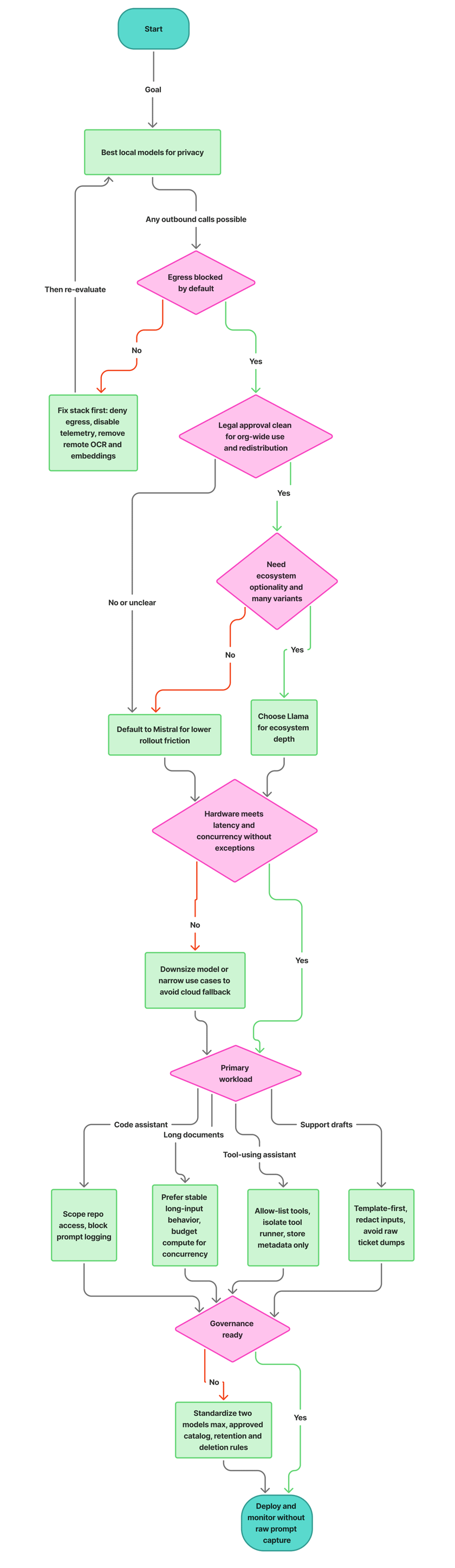
    Best local models for privacy

    When NOT to buy local LLMs

    The best local models for privacy are still the wrong buy if the basics are missing. Local only pays off when you can run it without exceptions, govern it without drama, and prove controls without hand-waving.

    1. Usage is unclear beyond a pilot, or the owner cannot state who will use it and for what tasks
    2. Workloads are spiky and unpredictable, and capacity planning will turn into constant firefighting
    3. No outbound deny posture, and too many components can “accidentally” call home (telemetry, plugins, remote OCR, remote embeddings)
    4. No retention policy for prompts, chat history, or embeddings, and no one can prove deletion across replicas and backups
    5. No data classification for what users will paste, and no redaction rules for tickets, emails, contracts, or customer identifiers
    6. No ealuation muscle: no test set, no quality gate, no red-team checks, just “looks good in the demo”
    7. No governance spine: every team can deploy its own model variant, and behavior will drift week by week
    8. No security owner for the full chain (UI, gateway, inference, tools, vector DB, logging, backups), only partial ownership by function
    9. The business case is “privacy” only, with no operational objective like reduced cycle time, fewer support touches, or faster internal search

    If two or more bullets are true, pause the purchase. Fix the foundations, then compare Llama vs Mistral.

    A rollout plan that survives month three

    MonthDoConsider it Done when
    Month 1Lock “local” rules. Deny egress. Disable telemetry. Stop raw prompt logging. Pick one pilot workflow.Zero outbound paths. Logs store metadata only. Pilot scope frozen.
    Month 2Run the pilot. Create an evaluation set. Add a regression gate for upgrades. Set up monitoring without content.Pilot meets a target. Upgrades can be blocked. Metrics work without storing prompts.
    Month 3Put memory on retention. Prove deletion across replicas and backups. Standardize the model catalog (max two). Allow-list tools. Scale in one wave.Deletion is provable. No model sprawl. Tools cannot “phone home.” First scale wave passes evaluation.

    FAQs

    What are local AI models?

    Local AI models run on your own machine or private infrastructure instead of external APIs. Your data stays inside your environment, not on a vendor’s servers.

    Why are local models preferred for privacy?

    Because data does not leave your system. No API calls, no third-party logging, no exposure to external training pipelines. You control storage, access, and processing.

    Which local models are commonly used for privacy-focused setups?

    Popular choices include LLaMA variants, Mistral models, DeepSeek, and Qwen. The choice usually depends on your hardware, use case, and how much customization you need.

    Are local models completely secure by default?

    No. Running locally reduces external risk, but internal risks still exist. Poor access control, logging, or misconfigured systems can still expose sensitive data.

    How do local models compare to cloud AI in performance?

    They are getting close for many tasks like coding, summarization, and structured analysis. But very large cloud models still lead in some complex reasoning tasks.

    What hardware is needed to run local models?

    • 3B–7B models: Can run on high-end laptops
    • 7B–13B models: Need decent GPUs
    • 30B+ models: Require dedicated servers

    There is always a trade-off between performance and hardware cost.

    Are local models cheaper than API-based AI?

    At scale, yes. You avoid per-token costs. But you pay upfront for hardware, setup, and maintenance.

    Can local models work without internet?

    Yes. Once installed, they can run fully offline, which is critical for regulated or sensitive environments.

    How do local models support customization?

    You can fine-tune them, connect internal data, build RAG pipelines, and control workflows completely. That level of control is not possible with most closed APIs.

    Are local models suitable for enterprise use?

    Yes, especially where data sensitivity is high. Many enterprises use them for internal tools, document processing, and secure automation.

    What is the biggest limitation of local models?

    Infrastructure and operations. You own the hardware, uptime, scaling, and security. It is not “plug and play.”

    What is the biggest mistake teams make with local AI?

    Assuming local automatically means secure. Without proper controls, logging policies, and access governance, local systems can still leak data internally.

    When should you choose local models over cloud AI?

    Choose local when:

    • Data is sensitive
    • Costs are scaling with usage
    • You need control and customization

    Otherwise, cloud AI is faster to deploy and easier to manage.

    Do local models eliminate API dependency completely?

    Yes, for many internal use cases. But some teams still use hybrid setups where sensitive tasks stay local and general tasks use APIs.

    What actually matters more than the model itself?

    The setup. Identity controls, data handling, retrieval permissions, logging, and infrastructure discipline matter more than whether you choose LLaMA or Mistral.

    Conclusion

    The best local models for privacy are the ones you can run without exceptions. Not “best on a benchmark,” best under your licensing constraints, your hardware limits, and your governance reality. If egress is not locked down, if prompts can land in logs, or if retention and deletion are not provable, model choice is a distraction. Pick the family that your legal team can approve cleanly, standardize to a tight catalog, and treat memory, logging, and tools as the real privacy surface. Then local becomes a control you can defend, not a claim you hope nobody tests.
  • Self-hosted LLM Infrastructure: Buy It Without Leaking Data

    Self-hosted LLM Infrastructure: Buy It Without Leaking Data

    You can ban public AI tools, block browser plugins or even add DLP pop-ups. Then someone pastes a customer escalation thread into a “private” chatbot anyway, because the fastest path still wins. That is the real problem: most leaks are behavioral and operational, not vendor-driven.

    Self-hosted LLM infrastructure helps, but only if you treat it like a regulated system, not a science fair. The failure points are unglamorous and costly: overbroad service accounts, chat logs that quietly capture secrets, RAG indexes built without document ACLs, telemetry shipped to “support,” and egress rules that exist only on paper. 

    One weak control and your “private AI” becomes a very efficient data vacuum.

    So, let’s find out the acceptance gates, disqualifiers, and the proof package to demand so you can protect data from public AI without buying a whole circus.

    Self-hosting does not block public AI leakage

    Self-hosting is a hosting choice, not a security outcome. It can keep company data away from public AI services, but it will not stop internal leakage unless your platform behaves like a controlled system.

    What self-hosting CAN remove: your prompts and files are not going to a public AI endpoint by default. You own the runtime boundary, network paths, and storage. That is real value.

    What self-hosting DOES NOT remove: over-scoped access, chat history retention, logging of sensitive text, retrieval that ignores document permissions, and outbound telemetry. Those are the usual sources of “private AI” embarrassment.

    Procurement decision rule: do not sign until you see proof of these three controls in the demo or POC.

    • Retention control for prompts, files, and outputs (including logs)
    • Permissioned retrieval that enforces document-level access (no shared-index leakage)
    • Egress control and visibility for every outbound path (telemetry, plugins, support, updates)

    Contract traps that show up after signature

    Procurement is told the same story every time: “Your data stays private,” “We do not train on it,” “Enterprise-grade security.” None of that matters if the contract language is vague or the platform behavior is undocumented. “Protect data from public AI” is a legal and operational requirement; treat it accordingly. 

    Make the vendor commit to behaviors you can audit, not intentions you can screenshot.

    Red flags that usually surface after you are already live:

    1. “No training” but no clarity on retention, backups, or derived artifacts like embeddings and logs
    2. “Private deployment,” but telemetry and diagnostics still leave your environment by default
    3. Support access that is broad, unaudited, or always-on, justified as “necessary for uptime.”
    4. Sub-processors are added silently over time, with notification language that is technically compliant but practically useless.
    5. Data residency and encryption claims without key ownership clarity (who can decrypt, when, and under what process).

    What to ask for, in contract terms, not email promises:

    • Explicit definition of “Customer Data” that includes prompts, uploads, outputs, logs, embeddings, evaluation traces, and fine-tuning artifacts
    • Retention and deletion obligations with timelines, including backups, and a statement on what cannot be deleted
    • A list of outbound telemetry categories, whether content is included, and a default of content-free telemetry
    • A support-access policy: break-glass only, time-boxed, approved, logged, and reviewable
    • Audit rights or at least audit artifacts: SOC reports, pen test summaries, and log export capability relevant to your deployment

    The buyer moves: if the vendor resists specificity here, stop negotiating features. You are not buying a model; you are buying a data-handling system.

    Pro Tip: Ask for a one-page “data handling matrix” as an appendix: data type, where stored, retention, who can access, and how it is deleted.

    Acceptance gates before demos

    Acceptance gateWhat you must see as proofInstant fail condition
    Data scope pinnedOne-page scope: in-scope data types, users, systems, and exclusions“We’ll define later,” or the scope expands during the demo
    Retention controlConfig showing retention for prompts, uploads, outputs, and logs; exportable policyThe vendor cannot show where the data is stored or for how long
    Deletion is realDemonstration of delete request + evidence of what is deleted and what is not (backups, traces)“Deletion by ticket” with no technical proof
    Permissioned accessSSO + RBAC mapping; least-privilege roles; admin separationShared admin accounts or unclear role boundaries
    Permissioned retrievalRAG demo proving document-level ACL enforcement per user/groupAny cross-team document bleed in the retrieval results
    Egress deny-by-defaultNetwork policy/allowlist and logs showing blocked outbound pathsTelemetry or plugins can send content out by default
    Support access is controlledBreak-glass process: time-boxed, approved, logged, reviewableAlways-on support tunnels or unaudited access
    AuditabilityExportable audit logs: who asked what, what was retrieved, key config changesNo log export, or logs omitted, retrieval and config changes
    POC exit criteriaWritten POC rubric mapped to gates, named approvers; pass/fail outcomes“POC success” is defined as “users liked it.”

    You force vendors to show measurable behaviors: retention, deletion, permissioned retrieval, egress control, and audit proof. This also keeps your POC tight. You are validating data-handling and control maturity, not model quality. 

    Any gate you defer becomes an explicit, owned risk, not a hidden surprise after go-live.

    IAM non-negotiables for LLM platforms

    If your identity and access model is weak, everything else is decoration. Self-hosted LLM infrastructure becomes a new internal data surface, which means you need the same discipline you apply to source code, ticketing, and production logs. Procurement should treat IAM requirements as disqualifiers, not “phase two.”

    Minimum requirements to protect data from public AI in real operations:

    • Single sign-on only, mapped to your IdP, with enforced MFA and conditional access policies
    • Role-based access with least privilege, separating end users, builders, reviewers, and admins
    • No shared accounts. No “one admin to rule them all.” Every privileged action must be attributable
    • Separate service accounts for each integration, scoped to the smallest dataset and action set
    • Break-glass admin access that is time-boxed, approved, logged, and reviewed
    • Environment isolation: dev, test and prod are separated so experimentation cannot touch real data
      Session controls: idle timeouts, device posture rules, and location or network restrictions if you use them elsewhere

    Trade-off you should accept upfront: strong IAM slows early experimentation. That is the point. If a vendor says “security will kill adoption,” they are telling you your users are going to do unsafe things when the system is convenient.

    If admins and integrations share one broad role, that role becomes your leak path.

    Procurement paths to keep data out of public AI

    There are three buying patterns. Self-hosted LLM infrastructure gives you maximum control, but you become the operator. Managed private is faster to launch, but your privacy posture depends on contracts, telemetry limits, and how support access works. Hybrid proxy can reduce exposure quickly, but it is only reliable if teams cannot bypass it.

    Before you compare vendors, estimate demand in one line.
    Monthly tokens in million = Users × prompts/day × tokens/prompt × 30 ÷ 1,000,000.
    Example: 500 users × 10 prompts/day × 2,000 tokens × 30 ÷ 1,000,000 = 300 million tokens/month. 

    This number matters because it turns the conversation from opinions to scale.

    Hosted options are mostly pay-per-use: million tokens × rate. 

    Self-hosted is mostly pay-per-month: compute running 24×7 plus the operating work that keeps it safe (on-call, patching, audits, log storage). 

    If you cannot estimate usage and monthly burn with named owners, you are not ready to commit to self-hosting. Start with a controlled managed path, measure real usage, then decide whether self-hosting is worth the fixed commitment.

    Also read: The ROI of Sovereign AI: Why Local AI Models Save 40% on API Tokens

    RAG is where data leaks

    Most “private LLM” incidents are not model problems. They are retrieval problems. The moment you add RAG, you are building a new search layer that can quote internal text back to a user. If that layer does not enforce the same permissions as your source systems, your self-hosted LLM infrastructure becomes a cross-team data mixer.

    The first leak pattern is the shared index. Teams ingest documents into one corpus because it is faster. Then they bolt on filters that are not tied to real identity and groups. The result is predictable: a user asks an innocent question, retrieval pulls a chunk they were never allowed to see, and the model summarizes it confidently. Nobody calls it a breach until the wrong person recognizes the content.

    The second leak pattern is preprocessing. Chunking, OCR and cleaning often strip metadata that you needed for access control. If the pipeline drops document owner, classification, or ACL references, you cannot enforce permissions later. 

    Embeddings are also derived artifacts. 

    Even if you do not store raw documents in the vector index, you still need to treat the index as sensitive because it exposes meaning and business context.

    What you should demand is boring but decisive. 

    • RAG must be permissioned end to end. 
    • Ingestion must preserve access metadata. 
    • Retrieval must run in the context of the logged-in user. 
    • Answers must be traceable to sources so you can audit what was retrieved. 

    If a vendor cannot demonstrate a permission failure test such as “user from Team A cannot retrieve Team B content,” your self-hosted LLM infrastructure is not protecting data. It is accelerating the wrong retrieval.

    The proof package buyers should demand

    If a vendor says “yes, supported,” treat it as noise until you see exports. For self-hosted LLM infrastructure, you need proof you can hand to Security, Legal, and Audit without rewriting it as a story.

    Demand these artifacts from the demo or POC:

    • Audit log export showing who accessed what, when, and from where
    • Retention settings for prompts, uploads, outputs, and logs, with evidence they are enforced
    • Deletion proof showing what is deleted, what remains, and why (backups, traces)
    • Egress evidence: allowlists, blocked outbound attempts, and telemetry scope
    • Support access model: break-glass flow, approvals, time-boxing, and logs
    • RAG proof: (You already read it above)
    • Ownership proof such as who can decrypt, under what process, and how keys rotate
    • Incident processes like who gets paged, what logs exist, and how you investigate

    If the platform cannot produce these quickly, you are not evaluating a product. You are funding a gap.

    Trade-offs that change the buying decision

    Self-hosted LLM infrastructure buys control, but it also buys ownership. The first trade-off is uptime. Once teams rely on the assistant for incident triage, ticket handling, or customer responses, downtime becomes a business problem, not an IT experiment. If you do not have a clear on-call model and a rollback path, you will either over-engineer for fear or run it unsafely until the first outage forces a scramble.

    The second trade-off is security drift. Model servers, vector stores, gateways, and observability stacks need patching and hardening like any other production system. Access creep is also real. The “temporary admin” role that helped the pilot becomes permanent. 

    The log system quietly retains sensitive prompts because nobody tuned it. The RAG corpus grows without re-validating permissions. These are not dramatic failures, they are slow decay.

    The third trade-off is economics. Self-hosting is a monthly commitment. You pay even when usage is low, and the real cost is not only compute. It is engineering time, security reviews, audits, and incident handling. 

    If you self-host, treat it like a platform product. Name a platform owner, publish acceptance gates, and run quarterly access and retention reviews.

    When NOT to buy self-hosted LLM infrastructure

    When NOT to buy self-hosted LLM infrastructureWhat this looks like inside the orgFinancial impact
    No approved rollout volumeNo signed rollout plan, no minimum active users, no monthly usage targetFixed monthly burn with low utilization; fast candidate for budget cuts
    Peak-load sizing is mandatory“Must work during incidents and exec escalations” becomes a hard requirementYou pay for peak capacity all month; average usage does not reduce cost
    No funded run capacityBuild team is expected to operate infra, patch, monitor, and respondHidden labor cost plus delivery slowdown; infra burn continues regardless
    HA/DR is expected at launchExpectations match core systems, not pilotsRedundancy multiplies cost; reliability spend grows nonlinearly
    Cost predictability is a CFO requirementFinance wants stable monthly spend and clear allocationInfra plus audit and incident overhead drives variance and add-ons
    “Cost saving” is the primary business caseThe case is “API is expensive” without stable usage and utilization assumptionsFront-loaded spend; savings only at sustained high utilization
    No chargeback modelNo BU owns usage; everything lands under central ITConsumption grows without accountability; ROI becomes undefendable
    Funding horizon is quarter-to-quarterRe-approvals, freezes, and stop-start governance are commonSunk cost risk rises; restarting later costs more than finishing now
    Audit evidence is required immediatelySecurity expects evidence packs from week oneRecurring compliance overhead; delays burn money without value delivered
    Platform direction is still fluidCloud, model family, vendor strategy, and regions are still debatedRe-platforming leads to write-offs and rework, not “optimization”
    Data access is politically fragmentedPermissions differ by department with exceptions and manual approvalsIntegration and access alignment dominate spend; infra is not the main cost

    Conclusion

    Self-hosted LLM infrastructure can protect company data from public AI, but only when it is bought and operated like a controlled system. The winning programs do not start with model benchmarks. They start with procurement gates, hard proof of retention and deletion behavior, permissioned retrieval that respects document access and outbound controls you can audit. 

    If you anchor the buy on evidence and financial shape, self-hosting stops being a risky science project and becomes a defensible platform decision that Security, Legal, and Finance can live with.

    Additional reading: Serverless vs. self-hosted LLM inference

  • The ROI of Sovereign AI: Why Local AI Models Save 40% on API Tokens

    The ROI of Sovereign AI: Why Local AI Models Save 40% on API Tokens

    Too many smart leaders are treating their AI strategy like a permanent hotel stay. You are paying a luxury markup for a room you can never decorate and a bed you do not own. Public APIs served a purpose during the experimental phase. Now, there is a massive leak in your operational bucket.

    The smartest players in the market realize that renting intelligence by the token is a recipe for margin collapse. It is the digital equivalent of paying for every breath of air in your office. Let’s find out how to stop the bleeding and reclaim forty percent of your budget. Welcome to the world of Local AI Models.

    The perpetual API subscription tax on your operational margins

    Public APIs are essentially a tax on your success. The more users you attract and the more data you process, the more you owe a third party. It is a backwards way to build a business because your most successful month becomes your most expensive one. I am seeing talented teams hesitate to roll out new features because they are terrified of what the bill will look like at the end of the quarter.

    Also Read: Self-hosted LLM Infrastructure: Buy It Without Leaking Data

    This is where local AI models change the equation from a variable drain to a fixed foundation. When you own the infrastructure, your cost to run one thousand queries is nearly the same as the cost to run ten. 

    You are moving from a world where you rent a brain by the minute to a world where you own the engine. If your business model relies on a vendor not raising their prices or changing their terms, you are not a manager. You are a hostage.

    The financial logic for a pure API strategy falls apart the moment you hit production scale. You are paying a massive premium for a generic service that has zero loyalty to your bottom line. By bringing the compute in-house, you are turning a recurring liability into a strategic asset that actually builds value on your balance sheet. 

    The winners of this decade will be the ones who stop paying the landlord and start owning the land.

    Also Read: 7 Hard Truths About AI-Based Startups Nobody Puts in Pitch Decks

    Stripping the provider markup to claim your 40 percent margin dividend

    The 40 percent saving is not a guess. It is the result of removing the massive premium that commercial providers charge to cover their own research and marketing. When you use local AI models, you are buying at wholesale prices. You stop subsidizing the profit margins of a trillion-dollar tech giant and start keeping that capital for your own infrastructure. 

    The markup on a standard API call is often four times the actual cost of the electricity and silicon used to generate it.

    The money usually leaks out in three specific ways:

    • You are paying for a giant brand name and a flashy website that your users never even see.
    • You are being forced to use a massive model to do a tiny job because the provider wants to simplify their own billing.
    • Your monthly check is paying for the vendor to train their next version instead of improving your own system.

    If you analyze an enterprise workload of 200 million tokens monthly, an API provider might charge you $5,000 for the privilege. Running that same workload on a dedicated server cluster costs a few hundred dollars in power and maintenance. 

    Also Read: Conversational AI Assistants Aren’t Chatbots. They’re Breakthrough Relationships Built on Understanding

    Local AI Models: the only cure for the hidden productivity tax of latency

    Every millisecond your data spends traveling to a server farm three states away is a millisecond your staff spends staring at a gray loading bar. While a three-second delay feels negligible for a single query, it becomes a massive bottleneck when integrated into high-frequency business processes or real-time customer interfaces. 

    By deploying local AI models, the intelligence sits in the same rack as the task, turning a stuttering workflow into a seamless stream of results that keeps your team in a state of high output.

    Efficiency FactorPublic Cloud APILocal AI ModelsDirect Benefit
    Response Latency2.0s – 5.0s (Network overhead)0.1s – 0.5s (Internal bus speed)Eliminate the wait tax on customer facing apps to boost retention.
    System ThroughputCapped by vendor rate limitsLimited only by your GPU VRAM10x more transactions per hour with your existing staff.
    Worker ProductivityHigh context switching riskNear instant flow state supportSave thousands of work hours annually on high volume audit tasks.
    Operational UptimeVulnerable to ISP and Cloud outages100% available behind your firewallCore logic remains functional even if the global internet flickers.
    Cost of IdlingPaying for system wait timeMaximum hardware utilizationStop paying for expensive talent to watch a loading spinner.
    Data Travel DistanceThousands of miles round-tripCentimeters across the motherboardRemove 100% of the interception risk from the transport layer.
    Concurrency LoadPerformance drops during peak hoursDedicated, consistent performanceReporting is ready by 8 AM regardless of global traffic.
    Batch ProcessingHigh cost for large-scale datasetsFree execution on owned hardwareDeeper analysis of your entire database without fear of a surprise bill.
    Debugging SpeedSlow feedback loops via API logsReal-time local console monitoringDevelopers can iterate and ship features twice as fast.
    Integration ComplexityConstant API version maintenanceStable, version-locked environmentsLower DevOps overhead by freezing the model stack.

    Locking your data vault by hosting intelligence inside the house

    Sending your company data to a cloud API is like handing your house keys to a stranger just because they offered to help you carry the groceries. You are trusting a third party to handle your proprietary secrets, customer records, and internal strategy while they train their own systems on your success. 

    Far too many leaders treat their data like a public utility when it is actually the only thing keeping them competitive in a crowded market.

    The financial stakes of a mistake are no longer a slap on the wrist. Looking at the 2025 numbers, the average cost of a data breach is a direct hit to your valuation. Beyond the legal fines, you have to deal with the fact that most consumers will simply walk away if they do not trust how you handle their personal information. 

    Using local AI models ensures your data never leaves your own silicon, effectively removing the third-party provider as a point of failure.

    By hosting your intelligence on-site, you are building a physical wall around your intellectual property. You stop being a guest in someone else’s data center and start being the warden of your own vault. Total ownership of your stack is the only real insurance policy in an era of high-speed corporate espionage.

    Stopping the drain of paying for computing power your tasks do not require

    Most cloud providers force you to rent a massive, one-size-fits-all brain to perform basic data entry tasks. It is like hiring a world-class neurosurgeon to put a bandage on a scraped knee. You are paying for billions of parameters of general knowledge and expensive safety alignment that have zero impact on your specific business logic. 

    By deploying local AI models, you match the size of the model to the complexity of the job, ensuring every dollar spent is directed toward your actual goals.

    • Use a lean 8B model for document extraction instead of a massive 400B model to cut your power and processing requirements by 90 percent.
    • Run specialized tasks in parallel on a single GPU cluster to finish a week of data processing in a single afternoon.
    • Stop paying for the extra compute cycles a cloud provider uses to run ethical filters on your own private, internal data.
    • Direct every bit of your VRAM toward revenue-generating tasks rather than paying for a giant model’s idle background processes.
    • Reduce your cost per interaction to near zero by stripping away the “general intelligence” fluff you never asked for.

    Trading volatile usage spikes for the peace of a fixed infrastructure budget

    Relying on a cloud API means your monthly expenses are tied to a roller coaster you do not control. If your application goes viral or your team runs a massive data audit, your bill spikes without warning. It is impossible to protect your margins when your infrastructure costs change every single day based on how many tokens you happen to consume.

    When you shift to local AI models, you are buying the farm instead of paying for every ear of corn. Your infrastructure cost becomes a flat and predictable line on your balance sheet. 

    You know exactly what your server costs will be for the next three years, regardless of whether you process a thousand requests or a billion. This transition allows you to forecast your margins with total confidence because you have removed the variable pricing risk from your core operations.

    A fixed budget model also changes the way your team iterates on products. When every experiment carries a direct financial penalty from a cloud provider, your developers stop taking risks to avoid blowing the budget. With your own hardware, the marginal cost of trying a new idea is zero. You can push your systems to the absolute limit without checking the balance on your credit card.

    Additional reading: Ten Key Insights from IBM’s Cost of a Data Breach Report 2025

    Conclusion

    Treat the shift to local AI models like buying the building instead of renting a cramped basement. The API era served as a useful training wheel phase, but keeping those wheels on during a competitive race is a guaranteed recipe for a margin crash. Owning the hardware is the only way to lock in profit and tell the cloud giants that the bank is closed for good. The dividend of this decision is simple: total autonomy and a balance sheet that finally stops leaking cash with every single query.

  • Top AI Startups in Healthcare: What Works Beyond the Demo

    Top AI Startups in Healthcare: What Works Beyond the Demo

    When people talk about top AI startups in healthcare, most of what gets celebrated would collapse the moment it touches a real hospital, lab, or pharma IT environment. Accuracy charts, flashy demos, and funding headlines mean very little once you’re dealing with legacy systems, regulatory landmines, pissed-off clinicians, and IT teams who already have enough fires to fight.

    Healthcare AI doesn’t fail because the models are dumb. It fails because it ignores how healthcare actually runs. The stack is old, layered, political, and brutally unforgiving. You don’t “move fast and break things” inside an EHR. You don’t casually rewrite lab workflows governed by accreditation bodies. You don’t drop an opaque model into a GxP setup and hope compliance sorts itself out later. Anyone who has tried knows how fast that fantasy dies.

    Vendors sell intelligence. IT teams buy survivability. 

    They care about what systems are touched, what data is read or written, who signs off, what gets logged, and how much damage is done when something goes wrong at 2 a.m. on a Sunday. The real separation between useful AI and expensive noise happens long before outcomes or ROI decks enter the conversation.

    So instead of ranking healthcare AI by buzzwords or clinical promises, this piece looks at it the way IT decision-makers actually do: by where AI plugs into the stack, how deep it goes, and how much trouble it causes when reality shows up. And there’s no better place to start that conversation than diagnostic workflows.

    LIS and LIMS: Where AI Meets Diagnostic Workflows

    Among top AI startups pitching into healthcare, diagnostic labs are often treated as an easy win. The reality is the opposite. LIS and LIMS environments expose weaknesses in healthcare AI startups faster than almost any other system because lab workflows are deterministic, regulated, and relentlessly audited.

    For IT leaders, the first practical question is not what the AI does, but where it sits. In most successful deployments, AI never replaces LIS or LIMS logic. 

    It operates alongside it. Read-only access is the default. Outputs are flags, prioritisation cues, or secondary interpretations that technicians and pathologists explicitly approve. If a healthcare AI startup requires direct write access to test results, it should trigger immediate escalation and architectural review.

    Integration effort is the real differentiator here. Healthcare AI startups that succeed in LIS and LIMS environments usually demonstrate three things early. First, clean handling of sample identifiers across instruments and reruns. Second, explicit traceability of AI output to sample ID, run ID, and model version. Third, a clear answer to how amended reports are handled without corrupting audit trails. If any of these answers are vague, the deployment cost will surface later in compliance reviews or accreditation audits.

    Validation expectations further separate deployable vendors from demo-only ones. In regulated labs and pharma-adjacent settings, AI models are treated as controlled components. 

    Versioning is mandatory. 

    Retraining is not continuous by default. Change control is documented. Healthcare AI startups that approach LIS and LIMS with a consumer software mindset often underestimate this effort and stall after the pilot phase.

    From an IT decision-making perspective, LIS and LIMS are not innovation sandboxes. 

    They are enforcement layers. 

    They force healthcare AI startups to prove operational maturity, not just technical capability. The vendors that pass this stage tend to scale quietly and sustainably. The ones that do not usually pivot away from diagnostics or remain stuck offering offline analytics that never touch production workflows.

    This is why diagnostic platforms remain one of the most reliable filters when evaluating top AI startups in healthcare. If an AI product can coexist with LIS and LIMS without weakening lineage, traceability, or validation discipline, it is far more likely to survive deeper integration elsewhere in the stack.

    RIS and PACS: Imaging-Centric AI Deployments

    Among all clinical systems, imaging is where healthcare AI startups have had the least resistance, and for very practical IT reasons. RIS and PACS environments are already built for high-volume data ingestion, parallel reads, and secondary interpretation. For a hospital or imaging network, AI here usually enters as an additional consumer of images, not a system that rewires workflows. 

    That distinction matters. 

    A healthcare AI startup that understands radiology IT does not try to become the reporting system or the system of record. It focuses on augmenting throughput, prioritisation, and review efficiency without disturbing radiologist ownership or PACS integrity. This is why imaging AI has quietly moved into production faster than most other AI categories, even when clinical impact is modest.

    • Most deployments rely on DICOM-compatible ingestion directly from PACS without changing existing routing rules
    • AI outputs are typically attached as overlays, structured findings, or secondary reports rather than primary interpretations
    • Radiologist sign-off remains mandatory, which keeps clinical governance intact and reduces IT escalation risk
    • Latency expectations are strict, especially for emergency workflows, forcing AI vendors to optimise inference pipelines early
    • PACS vendor compatibility often matters more than model accuracy when scaling across sites
    • Storage, bandwidth, and image retention policies quickly surface hidden infrastructure costs
    • Successful healthcare AI startups design for partial adoption, allowing hospitals to enable AI only for specific modalities or studies

    For IT teams, imaging AI works when it behaves like infrastructure-friendly software rather than a clinical authority. 

    The top AI startups in this space survive not by claiming diagnostic superiority, but by fitting cleanly into RIS and PACS ecosystems that were never designed to be disrupted.

    top ai startups

    EHR Touchpoints: Read, Write, and Governance Boundaries

    Among all healthcare AI deployments, imaging is where most IT teams first see real traction from top AI startups in healthcare. That is not because imaging is easy, but because RIS and PACS environments are structurally more tolerant of AI when handled correctly. Images are immutable, workflows are well defined, and responsibility is already split between acquisition, interpretation, and reporting. 

    Healthcare AI startups that succeed here understand one thing clearly: do not interfere with the image, the radiologist, or the system of record.

    For IT leaders, the value of imaging AI is not diagnostic brilliance. It is operational control. Faster triage, workload prioritisation, consistency checks, and structured reporting assistance without destabilising PACS or triggering governance escalations. 

    Most failures in this space happen when vendors overreach, underestimate PACS vendor constraints, or quietly assume access patterns that will never be approved in production.

    What IT teams actually evaluate in RIS and PACS-based AI deployments:

    • How DICOM ingestion is handled without altering original studies
    • Whether inference runs inline or asynchronously and its impact on reporting latency
    • How AI outputs are attached to studies without becoming part of the image record
    • Whether the radiologist signs off remains mandatory and traceable
    • How model outputs are versioned against reports and timestamps
    • PACS vendor compatibility and limits around proprietary extensions
    • Storage, compute, and egress cost visibility at scale
    • Failure behaviour when AI services are unavailable

    Healthcare AI startups that respect these boundaries move into production faster. Those who push for deeper control get stuck in approvals, exceptions, and endless pilot extensions. In imaging, AI earns adoption not by being smarter, but by being predictable, reversible, and boring enough to trust.

    Data Lakes and EDW: Analytics-First AI Architectures

    For many IT leaders evaluating top AI startups in healthcare, data lakes and EDW environments are where AI feels safest. A healthcare data lake or an Enterprise Data Warehouse (EDW) sits outside frontline clinical execution. It consumes data from LIS, EHR, RIS, billing systems, and devices without interfering with how care is delivered. That separation matters. It allows healthcare AI startups to operate on governed datasets while keeping operational systems untouched.

    Technically, this model works because data movement is controlled and predictable. Extracts flow through ETL or ELT pipelines, land in structured or semi-structured storage, and are processed under clear governance rules. 

    AI models run on historical and near-real-time data, not live transactions. Feature generation, inference, and reporting happen downstream, which means failures do not interrupt lab results, imaging workflows, or clinician order entry. For IT teams, this dramatically reduces blast radius and approval friction.

    The trade-off is speed and proximity to action. Analytics-first architectures are excellent for population health insights, trial analytics, operational forecasting, and retrospective decision support. They are weaker when real-time intervention is required. Still, this is why many healthcare AI startups deliberately position themselves around data lakes and Enterprise Data Warehouses. It gives them scale, auditability, and survivability. 

    For IT decision-makers, this architecture often represents the lowest-risk entry point for deploying healthcare AI at enterprise scale.

    Also read: AI Compliance Becomes a Profit Center in 2026

    Pharma IT Environments: ELN, CDMS, and QMS Constraints

    Pharma IT is a different world altogether. Speed matters, but evidence matters more. AI adoption here is dictated less by shiny architecture and more by how calmly a system can survive audits, inspections, and uncomfortable questions months after a decision was made. This is where many top AI startups in healthcare slow down, not because the models fail, but because their operational discipline does.

    Unlike hospitals or labs, pharma systems live under permanent regulatory scrutiny. Every data point, transformation, and output must be defensible. AI cannot behave like a constantly evolving black box. It must behave like a controlled, versioned system that produces the same result today and six months later, unless a documented change says otherwise. 

    For IT teams, this shifts the conversation from innovation to containment. The question becomes whether an AI system can be governed without creating compliance debt.

    Pharma IT teams evaluate healthcare AI through system boundaries rather than focusing on specific use cases. 

    ELN, CDMS, and QMS each impose different expectations, and startups that blur those lines usually pay for it during validation.

    ELN (Electronic Lab Notebook)

    • AI is typically allowed in research workflows first
    • Outputs are exploratory, not submission-grade
    • Versioning matters, but validation is lighter
    • Problems begin when research AI quietly drifts into regulated data

    CDMS (Clinical Data Management System)

    • Data integrity is non-negotiable
    • Traceability from source to output is mandatory
    • AI is tolerated only when transformations are explainable
    • Any model-driven inference must be reproducible on demand

    QMS (Quality Management System)

    • This is where AI faces the highest resistance
    • Decisions impact deviations, CAPAs, and compliance posture
    • Audit trails must be immutable and exportable
    • Black-box behavior is a deal-breaker, regardless of accuracy

    The pharma takeaway is simple. AI succeeds here only when it behaves like regulated software, not experimental intelligence. Many healthcare AI startups underestimate this shift and position themselves as fast-moving platforms, only to discover that the pharmaceutical industry rewards restraint, documentation, and predictability far more than speed.

    Also read: AI for Financial Analysis in 2026: 10 Breakthrough Ways Finance Leaders Can Use

    Why Some AI Solutions Deliberately Avoid Core Clinical Systems

    Here’s something most healthcare IT folks realise only after getting burned once: not every AI solution is supposed to touch your core systems. In fact, the smarter ones intentionally stay away. Not because they are weak, but because they want to get deployed, stay deployed, and not become tomorrow’s rollback incident.

    Core clinical systems like EHRs, HIS, or lab systems are slow to change for good reasons. Every small modification needs approvals, testing, clinical sign-off, and often weeks of coordination. When an AI tool plugs directly into these systems, it inherits all that friction. So many healthcare AI startups choose a safer route. They work alongside the core systems, read data from governed sources, and deliver value without forcing IT teams into endless change cycles.

    For IT decision-makers, this approach has clear benefits. Faster deployment. Lower risk. Fewer stakeholders yelling when something breaks. These AI solutions still help with planning, prioritisation, insights, or decision support, but they do it without asking for deep access or control. That is often the difference between an AI project that quietly delivers value and one that dies in committee meetings.

    How a Healthcare AI Startup Fits into Enterprise IT

    Here’s the uncomfortable truth most vendors won’t say out loud. Healthcare IT does not adopt AI because it is impressive. It adopts AI because it fits. For IT heads evaluating top AI startups in healthcare, the first question is never about the model. It is about effort. How much integration pain, how many approvals, how many things can go wrong if this goes to production?

    In practice, healthcare AI startups that succeed tend to follow a few predictable patterns that make life easier for IT teams.

    • They integrate around existing systems, not through them
    • They work with read-only access wherever possible
    • They do not demand real-time writes into EHR or core clinical systems
    • They accept existing identity, access control, and audit mechanisms
    • They can be isolated, monitored, and switched off without drama

    A healthcare AI startup that understands IT constraints gets deployed faster, reviewed less aggressively, and trusted sooner. One that ignores them may win pilots but rarely reaches scale. For decision-makers, this difference matters more than accuracy percentages or roadmap promises, because it determines whether AI becomes a quiet operational asset or just another stalled initiative.

    Also read: 7 Hard Truths About AI-Based Startups Nobody Puts in Pitch Decks

    Top AI Startups Worth Evaluating for Real-World Deployment

    Qure.ai
    Imaging-focused AI is deployed alongside PACS, typically read-only with clear clinical sign-off workflows.

    Oxipit
    Radiology triage and reporting automation designed to reduce workload without replacing radiologist authority.

    Deep Bio
    Digital pathology AI that fits into existing lab workflows without interfering with LIS systems of record.

    Ibex Medical Analytics
    Narrow pathology use cases with controlled deployment models and strong clinician-in-the-loop positioning.

    Aignostics
    Computational pathology focused on secondary analysis and research-adjacent deployments.

    Corti
    Real-time voice and decision support for clinical conversations, with minimal dependency on core clinical systems.

    Pieces Technologies
    Clinical insights platform designed to sit next to EHRs without deep write-back dependency.

    Unlearn.ai
    Pharma-focused AI enabling synthetic control arms, typically deployed within regulated analytics environments.

    Saama
    Clinical trial analytics operating across CDMS and data platforms with validation-aware operating models.

    Niramai
    Non-invasive diagnostic AI that integrates at the screening layer without deep hospital IT dependencies.

    SigTuple
    AI-assisted diagnostics for pathology and radiology, typically deployed as adjunct systems rather than replacements.

    Conclusion

    When people search for top AI startups in healthcare, what they usually get are loud names and louder promises. What actually helps IT decision-makers is clarity on fit, friction, and fallout. This post wasn’t about who is smartest or most funded, but about which AI solutions can realistically live inside existing healthcare IT without breaking workflows, audits, or teams. If there’s one takeaway, it’s this: in healthcare, AI succeeds less by being clever and more by being compatible. The startups worth backing, buying, or piloting are the ones that respect the stack you already run and the constraints you cannot wish away.

  • 7 Hard Truths About AI-Based Startups Nobody Puts in Pitch Decks

    7 Hard Truths About AI-Based Startups Nobody Puts in Pitch Decks

    Most of startups today claim that they are “AI-based startups”.

    Most of them are not.

    Some are clever wrappers around APIs. Some are automation tools wearing an AI costume. Some are just hoping the word “AI” buys them time, funding, and forgiveness.

    AI-based startups are not magic. They are harder, more expensive, more fragile, and far less forgiving than normal software companies. The upside is massive, yes. But so is the number of founders quietly panicking after the demo applause fades.

    Let’s talk honestly. No buzzwords. No worship. Just reality.

    What Actually Qualifies as an AI-Based Startups

    Let’s get this out of the way.

    Using ChatGPT APIs does not magically turn your startup into an AI company. Neither does adding “AI-powered” on the homepage or sprinkling a few prompts inside your product.

    An AI-based startup is one where artificial intelligence is not a feature but the core mechanism. 

    If you remove the AI layer and the product collapses, congratulations, you qualify. If the product still works fine without it, you’re just a regular SaaS wearing an AI costume.

    At its core, an AI-based startup uses models to learn, adapt, predict, and make decisions at scale. This could mean recommendation engines that improve with usage, systems that automate judgment-heavy tasks, models that spot patterns humans miss, or agents that act with limited autonomy. The intelligence must compound over time, not stay static.

    Another key qualifier is data gravity. Real AI-based startups are obsessed with data pipelines, feedback loops, training quality and inference costs. They worry less about UI polish and more about whether the model is drifting, hallucinating, or learning the wrong behaviour. If your biggest headache is prompt quality and model behaviour, you’re probably building something real.

    Finally, AI-based startups solve problems that were either impossible or wildly inefficient before AI matured. They compress time, reduce human dependency, or unlock scale without linear hiring. If your pitch sounds like “the same thing, but faster,” you might be missing the point. AI startups usually change who does the work, not just how fast it gets done.

    The Illusion of “We Use AI” vs Real AI Products

    Saying “we use AI” has become the startup version of saying “we are scalable.” It sounds impressive. It means almost nothing. A rules engine with a few if-else conditions wrapped inside a shiny dashboard is not AI. Calling an API from OpenAI does not magically turn your product into one of those serious AI-based startups people actually bet on.

    Here’s the uncomfortable truth. Many products slap the word AI on top because investors expect it, customers ask for it, and pitch decks look cooler that way. Under the hood, it is basic automation, static logic, or at best some analytics with thresholds. Useful, yes. Intelligent, no. And that gap becomes apparent very quickly once the product faces real-world complexity.

    AI-based startups

    Real AI products behave differently. They learn from data. They improve over time.

    They deal with uncertainty, not just predefined flows. A genuine AI-based system makes probabilistic decisions, adapts to patterns, and sometimes even surprises its creators. That is why real AI-based startups invest more in data pipelines, model training, evaluation loops, and monitoring than they do in landing pages.

    If your product stops working the moment rules change, or needs constant human tweaking to stay relevant, it is not AI-led. It is just well-packaged software. The difference matters because markets are getting smarter, buyers are asking sharper questions, and the “AI sticker” trick is wearing thin fast.

    Also Read: AI for Startups: 6 Authoritative Guidelines on Digital Transformation

    Where AI Startups Are Truly Creating Value

    AI-based startups captured an unprecedented share of global venture capital. The real value of AI startups is not in sounding intelligent. It is in doing something boring, expensive, or painful better than humans ever could. Most successful AI-based startups are not chasing buzzwords. They are quietly replacing fragile processes that break at scale.

    The strongest signal of real value is simple. If you remove the AI, the product collapses. If you can remove the AI and still sell the product, then AI was never the core.

    Here is where genuine value is actually being created.

    • End-to-end task ownership, not assistance
      The best AI startups do not “help” a human do the work. They take full responsibility for the task. Screening resumes. Categorizing support tickets. Reconciling invoices. Flagging fraud. Humans step in only for exceptions, not routine decisions.
    • Process compression
      Real AI reduces a five-step workflow into one decision. Not faster screens. Fewer screens. Not dashboards. Fewer meetings. If the product still needs heavy hand-holding, AI is decorative.
    • Decision-making under uncertainty
      Valuable AI startups operate where rules break down. Ambiguous data. Incomplete signals. Changing patterns. This is where static automation fails and learning systems earn their keep.
    • Operational scale without linear hiring
      When a startup claims AI value, ask one question. Can revenue grow without growing headcount at the same rate? If the answer is no, the AI is cosmetic.
    • Learning from live data, not static models
      Strong products improve quietly in the background. Models retrain. Thresholds adjust. Outcomes get better month after month without manual tuning.

    Some areas where this value shows up clearly today:

    • Customer support triage and resolution
    • Fraud detection and risk scoring
    • Sales qualification and lead prioritization
    • Content moderation and compliance checks
    • Demand forecasting and pricing optimization

    And some areas where “AI value” is usually exaggerated:

    AreaReality
    AI dashboardsLooks impressive, but teams rarely act on insights due to missing ownership and workflows
    Chatbots bolted onto appsAdds another interface without fixing root process or customer experience issues
    Predictive insights with no executionPredictions exist, but no system triggers actions or accountability downstream
    Generic copilotsProduces text and suggestions without measurable impact on real business outcomes
    AI alerts and notificationsToo many alerts fired, most ignored after initial excitement fades
    AI-powered recommendationsSuggestions are generic because models lack deep context and operational authority
    AI analytics for leadershipReports are consumed in reviews, then forgotten until the next quarterly meeting
    AI features sold as differentiationSounds advanced in sales decks, but delivers marginal value in daily operations

    The Tech Stack Most AI Startups Quietly Depend On

    Behind the flashy demos and confident pitch decks, most AI-based startups rely on a surprisingly similar technical backbone. Very few are inventing brand-new algorithms from scratch. The real work happens in stitching together proven cloud infrastructure, mature ML frameworks, scalable data pipelines, and deployment layers that can survive real users. What separates serious AI startups from hobby projects is not the model alone, but how reliably this entire stack works together under load, cost pressure, and imperfect data.

    Common building blocks you’ll find under the hood:

    • Cloud infrastructure (AWS, GCP, Azure): Used for elastic compute, managed storage, GPUs, and rapid scaling without owning hardware.
    • Model frameworks (PyTorch, TensorFlow, JAX): Core libraries for training, fine-tuning, and experimenting with machine-learning models.
    • Pretrained and foundation models: Startups rarely train from zero. They fine-tune large language models, vision models, or speech models for narrow, high-value tasks.
    • Data pipelines and storage layers:  Tools like object storage, data warehouses, and stream processors move raw data into usable training and inference formats.
    • Vector databases and embeddings: Used to power semantic search, recommendations, retrieval-augmented generation, and similarity matching.
    • Inference and serving layers: APIs, microservices, and model servers that handle real-time predictions with latency and cost controls.
    • Monitoring, logging, and evaluation tools: Track model drift, performance degradation, hallucinations, and unexpected behavior in production.
    • Security and access control
      Authentication, data isolation, and auditability become critical once enterprise customers are involved.

    This stack is not glamorous, but it is where most AI startups either become dependable businesses or quietly fall apart.

    Why Many AI Startups Will Die Young

    AI-based startups are being born at an absurd pace. Decks look sharp, demos feel magical, and everyone claims proprietary intelligence. But beneath the surface, most of these companies are fragile. Not because AI is hard, but because building a real business on AI is harder than wiring an API.

    Many startups confuse using AI with owning differentiation. If your core value disappears the moment an LLM API changes pricing or capabilities, you are not a company. You are a temporary wrapper. That fragility shows up the moment costs spike or competitors replicate features in weeks.

    Secondly, data reality hits late and hard. Models don’t improve without clean, relevant, continuously flowing data. AI-based startups realize too late that customer data is sparse, noisy, or legally unusable. Training stalls, insights plateau, and the “learning system” quietly stops learning.

    Thirdly, unit economics kill the romance. Inference costs, cloud bills, vector databases, and monitoring stacks add up fast. Many AI startups scale usage before fixing margins. Growth feels exciting until revenue cannot outrun infrastructure burn.

    Finally, execution discipline is missing. AI cannot compensate for weak distribution, unclear ICPs, or messy workflows. When hype fades, only startups with operational clarity survive.

    Revenue Models That Actually Work for AI-Based Startups

    Most AI-based startups don’t fail because the tech is weak. They fail because the revenue model is a fantasy. Founders love talking about models, parameters, and benchmarks. Customers care about outcomes, pricing clarity, and whether the thing actually saves money or makes money. Real revenue in AI is boring, repeatable, and tightly coupled to business value. Anything else is noise.

    • Usage-based pricing tied directly to transactions, documents, calls, or decisions processed.
    • Per-seat licensing only when AI replaces a real human role, not when it just “assists”.
    • Revenue share models where AI directly impacts sales, recovery, or cost reduction.
    • API-based pricing for AI embedded inside customer workflows and systems
    • Tiered SaaS plans with strict caps, limits, and enforcement to avoid runaway compute costs.
    • Enterprise contracts focused on outcomes, SLAs, and measurable efficiency gains.
    • Platform fees combined with professional services for onboarding, tuning, and integration.

    The AI-based startups that survive are brutally honest about what customers will pay for. They price outcomes, not intelligence. They align cost with value, avoid vague promises, and build models that scale without bleeding cash. Fancy demos don’t pay salaries. Predictable revenue does.

    Enterprise vs Consumer AI Startups

    Enterprise and consumer AI startups may use similar underlying technology, but they live in completely different business realities. Enterprise AI is sold into slow, political, risk-averse organizations where trust, compliance, integrations, and ROI matter more than slick demos. 

    Consumer AI lives in a fast, brutal market where adoption is emotional, switching costs are low, and users leave the moment the product stops feeling magical. 

    One side optimizes for contracts, stability, and long-term value. The other survives on retention, habit, and scale. Confusing these two worlds is one of the fastest ways AI-based startups burn money without ever finding traction.

    AspectEnterprise AI StartupsConsumer AI Startups
    Primary buyerCIO, CTO, operations or business headsIndividual users or small teams
    Sales cycleLong, complex, approval-heavyShort, impulse-driven
    Revenue modelHigh-value contracts, annual subscriptionsLow-cost subscriptions or freemium
    Product depthDeep workflow integration, customization requiredSimple, fast, feature-focused
    Switching costVery high once embeddedVery low, users churn easily
    Growth patternSlower but more predictableFast spikes, equally fast drop-offs
    Support expectationDedicated support, SLAs, complianceMinimal support tolerance
    Survival riskDies slowly if the product failsDies quickly if traction drops

    Conclusion

    Most AI-based startups will not fail because the tech was weak. They will fail because they mistook demos for products, pilots for revenue, and attention for adoption. The ones that survive are brutally clear about the problem they replace, the workflow they live inside, and the money they earn without storytelling gymnastics. AI is no longer a differentiator. Execution is. If your startup cannot prove real value without saying “AI-powered” in every second sentence, the market will do the filtering for you.

  • Conversational AI Assistants Aren’t Chatbots. They’re Breakthrough Relationships Built on Understanding

    Conversational AI Assistants Aren’t Chatbots. They’re Breakthrough Relationships Built on Understanding

    “You don’t have to explain it again,” the conversational AI assistant replied.

    “It’s already in your plan from yesterday.”

    A simple line, but it makes people instantly realize that they’re not talking to a chatbot. They’re interacting with something that remembers, adapts, and understands.

    Most businesses still measure conversational AI by how well it talks. Smooth replies, natural phrasing, fewer errors: all these are important, but none of them create trust. 

    What actually builds trust is continuity. When an assistant connects today’s conversation with yesterday’s intent, it stops being a tool and starts becoming a relationship.

    That’s the shift here we explore: conversational AI assistants aren’t chatbots.

    They’re relationships built on understanding.

    Conversations Are Momentary. Relationships Are Continuous.

    Most teams still celebrate when their AI gives a clean, polished reply. It looks impressive in a demo. It feels modern. But here’s the practical truth:

    A single good conversation does not MEAN ANYTHING, literally.

    Anyone can string together a few neat lines. Humans can do it. Machines can do it. Even that friend who replies after three days can do it.

    A chatbot that gives perfect answers in the moment is like that colleague who talks politely in meetings and forgets everything the next morning. A chatbot handles the moment. A relationship-based conversational AI assistant handles the pattern.

    Users return to assistants that understand context, not assistants that speak perfectly. If it forgets preferences, repeats questions, or behaves like each session is the first, the experience becomes shallow very quickly. No amount of clever language can hide that.

    A good conversational AI assistant feels steady.

    It learns your rhythm, adjusts when you are rushed, and brings forward what you already settled earlier. It does not need to be dramatic or overly “smart.” It simply needs to show that it is paying attention.

    That continuity is what builds trust.

    It is also what makes an assistant feel genuinely helpful, rather than just chatty.

    Chatbots focus on the reply.

    Conversational AI assistants focus on the relationship.

    And honestly, if an AI keeps forgetting basic context, it does not matter how polished its wording is. It still comes across as a system that talks a lot but understands very little.

    The Human Blueprint for Trust

    When people trust someone, it’s never because of one impressive moment. It comes from small behaviours that repeat consistently over time. A conversational AI assistant earns trust the same way. Users don’t care about the technical depth behind the screen. They care about whether the assistant behaves like something that listens, remembers, and doesn’t make them repeat the work. The more human the signals feel, the more natural it is for users to rely on them.

    Here’s what that looks like in practice:

    • Being steady and predictable so the user doesn’t wonder what version of the assistant they’re getting today.
    • Remembering past interactions or preferences so the user isn’t stuck repeating simple information.
    • Picking up on cues like frustration, urgency, or confusion and adjusting the tone accordingly.
    • Following through on tasks without dropping steps or asking for the same input again.
    • Learning gradually from each interaction, so the experience becomes smoother over time.

    These behaviours are small on their own, but together they create a sense of dependability. Trust forms not in the conversation itself but in the continuity that follows. That’s what separates a tool from a relationship.

    Designing for Understanding, Not Conversation

    Most teams still chase “better chat” as if a conversational AI assistant needs to win a poetry contest. Nice wording looks great in a boardroom demo, but out in the wild, users don’t care. They just want the thing to get them. That’s it. If the assistant can’t understand intent or remember basic context, all that polished language might as well be lipstick on a clueless robot.

    Understanding is the real superpower. If the user already explained something, don’t make them repeat it like some punishment. If they’re clearly rushed, drop the essays. If they correct you, don’t mess it up again tomorrow. And if they’re annoyed, maybe don’t respond like a corporate email template.

    Conversation is cheap. Understanding is hard. But that’s what makes a conversational AI assistant feel alive in the right way, not human, but genuinely useful. The moment it starts anticipating, adjusting, and acting with context, the whole experience shifts from “chatting with a system” to “working with something that actually pays attention.”

    The Invisible Metrics of Relationship-based Conversational AI Assistant

    Traditional chatbot metrics look clean on a slide, but they miss the whole point. A conversational AI assistant isn’t judged by how fast it replies or how perfectly it forms a sentence. It’s judged by whether users come back, whether they forgive small mistakes, and whether the experience feels steady instead of mechanical. These signals are subtle, emotional, and often ignored, yet they’re the real indicators of whether an assistant is building a relationship instead of just running a script.

    What You MeasureWhat It Really ShowsWhy It Matters
    Re-engagement rateUsers return on their ownTrust is forming
    Forgiveness rateUsers continue after errorsEmotional comfort exists
    Continuity scorePast context is rememberedExperience feels stable
    Tone matchReplies fit the user’s moodInteraction feels natural
    Drop-off reasonsWhy users leavePinpoints trust gaps

    When Conversational AI Assistants Start Earning Loyalty

    Loyalty shows up the moment a conversational AI assistant stops behaving like a chatbot and starts behaving like something that actually remembers you. Users don’t celebrate perfect sentences. They notice when the assistant picks up yesterday’s thread without making them repeat the basics. That small continuity feels surprisingly powerful.

    conversational AI assistant

    Over time, the small behaviours add up. 

    The conversational AI assistant answers faster when you’re in a rush, stays calm when you’re irritated, and keeps track of decisions you’ve already made. Nothing flashy. Nothing dramatic. Just a steady, reliable presence. That’s the stuff people trust.

    And once that trust sets in, loyalty follows quietly. The conversational AI assistant becomes part of the user’s routine, not a tool they “try out.” It earns its place by paying attention, not by talking a lot.

    Read On: How AI will shape financial analysis in 2026

    Conclusion

    The real shift in conversational AI assistants isn’t louder, smarter, or more natural chat. It’s the move toward assistants that actually understand people. Not perfectly. Not magically. Just well enough to remember what matters, adapt when needed, and stay consistent over time. That’s what makes an assistant feel reliable instead of replaceable.

    In the end, users don’t form loyalty around conversation. They form it around continuity. When an assistant reduces friction, carries context forward, and behaves like it’s paying attention, the relationship feels real in a practical, grounded way. And that’s the goal. Not chatter. Not clever lines. Understanding.

    A chatbot talks.

    A relationship grows.

  • AI for Financial Analysis in 2026: 10 Breakthrough Ways Finance Leaders Can Use

    AI for Financial Analysis in 2026: 10 Breakthrough Ways Finance Leaders Can Use

    AI for financial analysis is no longer an experiment. Finance teams in various industries use it to find insights, speed up closing cycles, and cut down on manual work. The challenge isn’t accuracy anymore; it’s keeping up with the speed and volume of financial data that floods in every day.

    By 2026, AI will have become a mainstream part of financial operations. From predicting cash flow to summarizing reports, it helps analysts focus on strategy instead of spreadsheets. Traditional tools are useful, but they can’t match the speed and realtime intelligence that AI offers for decision-making.

    This post outlines ten practical ways to apply AI in financial analysis. These specific and proven ideas are ready for finance leaders to explore, test, or put into action in 2026.

    Predictive Cash Flow Forecasting

    Month-end firefighting is not a plan. You want to see liquidity risk early, test “what if” quickly, and walk into reviews with numbers you trust. AI for financial analysis system does that by pulling AR, AP, order book, payroll, and bank feeds into a single model that updates as transactions land. The goal is simple: fewer surprises, tighter working capital, and faster calls on borrowings or investments.

    Use

    • Aggregate AR/AP, bank statements, order pipeline, and seasonality drivers in one store.
    • Start with proven models LSTM, Prophet, or pretrained Chronos for quick baselines.
    • Add drivers like pricing changes, promo calendars, FX, and collections behaviour.
    • Backtest on 12–24 months, track MAPE and P90/P50/P10 intervals, and set alert thresholds.
    • Keep an analyst override log and change notes so Finance owns the forecast, not the model.

    Tools

    Business impact

    • Early visibility into shortfalls so treasury can act days or weeks sooner.
    • Lower idle cash buffers while staying safe, which frees capital for growth.
    • Fewer fire drills at close since forecasts refresh as transactions post.
    • Clear audit trail of overrides and assumptions, which builds trust in reviews.

    Automated Variance & Anomaly Detection using AI for financial analysis

    Finance teams often waste hours looking for numbers that aren’t right. They check for mismatched entries, sudden spikes, or unexplained drops. By the time the issue surfaces, it’s already in the month-end report. AI for financial analysis flips that routine. It continuously scans ledgers, journals, and sub-systems to catch irregularities the moment they occur. Instead of chasing errors after they’re published, analysts can focus on explaining and correcting them early.

    Use

    • Connect your ERP, bank, and expense data into a unified view.
    • Apply unsupervised learning models (Isolation Forest, Autoencoder) to flag deviations in transactions or cost centres.
    • Layer rules for context such as vendor limits, regional expense norms, or historical variance bands.
    • Review flagged anomalies through an analyst dashboard, allowing human validation before escalation.

    Tools

    • MindBridge Ai Auditor: Uses machine learning and control logic to find anomalies across ledgers and journals before audit season.
    • Alteryx Auto Insights: Turns variance data into plain-language summaries for finance teams.
    • DataRobot Time Series: Builds anomaly and trend models with automated feature engineering.
    • Anodot: Real-time anomaly detection for revenue, cost, and operational data streams.
    • Tableau Pulse: Integrates with BI dashboards to highlight unusual metrics automatically.

    Business impact

    • Detects potential fraud, duplicate payments, and manual-entry errors in near real time.
    • Saves hundreds of analyst hours each quarter by replacing manual reconciliation checks.
    • Builds an audit trail of exceptions and corrective actions, improving governance.
    • Reduces surprise variances during close and increases trust in financial data.

    Read on: AI Compliance Becomes a Profit Center in 2026

    Natural-Language Financial Reporting

    AI for financial analysis isn’t only about crunching numbers; it’s also about communicating them clearly. Analysts spend countless hours turning tables and charts into readable commentary for management, investors, and auditors. Natural-language financial reporting uses AI to bridge that gap. It translates raw metrics into easy-to-understand insights, adding context, tone, and even recommendations, all within seconds.

    Use

    • Train large language models (LLMs) on internal data to generate monthly summaries, variance notes, and board-ready commentary.
    • Connect the model with BI tools or your data warehouse so it pulls metrics directly, reducing manual copy-paste.
    • Standardise tone, compliance guidelines, and KPI definitions to maintain consistency.
    • Review and approve generated text to ensure accuracy and alignment with company messaging.

    Tools

    • Microsoft Copilot for Finance: Drafts summaries and commentary from Excel or ERP data right inside Microsoft 365.
    • Narrative Science (Tableau integration): Adds AI-generated explanations to charts and dashboards.
    • Jasper Business: Produces branded, data-driven narratives for reports and presentations.
    • ChatGPT Enterprise: Custom LLMs for internal financial reporting and scenario explanation.
    • Hypotenuse AI: Generates consistent, multi-format narratives for management and investor reports.

    Business benefit

    • Saves hours per reporting cycle by automating commentary and insight summaries.
    • Ensures consistency and clarity across all financial communication.
    • Makes dashboards understandable for non-finance executives.
    • Helps finance teams tell the story behind numbers.
    AI for Financial Analysis

    Scenario Planning & What-If Modelling

    Planning has always been about assumptions, but most teams struggle to test more than a few at a time. Analysts often rebuild complex sheets for every new variable, wasting hours on formulas. With AI for financial analysis, scenario planning becomes fluid. You can model pricing changes, cost hikes, or currency swings in seconds and see their immediate impact on revenue, margins, and cash flow.

    Use

    • Combine forecasting models with core business drivers such as sales volume, margins, or cost of capital.
    • Use generative AI to model best case, base case, and stress case scenarios in seconds.
    • Integrate results into FP&A dashboards so assumptions remain clear and traceable.

    Tools

    • Pigment: Planning platform that uses AI to simulate multiple financial outcomes in real time.
    • Anaplan PlanIQ: Predictive modelling add-on for enterprise planning workflows.
    • Palantir Foundry: Merges operational and financial data for scenario testing at scale.
    • IBM Planning Analytics with Watson: Adds predictive capabilities to budgeting and forecasting models.

    Business benefit

    • Enables faster and more confident decision-making.
    • Cuts down on repetitive spreadsheet modelling.
    • Improves visibility into the financial impact of changing business conditions.

    Expense Categorization & Reconciliation Automation

    Manual expense tagging and reconciliation drain time and patience. Analysts often spend hours tracing mismatched invoices, vendor codes, or duplicate entries across systems. When AI for financial analysis steps in, this tedious work becomes near-instant. It reads invoices, matches payments, and flags irregularities before the month closes.

    Use

    • Apply natural language processing (NLP) and optical character recognition (OCR) to extract data from invoices and receipts.
    • Match transactions automatically against ledger entries and approval workflows.
    • Train the model on historical expense data to improve accuracy and category mapping.

    Tools 

    • Rossum: AI document gateway that captures and validates invoice data from any source.
    • Vic.ai: Automates accounting and expense categorization with self-learning algorithms.
    • AppZen: Real-time audit and spend compliance platform for finance teams.
    • Expensify: Automates expense reporting with integrated AI receipt scanning.
    • Kofax AP Essentials: Cloud-based invoice automation for accounts payable.

    Business benefit

    • Reduces manual reconciliation effort and human error.
    • Speeds up month-end close by automating repetitive checks.
    • Improves spend visibility and compliance tracking.
    • Frees analysts to focus on exception handling and insight generation.

    AI-Driven Investment and Portfolio Insights

    Investment analysis combines skill and instinct. By 2026, that instinct will rely more on machine intelligence than manual spreadsheets. Analysts will handle growing volumes of market data, filings, and news that no human team can fully process alone. With AI for financial analysis integrated into their workflows, portfolio reviews will become sharper and faster. The system will detect correlations, interpret sentiment, and test allocation scenarios under shifting market conditions giving analysts a level of foresight that once came only with experience.

    Use

    • Combine structured data (market prices, fundamentals) with unstructured inputs like news and sentiment.
    • Apply reinforcement learning or predictive models to test portfolio allocations and rebalance strategies dynamically.
    • Integrate AI dashboards into portfolio management systems for real-time monitoring.

    Tools

    • Kensho Analytics: AI AI for financial analysis suite for market trends, macro signals, and portfolio risk.
    • QuantConnect: Cloud-based algorithmic trading platform with backtesting and data feeds.
    • Kavout: AI AI for financial analysis engine that ranks stocks using predictive analytics and factor modelling.
    • Alphasense: Uses NLP to surface insights from financial documents and earnings calls.
    • Sentifi: Real-time market intelligence from millions of news and social media sources.

    Business benefit

    • Delivers faster, more accurate investment insights with continuous model learning.
    • Helps analysts uncover hidden correlations and early risk signals.
    • Improves portfolio performance through proactive rebalancing and predictive risk control.
    • Reduces manual data mining and allows teams to focus on high-value investment decisions.

    Dynamic Risk Scoring for Credit & Accounts Receivable

    Credit and collections are often reactive. Finance teams realise a customer is risky only after payments start slipping. By 2026, that will change. With AI for financial analysis embedded in credit and AR workflows, risk scoring becomes proactive. The system learns from payment behaviour, transaction history, and even market signals to flag customers likely to default before they do.

    Use

    • Combine internal data such as payment patterns, invoice ageing, and dispute history with external inputs like credit bureau data or sector indices.
    • Train classification and regression models to assign risk scores dynamically as new data arrives.
    • Set automated triggers for follow-up, credit limit adjustments, or escalation based on predicted risk levels.

    Tools

    • Zest AI: Uses explainable machine learning for real-time credit risk scoring.
    • Taktile: Decision automation platform that lets analysts design and test credit policies with live data.
    • SAS Risk Engine: Predictive analytics suite for financial institutions managing loan and AR portfolios.
    • FICO Platform: Advanced analytics for credit decisioning and risk mitigation.
    • Credit Benchmark: Aggregates consensus credit risk data from leading financial institutions.

    Business benefit

    • Identifies at-risk customers weeks before default, improving collection efficiency.
    • Optimises working capital by aligning credit limits with real-time behaviour.
    • Reduces bad-debt exposure and enhances confidence in AR forecasts.
    • Supports compliance and audit through transparent, explainable risk models.

    Voice-Based Financial Query Assistants

    Finance systems store massive volumes of data, but most users can’t reach what they need without multiple steps. Analysts still export reports, filter columns, or depend on the BI team for answers. By 2026, this gap will narrow. With AI for financial analysis built into dashboards, voice-based query assistants will let users ask plain questions like “What was our Q3 margin by region?” and get instant, contextual replies within secondsF

    Use

    • Integrate natural language interfaces with existing BI tools and ERP systems.
    • Use voice or chat-based prompts to fetch live metrics, comparisons, or summaries.
    • Enable personalised responses by linking access controls and user roles.

    Tools

    • ThoughtSpot Sage: Conversational BI assistant that answers natural-language queries on enterprise data.
    • ChatGPT for Power BI: Adds conversational data exploration inside Power BI dashboards.
    • Tableau Pulse: Provides contextual insights and smart summaries directly in Tableau workbooks.
    • Zoho Analytics Ask Zia: Voice-enabled AI assistant that retrieves insights from datasets.

    Business benefit

    • Speeds up access to financial data without dependency on technical teams.
    • Makes dashboards interactive and intuitive for all business users.
    • Reduces report-generation workload and improves data-driven responsiveness.
    • Strengthens decision-making with real-time conversational insights.

    AI for Compliance & Continuous Audit

    Compliance checks and audits often feel like afterthoughts. They usually occur after the numbers are finalized. By 2026, that rhythm will shift. With AI for financial analysis built into accounting and ERP systems, compliance becomes a live process. Every transaction is checked against policy, regulatory rules, and approval logic as it happens, not months later.

    Use

    • Deploy NLP models to read and interpret regulation text, linking it to transaction patterns.
    • Map financial policies into rule-based engines that flag exceptions in real time.
    • Use AI-driven reconciliation to trace every entry back to its source document for audit readiness.

    Tools

    • Hyperproof: Automates evidence collection and compliance tracking with AI assistance.
    • Smarsh: Monitors and archives communication data for financial compliance.
    • Ayfie Inspector: Uses NLP to identify non-compliant content across documents.
    • Caseware IDEA: Supports continuous auditing and fraud detection with automated analytics.

    Generative AI for Financial Communication

    Most analysts spend far too much time turning spreadsheets into plain English. Drafting board notes, investor briefs, or policy summaries eats into the hours meant for actual analysis. In the coming months, this will change. Generative AI can now produce readable first drafts directly from structured data, helping teams communicate faster and more consistently.

    Use

    • Link your reporting data or Excel exports to a text-generation tool through APIs or low-code connectors.
    • Create prompt templates for recurring outputs such as board updates or budget summaries.
    • Always keep a review step; the human analyst validates tone, accuracy, and key messaging.

    Tools

    • Notion AI: Helps create narrative summaries within internal knowledge bases.
    • Copy.ai: Drafts business updates and presentation text from structured prompts.
    • TextCortex: Browser-based assistant that rewrites or expands financial paragraphs quickly.
    • Cohere Generate: Developer-friendly API for custom text generation at scale.
    • Local Llama 3 models: Run open-source LLMs on-premise for sensitive financial data.

    Business benefit

    • Cuts report-writing time and reduces dependency on communication teams.
    • Keeps messaging consistent across management decks and investor notes.
    • Reduces cost of paid enterprise tools by using lighter, flexible alternatives.
    • Frees analysts to focus on analysis instead of formatting and phrasing.

    Editor’s Choice:

    And here’s my personal pick….

    ToolBest ForWhy It Stands Out
    Vertex AI ForecastingCash flow predictionScalable model deployment and direct data integration.
    MindBridge Ai AuditorAnomaly detectionDetects irregularities and fraud risk before audits.
    Microsoft Copilot for FinanceFinancial reportingReduces manual reporting time inside Excel and ERP.
    PigmentScenario modellingSimplifies planning through real-time collaborative simulations.
    Vic.aiExpense automationLearns from past data to automate invoice categorisation.
    Kensho AnalyticsPortfolio insightsAnalyzes market and macro trends for smarter investment calls.
    Zest AICredit risk scoringTransparent, explainable risk models for credit decisions.
    ChatGPT EnterpriseFinancial reporting automationCreates secure, compliant financial summaries and narratives.
    HyperproofContinuous auditMaintains real-time compliance evidence and audit trails.
    Notion AICommunication draftsProduces readable summaries and internal financial updates.
  • AI Compliance Becomes a Profit Center in 2026: Turning Regulation into Competitive Advantage

    AI Compliance Becomes a Profit Center in 2026: Turning Regulation into Competitive Advantage

    AI compliance? WTF! Well, that’s the reaction you get when you ask eight out of ten CIOs. Most CIOs don’t know, and the few who pretend usually have a deck, not a plan. (Apologies to the CIO community, but someone had to say it.)

    Everyone is busy chasing “AI transformation.” But there’s one question that matters: can your AI explain without causing you embarrassment? We have reached a point where companies brag about “responsible AI,” yet can’t trace a single decision.

    The truth is simple. Compliance is the part of AI no one wants to talk about until it bites them. It’s boring, it’s bureaucratic, and it’s brutally revealing. In 2026, when regulators tighten rules and customers seek proof, the same boring stuff will differentiate the lasting brands from those that are just trends.

    Because soon, “trust” won’t be a tagline. It’ll be a metric.

    The Great “Responsible AI” Lie

    Let’s be honest. “Responsible AI” has become the new corporate yoga. Everyone talks about doing it, but very few actually practice it. Every other company now has an ethics charter, a fairness slide, and a two-hour workshop with a consultant who once read the EU AI Act. Next, it’s back to business as usual.

    The problem is not that people do not care about ethics. It is that most organizations treat responsibility as optics. It is something to announce in a press release, not bake into a pipeline. You see words like transparency, explainability, and accountability on banners. But when you ask for the bias audit report or model documentation, there is nothing but silence. Sometimes worse, a file named AI_Strategy_Final_v17_NEW(1).pptx.

    The loudest voices about “ethical AI” are often the ones flying blind. They fail to log how their models evolve. They have no rules for protecting sensitive data. Plus, they don’t realize that half of their training data goes against their own privacy policy.

    In short, responsible AI today is like a gym membership. Everyone claims to have one, but most of them never show up.

    You’re About to Face a Compliance Reality Check

    The AI honeymoon is ending. For years, companies dodged accountability. They used half-baked chatbots, data-hungry recommendation engines, and confusing predictive tools that no one outside the tech team could fully explain. That window is closing fast.

    Regulators have started paying attention, and this time they are not asking for vision decks. The EU AI Act, India’s DPDP Act, and a wave of regional privacy frameworks are moving from discussion tables to audit checklists. Procurement teams are asking vendors for proof of AI compliance. They want bias testing reports and clear data handling policies, too.

    The next wave of questions will not come from lawyers. They will come from customers and investors. Someone will ask, “How did your AI make that decision?” and silence will no longer be an acceptable answer. Every enterprise that considers compliance a paperwork chore will have to start treating it as an operational pillar.

    2026 will be the year of accountability in terms of AI compliance. The ones that can prove transparency will grow faster because trust will have a real market value. The rest will learn what happens when the hype fades and the invoices arrive.

    From Panic to Process: Building a Real AI Discipline

    The truth is, most companies start with panic. The first AI compliance request shows up, and everyone scrambles to find where the data came from, who approved it, and what the model actually does. The surprise isn’t that chaos exists. It keeps repeating because nobody turns the panic into a process.

    Building discipline around AI does not mean hiring another consultant or adding another slide to the governance deck. It means setting up habits that make compliance a natural part of building, not a reaction when trouble arrives.

    Here is what that discipline looks like:

    • A culture that documents as it builds. Every model, dataset, and prompt has a record of who created it, where it came from, and who signed off.
    • Clear lines of responsibility exist. There is always a name attached to every system, not a department. Accountability stops being abstract.
    • Regular reviews that aren’t for show. AI Compliance checks happen before launches, not after headlines. Teams walk through what could go wrong, not what went right.
    • Design with transparency in mind. The best AI setups can explain themselves in plain language. If you can’t describe what your system is doing, you are not ready to defend it.
    • Learning is built into the workflow. Data scientists and business heads get comfortable with privacy and fairness basics. Compliance stops being a “legal’s job.”

    Discipline is not about slowing innovation. It is about giving it a spine. Companies that get this will stop seeing compliance as a speed bump. Instead, they will view it as guardrails that let them move faster without crashing.

    Read on: How AI Business Strategy Evolved from Pilot to a Magnificent Game-Changer

    How to Tell if Your Company Is Just Pretending

    You can spot a company faking AI compliance within five minutes of conversation. They talk about “AI ethics” as if it were a branding exercise. They have a working group, a poster, and sometimes even a mascot, but nobody in the room can identify who owns the data or how the team tracks model drift. The moment you ask for documentation, the enthusiasm drops faster than a bad stock.

    Pretending companies love the idea of “transparency” until it means showing something real. They will brag about having a AI compliance governance committee, but cannot produce a single record of a bias review. Their compliance dashboard is usually a slide made by marketing, not a live system that actually monitors anything. And when something fails, they always blame the vendor, the API or the IT team. Never the culture.

    If your team treats AI compliance like a presentation topic rather than an engineering practice, you are pretending. Real compliance lives in commits, logs, and audit trails, not in LinkedIn posts. It is quiet, technical, and sometimes boring. But that is also why it works. The showmen will keep polishing their slides. The serious ones are busy keeping receipts.

    The Four Things That Actually Make You Compliant

    AI compliance is not magic; it is a habit. The companies that get it right are not the ones with the biggest budgets; they are the ones that do the basics without pretending it is innovation.

    1. Someone has to actually own it.

    Every model needs a person behind it. Not a team, not a committee, not a Slack channel. One person who knows what it does and can take a call when it breaks. Real ownership is not about titles; it is about responsibility.

    2. Write down what you did and why.

    Half the chaos around AI compliance comes from missing context. People train a model, deploy it, and six months later, nobody remembers the data, the parameters, or the reason it even exists. Good documentation is not paperwork; it is memory. It saves you when the regulator or customer starts asking hard questions.

    3. Test it like you expect it to fail.

    Most teams test for accuracy and stop there. That is lazy. Real testing looks for what the system might do wrong, who it could hurt, and how it behaves when the data goes weird. The goal is not perfection; it is awareness.

    4. Tell the truth when people ask.

    Transparency sounds fancy until someone asks, “How does your model decide?” and the room goes quiet. Being transparent is not about publishing a manifesto; it is about being able to explain your system in simple words and standing by it when you do.

    The truth is, these four things are not special. They are basic, human, and somewhat dull. Which is exactly why they work.

    Where is the Money in AI Compliance?

    Most leaders still see compliance as an expense, not an asset. They think it is something you do to avoid penalties or bad press. That thinking is outdated. In 2026, the companies that treat AI compliance as part of their business strategy will make more money than the ones that treat it as insurance.

    Here is where the returns actually come from.

    • You close deals faster. Large to mid-sized customers, especially in finance and healthcare, are already asking for AI audit reports and data protection credentials. If you can show them clean records and governance workflows, you move to the front of the line.
    • You retain customers longer. People stay with brands they trust. Transparent systems lead to fewer user complaints. Churn decreases, and your reputation improves without drawing attention.
    • You spend less on fixing messes. Every incident costs more than prevention. Bias, data leaks, or explainability gaps take months to repair. Mature compliance saves those firefighting costs.
    • You attract better investors. The new investor questions are not “What model are you using?” but “Can you prove it is fair, secure, and privacy-compliant?” AI-ready investors now prefer companies that can show ethical stability.

    Compliance pays because it builds something money alone cannot buy: credibility. When everyone’s AI looks similar, the company that can prove it is trustworthy will always win the deal.

    Automation is the new Holy Grail

    AI Compliance

    Everyone in AI governance is chasing automation. The idea sounds perfect. Systems that document themselves, models that log their own changes, or dashboards that tell you when something breaks. In theory, this is how compliance becomes painless. In reality, most companies still rely on spreadsheets, shared drives, and late-night emails to prove they followed the rules.

    Automation works when it is invisible. The goal is not to replace people but to remove friction. A good setup captures what matters without anyone needing to remember it. Training logs, version histories, consent records, and access trails should generate themselves as part of the normal workflow. When evidence builds automatically, compliance stops being a project and becomes a process.

    The best teams already get this. They use automation to create trust, not efficiency. Their systems flag bias before launch, record every data change, and link every deployment to an accountable owner. The result is quiet confidence. When someone asks for proof, they have it ready. No panic, no guesswork, no drama. Only good processes in the background.

    Turning Compliance from Defense to Offense

    Defensive AI compliance protects you. Offensive AI compliance grows you. The first avoids penalties; the second wins contracts, renewals, and trust. The difference lies in how you use the proof you already collected.

    Turn your artifacts into selling points.

    • Model cards become conversation starters. Include a short, visual summary of what your AI does, what data it uses, and its known limits. Clients see honesty before they see capabilities.
    • Bias reports become trust signals. Share the metrics before and after that show how you measured and reduced bias. It turns a vulnerability into proof of progress.
    • Data-lineage maps become confidence charts. Show that you know, consent to, and can audit every data source. Buyers will stop worrying about hidden risks.
    • Audit trails become response tools. When a client questions a prediction, you can trace it instantly. That shortens review cycles and builds credibility.

    Turn governance into product features.

    • Explainability is built into the interface. Add a “why this decision” button that displays key features or reasoning in plain language.
    • Fairness dashboards for enterprise clients. Let them monitor performance and bias across demographics rather than waiting for quarterly reports.
    • Consent and deletion workflows that show proof. Generate automatic confirmations when user data is removed or anonymized.
    • Compliance APIs for partners. Give large customers a way to pull governance logs directly, reducing their audit time and increasing stickiness.

    Turn compliance into commercial leverage.

    • Shorter sales cycles. When your AI is audit-ready, buyers in regulated industries approve faster.
    • Premium pricing. Verified transparency and safety justify higher rates for high-risk use cases.
    • Easier expansion. Strong compliance allows you to enter new geographies with minimal recertification.
    • Investor comfort. Documented governance reduces due diligence friction and raises valuation.

    Conclusion

    By 2026, every serious company will have some version of AI in production, but only a few will have the proof to back it up. AI compliance will no longer be about avoiding fines or filing reports. It will be the language of trust that separates real innovators from fast talkers. The companies that invest early in fairness, explainability, and transparency will walk into boardrooms with evidence instead of slides. The rest will still be updating their policies while the market moves ahead without them.

  • 10 AI Marketing Content Tools That Turn the Painstaking Process Into a Smooth Workflow

    10 AI Marketing Content Tools That Turn the Painstaking Process Into a Smooth Workflow

    AI marketing content concepts are reshaping how brands approach personalization at scale. Audiences now expect tailored messaging, but producing individualized content across channels has long been a high-cost, high-effort challenge. Traditional pipelines such as manual copywriting, design cycles, and endless revisions can’t keep up with the demand for relevance. The result? Generic campaigns that underperform. With AI marketing content, lean teams can now generate, adapt, and distribute campaign assets rapidly, affordably, and with greater contextual fit. What was once a luxury for enterprise-scale budgets is now accessible to smaller teams through intelligent tools built for automation, variation, and delivery.

    Building a Scalable Stack for AI Marketing Content Delivery

    AI marketing content only works when there’s a system behind it. Teams that succeed don’t just use automation tools; they also utilize them effectively. They build a flow where user data informs the content, variations happen quickly, and feedback improves results. Most setups follow four working layers of planning.

    Audience Intelligence

    It begins with thorough business planning and a detailed understanding of your audience. That means more than just demographics. You need behavior patterns, purchase history, preferences, and even timing signals. CRM data, browsing habits, and campaign responses all feed into this layer.

    Clearer inputs lead to more relevant content. Without this foundation, even the most intelligent AI will fall short of its potential.

    Content Intelligence

    This is where content gets generated. The AI marketing content platform transforms briefs and audience data into usable marketing assets, including text, visuals, or a combination of both. But it’s not just about output. The system must understand tone, purpose, and format.

    You don’t want generic text. You want a product description tailored to a specific buyer or a headline that aligns with their intent. This layer does that work.

    Variation and Adaptation

    One campaign should never mean one version. At this stage, the AI marketing content system adapts the base content to different users, platforms, or regions. The headline changes for social media, the CTA shifts for returning users, and the visuals align with local preferences.

    Instead of creating something from scratch each time, you build upon what already works.

    Delivery and Feedback

    Once the content is ready, it must be delivered through the appropriate channels. Email, web, ads – each platform has its context. This layer handles that, while also collecting performance data. If a message performs well, it gets reused or scaled. If not, the system adjusts. The goal is steady improvement with minimal manual effort.

    AI marketing content

    15 Tools Powering Scalable Marketing Content

    Phrasee
    Phrasee utilizes AI to craft email subject lines and copy that align with your brand voice and consistently perform better over time. It analyzes past campaign data to suggest phrasing that improves open rates and clicks. Large email teams benefit the most, especially those running frequent or automated campaigns. This AI marketing content tool reduces the guesswork in A/B testing and helps standardize quality at scale.
    Pricing: Custom enterprise pricing. Expect mid-five figures annually for full-scale usage.

    Persado
    Persado specializes in crafting emotionally resonant marketing language. It doesn’t just generate copy; it selects words and tones based on what historically drives action for each audience. It’s often used by retail, finance, and telecom brands for high-volume campaigns where conversion uplift justifies the investment. The platform maps content to emotional triggers, including urgency, trust, and curiosity.
    Pricing: Enterprise-only. Reports suggest contracts starting at $ 100,000 per year for full access.

    Read our post covering Authoritative Guidelies on Digital Transformation using AI

    Creatopy
    Creatopy is a creative automation tool designed for fast ad production. You set up a design template once, input your product data or messaging, and generate multiple ad sizes or variants in just minutes. It’s useful for marketing teams that need consistent, brand-aligned visuals across campaigns, regions, or products.
    Pricing: Starts at $36/month for individuals. Business plans starting at $290/month, including automation features.

    Rephrase.ai
    Rephrase.ai turns your script into a personalized video using photorealistic AI avatars. You can insert names, locations, or products into each video to make it feel personal. This AI marketing content tool is ideal for product introductions, direct outreach, or festive greetings on a large scale, especially when traditional video production is not feasible.
    Pricing: Paid plans start from approx. $25 per video. Custom pricing for enterprise-level personalization.

    Movio
    Movio helps create short AI videos using avatar presenters and voiceovers. It focuses on quick, simple outputs rather than realism. Marketers use it for explainers, promo intros, or social content when speed and consistency matter more than production polish.
    Pricing: Free plan available. Paid plans start from $30/month for 10 video credits.

    Smartly.io
    Smartly.io helps manage and scale paid advertising across platforms like Facebook, Instagram, TikTok, and Pinterest. It automates the creation and testing of ad variations using dynamic templates and live product feeds. This is especially useful for e-commerce brands and agencies that run high-volume campaigns across multiple markets.
    Pricing: Not public. Typically used by larger teams or agencies with monthly ad spends in the five- to six-figure range.

    Bynder
    Bynder is a digital asset management (DAM) platform that helps organize, version, and distribute brand-approved content. Its creative automation features enable teams to generate new visuals based on pre-approved templates, ensuring consistency while accelerating production. It’s ideal for companies managing multi-brand or multi-region content libraries.
    Pricing: Custom enterprise pricing. Generally starts at $450/month for small teams, with higher rates for advanced automation.

    Pencil
    Pencil generates ad creatives using AI trained on your previous campaigns. It learns from past successes and suggests new combinations of headlines, visuals, and formats to test. The tool is designed for performance marketers who want to iterate fast without sacrificing creative quality.
    Pricing: Starts at $79/month for basic plans. Higher-tier pricing includes more creative volume and integrations.

    Mailmodo
    Mailmodo is an email platform that supports interactive AMP emails and AI-powered content generation. It enables marketers to create dynamic elements within emails, such as forms or surveys, without requiring coding. AI features can also assist with crafting subject lines, creating content blocks, and personalizing content to enhance user engagement.
    Pricing: Free plan available. Paid plans start at $39/month with AMP support and automation features.

    Mutiny
    Mutiny personalizes website content in real time based on visitor profile, industry, or behavior. Marketing teams use it to tailor headlines, CTAs, or entire landing pages without involving developers. It’s designed for B2B companies looking to improve conversion rates through targeted messaging.
    Pricing: Not listed publicly and typically geared toward mid- to large-sized B2B teams with dedicated growth roles.

    Mistakes to Avoid When Scaling with AI

    • AI writes fast, but not always smart. If you’re publishing without reviewing, expect weird tone, off-brand lines, or flat messaging.
    • No segments, no signals, no structure? Then don’t expect the AI to produce anything worthwhile. You still need to do the groundwork.
    • Personalization works when it adds meaning. Dropping names or cities into every message doesn’t create real relevance; it just feels forced.
    • Trying to automate everything at once is a recipe for confusion. Start with one campaign or workflow, learn from it, and then expand your efforts.
    • Five tools with no connection slow you down more than they help. If your content, targeting, and delivery tools can’t talk to each other, you’re stuck patching gaps manually.
    • If your brand tone disappears in AI-generated content, it’s a problem. Always feed the system some guardrails, or the voice won’t sound like you.
    • Scaling without tracking is just noise. If you’re not watching what performs and feeding that back into the process, you’re wasting the most significant advantage AI gives you.

    Conclusion

    AI marketing content isn’t just about saving time. It’s about creating more innovative, faster campaigns that still feel personal without overspending. With the right tools, lean teams can now produce at the scale and quality that previously required large creative setups. The tech is ready. What matters is how you build your stack and what you do with it.

  • Predictive Maintenance in Manufacturing with 10 Battle Tested Companies. Does it work?

    Predictive Maintenance in Manufacturing with 10 Battle Tested Companies. Does it work?

    Predictive maintenance in manufacturing is no longer a future goal. It’s becoming a competitive necessity. In most factory environments, maintenance is still largely reactive. Equipment is repaired after it fails, often causing avoidable downtime and production delays. AI-powered systems are now helping manufacturers adopt a proactive approach, one that reduces disruptions, extends asset life, and enhances overall efficiency.

    Let’s explore how AI enables predictive maintenance, where it is currently being utilized, and which startups are helping manufacturers adopt this technology.

    What Is Predictive Maintenance in Manufacturing and Why Does It Matter

    Traditional maintenance follows two models: either fix it when it breaks or service it at fixed intervals. Both approaches carry risks. Waiting too long can lead to unexpected downtime. Servicing too early wastes time and resources.

    Predictive maintenance takes a different path. It uses real-time data from sensors, logs, and control systems to anticipate when equipment is likely to fail. AI models process this data to detect anomalies and flag early signs of wear or malfunction.

    For manufacturers, the impact is measurable. 

    Unplanned downtime can cost thousands per hour. With predictive maintenance, machines stay online longer, servicing is scheduled more efficiently, and parts are replaced only when needed. It enhances asset reliability and enables operations teams to transition from a firefighting mode to a controlled execution.

    Predictive maintenance in manufacturing is more than just a technical fix. It changes how factory floors are run. Maintenance teams spend less time reacting and more time planning. Instead of guessing when something might break, they know. And when machines run predictably, the rest of the operation follows.

    How AI Enables Predictive Maintenance in Manufacturing

    Predictive maintenance in manufacturing begins with raw data, but it’s AI that gives that data meaning. Machines in any manufacturing setup generate constant signals, including temperature, vibration, pressure, speed, current flow, and error logs. This data is already there. The challenge is knowing what to do with it.

    AI models can find patterns in this noise. They analyze how machines behave under normal conditions and learn what changes when a failure is imminent. These systems don’t need a technician to set rules. They learn from past data, such as successful runs, breakdowns, and partial failures, and then apply that knowledge in real-time.

    The goal is simple: to know when a part is likely to fail, before it does.

    For example, a motor might show a slight increase in vibration and heat weeks before it breaks down. A human might miss it. AI won’t. It picks up these shifts early and flags them, giving maintenance teams time to act before the problem becomes critical.

    Over time, the system improves. More data leads to better predictions, fewer false positives, and more confidence in every alert.

    AI doesn’t eliminate maintenance. It just makes it smarter. Instead of working with fixed schedules or waiting for things to go wrong, manufacturers can now maintain machines based on actual need. That’s a practical win, not just for uptime, but for cost and control.

    Examples of Predictive Maintenance in Real Manufacturing Setups

    Predictive maintenance in manufacturing isn’t just a lab concept. It’s already being used on real factory floors across industries. What connects these use cases is not high-end AI complexity, but simple, repeatable value.

    GE Power (Energy Sector)

    GE uses its Predix platform to predict failures in gas turbines, jet engines, and power plant equipment. In one documented case, Predictive maintenance in manufacturing led to a 25% reduction in maintenance costs and a 20% increase in equipment uptime. This has resulted in tens of millions of dollars in savings across industrial clients.

    Penske Truck Leasing (Fleet Maintenance)

    Penske tracks over 433,000 trucks, collecting more than 300 million data points per day. By using Catalyst AI, the company proactively identifies faults before they lead to breakdowns. The result is improved vehicle uptime, faster service response times, and fewer on-road failures, all of which are critical for logistics businesses.

    Siemens (Manufacturing Equipment)

    Siemens utilizes AI-driven predictive maintenance across its factories to monitor equipment, including motors, gearboxes, and pumps. In one project, they reduced unplanned downtime by up to 30% and improved maintenance planning efficiency across multiple plants.

    PRANA System by ROTEC (Power Plants)

    PRANA is deployed across over 100 power units in Russia and Central Asia. In monitored plants, incident rates were reduced by 16.8 times, while the average maintenance cost per plant decreased from $10.1 million to $1.8 million, a staggering reduction attributed to AI-enabled early intervention.

    Konux (Rail & Infrastructure)

    German rail operator Deutsche Bahn utilizes Konux sensors and AI to monitor rail switches, a significant source of delays. With over 3,500 switches tracked, the system predicts mechanical wear, enabling proactive servicing and reducing unexpected disruptions. Train punctuality and asset availability improved significantly.

    Pluto7 + Konnect Manufacturing (Ceramics & Electronics)

    Pluto7 collaborated with Konnect, a global ceramics and electronics manufacturer, to integrate Google Cloud–based ML models into their production lines. The result: $10 million in annual savings by reducing defect rates and anticipating process failures.

    ABB Ability (Industrial Automation)

    ABB’s smart sensors and AI tools are widely deployed in motors and pumps. In a case study, predictive analytics enabled a cement manufacturer to reduce downtime by 70% and extend motor life by 20%, while also decreasing the frequency of technician visits.

    Read our post on 7 Fail-proof Ways to Use AI for Business Planning That Work

    Predictive Maintenance in Manufacturing

    10 Startups Providing Predictive Maintenance Solutions for Manufacturers

    Augury

    Augury builds easy-to-install sensors that monitor vibration and sound. Small manufacturers love the fact that they don’t need a whole data team to make this work. Augury’s AI dashboard provides alerts when machines start to behave abnormally, enabling teams to act before a breakdown occurs. Clients have reported up to a 20× ROI simply by avoiding unexpected stoppages. Pricing is based on the number of assets you monitor. Start with just a few machines and scale up as needed. It’s a perfect system for Predictive maintenance in manufacturing for plants running pumps, motors, or packaging lines. Visit: https://www.augury.com

    Factory AI

    Factory AI is a lean predictive maintenance platform designed for manufacturers seeking simplicity and efficiency. It comes with a free starter plan, and the paid version starts at about $35 per user per month. Their analytics engine flags issues, such as bearing faults or excessive vibration, using real-time data from your machines. You get actionable alerts, not graphs that need decoding. Small teams have reported up to 70% fewer breakdowns and a 25% reduction in maintenance costs. Visit: https://f7i.ai

    Uptime AI

    Uptime AI offers sensor kits and an integrated AI engine that works well for factories with 50 to 200 machines. It’s a good fit if you want to avoid building a complex system from scratch. Their pilot plans start at under $10,000, and pricing scales based on the number of assets. Several clients have reported tens of thousands of dollars in savings through the early detection of failures and reduced downtime. Visit: https://www.uptimeai.com.

    Uptake

    Uptake is known for serving large industrial clients, but its technology also works for mid-sized plants. They offer modular pricing and pre-built failure models for over 800 types of equipment, so you don’t have to build anything from scratch. Customers can start small, just a few critical machines, and expand gradually. Expect setup within a few weeks, not months. Check here: https://www.uptake.com.

    Seebo

    Seebo helps process-heavy industries, such as cement, food, or chemical manufacturing, track their line performance using AI and simulation. It doesn’t require a data science team to run. Their digital twin approach enables you to simulate what’s likely to go wrong before it occurs. Seebo charges based on line complexity and usage, making it easier for mid-sized plants to plan budgets for implementing predictive maintenance in manufacturing. Visit for further details: https://www.seebo.com

    Senseye

    Senseye delivers a cloud-based monitoring solution that uses machine learning to predict asset failures. It works with over 30 types of industrial machines, from gearboxes to fans. Clients report improved uptime and fewer surprise stoppages without needing AI experts on staff. Licensing is modular; choose the assets to monitor and scale from there. One of their customers, who owns a mid-sized plastics plant, reportedly cut downtime by more than 30% in under six months. More details: https://www.senseye.io

    Braincube

    Braincube is a digital ecosystem designed to gather shop floor data and apply AI-based predictive maintenance in manufacturing models to detect failures. It supports dozens of KPIs on a single dashboard and exports alerts directly to your maintenance system. They typically work with plants that have 50 to 500 machines, helping teams avoid production slowdowns and reduce energy spikes. Users have reported up to 20% improvement in OEE. Visit: https://www.braincube.com

    Augmentir

    Augmentir offers an AI-driven maintenance assistant focused on frontline teams. It utilizes sensor data paired with voice and AR-guided workflows, enabling technicians to proactively resolve issues. Onboarding takes only a few days, and small plants see meaningful returns fast. As reported, a mid-tier electronics maker reduced emergency fixes by 40% in the first quarter. Check here: https://www.augmentir.com.

    Fero Labs

    Fero Labs delivers predictive models that are simple enough for on-site teams to adjust. It connects directly with sensors or control systems, monitors variables such as speed or pressure, and sends straightforward alerts. Their pay-per-machine model starts at under $200/month. Fero Labs claimed that a food manufacturing plant avoided costly production line stoppages, saving over $25,000 in a season. Check here: https://www.ferolabs.ai.

    Sight Machine

    Sight Machine ingests data from machines and ERP systems to monitor performance and predict failures across multiple plants. Users get easy reports and alerts via email or SMS. According to reports, a furniture manufacturer that utilized Sight Machine experienced a 15% reduction in unplanned downtime and improved scheduling accuracy across all lines within six months of implementing their predictive maintenance model in manufacturing processes. Check here: https://www.sightmachine.com.

    Predictive Maintenance Toolkit

    Everything you need to get started – startup comparison, ROI calculator, vendor scorecard, and implementation checklist in one handy PDF.

    Conclusion

    Predictive maintenance in manufacturing is no longer a futuristic concept; it’s an operational advantage that’s both practical and proven. Whether you’re running a mid-sized factory or scaling a multi-line setup, the right AI-driven tools can help you reduce unplanned downtime, save on maintenance costs, and extend equipment life. Start small, validate fast, and expand smart. That’s the way to make predictive maintenance work for your factory floor.