
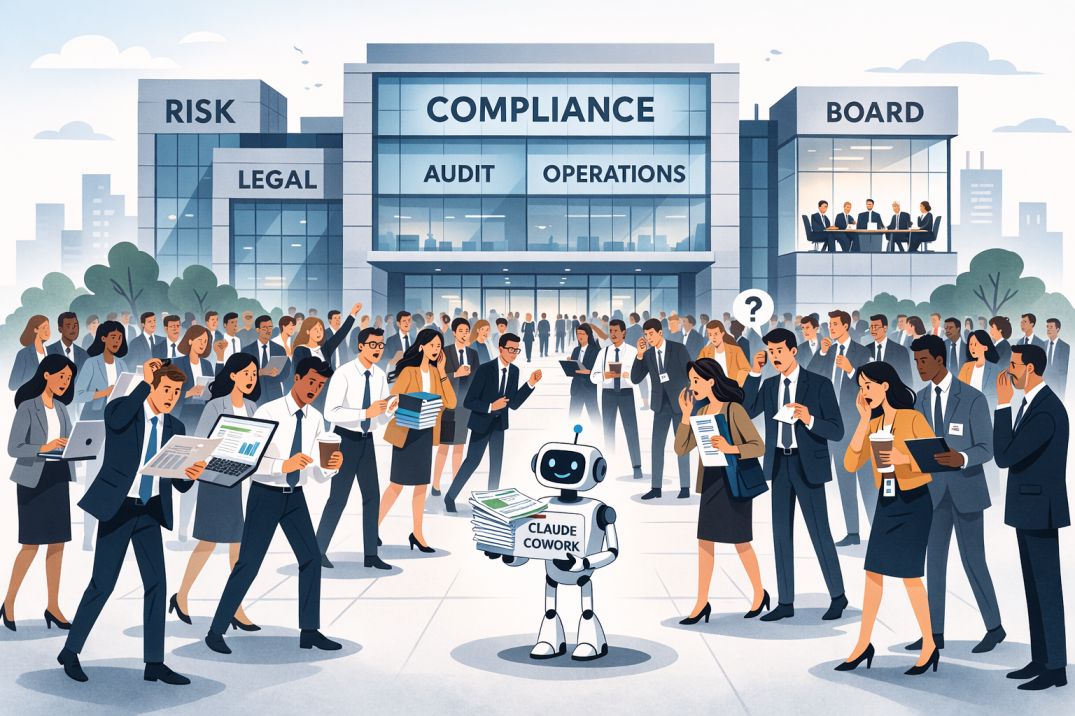
On February 25, 2026, Anthropic announced expanded capabilities for Claude Cowork, its workflow-oriented AI agent aimed at automating structured enterprise tasks in HR, finance, legal review, and research.
The market reaction was abrupt and visible.
In India, the Nifty IT index fell more than 5 percent in the immediate session and went on to lose over 20 percent in February. Infosys dropped more than 20 percent during the month, while Tata Consultancy Services and other major IT services firms traded sharply lower.
On Wall Street, research-linked and IT services stocks saw intraday pressure as analysts flagged automation exposure. European technology services firms also traded lower as investors reassessed white-collar delivery models.
Inside companies, the reaction moved faster than the charts. Recruiters reported paused hiring conversations for junior analyst roles. Internal Slack and WhatsApp groups circulated screenshots of Claude’s demo outputs. Brokerage desks fielded calls about offshore services exposure. Finance and HR teams began asking whether documentation-heavy functions were suddenly at risk.
Within hours, the debate had shifted from product capability to the broader Claude Cowork jobs impact.
Claude Cowork jobs impact: What Is Actually Happening
Claude Cowork extends generative AI beyond chat into structured workflow environments.
It can read defined document sets, generate formatted reports, summarize financial material, and prepare first-draft research outputs across connected tools. In HR contexts, it can assemble policy summaries and draft performance documentation. In finance, it can synthesize data into structured memos. In research settings, it can convert source material into presentation-ready drafts.
That narrows the time gap between raw input and usable output.
What it does not introduce is decision autonomy.
Enterprises piloting these capabilities are operating within strict boundaries. Access is permission-controlled. Outputs require human review. Audit trails remain mandatory. Compliance and legal teams continue to define the scope.
The observable change is draft acceleration.
There is no observable shift toward AI-led approval authority, budget control, or regulatory sign-off.
The market reaction extrapolated from workflow compression to workforce collapse.
The deployments themselves remain incremental.
Also Read: Enterprise AI Reviews Are Exposing Ownership Gaps
Why This Is Happening Now
Claude Cowork did not appear in isolation.
Over the past 18 months, enterprises have already deployed generative AI in limited pilots. What changed on February 25 was the scope. The model moved from answering prompts to operating across structured files and connected business tools.
That shift touches billable workflows.
Indian IT services firms generate a significant share of revenue from documentation-heavy delivery, testing, reporting, and support layers. When a model demonstrates it can automate part of that stack, investors price in margin risk immediately.
The same logic applies in U.S. and European markets. Research associates, compliance documentation teams, and junior finance analysts sit in workflow chains built around structured drafting. When automation enters that layer, hiring assumptions are questioned.
The fear is not theoretical.
It is tied to revenue models that depend on human throughput.
Claude Cowork surfaced at a moment when services valuations were already sensitive to automation risk. The product became a trigger point for an existing concern: whether labor-based delivery models compress faster than companies can redesign them.
That is why the reaction was immediate.
What Changes Next
Claude Cowork will not collapse enterprise jobs.
It will change hiring math.
The first visible shift will be in entry-level documentation roles. Teams that relied on junior analysts for formatting, summarizing, and first-draft production will reassess headcount growth. Hiring may slow. Role descriptions will change.
That is compression, not elimination.
The second shift will be inside services pricing models.
Clients will ask harder questions about effort hours tied to documentation-heavy workflows. Delivery contracts based on volume of human throughput will face scrutiny. Firms that cannot demonstrate automation leverage will see margin pressure.
That affects cost structures, not enterprise existence.
What does not break next:
- Regulatory accountability
- Audit responsibility
- Client ownership
- Capital allocation authority
- Strategic decision-making
Enterprises are not built around document assembly. They are built around judgment and liability.
Claude Cowork accelerates structured output.
It does not assume risk.
That boundary protects core employment layers.
The companies most exposed are those whose value proposition is repetitive execution at scale. The companies least exposed are those that sell interpretation, domain expertise, and accountability.
The Line Between Meaningless Panic and Actual Reality
The fear around Claude Cowork is not irrational.
It is misplaced in scale.
A model that can draft faster than a junior analyst will change hiring math. It will force documentation-heavy functions to justify their size and structure. It will push services firms to defend effort-based pricing.
It will not dismantle enterprises.
Large organizations are not constructed around document assembly. They are constructed around risk ownership, capital allocation, regulatory accountability, and client trust. Those layers remain human because the consequence remains human.
Claude Cowork changes the speed of preparation.
It does not change who signs, who approves, who carries liability, or who answers when something fails.
That boundary is why enterprise jobs do not collapse when tools improve.
They evolve when leadership adapts.
And that is the real story behind the volatility.
Who Will Lose Jobs and Who Is Safe
Let’s be direct.
Some roles are exposed.
Some are not.
If your company or line of business is built around:
- High-volume documentation
- Structured report production
- Repetitive research summarization
- Manual compliance drafting
- Large analyst pools executing template-driven tasks
Well, to be brutally honest, you are exposed.
If revenue depends on billing human effort tied to document-heavy workflows, Claude Cowork compresses that layer. Pricing assumptions get questioned. Growth through headcount scaling slows.
That is where contraction begins.
If your business is built around:
- Signing off on financial or regulatory risk
- Managing client relationships
- Making capital allocation decisions
- Handling ambiguity that has no template
- Owning accountability when something goes wrong
You are safe.
Claude Cowork accelerates preparation.
It does not assume liability. It does not face regulators. It does not absorb commercial consequences.
Enterprises pay for ownership and judgement. Not for formatting files. So, if you have been robbing of your customers for bordering pages or changing font sizes in Doc files, you should better change your Line of Business now. You have survived much longer than your God-given life expectancy. No more.
What This Means for Enterprise Leaders
The headline promises stability.
The responsibility now shifts to leadership.
If your organization sits in an execution-heavy segment, the decision is not whether automation will enter. It already has. The decision is whether you redesign roles before margins force you to.
If your organization sits in a judgment-heavy segment, the risk is complacency. Acceleration without governance introduces exposure. Speed without control creates audit risk.
For CIOs and CTOs, the task is structural:
- Identify where draft production dominates cost
- Separate preparation from decision authority
- Redesign entry-level roles toward interpretation, not formatting
- Align pricing models with outcomes, not effort hours
Claude Cowork is a productivity event.
It becomes a disruption event only if leadership treats it as noise.
Enterprise jobs will not collapse because of one AI release.
But revenue structures and role definitions will evolve faster than many organizations are prepared for.
The model will not decide the difference.
The management’s response will decide it.
What Will Not Happen
Claude Cowork is impressive.
It meaningfully improves workflow automation inside enterprise systems. It will compress repetitive drafting layers. It will pressure labor-heavy delivery models. It will slow hiring in documentation-driven functions.
But Claude Cowork will not collapse enterprise jobs.
Because enterprises are not built around drafting documents. They are built around owning consequences.
Claude Cowork generates output.
Humans absorb risk.
Until that changes, enterprise employment does not disappear. It restructures.
That is the boundary this Claude-phobia ignores.