
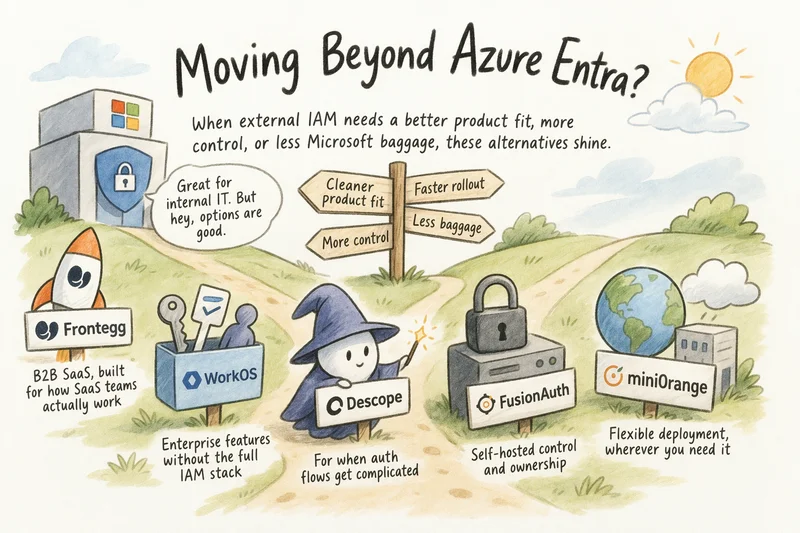
The conversation around Azure Entra alternatives usually starts late, because Microsoft is already embedded in your estate, and Entra feels like the obvious first yes. In many rooms, that is enough to keep the discussion moving.
For workforce identity, that logic is hard to argue with.
But once you move into IAM, the comfort starts fading. Customer login is not the same problem. Partner access is not the same problem. B2B SaaS onboarding is definitely not the same problem. And if you are building a product, you probably do not want those flows carrying the full weight of Microsoft’s identity worldview.
That is the gap this post is tackling.
Azure Entra is not weak. That is not the issue. The issue is fit. You may be dealing with a problem that needs speed, cleaner implementation, and less enterprise baggage. Entra can handle the job, but it can also make the job feel bigger, slower, and more admin-heavy than it should be.
That is when you start looking at Frontegg, WorkOS, Descope, FusionAuth, and miniOrange. Not because Microsoft suddenly forgot identity. Because you may not need all that Microsoft gravity attached to a product-facing identity problem.
This post looks at where Entra starts feeling too heavy, which of these alternatives are better aligned to external identity, and where you are most likely to feel the pain once the demo is over and the actual work begins.
Choose Frontegg, WorkOS, or Descope if:
You want identity to behave like part of the product, not like an extension of internal IT.
Choose FusionAuth or miniOrange if:
You want more say over hosting, deployment, or architecture.
Avoid all five if:
The problem is still mostly workforce identity, and Azure Entra already fits that job.
Microsoft is often the safe shortlist. Safe does not always mean right.
Why start looking at Azure Entra alternatives for IAM
Most Azure Entra alternatives do not enter the shortlist because Entra is broken. They enter because IAM starts changing, and Entra starts feeling like more of a platform than a problem.
That usually happens when your team is no longer dealing with plain workforce access. Now you are dealing with customer identity. Partner IAM. B2B SaaS onboarding. Tenant-aware access. Enterprise SSO inside your product. That is a different game.
And this is where Microsoft starts pushing its luck.
Entra is powerful, but it often carries the habits of a big-enterprise IAM stack. More structure. More configuration. More Microsoft-shaped logic. If your goal is to ship external identity quickly and keep the experience clean, that extra weight stops feeling reassuring and starts feeling expensive.
Azure Entra vs Auth0 Comparison: Identity Platform Choice Under Real Constraints
The problem is not capability. The problem is fit.
You may not need your IAM layer to behave like a committee. You may need it to handle login, federation, user provisioning, access control, and tenant separation without turning your product roadmap into an identity management project.
That is why Azure Entra alternatives keep getting traction in the latest IAM discussions. Buyers are not just asking who has the longest feature list. They are asking sharper questions:
- Can this IAM platform fit naturally into the product?
- Can my team implement it without dragging in unnecessary complexity?
- Will pricing stay sane once enterprise features show up?
- Will admin overhead stay under control six months later?
That is the real shift.
When IAM is tied to product growth, external onboarding, and customer-facing experience, the safest enterprise default is not always the smartest choice.
Sometimes it is just the biggest name in the room.
And sometimes that name brings more gravity than you need.
Okta vs Ping Identity Comparison: Buyer Guide for Enterprise Identity Strategy
Azure Entra alternatives at a glance
Most Azure Entra alternatives look good in a shortlist for the same reason most IAM demos look good: the hard parts are still hiding off-screen.
At a glance, all five can give you some version of login, federation, access control, and enterprise identity support. That is not a useful filter. The useful filter is this: what kind of IAM problem are you actually solving, and how much operational baggage are you willing to absorb to solve it?
IAM Pricing Models Explained: Per User vs Tiered vs Enterprise Plans
If you are building a B2B SaaS product, you should care about tenant awareness, enterprise onboarding, SSO rollout, and how quickly your team can ship. If you care about deployment control, self-hosting, or keeping IAM architecture closer to your own stack, the shortlist changes again.
Azure Entra alternatives need to be judged by fit, not by feature noise.
| Platform | Best Fit | IAM Strength | Where It Starts Hurting | Deployment Angle | Verdict |
|---|---|---|---|---|---|
| Frontegg | B2B SaaS products | Tenant-aware external IAM with fast enterprise onboarding | Can become narrower if your IAM needs stretch beyond product-led external identity | Product-first, embedded SaaS layer | Strong Azure Entra alternative for SaaS teams |
| WorkOS | Enterprise-ready app features | SSO, directory sync, and enterprise IAM building blocks | Feature modules can turn into a pricing staircase | Developer-first integration layer | Best for shipping enterprise IAM features fast |
| Descope | Flexible customer IAM journeys | Strong external IAM orchestration and flow flexibility | Can feel like more platform than you need for simpler use cases | Flexible cloud-first model | Good fit when identity logic is complex |
| FusionAuth | Control-focused teams | Self-hosted IAM with strong architecture ownership | More implementation ownership lands on your team | Cloud, self-hosted, hybrid | Best Azure Entra alternative for deployment control |
| miniOrange | Flexible enterprise deployments | Broad IAM coverage across varied deployment models | Positioning can feel broader and less sharply product-led | Cloud, on-prem, hybrid flexibility | Useful when deployment freedom matters |
The important thing here is not who has the most IAM language on the website. It is who matches your problem without dragging in a second layer of pain.
If you want speed and product fit, Frontegg, WorkOS, and Descope look more natural.
If you care more about control, hosting freedom, or owning the architecture, FusionAuth and miniOrange deserve a harder look.
Feature comparison
A lot of IAM shortlists look smarter than they are.
Every vendor says the expected things: SSO, federation, user management, access control, enterprise readiness. Fine. That still leaves you with the real problem. What is each platform actually built to do, and how much friction comes with it once your team starts implementing it?
Frontegg is built with B2B SaaS products in mind. WorkOS is more like a toolbox for adding enterprise-ready identity features. Descope leans harder into flexible flows and customer-facing journeys. FusionAuth is for teams that want control and do not mind owning more of the stack. miniOrange covers a wider spread, especially when deployment flexibility matters.
In IAM, feature lists can be misleading. Five products may all tick the SSO box and still create completely different amounts of engineering drag, admin effort, and architectural baggage.
| Platform | Best Known For | Enterprise SSO | SCIM / Provisioning | Multi-Tenancy | User Management | Workflow Flexibility | Hosting Control | What Stands Out |
|---|---|---|---|---|---|---|---|---|
| Frontegg | B2B SaaS identity | Strong | Strong | Native strength | Strong | Moderate | Limited | Feels built for SaaS products, not internal IT |
| WorkOS | Enterprise feature modules | Strong | Strong | Moderate | Good | Moderate | Limited | Fast route to enterprise features without dragging in a full IAM stack |
| Descope | Flexible identity journeys | Strong | Available | Good | Good | Strong | Limited | Useful when auth flows get messy and standard templates stop helping |
| FusionAuth | Self-hosted control | Strong | Available | Good | Strong | Good | Strong | Puts architecture ownership back in your hands |
| miniOrange | Deployment flexibility | Strong | Available | Moderate | Good | Moderate | Strong | Useful when deployment model matters as much as features |
A few differences matter more than the rest.
Frontegg is the cleanest fit for B2B SaaS teams that need tenant-aware onboarding, enterprise SSO, and user management without turning identity into a second product roadmap.
WorkOS makes more sense when the goal is to add enterprise features in pieces. SSO, directory sync, and audit-ready building blocks are the main attraction here, especially for teams that want speed without swallowing a full IAM platform.
Descope earns attention when identity flows stop being neat. Customer journeys with exceptions, branching logic, and custom requirements sit more naturally here than in tools built around straighter paths.
FusionAuth becomes more attractive the moment control enters the conversation. Self-hosting, infrastructure ownership, and tighter control over the stack are the real reasons it lands on serious shortlists.
miniOrange stays relevant when deployment flexibility carries more weight than product elegance. It is less sharply shaped for modern SaaS use cases, but harder to ignore in environments where cloud, on-prem, and hybrid options all matter.
Best IAM Solutions for Mid-Size Enterprise: What Actually Works After 500 Employees
Which platform fits which buyer
These five do not solve the same IAM problem. Treating them as neat substitutes is how shortlists go bad.
Frontegg fits B2B SaaS teams that need enterprise onboarding, tenant-aware architecture, and user management without building the whole identity layer themselves.
WorkOS suits product teams that want enterprise SSO, directory sync, and audit-ready features as modules, not as a full platform commitment.
Descope makes more sense when identity flows are messy. Multiple user types, custom journeys, and awkward edge cases sit more naturally here.
FusionAuth is for teams that care about control. Self-hosting, infrastructure ownership, and tighter architecture control are the real reasons it stands out.
miniOrange stays relevant where deployment flexibility matters more than product polish. It is broader, less sharp, but still useful in mixed or constrained environments.
The split is simple. Frontegg, WorkOS, and Descope lean more product-facing. FusionAuth and miniOrange lean more control-facing.
What breaks first at scale in Azure Entra alternatives
Most Azure Entra alternatives do not break early. They get heavier.
Frontegg starts feeling tighter once your IAM needs move beyond the clean B2B SaaS path. The more exceptions you add, the more that neat product fit gets tested.
WorkOS usually hits through the pricing structure. The modular model looks clean at first. Later, it can start feeling like enterprise IAM by add-on.
Descope creates a different kind of strain. Flexibility is useful. Too much custom identity logic is not. What looks elegant early can become harder to govern later.
FusionAuth puts the trade-off right in front of you. More control, more hosting freedom, more ownership. Also, more maintenance, more upgrades, more operational responsibility.
miniOrange tends to get heavier through the admin surface. Broad IAM coverage helps in mixed environments, but broader platforms also bring more configuration weight.
That is the real pattern. One platform gets expensive. Another gets admin-heavy. Another starts leaning into governance drag. The feature list survives. Your operating patience gets tested first.
Pricing reality, not brochure pricing
IAM pricing rarely hurts at the start. It hurts later, after the shortlist, after the clean demo, and usually after someone says, “This looks manageable.”
The first trap is familiar: entry pricing is not an operating cost.
Frontegg and WorkOS both look easy to like early. That is part of the appeal. The problem starts when enterprise requirements stop being “nice to have” and become mandatory.
SSO, provisioning, admin controls, tenant support, usage growth, support expectations. The tidy starting point starts looking less like a deal and more like an invitation.
Descope is easier to respect because the pricing signal is more visible. That helps buyers plan. It does not make growth free.
More tenants, more usage, more enterprise demands. Same story, just with fewer surprises on day one.
FusionAuth plays a different game. The lure is control. The bill shows up in a different place. Instead of watching SaaS spend climb, you start watching internal ownership climb: hosting, upgrades, maintenance, accountability.
The vendor invoice may look leaner.
Your ops burden may not.
miniOrange belongs in the flexibility bucket. Useful, especially in mixed environments. But flexibility and pricing clarity do not always travel together.
The broader the packaging, the more likely the deal needs explanation before it needs approval.
A simpler way to read the pricing split:
- Frontegg / WorkOS: easy to start, easier to expand into a bigger bill
- Descope: clearer upfront, still sensitive to usage and scale
- FusionAuth: lower vendor dependence, higher internal ownership
- miniOrange: flexible to package, harder to model neatly
That is the real pricing divide in this category.
Some tools look cheaper because the bill is delayed. Some look cleaner because the cost is shifted.
And some look flexible because the pricing story is still half in the sales deck.
The mistake is comparing the sticker price like this to endpoint security or email software.
It is IAM.
The real cost shows up when the architecture gets real.
Procurement and contract reality
- The low number in the first meeting is rarely the number that survives production.
- Free tiers make the shortlist easier, but they tell you almost nothing about steady-state IAM cost.
- Modular pricing looks efficient until every serious requirement arrives as its own commercial add-on.
- Quote-led pricing gives you flexibility, but it also gives the vendor room to stay conveniently vague.
- Self-hosting changes the bill, not the burden; the cost shifts from the vendor to your team.
- Multi-year IAM deals look harmless early and feel much less harmless once the platform is embedded.
- The real commercial risk is not onboarding cost, but what happens when usage and requirements expand.
- Scope creep enters quietly in IAM and usually shows up first in packaging, not engineering.
- A clean demo can still lead you into a contract built to get more expensive over time.
- In IAM, the contract often tells you more truth than the product tour ever will.
Who should not buy these tools
Not every shortlist deserves to survive.
Some teams start looking at Azure Entra alternatives because they have a real external IAM problem. Others start looking because Microsoft feels heavy, boring, or politically unpopular for the month. Those are not the same thing.
You should not buy any of these tools just because Entra feels too corporate. That is not a buying reason. That is the mood.
A few disqualifiers are more serious:
- The real problem is still workforce IAM, and Entra already does that job well.
- Team wants “flexibility” but has no appetite for identity ownership.
- Chasing lower vendor cost while ignoring higher internal cost.
- You do not have a clear view of the tenant model, onboarding flow, or access design.
- Want enterprise SSO and provisioning, but have not thought through the admin burden.
- Treating IAM as a feature add-on rather than production infrastructure.
There is another buyer that should be careful: the team that wants control because control sounds powerful.
FusionAuth or self-hosted leaning options can look very smart in a strategy deck. Then real life arrives. Patching. uptime. upgrades. internal blame. Suddenly, “full control” starts sounding like a part-time operations job nobody asked for.
The opposite mistake shows up too. Teams buy the product-led option because it looks quick, clean, and modern.
That works until the customer base gets messier, enterprise demands pile up, and identity starts asking harder questions than the neat demo ever showed.
So the filter is simple.
Buy from this category when you have a genuine external IAM problem and a clear operating model.
Stay out when you are just reacting to Microsoft fatigue, vendor boredom, or a vague hope that another platform will magically make identity simpler.
FAQs
Can Azure Entra alternatives work alongside Microsoft rather than replace it?
Yes. Many teams keep Microsoft for workforce IAM and use another platform for customer or partner identity.
How hard is migration from Entra to another IAM platform?
Usually harder than the demo suggests. The pain sits in user flows, federation, provisioning, and policy cleanup.
Which Entra alternatives are easiest for developers to ship with?
WorkOS and Frontegg usually feel faster for product teams. FusionAuth asks for more ownership.
Do these alternatives create more vendor risk?
Sometimes yes. A smaller vendor can mean less ecosystem gravity, but also less comfort for conservative procurement teams.
Which option is least likely to turn into an internal IT project?
Frontegg or WorkOS. Both are easier to position as product-enablement layers rather than full IAM programs.
Should I care about the hosting model this early?
Absolutely. Hosting is not a technical footnote. It changes cost, control, compliance, and internal workload.
Are these alternatives easier to price than Entra?
Some are clearer upfront. That does not always make them easier to budget once scale and enterprise requirements kick in.
What usually gets underestimated in IAM buying?
Admin burden. Teams focus on login and SSO, then underestimate governance, support, and ongoing operational drag.
Can the wrong IAM choice slow product delivery?
Very easily. A heavy platform can turn simple onboarding and access work into roadmap friction.
Conclusion
Azure Entra is the safe but not necessarily the correct choice. When external IAM starts demanding cleaner product fit, faster rollout, more control, or less Microsoft baggage, that is when Frontegg, WorkOS, Descope, FusionAuth, and miniOrange become worth your attention.
The real win is not replacing Microsoft. It is avoiding an IAM decision that becomes heavier than the problem you were trying to solve.