
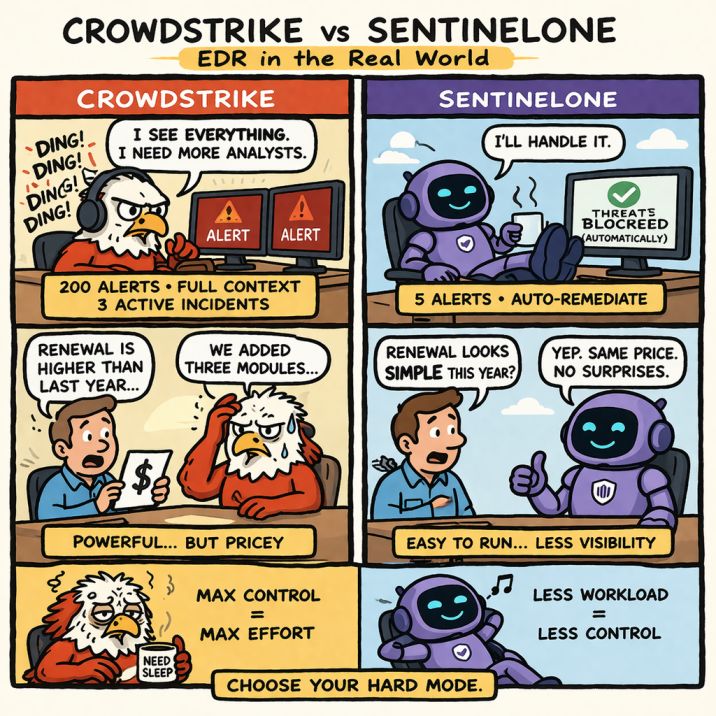
CrowdStrike vs SentinelOne EDR comparison is a decision about how your security team will operate when things get messy. Not during a clean demo. Not during a controlled POC. When alerts pile up, endpoints behave unpredictably, and your team has to respond fast.
Both platforms look strong at first glance. Detection is solid. Agents are lightweight. Deployment feels manageable. The difference shows up later. One starts demanding more tuning and licensing decisions. The other shifts more control to automation, which does not always behave the way you expect.
Most teams realize the trade-offs after the first serious incident or during renewal discussions.
There is no safe default here. You are choosing between operational effort, cost expansion, and how much control you want during a response.
This breakdown focuses on where each platform holds up, where it starts to strain, and what it will demand from your team once it is fully rolled out.
CrowdStrike vs SentinelOne EDR comparison: Core Capability Breakdown
| Capability | CrowdStrike | SentinelOne |
| Detection Model | Behavior + threat intelligence, cloud-heavy analysis | AI-driven, more on-device decision making |
| Response Style | Guided, analyst-influenced | More autonomous out-of-the-box |
| Visibility | Broader across endpoints, identity, and cloud (with modules) | Strong at endpoint level, narrower beyond that |
| Integration | Mature ecosystem (SIEM, SOAR, identity, cloud) | Improving, but not as deep |
| Offline Protection | Limited dependency on cloud connectivity | Stronger due to local AI logic |
| Agent Performance | Lightweight, stable | Lightweight, stable |
| Threat Intelligence | Deep, continuously updated | Present but less extensive |
| Management | Modular, more moving parts | Unified console, simpler to operate |
CrowdStrike is built as a broader platform. It gives you greater visibility and integration options, but you pay for them with increased complexity and a more complex licensing structure. SentinelOne keeps things tighter. It focuses on endpoint protection with more built-in automation and fewer moving parts.
The trade-off is clear early. CrowdStrike gives you more control and ecosystem depth. SentinelOne reduces the amount of manual work your team has to do day to day.
Directional takeaway: CrowdStrike is better if you want control and integration depth. SentinelOne is easier to run with a smaller or stretched team.
Find out: How to Choose Managed Cyber Security Services (MSSP) in 2026
Detection Quality When Alert Volume Increases
CrowdStrike pushes more alerts as volume rises. The signals are richer, with clearer timelines and stronger linkage to known threats. The downside shows up quickly. Queues grow. Without tight tuning, analysts spend time filtering instead of responding.
SentinelOne keeps the alert stream smaller. More decisions are handled on the endpoint, so fewer alerts reach the console. This reduces day-to-day load, but context is thinner. In multi-stage attacks, the full sequence is not always visible early.
CrowdStrike increases the amount of work but gives you more to work with. SentinelOne reduces the work but limits what you see.
Teams with capacity can extract more value from CrowdStrike. Teams under pressure usually lean toward SentinelOne to keep operations manageable.
Directional takeaway:
CrowdStrike gives deeper visibility but increases alert load.
SentinelOne keeps alerts manageable but reduces investigation depth.
Automation vs Manual Effort in Response
In a CrowdStrike vs SentinelOne EDR comparison, response style matters as much as detection quality. Both platforms can stop threats, but they do not distribute the work in the same way.
CrowdStrike keeps your team closer to the action. It provides guidance and strong workflow support, but your analysts still remain central to containment, escalation, and follow-through. That gives you tighter control over what happens next.
In regulated environments or critical production setups, that control matters because one bad action can create a business problem of its own.
The weakness is speed under pressure.
If alert volume is high or your SOC is thin outside business hours, response starts depending on human availability. Incidents wait longer. Containment slows down. Small delays become operational risk when attackers move faster than your team.
SentinelOne pushes further into automation. It can isolate endpoints and roll back malicious activity with less analyst involvement. That reduces dependency on round-the-clock response and helps teams that do not have deep bench strength.
For a lean security team, this can be the difference between staying afloat and falling behind.
But faster action is not free.
If automation makes the wrong call, your team inherits a different problem. Now they are not only handling the threat. They are also dealing with the impact of an unnecessary rollback, an isolated system, or a disrupted business process. In sensitive environments, that risk is real.
That is the core trade-off in this part of the CrowdStrike vs SentinelOne EDR comparison. CrowdStrike gives your team more control but asks more from them. SentinelOne removes the manual burden but asks you to trust the platform more than some teams are comfortable with.
CrowdStrike fits teams that want tighter response control. SentinelOne fits teams that need faster action with less analyst dependence.
Pricing Model and Starting Cost
In a CrowdStrike vs SentinelOne EDR comparison, both start as per-endpoint subscriptions. The difference is all about pricing expansion after onboarding.
CrowdStrike
- Modular pricing
- EDR is just the base layer
- Most capabilities sit behind add-ons
- Pricing depends on how many modules you activate
- The initial quote rarely reflects the full deployment cost
- More bundled tiers
- Core capabilities included upfront
- Fewer add-on decisions early
- Pricing is easier to estimate during evaluation
- Less negotiation around feature scope
What this means
- CrowdStrike → you start small but keep adding cost as scope grows
- SentinelOne → you commit more upfront but avoid constant expansion decisions
Directional takeaway: CrowdStrike spreads cost across modules. SentinelOne concentrates costs upfront and is easier to predict.
Where Costs Increase Over Time
In CrowdStrike vs SentinelOne EDR comparison, the real cost difference shows up after year one.
CrowdStrike expands through modules. Most teams start with core EDR, then add capabilities as gaps appear. Identity protection, device control, threat intelligence, log retention, and XDR features are typically licensed separately.
Each addition looks small in isolation, but over time the stack grows and so does the bill.
Renewals become harder to predict because your footprint is no longer what you originally bought. You are paying for a platform that keeps expanding as your security maturity increases.
SentinelOne behaves differently. The core platform is more bundled, so you do not add as many components later. Cost growth is less about features and more about scale.
As endpoint count increases, pricing rises in a more linear way.
The trade-off is subtle but important.
CrowdStrike cost grows with capability expansion.
SentinelOne cost increases with endpoint expansion.
If your environment is stable but your security scope keeps evolving, CrowdStrike becomes expensive faster. If your environment is growing in size, SentinelOne scales more predictably but still adds up with volume.
Teams often underestimate this phase. The initial deal looks manageable. The renewal tells a different story.
CrowdStrike costs grow through add-ons and platform expansion. SentinelOne costs grow more linearly with endpoint scale.
Deployment Effort and Ongoing Maintenance
Deployment is straightforward for both. Agents roll out quickly. Initial setup does not take much time.
The difference shows up after that.
CrowdStrike needs more tuning to stay effective. Policies have to be adjusted. Detection behavior needs refinement. If you are using multiple modules, each adds its own configuration layer. Integrations also take effort to stabilize.
This does not stop after rollout. It becomes ongoing work.
If tuning is not handled properly, alert quality drops and noise increases. The platform still runs, but your team spends more time managing it than using it.
SentinelOne is easier to stabilize early. Default configurations are usable. You can reach a steady state faster without heavy tuning. Day-to-day maintenance is lighter, especially for smaller teams.
But that simplicity comes with limits.
You get fewer controls to fine-tune behavior. In complex environments, this can become restrictive when you need greater precision.
CrowdStrike asks for more effort but gives more control.
SentinelOne reduces effort but limits how much you can shape the system.
CrowdStrike needs ongoing tuning to stay effective. SentinelOne is easier to maintain but less flexible in complex environments.
Operational Pressure on the Security Team
| Factor | CrowdStrike | SentinelOne |
| Alert Volume | Higher | Lower |
| Analyst Involvement | High | Lower |
| Triage Effort | Significant, especially without tuning | Reduced due to automation |
| Response Dependency | Depends on analyst availability | Less dependent on human response |
| Fatigue Risk | Higher if alert queues build up | Lower day-to-day fatigue |
| Visibility | Deeper, more context available | Limited to what system surfaces |
| Risk Type | Delays due to workload | Missed or hidden context |
CrowdStrike puts continuous pressure on analyst capacity. It works well if your team can keep up with alert volume and investigation workload.
SentinelOne reduces daily operational strain. It is easier to manage with smaller teams, but you rely more on what the system chooses to show and act on.
CrowdStrike demands more from your team but gives full visibility. SentinelOne reduces team pressure but increases dependence on automation.
Procurement and Renewal Challenges
CrowdStrike
- Modular licensing structure
- Each capability priced separately
- Easy to start with a smaller scope
- Cost expands as more modules are added
- Renewals involve multiple components, not a single contract
- Expansion often happens during renewal discussions
SentinelOne
- Fewer tiers, more bundled
- Easier to understand what you are buying
- Less negotiation around individual features
- Renewals are more predictable
- Pricing tied more directly to endpoint count
CrowdStrike becomes layered over time. You are not renewing one product. You are renewing a stack of capabilities. Each one affects pricing and negotiation.
SentinelOne stays simpler. Fewer components mean fewer variables during renewal, and cost discussions are more straightforward.
Who Should Not Choose Either Platform
Both platforms assume a certain level of maturity. Without that, they create more problems than they solve.
Avoid CrowdStrike if:
- You do not have a team to tune and manage policies
- You expect low operational effort after deployment
- You are not prepared for modular pricing expansion
- You need a simple, fixed-cost setup
Avoid SentinelOne if:
- You are not comfortable with automated actions on endpoints
- You need deep visibility across complex attack chains
- Your environment requires tight manual control over response
- You want extensive ecosystem integration beyond endpoints
Avoid both if:
- You expect “set and forget” security
- You do not have the internal capability to validate alerts and responses
- You are buying EDR without a broader security strategy
Conclusion
CrowdStrike vs SentinelOne EDR comparison comes down to control versus effort. CrowdStrike gives deeper visibility and flexibility but demands continuous tuning and analyst involvement. SentinelOne reduces operational load with more automation but requires trust in system-driven actions.
Choose based on what your team can sustain. If you have capacity and want control, CrowdStrike fits better. If you need to keep operations manageable with limited bandwidth, SentinelOne is easier to run.