
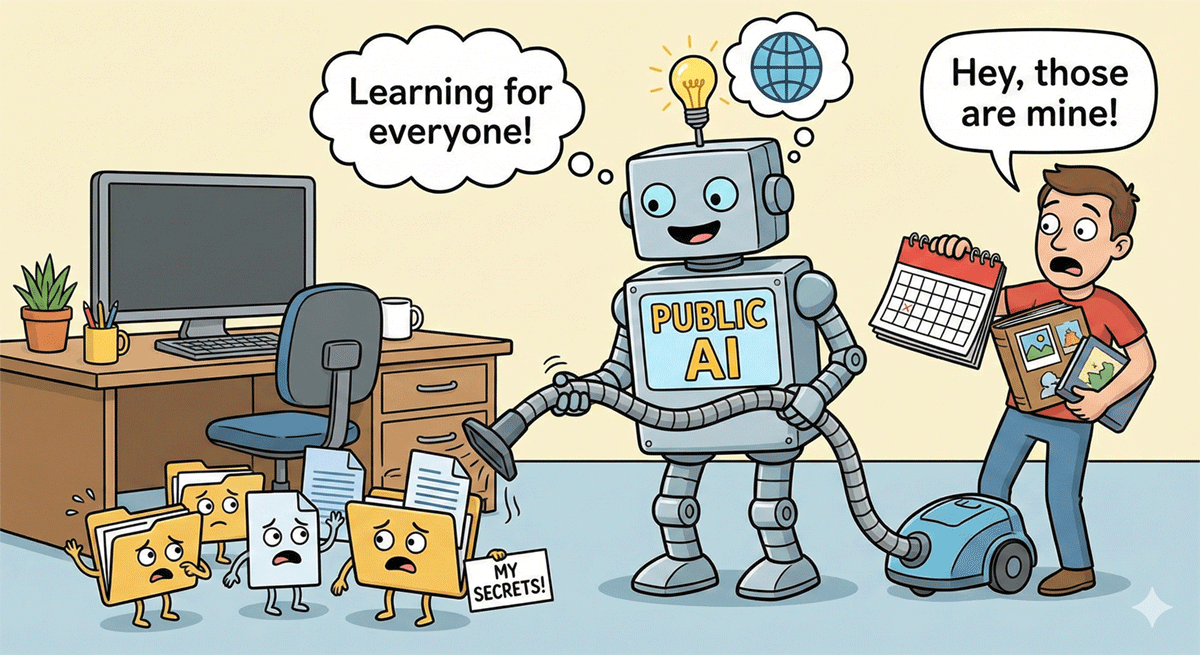
At 2:13 a.m., the on-call phone lit up. Not because the local model hallucinated. Because an auditor found customer sentences sitting in a logging bucket nobody remembered existed.
The setup looked clean. LLM weights on-prem. No external API keys. A tidy internal chat UI. The team told leadership they had picked the best local models for privacy. Then the real system showed up: the UI shipped prompts to an analytics endpoint, the inference server kept debug traces during an incident, and the vector database held embeddings indefinitely because retention was “later.” The model never left the building. The text did, just sideways.
By morning, the CIO was not asking Llama vs Mistral. They were asking who turned logging on, who can delete data on request, and why “local” still needs outbound controls.
Privacy starts with a threat model
People obsess over the best local models for privacy and miss the part that gets them burned: “local” does not fail loudly. It fails silently, in places nobody demos. A debug flag left on during an incident. A tracing agent capturing request bodies. A vector store that keeps embeddings forever because “we will add retention later.” Six weeks later, someone asks for evidence of deletion, and the room goes quiet.
You want a direct payoff from reading this section. Here it is: a way to stop buying privacy theater.
Write down three sentences and make them true in your design. If you cannot, do not call it private, no matter what model you run.
First, “No prompt or attachment is stored unless a human explicitly chooses to store it.” That single line forces your UI, gateway, inference server, and observability stack to behave. It kills the casual habit of logging raw payloads “for troubleshooting.”
Second, “Anything we do store has an owner, a retention window, and a deletion path that works across replicas and backups.” If you cannot name the owner, you have already lost. If you cannot delete from backups, you are not doing privacy, you are doing hope.
Third, “Nothing talks to the internet unless we can justify it in writing.” Not the UI, not the model server, not the tool runner, not the metrics agent. Most leaks are not malicious. They are convenient defaults.
Once you enforce those three sentences, model selection becomes a productive conversation. Without them, Llama vs Mistral is a distraction. You are just choosing which car to drive while the fuel tank is leaking.
Licensing decides your “local” strategy
In an enterprise, licensing is not paperwork. It is the switch that decides whether your “local” plan can scale beyond one team.
Mistral is often easier to operationalize because permissive terms reduce review friction. You can standardize faster, redistribute internally with fewer exceptions, and avoid last-minute “legal says no” surprises.
Llama buys you ecosystem gravity, but you also inherit a license that will be scrutinized. That usually means more governance, clearer redistribution boundaries, and tighter internal guidance on where and how it can be used.
Decision rule: if you plan a broad internal rollout, partner delivery, or any product-like packaging, pick the option your legal team can approve once and stop revisiting.
Pro Tip: If legal cannot give you a simple “yes” for enterprise-wide use, your benchmark results do not matter.
Hardware limits are security limits
If performance is tight, teams do stupid things to “make it work.” They add cloud fallbacks, relax controls, and turn on logging. That is not a model problem. It is a sizing problem that becomes a privacy problem.
- Pick the weakest machine that must run this. If it cannot run there, you will create “temporary” cloud exceptions.
- Define an acceptable response time up front. Tight targets push you to smaller models. Loose targets require queues and capacity planning.
- Plan for real concurrency, not a demo. Shared servers force caching and debugging, and sensitive text gets copied.
- Treat chat history and retrieval memory as data stores. Add retention, deletion, and access controls on day one.
- Use quantization intentionally. If quality drops, users paste more context to compensate. Exposure goes up.
- Enforce outbound deny at the host or network layer. App settings are not a control.
Also read: The ROI of Sovereign AI: Why Local AI Models Save 40% on API Tokens
Llama vs Mistral, compared like production
| Decision factor | Llama: (local privacy lens) | Mistral: (local privacy lens) | Score (10) |
| Licensing friction | More legal review, more internal rules around redistribution | Usually smoother standardization with fewer policy exceptions | Llama: 6/10Mistral: 9/10 |
| Ecosystem depth | Massive ecosystem, many variants, lots of tooling | Smaller ecosystem, often more controlled | Llama: 9/10Mistral: 7/10 |
| Model range | Wide spread from small to very large | Strong small-to-mid lineup, plus larger options | Llama: 9/10Mistral: 8/10 |
| Governance risk | Higher sprawl risk if teams pull random fine-tunes | Easier to keep a tighter catalog | Llama: 7/10Mistral: 8/10 |
| Long documents | Works, but costs rise fast with context and concurrency | Often positioned well for long-context workloads | Llama: 7/10Mistral: 8/10 |
| Internal adaptation | Plenty of recipes and community know-how | Good, but less “everyone has done it” volume | Llama: 8/10Mistral: 7/10 |
| Procurement optics | “Open weight” plus clauses can trigger extra cycles | Permissive perception usually accelerates approvals | Llama: 6/10Mistral: 9/10 |
| Default enterprise pick | Best if you want maximum optionality and can govern it | Best if you want a faster rollout with less licensing debate | Llama: 7/10Mistral: 8/10 |
Winner: Mistral, if you are optimizing for enterprise rollout. Licensing friction and procurement drag kill programs faster than model quality.
When Llama wins: when you want ecosystem optionality and you have strong governance to prevent model sprawl.
How “local” still leaks data
Local deployments usually leak through routine defaults, not dramatic attacks. The most common route is observability: gateways, reverse proxies, application logs, tracing, and error trackers capturing request bodies when troubleshooting kicks in. Once raw prompts enter logs, they spread fast through replication and backups, and far more people can access them than the LLM itself.
The next leak is “memory” treated as a product feature. Chat history, retrieval snippets, and embeddings become a quiet data store with no named owner. Teams assume embeddings are safe because they are not plain text. In practice, similarity search can surface sensitive context, and you end up maintaining a searchable archive of internal material.
Tools create another leakage path. One plugin call, external OCR, or remote embeddings turns “local” into “mostly local.” Even when tools are on-prem, temp files and caches can remain in containers and shared volumes. Performance fixes like caching and request replay add more copies of sensitive text than anyone planned for.
Finally, deletion often stops at the application layer. The record disappears from the UI, but replicas and backups keep it for months. If you cannot state retention windows and prove deletion across the chain, assume the data remains.
Also Read: Self-hosted LLM Infrastructure: Buy It Without Leaking Data
The hidden ops tax of local LLMs
Local seems simple until it is treated like a production service. Then the cost shows up as operational work.
- Manage concurrency, queues, peak loads, throttling.
- Handle model refreshes, runtime updates, driver drift, regression testing.
- Enforce outbound deny, secrets handling, access boundaries, audit trails.
- Build test sets, quality gates, red-team checks.
- Triage “slow,” “wrong,” “unsafe,” and escalation workflows.
- Define retention, deletion, backups, access reviews for prompts and memory.
- Restrict variants, standardize packaging, control fine-tunes.
- Track latency, saturation, error rates without raw prompt capture.
Match the model to the job

When NOT to buy local LLMs
The best local models for privacy are still the wrong buy if the basics are missing. Local only pays off when you can run it without exceptions, govern it without drama, and prove controls without hand-waving.
- Usage is unclear beyond a pilot, or the owner cannot state who will use it and for what tasks
- Workloads are spiky and unpredictable, and capacity planning will turn into constant firefighting
- No outbound deny posture, and too many components can “accidentally” call home (telemetry, plugins, remote OCR, remote embeddings)
- No retention policy for prompts, chat history, or embeddings, and no one can prove deletion across replicas and backups
- No data classification for what users will paste, and no redaction rules for tickets, emails, contracts, or customer identifiers
- No ealuation muscle: no test set, no quality gate, no red-team checks, just “looks good in the demo”
- No governance spine: every team can deploy its own model variant, and behavior will drift week by week
- No security owner for the full chain (UI, gateway, inference, tools, vector DB, logging, backups), only partial ownership by function
- The business case is “privacy” only, with no operational objective like reduced cycle time, fewer support touches, or faster internal search
If two or more bullets are true, pause the purchase. Fix the foundations, then compare Llama vs Mistral.
A rollout plan that survives month three
| Month | Do | Consider it Done when |
| Month 1 | Lock “local” rules. Deny egress. Disable telemetry. Stop raw prompt logging. Pick one pilot workflow. | Zero outbound paths. Logs store metadata only. Pilot scope frozen. |
| Month 2 | Run the pilot. Create an evaluation set. Add a regression gate for upgrades. Set up monitoring without content. | Pilot meets a target. Upgrades can be blocked. Metrics work without storing prompts. |
| Month 3 | Put memory on retention. Prove deletion across replicas and backups. Standardize the model catalog (max two). Allow-list tools. Scale in one wave. | Deletion is provable. No model sprawl. Tools cannot “phone home.” First scale wave passes evaluation. |
Conclusion
The best local models for privacy are the ones you can run without exceptions. Not “best on a benchmark,” best under your licensing constraints, your hardware limits, and your governance reality. If egress is not locked down, if prompts can land in logs, or if retention and deletion are not provable, model choice is a distraction. Pick the family that your legal team can approve cleanly, standardize to a tight catalog, and treat memory, logging, and tools as the real privacy surface. Then local becomes a control you can defend, not a claim you hope nobody tests.