
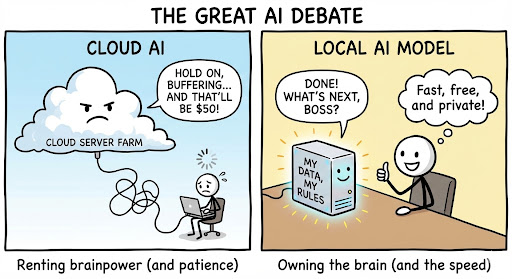
Too many smart leaders are treating their AI strategy like a permanent hotel stay. You are paying a luxury markup for a room you can never decorate and a bed you do not own. Public APIs served a purpose during the experimental phase. Now, there is a massive leak in your operational bucket.
The smartest players in the market realize that renting intelligence by the token is a recipe for margin collapse. It is the digital equivalent of paying for every breath of air in your office. Let’s find out how to stop the bleeding and reclaim forty percent of your budget. Welcome to the world of Local AI Models.
The perpetual API subscription tax on your operational margins
Public APIs are essentially a tax on your success. The more users you attract and the more data you process, the more you owe a third party. It is a backwards way to build a business because your most successful month becomes your most expensive one. I am seeing talented teams hesitate to roll out new features because they are terrified of what the bill will look like at the end of the quarter.
Also Read: Self-hosted LLM Infrastructure: Buy It Without Leaking Data
This is where local AI models change the equation from a variable drain to a fixed foundation. When you own the infrastructure, your cost to run one thousand queries is nearly the same as the cost to run ten.
You are moving from a world where you rent a brain by the minute to a world where you own the engine. If your business model relies on a vendor not raising their prices or changing their terms, you are not a manager. You are a hostage.
The financial logic for a pure API strategy falls apart the moment you hit production scale. You are paying a massive premium for a generic service that has zero loyalty to your bottom line. By bringing the compute in-house, you are turning a recurring liability into a strategic asset that actually builds value on your balance sheet.
The winners of this decade will be the ones who stop paying the landlord and start owning the land.
Also Read: 7 Hard Truths About AI-Based Startups Nobody Puts in Pitch Decks
Stripping the provider markup to claim your 40 percent margin dividend
The 40 percent saving is not a guess. It is the result of removing the massive premium that commercial providers charge to cover their own research and marketing. When you use local AI models, you are buying at wholesale prices. You stop subsidizing the profit margins of a trillion-dollar tech giant and start keeping that capital for your own infrastructure.
The markup on a standard API call is often four times the actual cost of the electricity and silicon used to generate it.
The money usually leaks out in three specific ways:
- You are paying for a giant brand name and a flashy website that your users never even see.
- You are being forced to use a massive model to do a tiny job because the provider wants to simplify their own billing.
- Your monthly check is paying for the vendor to train their next version instead of improving your own system.
If you analyze an enterprise workload of 200 million tokens monthly, an API provider might charge you $5,000 for the privilege. Running that same workload on a dedicated server cluster costs a few hundred dollars in power and maintenance.
Local AI Models: the only cure for the hidden productivity tax of latency
Every millisecond your data spends traveling to a server farm three states away is a millisecond your staff spends staring at a gray loading bar. While a three-second delay feels negligible for a single query, it becomes a massive bottleneck when integrated into high-frequency business processes or real-time customer interfaces.
By deploying local AI models, the intelligence sits in the same rack as the task, turning a stuttering workflow into a seamless stream of results that keeps your team in a state of high output.
| Efficiency Factor | Public Cloud API | Local AI Models | Direct Benefit |
| Response Latency | 2.0s – 5.0s (Network overhead) | 0.1s – 0.5s (Internal bus speed) | Eliminate the wait tax on customer facing apps to boost retention. |
| System Throughput | Capped by vendor rate limits | Limited only by your GPU VRAM | 10x more transactions per hour with your existing staff. |
| Worker Productivity | High context switching risk | Near instant flow state support | Save thousands of work hours annually on high volume audit tasks. |
| Operational Uptime | Vulnerable to ISP and Cloud outages | 100% available behind your firewall | Core logic remains functional even if the global internet flickers. |
| Cost of Idling | Paying for system wait time | Maximum hardware utilization | Stop paying for expensive talent to watch a loading spinner. |
| Data Travel Distance | Thousands of miles round-trip | Centimeters across the motherboard | Remove 100% of the interception risk from the transport layer. |
| Concurrency Load | Performance drops during peak hours | Dedicated, consistent performance | Reporting is ready by 8 AM regardless of global traffic. |
| Batch Processing | High cost for large-scale datasets | Free execution on owned hardware | Deeper analysis of your entire database without fear of a surprise bill. |
| Debugging Speed | Slow feedback loops via API logs | Real-time local console monitoring | Developers can iterate and ship features twice as fast. |
| Integration Complexity | Constant API version maintenance | Stable, version-locked environments | Lower DevOps overhead by freezing the model stack. |
Locking your data vault by hosting intelligence inside the house
Sending your company data to a cloud API is like handing your house keys to a stranger just because they offered to help you carry the groceries. You are trusting a third party to handle your proprietary secrets, customer records, and internal strategy while they train their own systems on your success.
Far too many leaders treat their data like a public utility when it is actually the only thing keeping them competitive in a crowded market.
The financial stakes of a mistake are no longer a slap on the wrist. Looking at the 2025 numbers, the average cost of a data breach is a direct hit to your valuation. Beyond the legal fines, you have to deal with the fact that most consumers will simply walk away if they do not trust how you handle their personal information.
Using local AI models ensures your data never leaves your own silicon, effectively removing the third-party provider as a point of failure.
By hosting your intelligence on-site, you are building a physical wall around your intellectual property. You stop being a guest in someone else’s data center and start being the warden of your own vault. Total ownership of your stack is the only real insurance policy in an era of high-speed corporate espionage.
Stopping the drain of paying for computing power your tasks do not require
Most cloud providers force you to rent a massive, one-size-fits-all brain to perform basic data entry tasks. It is like hiring a world-class neurosurgeon to put a bandage on a scraped knee. You are paying for billions of parameters of general knowledge and expensive safety alignment that have zero impact on your specific business logic.
By deploying local AI models, you match the size of the model to the complexity of the job, ensuring every dollar spent is directed toward your actual goals.
- Use a lean 8B model for document extraction instead of a massive 400B model to cut your power and processing requirements by 90 percent.
- Run specialized tasks in parallel on a single GPU cluster to finish a week of data processing in a single afternoon.
- Stop paying for the extra compute cycles a cloud provider uses to run ethical filters on your own private, internal data.
- Direct every bit of your VRAM toward revenue-generating tasks rather than paying for a giant model’s idle background processes.
- Reduce your cost per interaction to near zero by stripping away the “general intelligence” fluff you never asked for.
Trading volatile usage spikes for the peace of a fixed infrastructure budget
Relying on a cloud API means your monthly expenses are tied to a roller coaster you do not control. If your application goes viral or your team runs a massive data audit, your bill spikes without warning. It is impossible to protect your margins when your infrastructure costs change every single day based on how many tokens you happen to consume.
When you shift to local AI models, you are buying the farm instead of paying for every ear of corn. Your infrastructure cost becomes a flat and predictable line on your balance sheet.
You know exactly what your server costs will be for the next three years, regardless of whether you process a thousand requests or a billion. This transition allows you to forecast your margins with total confidence because you have removed the variable pricing risk from your core operations.
A fixed budget model also changes the way your team iterates on products. When every experiment carries a direct financial penalty from a cloud provider, your developers stop taking risks to avoid blowing the budget. With your own hardware, the marginal cost of trying a new idea is zero. You can push your systems to the absolute limit without checking the balance on your credit card.
Additional reading: Ten Key Insights from IBM’s Cost of a Data Breach Report 2025
Conclusion
Treat the shift to local AI models like buying the building instead of renting a cramped basement. The API era served as a useful training wheel phase, but keeping those wheels on during a competitive race is a guaranteed recipe for a margin crash. Owning the hardware is the only way to lock in profit and tell the cloud giants that the bank is closed for good. The dividend of this decision is simple: total autonomy and a balance sheet that finally stops leaking cash with every single query.