
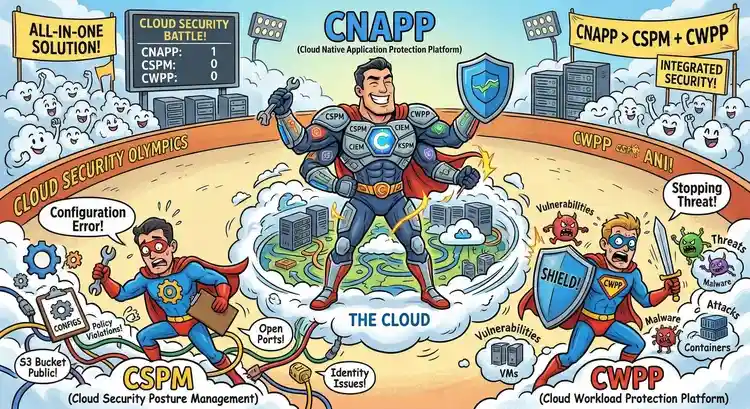
CNAPP vs CSPM vs CWPP becomes a buying discussion only after the cloud security stack starts wasting money. By that point, the security lead is already staring at overlapping findings, separate consoles, duplicated policy logic, and a messy question from leadership: why are we paying for more tools and still arguing about exposure?
The problem is not category confusion. It controls fragmentation. CSPM can flag misconfigurations across accounts and services, but it does not cleanly map risk to live workloads.
CWPP improves runtime depth, but it adds sensors, policy tuning, and another stream of operational noise. CNAPP promises to pull posture, workload, identity, and attack-path context into a single model, but that promise becomes expensive if the environment remains immature.
That is where most teams get stuck.
They are not choosing between neat product definitions.
They are trying to decide whether cloud security platform consolidation will cut response friction, reduce overlap, and improve multicloud control, or just turn existing confusion into a bigger contract. This comparison is about that decision.
Overlapping CSPM and CWPP Spend Is Usually the First Sign of a Broken Model
The CNAPP vs CSPM vs CWPP decision usually starts after the budget has already been split across overlapping controls.
One product is checking posture across cloud accounts and services. Another is watching workloads at runtime.
A third tool often gets added for identity context, container risk, or attack-path visibility because the first two never joined up properly.
What looks sensible in a vendor demo starts to feel clumsy in production.
The bigger problem is not just license overlap. It is an operational split. CSPM findings usually flow toward cloud or platform teams. CWPP signals often land with security operations, endpoint teams, or whoever owns host and container defense.
The exposure may be part of one attack path, but the ownership is fragmented. That is where the CNAPP vs CSPM vs CWPP discussion becomes a buying decision instead of a category debate.
What teams usually discover at this stage:
- The same workload can show up in multiple tools with different severity scores and no shared priority.
- Misconfiguration policy lives in one product, runtime behavior policy in another, and exception handling becomes slow.
- Cloud assets, containers, hosts, packages, identities, and runtime events are not mapped into a single clean model.
- Analysts start switching consoles just to validate a single issue properly.
- Alert routing follows product boundaries rather than the real risk chain.
- Leadership sees rising cloud security spend, but the team still cannot show one clear path from finding to remediation.
This is the point where CNAPP benefits start sounding attractive. Not because consolidation is fashionable, but because separate CSPM and CWPP tools are already creating response friction.
That is the real start of cloud security platform consolidation.
The trigger is usually not feature envy.
It is duplicated spending, fragmented workflows, and too much time lost between detection and action.
Overlapping CSPM and CWPP Spend Is Usually the First Sign of a Broken Model
This buying problem usually appears after the stack is already bloated. One tool is checking posture across cloud accounts and services. Another is watching workloads at runtime. Then something else gets added for container context, identity risk, or attack-path visibility because the first two never connect cleanly enough.
The result is not better control. It is a more expensive operating model with more moving parts.
The real pain shows up in execution.
Posture findings often move toward cloud or platform teams.
Runtime alerts usually land with security operations or whoever owns host and container defense.
The exposure may belong to one risk chain, but the response path is split across products and teams. That is when cloud security platform consolidation starts to look less like vendor packaging and more like a serious discussion about budget and architecture.
What teams usually run into:
- The same workload appears across multiple products, each with a different severity label.
- Misconfiguration review and runtime investigation happen in separate consoles.
- Exception handling slows down because the policy logic is split.
- Asset context is inconsistent across cloud resources, hosts, containers, packages, and identities.
- Analysts lose time validating one issue across multiple dashboards.
- Security spend rises, but the path from finding to remediation still looks broken.
That is the first real signal that the model is under strain. The problem is not that the team lacks tools. The problem is that each tool sees a slice of the risk, while the response still depends on humans stitching the picture together.
CSPM Stops Being Enough Once Risk Moves Into Live Workloads
CSPM is strong at reading cloud state.
It inspects control-plane configuration across accounts, subscriptions, projects, storage, IAM bindings, network exposure, encryption settings, logging posture, and service-level misconfigurations. That makes it useful for detecting drift, weak defaults, exposed assets, and policy violations before an attacker touches the workload.
Its limit is structural.
CSPM mostly sees the declared state, not what the workload is doing after deployment.
That gap matters more than many teams expect. A workload can be deployed from a compliant image, sit behind the right security groups, and still become risky at runtime because of vulnerable packages, a suspicious process chain, a leaked credential in memory, privilege abuse inside a container, or an execution path that turns dangerous only when workload identity and network reachability combine.
This is where CNAPP vs CSPM vs CWPP turns into a live buying decision.
The control plane may look acceptable, while the execution layer is already exposing a different class of risk.
What teams usually discover once incidents or deep reviews begin:
- A publicly reachable service may already be known, but the bigger issue is the over-privileged role attached to the running workload.
- A Kubernetes cluster can appear compliant in posture checks while a single live pod is running with excessive privileges, weak namespace isolation, and outbound patterns that no one is monitoring.
- Storage, encryption, and logging settings may pass review, yet the workload still carries exploitable libraries and exposed runtime behavior.
- Network configuration can look clean on paper, while lateral movement inside a cluster or VPC stays largely outside posture visibility.
- Build-time image checks may pass, but the running asset can drift through new packages, injected processes, shell execution, or unapproved binaries.
- Isolated findings often appear low priority until identity, exposure, and workload context are correlated into a single attack path.
The issue is not that CSPM fails.
It was never designed to carry the full burden of runtime risk.
Once exposure moves into containers, hosts, Kubernetes nodes, serverless execution, workload identity, and live process behavior, the signal shifts from posture to execution.
Passing posture checks while runtime signals are fragmented means you are missing active risk.
CWPP Improves Runtime Visibility but Adds Agent Sprawl and Policy Overhead
CWPP becomes relevant when the real risk is inside running workloads, not just in cloud configuration. It can detect process execution, package-level exposure, container activity, privilege misuse, file changes, and suspicious behavior on hosts and workloads that CSPM will not see well.
That value comes with operational overhead. Coverage depends on sensor deployment, policy tuning, workload baselining, exception handling, and continuous alert triage.
In Kubernetes-heavy or fast-changing environments, that burden grows quickly.
What CWPP helps with:
- Runtime visibility across hosts and containers
- Detection of exploit behavior and privilege abuse
- Better context on packages, processes, and workload activity
- Stronger coverage for live workload risk
What it adds to the team:
- Sensor rollout and uneven coverage
- More policy maintenance across VMs, containers, and clusters
- More noise from short-lived or dynamic workloads
- Higher triage load for security teams
CWPP is useful when runtime exposure is the real gap. It becomes harder to justify when the team receives more telemetry but still has to manually correlate it with posture, identity, and cloud context.
CNAPP Pays Off Only When Fragmented Controls Are Slowing the Team Down
CNAPP helps when the problem is no longer missing coverage, but split coverage. Posture, runtime, identity, and exposure data sit in different tools, and the team is wasting time correlating them manually.
That is where CNAPP benefits become actual.
It can connect cloud assets, workload behavior, permissions, and attack paths in a single view, then drive a cleaner prioritization and remediation flow.
Where CNAPP helps:
- Correlates posture and runtime findings
- Brings identity and asset context into the same risk view
- Reduces console switching during triage
- Improves prioritization of multi-layer risk
- Shortens the path from finding to remediation
Where teams get it wrong:
- Buying it before basic cloud hygiene is stable
- Expecting consolidation to fix weak ownership
- Assuming one platform removes tuning effort
- Using it to replace process discipline
CNAPP is worth it when tool boundaries are slowing the team down. It is the wrong buy when the real gap is still basic coverage or governance.
CNAPP Pays Off Only When Fragmented Controls Are Slowing the Team Down
Most CNAPP vs CSPM vs CWPP evaluations start after the stack becomes hard to operate. Posture, runtime, identity, and exposure data sit in different tools, and the team is wasting time correlating them manually.
CNAPP helps by connecting cloud assets, workload behavior, permissions, and attack paths in a single operating view, with clearer prioritization and remediation flow.
Where CNAPP helps:
- Correlates posture and runtime findings
- Brings identity and asset context into the same risk view
- Reduces console switching during triage
- Improves prioritization of multi-layer risk
- Shortens the path from finding to remediation
Where teams get it wrong:
- Buying it before basic cloud hygiene is stable
- Expecting consolidation to fix weak ownership
- Assuming one platform removes tuning effort
- Using it to replace process discipline
CNAPP is worth it when tool boundaries are slowing the team down. It is the wrong buy when the real gap is still basic coverage or governance.
Managed SOC vs MSSP: Which One Breaks First During a Zero-Day?
Multicloud Usually Fails at Ownership Before It Fails at Coverage
Multicloud rarely breaks down due to a lack of visibility. It breaks because no one owns the full path from finding to fixing across AWS, Azure, and GCP.
Each cloud has its own identity model, policy structure, resource hierarchy, and service behavior.
CSPM can scan all three.
CWPP can cover workloads across them. But ownership still splits across cloud teams, platform teams, and security. That is where things slow down.
What starts going wrong:
- The same policy is implemented differently across clouds
- Identity risk is evaluated per cloud, not across access paths
- Findings get routed to different teams based on platform, not exposure
- Remediation timelines vary because each team follows its own workflow
- Asset context is inconsistent across accounts, subscriptions, and projects
- No single view shows which issues actually matter first
This is where cloud security platform consolidation starts to make sense. Not because visibility is missing, but because coordination is broken.
Multicloud increases the number of tools you can use. It also increases the cost of not having a shared control model.
7 Mistakes That Turn Enterprise EDR Evaluation Into an Expensive Procurement Exercise
The Core Technical Difference Is Not Visibility but Correlation and Control Flow
| Control Layer | CSPM | CWPP | CNAPP | Failure at Scale |
|---|---|---|---|---|
| Primary focus | Cloud config, IAM, network exposure, storage policies | Workload runtime: processes, containers, hosts | Unified: config + runtime + identity + exposure graph | Context split across tools |
| Telemetry source | Cloud APIs, config snapshots | Agents, kernel/runtime signals | APIs + runtime + identity graph | Partial visibility leads to blind spots |
| Misconfiguration detection | Strong | Limited | Strong with context | Findings pile up without prioritization |
| Runtime behavior | None | Strong (process, file, exec, privilege) | Moderate–strong (depends on depth) | Misses live exploit signals |
| Container coverage | Config only (RBAC, exposure) | Runtime (pods, namespaces, exec) | Combined posture + runtime | Split view of same workload |
| Kubernetes visibility | Cluster posture, RBAC, network policy | Pod/node runtime activity | Cluster + workload + identity context | Handoffs between teams slow response |
| Identity handling | IAM roles, policies | Credential usage at runtime | Identity + workload + exposure linkage | Privilege risk underestimated |
| Attack path | Fragmented | Local to workload | Graph-based correlation | No end-to-end risk chain |
| Prioritization | Rule-based, often noisy | Signal-heavy, needs tuning | Context-aware prioritization | Too many alerts, low clarity |
| Remediation flow | Cloud/platform teams | Security/infra teams | Cross-team routing possible | Ownership fragmentation |
| Coverage model | Broad (all cloud assets) | Deep (covered workloads only) | Broad + deep (if integrated well) | Gaps between layers |
| Operational load | Low–moderate | High (agents, tuning, triage) | High upfront, lower correlation later | Ops overhead increases with scale |
| Failure mode | Too many findings, low context | Too much telemetry, tuning fatigue | Governance gaps break value | Response slows despite tools |
| Multicloud | Good for posture consistency | Heavy to operate across clouds | Better for unified control | Coordination breaks first |
| Best fit | Posture maturity stage | Runtime risk exposure stage | Fragmentation + scale stage | Wrong fit leads to wasted spend |
Standalone Tools Look Cheaper Until Response Work Starts Crossing Consoles
| Decision Factor | CSPM + CWPP as Separate Tools | CNAPP | What Changes Financially | What Usually Breaks First |
|---|---|---|---|---|
| License model | Usually lower entry cost, split across products | Higher platform cost, broader scope in one contract | Separate tools look cheaper early | Budget overlap becomes visible at renewal |
| Buying motion | Can be added incrementally | Usually requires platform-level approval | Standalone tools spread spend over time | Teams delay consolidation too long |
| Deployment effort | Two control planes, two rollout tracks | One platform, but broader implementation scope | Integration effort shifts from procurement to deployment | Project complexity gets underestimated |
| Policy management | Split between posture and runtime policies | More centralized policy model | Separate tools increase admin time | Exception handling becomes messy |
| Alert handling | Findings arrive in different consoles | Better chance of unified prioritization | Analyst time rises with separate tools | Duplicate triage work piles up |
| Asset context | Often split across cloud, workload, and identity tools | More likely to be correlated in one model | Manual validation cost drops only if correlation is good | Teams still chase context manually |
| Remediation routing | Usually split by product and team | Can align to one risk view | Engineering handoff cost is higher with separate tools | Fixes stall between teams |
| Runtime operations | CWPP tuning burden remains separate | Still exists, but may sit inside one workflow | CNAPP does not remove runtime ops cost | Buyers assume consolidation means less tuning |
| Reporting | Needs cross-tool stitching for one cloud risk story | Easier to present one consolidated view | Reporting effort falls if data quality is strong | Executive reporting hides response gaps |
| Multicloud operations | Tool and team fragmentation increases across clouds | Stronger fit when multicloud control flow is already strained | Operational savings show up later, not immediately | Ownership breaks before visibility does |
| Renewal pressure | Harder to defend overlapping spend | Harder to justify if governance is weak | Both models get challenged, but for different reasons | Teams cannot prove value cleanly |
| Best commercial fit | Teams solving a narrower gap with tighter budget control | Teams already paying the cost of fragmented operations | The cheaper option depends on operating friction, not sticker price | License cost is treated as total cost |
Separate tools usually win the first budget discussion. CNAPP usually wins later, when triage, routing, duplication, and slow remediation start costing more than the extra license concentration.
Red Flag: Lower license cost means little if one incident still requires three consoles and two handoffs.
SentinelOne vs Microsoft Defender Scorecard: Which EDR Delivers Better Long-Term Value?
CrowdStrike Alternatives for Enterprise: 15 Tools Compared for Cost, Detection, and Control
EDR Solutions for Mid-Size Enterprise: The Buying Guide Vendors Won’t Give You
Buy Against the Bottleneck, Not the Category
Start with the failure point, not the product label.
Buy CSPM first when the main problem is control-plane drift:
- exposed storage
- weak IAM policy
- public attack surface
- encryption and logging gaps
- inconsistent cloud baseline
Buy CWPP when posture is not the main issue and the risk sits inside running workloads:
- container runtime behavior
- package exposure
- suspicious process execution
- privilege misuse
- host and pod-level activity
Buy CNAPP when the team is already paying the price of fragmentation:
- Posture and runtime findings do not connect
- The identity context is split
- Risk prioritization is weak
- Remediation crosses too many teams
- Multicloud coordination is slowing response
Do not force consolidation too early. If cloud hygiene is still weak, CNAPP can centralize noise. Do not stay fragmented too long either. If analysts are correlating posture, runtime, and identity risk by hand, the cheaper stack is already getting expensive.
The right sequence is simple:
- Fix baseline posture problems first
- Add runtime depth where live workload risk is real
- Consolidate only when control overlaps, and response friction becomes the bottleneck
That is the cleanest path through CNAPP vs CSPM vs CWPP. The right buy is the one that removes the current constraint, not the one with the broadest demo.
Cybersecurity Best Practices That Actually Reduce Risk in 90 Days
Conclusion
That is where the right model starts standing out. A good decision here does not come from chasing the broadest platform. It comes from matching the control layer to the pressure point, then consolidating only once the operating model is ready.
The cloud security stack gets simpler only when the buying logic gets stricter. Teams that stay honest about the bottleneck usually make better decisions here. Some need cleaner posture control. Some need deeper runtime coverage. Some have already crossed the point where fragmented tools are slowing response more than improving protection.
Also check this Reddit discussion: Cloud Security CSPM vs CWPP and IaaS vs PaaS