
Cross-functional team alignment sounds good in theory, but it’s a different story when you see it in practice.
Sales rolls their eyes at Product. Product complains about Engineering. Engineering quietly builds what it thinks is best because no one else seems to understand it.
It’s the same dance in every tech-driven company.
Different rooms. Same friction.
Each team is convinced they’re the adult in the room. The ones with the objective perspective. The others? Distracted. Overreaching. Unreasonable.
So we create meetings. Cross-functional working groups. Alignment decks.
And what do we get?
Fatigue.
Everyone’s calendar gets bloated. Decisions take weeks. Progress slows. And ironically, the very thing we wanted – alignment, starts to feel like overhead.
But here’s the uncomfortable truth: You don’t need more collaboration. You need better clarity.
And a system that lets Product, Tech, and Sales move without tripping over each other.
Let’s talk about how that happens.
The Real Cost of Poor Cross-Functional Team Alignment
Cross-functional alignment failures rarely show up all at once. They begin as soft friction, slipped deadlines, confusing handovers, and strategy calls that sound out of sync. Everyone is working, but not necessarily together. Priorities shift mid-sprint. Product specs evolve after development starts. Sales pitches get ahead of releases. And soon, no one’s sure where the source of truth is.
Now put that in numbers. Take a 25-member team working on a mid-sized digital product that includes product managers, engineers, QA, designers, Sales, Pre-Sales, and others. If each person loses just 5 hours a week to misaligned work, back-and-forths, or unnecessary meetings, that’s over 500 hours per month gone. That’s a complete sprint cycle lost to confusion and coordination debt.
And the cost isn’t just time. It’s output, momentum, and morale. With a blended team cost of $2,500 to $4,000 per person per month (including salaries, overhead, and tools), that’s a monthly burn of $60,000 to $100,000 for a 25-member team. Even a modest 15% productivity leak due to poor alignment equals $9,000 to $15,000 lost every month, with no value shipped.
Misalignment isn’t a workflow issue. It’s a business risk hiding in plain sight.
Shared Objectives Beat Shared Calendars
Cross-functional Team Alignment doesn’t mean syncing schedules. It means syncing priorities. Cross-functional teams don’t need more Zoom or Teams calls; they need a shared definition of success. Here’s how to do it.
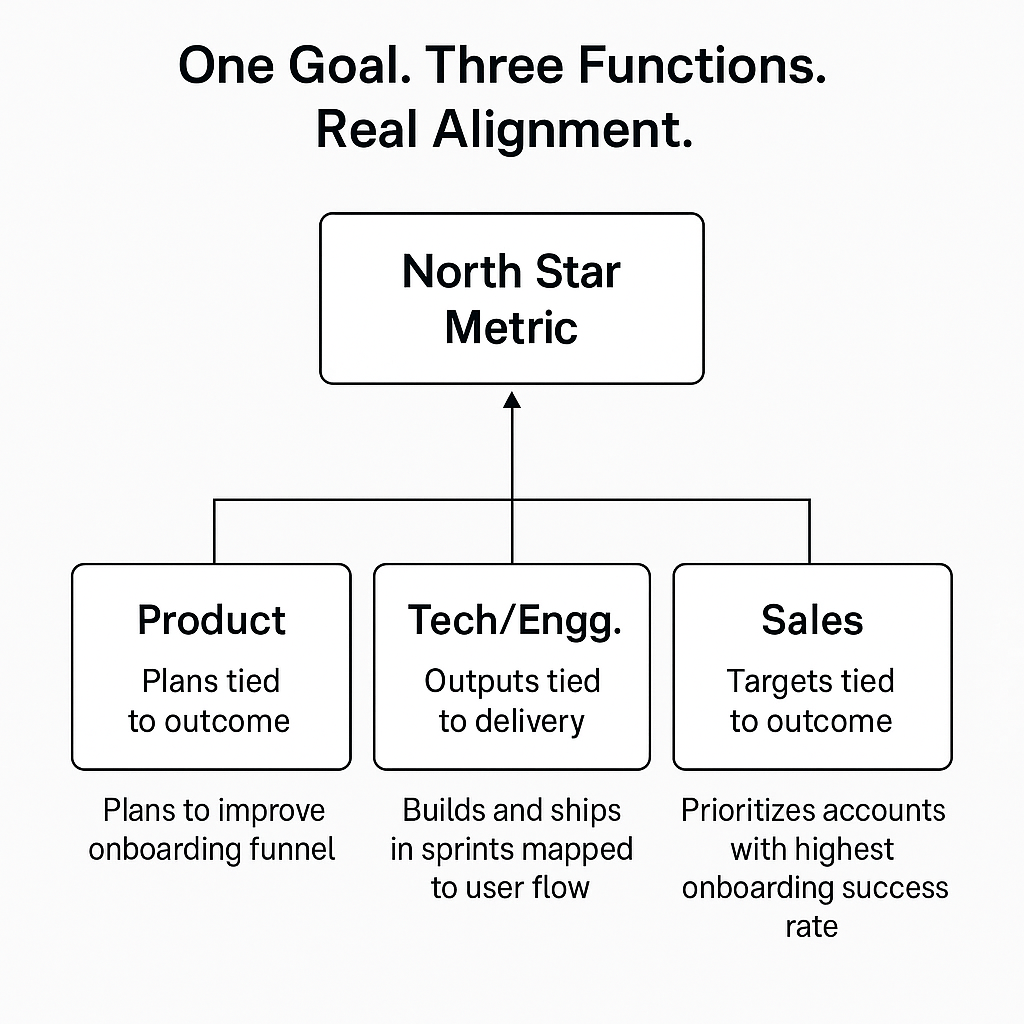
Anchor all teams to the same North Star metric.
Whether it’s activation rate, time-to-value, or revenue per seat, pick a metric that reflects real business value and make it visible to everyone.
Define success for each function in terms of that shared goal.
The product focuses on adoption, Engineering optimizes for delivery velocity, and Sales drives segment fit, all in service of the same outcome.
Use lightweight OKRs or thematic goals instead of feature lists.
Replace “ship feature X” with “increase onboarding completion by 20%.” It gives teams room to innovate while staying aligned.
Make tradeoffs transparent.
When two functions have different objectives, tie them back to the shared purpose. If it doesn’t move the needle, it doesn’t move forward.
Kill vanity metrics at the edges.
If Sales celebrates leads that churn in 10 days, or Engineering hits ticket velocity while shipping unused features, alignment is already broken.

Structure the Handoffs, Not the Meetings
A lack of meetings doesn’t cause most coordination problems; poorly defined handoffs are the primary cause. When Product tosses specs over the wall to Engineering without shared understanding, or when Tech completes delivery but Sales doesn’t know how to position the release, things break. Not immediately, but soon enough.

What’s missing is a precise operating rhythm. Every stage of a cross-functional workflow should include: what is being handed off, who owns it next, and what “done” means at that point. Is the feature doc just a bullet list, or does it include user flows? Does the tech team flag readiness with a code freeze or a QA-approved staging release? If that language isn’t consistent across teams, misalignment creeps in.
Instead of recurring syncs, define structured checkpoints. Create handoff playbooks: Product to Tech → MVP approval. Tech to Sales → Release documentation and internal demo. These are the real bridges. Build them once, and meetings become backup, not the backbone.

Asynchronous Rituals Keep Teams in Sync
Synchronous updates are useful until they become a hindrance. When your team grows or stretches across time zones, real-time alignment becomes a bottleneck. Async rituals fix that. They reduce interruptions, improve clarity, and scale decision-making without burning hours on Zoom.
Here’s how async Cross-functional Team Alignment works:
- Product teams can record feature walkthroughs once. Tech and Sales can review them at their convenience, without needing to schedule a call.
- Use tools like JIRA, Trello, or ClickUp to give everyone real-time visibility into what’s moving, what’s blocked, and what’s next.
- Designate specific channels for Product, Tech, and Sales syncs. Use pinned formats for updates (e.g., “What we shipped / What’s coming / Blockers”).
- Encourage team members to post short demo videos every week; schedule optional office hours instead of mandatory reviews.
- Hook dashboards to Slack or Teams so significant state changes (MVP tagged, feature shipped, doc ready) notify the right people, instantly.
The most effective asynchronous rituals are those that are boring and repetitive. That’s the point. They free up your team to do the real work of building, closing, and shipping without waiting on the next invite.
Respect Autonomy While Staying Aligned
Cross-functional Team Alignment often breaks down not because teams avoid collaboration, but because they’re pulled into multiple tasks simultaneously. That’s not alignment. That’s micromanagement masquerading as teamwork.
Once goals and handoffs are clear, each function should execute independently. The product team doesn’t need to approve every design. Engineering shouldn’t have to defend every line of code. Sales doesn’t need a nod before pitching. What matters is that constraints are known, outcomes are defined, and responsibilities are understood.
The best teams work within guardrails, not approval loops. Product owns the what and why, Tech owns the how, and Sales owns the impact. Everyone stays informed, but no one waits for permission. That’s what absolute autonomy looks like.
Centralize Context, Decentralize Execution
In most teams, work slows down not because people lack direction, but because they lack access to context. Key decisions are buried in emails. Requirements are scattered across tools. Customer insights sit with Sales. As a result, meetings become the primary means of staying aligned.
That’s avoidable. Create a single source where the product vision, specifications, customer feedback, and go-to-market assets are all documented and easily accessible. When context is shared and up to date, teams don’t need to check in constantly. Product can plan, Engineering can build, and Sales can engage customers without waiting for answers. Alignment becomes part of how the team operates, not something you stop to do.

Read this excellent article on Cross-functional team alignment by Atlassian, creator of Jira.
Use Review Forums, Not Update Calls
Most cross-functional teams spend too much time talking about the work and not enough time making decisions. Daily syncs, update calls, and check-ins become routine but offer little value beyond what a dashboard already shows. The real fix is to replace passive updates with structured review forums that drive decisions and move things forward.
- Replace update meetings with weekly review forums that focus on shipped work, blockers, and decisions. Nothing more.
- Limit attendance to one representative per function to keep meetings tight and focused.
- Focus on metrics that matter, not effort logs or activity summaries.
- Use a consistent format across teams: what shipped, what it impacted, what’s next.
- Decide live. Every discussion concludes with an explicit action or next step.

Build Cross-Functional Empathy by Design
Most Cross-functional Team Alignment issues aren’t technical. They’re relational. Teams work next to each other without understanding what the others are solving, optimizing, or avoiding. Assumptions take the place of insight. Friction follows. The best way to fix this isn’t with more process, it’s with exposure.
- Rotate engineers into recorded sales calls to hear real objections and customer language.
- Let sales teams observe product roadmap walkthroughs to understand what’s feasible and why.
- Share design reviews and usability test clips across teams so everyone sees the product through the user’s eyes.
- Celebrate launches as a cross-team milestone, not a single-function win.
- Create informal spaces for product, tech, and sales to talk without an agenda.
- Encourage people to write, not just talk. Shared notes, Looms, and briefs help teams see each other’s thinking.
Empathy is built in the details when one team understands how another works, the alignment problems start to fix themselves.
Read these guidelines for Digital Transformation using AI.
Conclusion
The most effective teams aren’t the ones with the most meetings or the fanciest tools. They’re the ones who understand how to move together without getting in each other’s way. With shared goals, clear handoffs, and just the right amount of structure, alignment becomes a benefit rather than a burden. It becomes momentum. That’s the shift modern product companies need to make, and the ones that do it well move faster than everyone else.