
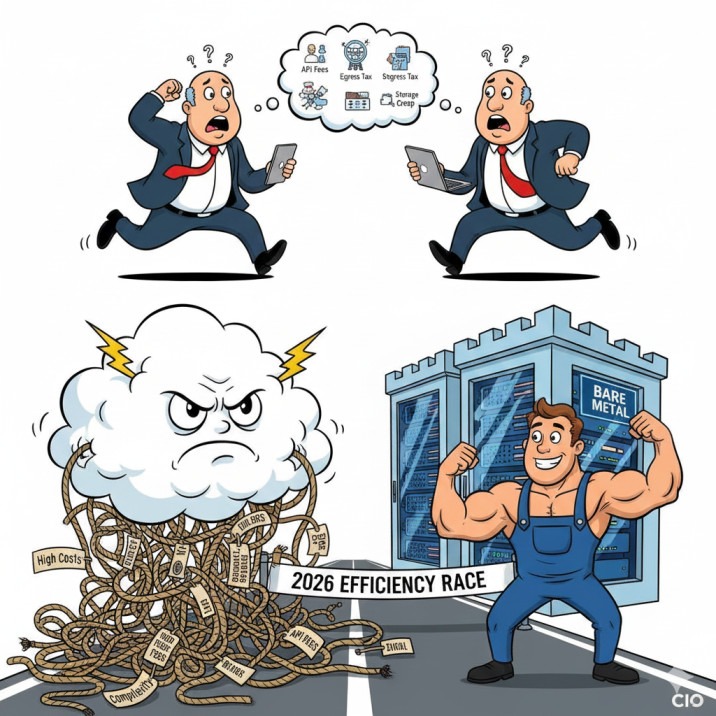
Let’s be real: the “Cloud-First” honeymoon is over. We all spent the last decade throwing everything into AWS or Azure because it felt like magic. But in 2026, magic has a price tag that’s starting to look like a mortgage on a house you don’t even own.
I have sat in those governance meetings where the CIO looks at the monthly bill, then looks at people around the table, and we all know the truth – the “elasticity” we are paying for is actually just expensive, unused air. We have been conditioned to think that renting is the only way to stay agile, but this year, we are experiencing a massive pivot. This year, the goal isn’t just scaling at any cost; it’s unit economics; it’s Cloud vs. Bare Metal. We are moving from being cloud-blind to being margin-native. It’s time to stop talking about “the stack” and start talking about the bottom line.
The Virtualization Tax: Raw Power vs. Hypervisor Overhead
In the public cloud, you are never alone with your hardware. Every virtual machine sits on top of a hypervisor. This software acts as a middleman between your app and the CPU. This abstraction is the “Virtualization Tax.” It consumes 10% to 15% of your processing power just to exist. You pay for 100% of the silicon, but your application only sees what is left after the middleman takes its cut.
Then there is the “Noisy Neighbor” problem. Public cloud is multi-tenant. You share a physical rack with other companies. If their usage spikes, your performance jitters. This “Steal Time” causes latency spikes that are impossible to debug. On Bare Metal, you are the only tenant. There is no contention for the bus and no one else’s code is slowing down your production.
This architecture forces you to over-provision in the cloud just to survive shared-resource dips. With Bare Metal, you get sub-millisecond access to the silicon. You are not just buying a server; you are buying the certainty that every cycle belongs to your code. For steady, high-utilization workloads, a comparison of Cloud vs. Bare Metal is a difference between a shared gamble and a dedicated asset.
Also Read: A Rental Trap: A Blueprint for Strategic Exit from Cloud in 2026
The Silent Killers: Egress, API, and Storage Creep
Cloud bills are rarely high because of the sticker price on the instance. They are high because of a secondary layer of fees that scale faster than your revenue.
1. Data Egress: The Ransom on Your Own Data. In the public cloud, you are not just paying to store data; you are paying a ransom to move it. Most major providers charge between $0.05 and $0.09 per GB for data leaving their network to the internet.
Consider a mid-sized enterprise moving 100 TB of data per month.
- Public Cloud Egress Cost: 100,000 GB x $0.08 (avg) = $8,000 per month.
- Bare Metal Egress Cost: Most dedicated providers offer a 100 TB or 1 Gbps unmetered pipe included in the server lease.
- The Loss: You are losing $96,000 USD per year simply to send your own data to your users.
2. API Request Creep: The Interaction Tax. Every time your application talks to a managed cloud service, you are billed for the request. In a microservices architecture, a single user action can trigger 50 internal API calls.
- The Reality: At $0.005 per 1,000 PUT requests, it seems cheap. But for a high-traffic app doing 1 billion requests a month, you are looking at $5,000 USD per month just for the “noise” of your services talking to each other.
- The Difference: On Bare Metal, internal communication happens over a local backplane. It is free, and it is sub-millisecond.
3. Storage Creep: Paying for Hot Air Cloud storage is priced by tiers, and the trap is staying in “Standard” storage for datasets that are rarely accessed.
- The Math: Storing 500 TB on the cloud in a standard tier costs roughly $11,500 USD per month.
- The Bare Metal Alternative: You can lease a massive storage array with 500 TB of raw NVMe capacity for approximately $3,000 per month.
- The Loss: That is an $8,500 monthly leak.
When you add these up, the convenience of the cloud is costing you a 60% to 80% markup on the basic utilities of computing. If you are looking for the source of your budget bloat, it is likely hiding in these three line items. In Cloud vs. Bare Metal, Bare Metal wins.
The 3-Year TCO Comparison in Cloud vs. Bare Metal: The $160 Trigger Point
If the monthly cloud bill for a single, steady-state workload is higher than $160, you have likely crossed the line into overpayment. Infrastructure costs should be measured over a 36-month lifecycle. Public cloud providers win on “Zero Down” flexibility, but they lose on the “Mortgage.” When I look at a production database, something that stays powered on 24/7, the math is not even close.
Let us compare a standard high-performance setup in 2026: 8 vCPUs and 32GB RAM (equivalent to an AWS m5.2xlarge).
| The 3-Year “Truth” | Public Cloud (Managed VM) | Bare Metal (Dedicated) |
| Monthly Compute | $280 (On-Demand) | $140 (Fixed Lease) |
| Data Egress (10TB/mo) | $900 (at $0.09/GB) | $0 (Included) |
| Storage (1TB NVMe) | $120 (IOPS + Capacity) | $0 (Included in Lease) |
| Support (Business/Premium) | $130 (10% of Spend) | $20 (Fixed Remote Hands) |
| Backup & Recovery | $50 (Snapshots) | $30 (Offsite Storage) |
| Managed DB Surcharge | $150 (RDS/Cloud SQL) | $0 (Self-Managed) |
| Monthly Total | $1,630 | $190 |
| 3-Year Grand Total | $58,680 | $6,840 |
The gap is now even wider. We are looking at a $51,840 difference for a single production server over three years. When people tell me the cloud is cheaper, they are usually only looking at the $280 compute cost and ignoring the $1,350 in “operational friction” that follows it.
I am not saying the cloud has no value. I am saying that for a steady-state workload, you are essentially paying a 760% markup for the convenience of not having to manage a physical operating system. For a cluster of ten servers, that is over half a million dollars that could have been profit or R&D budget.

The Talent Debt: Managed Ease vs. Operational Control
There is no such thing as a free lunch in infrastructure. The cloud is a hotel. You pay a premium because someone else changes the sheets, fixes the plumbing and ensures the lights stay on at 3 AM. When you move to Bare Metal, you are buying the house. The monthly invoice for the hardware drops to the floor, but the requirement for specialized skill rises to the ceiling.
This is the “Talent Debt.” You are trading a high AWS bill for the cost of human expertise. If the current team consists only of developers who are used to clicking a “Deploy” button in a web console, Bare Metal will be a shock to the system. You need people who understand Linux kernel tuning, physical firewall configuration, and local RAID arrays. I have seen projects fail because the leadership chased the lower server price but forgot that someone still has to patch the physical OS and handle hardware failures.
You must ask yourself a hard question: Is the $50,000 you are saving per server enough to pay for the man-hours required to manage it? In 2026, automation tools like Terraform and Ironic have made Bare Metal feel more “cloud-like,” but you still cannot outsource the ultimate responsibility for the hardware. You are gaining total control, but you are also losing the ability to blame a provider when things go dark. If the infra invoice is in your KRA, this is not just a budget shift; it is a culture shift.
The Decision Matrix: Who Wins for Your Specific Scale?
In 2026, the “Cloud or Bare Metal” question is no longer an all-or-nothing debate. It is about matching the environment to the maturity of the workload. If you are still in the “move fast and break things” phase, the cloud is your best friend.
If you have found your product-market fit and your traffic is a steady river rather than a series of spikes, Bare Metal is your best financial move.
| Business Scenario | Recommended Stack | Primary Reason |
| Early-Stage Startup | Public Cloud | Agility is more valuable than margin. Do not waste time on hardware. |
| High-Growth Scale-Up | Bare Metal | At this stage, egress and storage fees will cannibalize your profit. |
| Data-Heavy AI/ML | Bare Metal | You need 100% GPU/CPU utilization without the “Virtualization Tax.” |
| Static Legacy Apps | Bare Metal | These rarely scale. Why pay a premium for “elasticity” you never use? |
| Global Consumer App | Hybrid Model | Cloud for the “spiky” front-end; Bare Metal for the heavy database. |
| High-Compliance (HIPAA/GDPR) | Bare Metal | Physical isolation simplifies audits and guarantees data residency. |
| Edge Computing (IoT/Retail) | Bare Metal | Sub-millisecond local processing is required at the physical location. |
| Multi-Region Bursting | Public Cloud | Spin up 20 regions in minutes. Bare Metal lead times are too slow here. |
| Exit Strategy / Portability | Bare Metal | Avoiding “Service Lock-in.” It is easier to move a Linux box than a proprietary API. |
The decision logic is simple. If the workload is unpredictable, rent the flexibility of the cloud. If the workload is predictable, own the efficiency of Bare Metal. Moving to a hybrid model is often the most sophisticated choice for a modern enterprise.
Additional reading: Bare metal economics: Why more companies are ditching shared infrastructure
Conclusion
The era of “Cloud at any cost” is over. In 2026, efficiency is the only metric that matters. We have spent years treating the public cloud like an infinite resource, but the math proves it is often just a high-interest loan on your margins. My verdict is simple: stop being cloud-native and start being value-native. Renting is for laboratories; owning is for factories. Audit your invoice, identify the silent killers, and move your steady-state workloads back to dedicated silicon. Reclaiming that margin is not just a technical win; it is a competitive advantage.